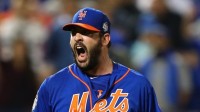
With Carlos Beltran giving his opinion on Terry Collins decision to send Matt Harvey back out for the ninth inning, I began to think of the different ways the Mets won or lost postseason series. Can you name the players involved in the last play in each of the Mets postseason series? Good luck!

Normally, when a player leaves the Mets, I like to take stock of all the good things they did with the Mets. With Eric O’Flaherty it’s near impossible.
When the Mets acquired him, I thought he was the missing piece to the Mets bullpen. He was going to be the LOOGY the Mets needed. Instead, O’Flaherty was just terrible. He had a 13.50 ERA and a 2.654 WHIP. Honestly, I’m not even sure he was that good. To put it in perspective, his ERA+ was 29. TWENTY-NINE! While I could say that there are no words to describe how poorly he pitched with the Mets, I think saying 29 describes it perfectly.
To be fair, there was one good thing that came from the O’Flaherty trade. The corresponding move was the Mets designating Alex Torres and all his hats for assignment. For that, Mets fans do owe him a little bit of gratitude.
Now, he’s off to Pittsburgh on a minor league deal. I’m sure now that he’s completed his post-Tommy John season and his being under the tutelage of Ray Searage, O’Flaherty will return to the effective LOOGY he once was. I’m positive hell revert back to the guy that has a 1.69 career ERA against the Mets.
In any event, O’Flaherty is a Pittsburgh Pirate ending his reign with the New York Mets. I think I speak for everyone when I say that’s best for everyone.
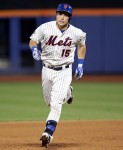
For one reason or another, Travis d’Arnaud switched uniform numbers with bench coach Bob Geren heading into the 2015 season. Now that Bob Geren has left the Mets for the Dodgers, the Mets should not give out the number 15 again.
It’s what the Mets have traditionally done with numbers they have anticipated they will retire. After Tom Seaver was traded to the Reds, no other Met would wear the number 41. After Mike Piazza left the Mets as a free agent, the Mets never re-issued 31. These were two future Hall of Famers that were expected to enter the Hall of Fame as a Met. These are the only players to have their numbers retired by the team. With them, the Mets have created the standard that they will retire the numbers of players that have entered the Hall of Fame as a Met.
With Carlos Beltran announcing he may retire after this year, the Mets should give him similar treatment.
Beltran is coming to the end of a terrific career, one that is certainly worthy of the Hall of Fame. Right now, it appears it’ll be up to Beltran as to whether he enters the Hall as a Met, Royal, or a blank cap. For what it’s worth, Beltran has said that if he receives the honor, it’s possible he could enter the Hall of Fame as a Met. If so, the Mets should effectively retire the number now instead of handing it out to the Fred Lewises and Val Pascuccis of the world. Looking at the Mets current roster, the number hasn’t been assigned. The players without designated numbers aren’t players of Beltran’s caliber.
d’Arnaud should be the last Met to ever wear the number 15. Hopefully, one day the Mets can retire the number 15. Even better, it would be great to retire number 7 for d’Arnaud.
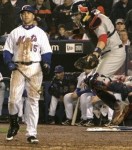
According to WAR, Carlos Beltran is the sixth best Met of all-time. He’s higher ranked than recent Hall of Fame inductee Mike Piazza. He’s a future Hall of Famer. The end of his Mets tenure was the beginning of Terry Collins tenure. When Beltran speaks, he deserves your full attention.
With that said, a person should always pick their spots when to interject an opinion. In his interview with George A. King, III, Beltran offered his opinions on Terry Collins sending Matt Harvey out for the ninth in Game 5 of the World Series. Collins’ decision ranks right up there with Grady Little leaving Pedro Martinez in during Game 7 of the 2003 ALCS. It’ll be talked about for generations. Everyone will have a perspective. For what it’s worth, here was Beltran’s take on Collins sending Harvey back out there:
He was looking down and I felt that he wanted to take Harvey out. But at the same time, Harvey was pitching such a good game and Harvey wanted that moment. He went with what Harvey showed him and not what he was thinking. That’s an experience for him. Later on [taking Harvey out] will happen. He will say,’My friend, I will give you a kiss of I have to, but I have to get my closer.’ It was a bad decision to leave him in, but in his heart I felt that he wanted to make a different move.
It’s a fine and reasonable take, but man, I really don’t want to hear Beltran talking about decision that lead to the end of playoff series. Much like the end of the 2015 World Series, his strikeout at the end of the 2006 NLCS will forever haunt Mets fans. For his part, Beltran said he couldn’t do anything with the pitch. To be fair, it was filthy:
However, with that said, he didn’t try to foul it off. He didn’t try to make a fielder make a play. There would be no little groundball up the first baseline. No, Beltran was beat, and he didn’t go down swinging. This doesn’t change the fact that he was a great Met. It doesn’t mean he shouldn’t be a Hall of Famer. It doesn’t even mean his opinion on Collins sending Harvey back out there was wrong.
No, it just means that when it comes to series altering decisions, Beltran’s opinion is the last one I want to hear.
Editor’s Note: this was first published on metsmerized.com
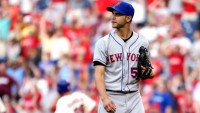
We are all guilty at times of becoming too focused on statistics when it comes to determining a player’s worth. Sometimes we overlook the value of being able to take the ball whatever the situation. Ultimately, that was Carlos Torres‘ greatest attribute.
Over the past three years, Terry Collins stretched that rubber arm of his to a breaking point. Torres served as a spot starter, long man, and set-up guy in his three years with the Mets. In his time with the Mets, he averaged over 1.1 innings per appearance. Torres’ rubber arm allowed Collins to rest the other arms in the Mets bullpen. There is immense value in a pitcher that can constantly take the ball in a variety of spots.
However, saying Torres’ value was taking the ball whenever needed is underselling him. Torres was an effective pitcher with the Mets. Torres had a 3.59 ERA, a 1.253 WHIP, and an 8.2 K/9 in his three years in Flushing. He was a good pitcher. Unfortunately, after all the time and hard work he put in with the Mets, Torres was hampered by a hamstring injury which prevented him from pitching in the postseason.
However, that’s not to say he didn’t have an impact on the 2015 season. He started and finished the most amazing defensive play of the season:
We also discovered he might’ve been the fastest Met on the team. Finally, he gave up his number 52 for Yoenis Cespedes. I expected nothing less from someone who was a team first guy.
With the Mets signing Antonio Bastardo, there wasn’t any room for him left on this Mets team. It’s a cruel twist of fate we see all too often in sports. A guy gives everything he has to help a losing team, and when things begin to turn around, he is sent packing. It’s unfortunate, but it’s the way things work. Sure, Torres deserved better, but that still doesn’t mean there was room for him on the 25 man roster.
With that said, it shouldn’t come as no surprise that Torres didn’t return to the Mets. Not even on a minor league deal. Instead, Torres signed a minor league deal with the Braves. He should have no problem making their Opening Day roster as Torres can fill any role he teams needs.
Teams always need a player like Torres, and I’m sure at varying points of the season, so will the Mets. He was a player who brought real value to the team. It certainly leaves a hole in the organization not having him and his rubber arm around anymore. He was a good Met, and he will be missed.
Thank you Carlos Torres.
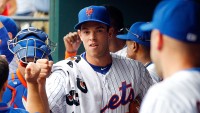
Last year, I made sure to bring my son to Steven Matz‘s first start. I wanted him to be there to see what we all presumed was the last installment of what was to be a Mets super staff.
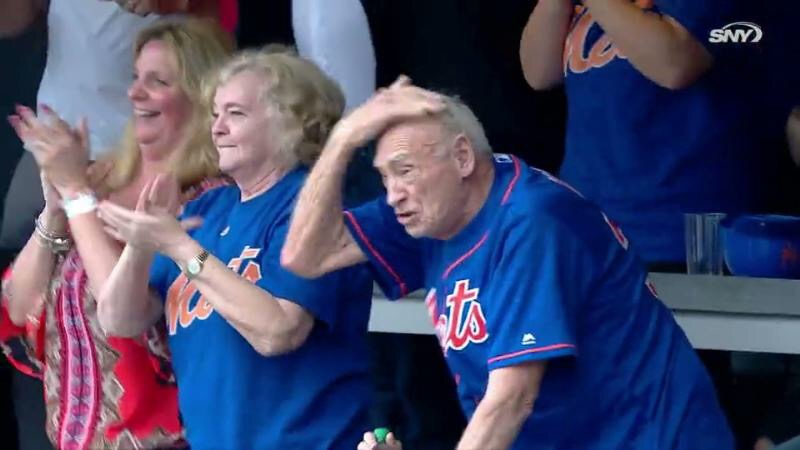
It was a great day. Matz allowed only two runs over 7.2 innings. He went 3-3 at the plate with four RBI. It was such an amazing first start that his celebrating grandfather became a legend in his own right:
Matz followed that up with a terrific start in Los Angeles allowing no runs over 6.0 innings recording eight strikeouts. After that, Matz was shut down with an torn oblique that Dan Warthen checked out himself before the Dodger start.
He would’ve pitch again for another two months. He came back, and he went 2-0 with a 2.86 ERA in four starts. However, those numbers seem better than he pitched. In those four starts, batters hit .297/.330/.374 against him. He has a 1.45 WHIP. He would then have a back injury. This injury would not prevent him from being named to the postseason roster.
Matz wasn’t great in the postseason. He was 0-1 with a 3.68 ERA. He pitched into the sixth inning once in his three starts. He had a 1.432 WHIP.
What can we glean from all of this? Absolutely nothing. Matz’s first two starts were exciting, but they were only two starts. The four starts at the end of the season were after two months of complete inactivity. His postseason starts came more than two weeks after his last regular season start. His second postseason start came eight days later. His World Series start was 10 days later. He wasn’t getting enough work to stay sharp.
As of today, he’s probably a favorite to be the National League Rookie of the Year. Most Mets fans expect him to be an ace. I think that’s not fair. Matz hasn’t showed himself to be that good yet. The projections for him aren’t that rosy.
I don’t know what’s driving those numbers. I don’t know if his injuries last year are driving those low innings projections. It could be his two injuries last year.
I’m not sure how it is to presume Matz is injury prone. While he did have two freak injuries last year, it’s not fair to say he’s injury prone. So far, all we have is the two injuries this year and a longer than usual rehab from Tommy John surgery. So while I’m sure the Mets will have an eye on his innings pitched, I also believe, he has a reasonable chance to be healthy for a full season.
The next issue is why do the projections see Matz having such a high ERA next year. My presumption is that this is based on Matz’s 3.61 FIP last year. Based upon his FIP numbers, the projected ERAs are certainly justifiable. However, again, four of those starts were made after Matz had no baseball activities for two months due to his lat injury.
We all have hope Matz will be great in 2016. However, there is nothing from his 2015 season that can establish he will be good or bad next year. Whatever happens, I’m going to enjoy the ride.

During Jeurys Familia‘s time answering questions on the Mets Twitter account, the dumbest baseball argument was resurrected:
A sandwich is a sandwich, a hot dog is a hot dog! #AskFamilia https://t.co/rht7efanCs
— New York Mets (@Mets) February 9, 2016
Sigh.
I guess it’s a sign that the Mets are in such good shape for the upcoming season that we’re back to arguing about whether or not a hot dog is a sandwich.
Alright, let’s start with the basics. It should be fair to say that most people do not believe they are ordering a sandwich when they are ordering a hot dog at a game. However, there’s no reason why that should be dispositive. For example, most people, the State of New Jersey, and the Supreme Court believe a tomato to be a vegetable. It’s not. A tomato is a fruit. No matter how you argue it, it’s a fruit.
Now, I bring this up because there are many arguments on the tomato. The arguments are similar. It’s a gut feeling, or wanting to tax an item, that is the driving force. If you want to rely upon tax codes and the Supreme Court, I refer you to the New York State Department of Taxation and Finance who clearly defines a hot dog in a bun as a sandwich.
Personally, I wouldn’t want to rely on that. Tax codes and the like aren’t written to be correct. Rather, they are written to exact as much revenue as possible. So let’s try another route.
The dictionary definition of a sandwich is two or more slices of bread, or a split roll, with a filling. So yes, under the dictionary definition, a hot dog on a roll is a sandwich. It’s a position food experts seem to share:
— Alton Brown (@altonbrown) February 4, 2016
I’ve heard all the contrary opinions. When you order a sandwich, you’re not expecting a hot dog. Maybe, but when I order peanut butter and jelly, I’m expecting that to be on bread.
When you go to a game and order a hot dog, you expect to get a hot dog on a bun. True, but when your spouse tells you to get hot dogs from the grocery store, do you bring them home already cooked and in buns, or do you purchase them separately?
Look, it’s not a sandwich, it’s just a hot dog. To me this is an argument that just seeks to prove its underlying point. It’s like saying Lucas Duda isn’t a good first baseman because of one throw while ignoring his 57 homers in two years.
So overall, whether we like it or not, a hot dog on a bun is a sandwich. Now, can we please move onto more important topics like who will pitch the sixth inning for the Mets this year?
Yesterday, the Mets signed Roger Bernadina to a minor league deal. Anytime the Mets sign a player on a minor league deal, I think it’s a great low risk high reward move.With that said, I’m curious why the Mets signed Bernadina.
Bernadina is a 31 year old outfielder that was originally signed by the Montreal Expos. He played three full seasons with the successor Nationals before being released. Bernadina bounced around a bit since, and he spent all of 2015 in the minor leagues. He’s a career .236/.307/.354 hitter. He’s played all three outfield positions in his career reasonably well. Considering the Brandon Nimmo injury and the Darrell Ceciliani trade, this was a good depth move. Or was it?
His current deal with the Mets he has a June 15th opt out clause. That’s the same day the Mets can trade Alejandro De Aza without any restrictions. This begs the question whether Bernadina was signed as minor league depth, or whether he was signed so the Mets could trade De Aza? Is Berndina slated to be the fifth outfielder or is he really just depth to protect against injury?
Time will tell. In either scenario, this was a solid organizational depth move by the Mets.
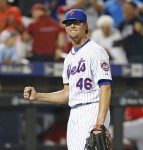
Last season, the Mets trading for Tyler Clippard was the first sign that the Mets were all-in on the 2015 season. The Mets gave up a very promising prospect in Casey Meisner for three months of a middle reliever.
When Clippard came to the Mets, he immediately locked down the eighth inning. When the division was still in doubt, from July 28th to September 16th, he pitched 26.1 innings in 26 appearances with a 2.73 ERA and a 1.03 WHIP. He limited batter to a .182/.257/.364 batting line. He combined with Jeurys Familia to make Mets games seven inning games. Combined with the Mets starting pitching, you have a 20-8 August and the Mets putting away the Nationals and the NL East.
With that, Clippard completed his goal of “chasing down [his] old teammates there in Washington.” He wanted bragging rights over his old teammates, and he got them.
Unfortunately, Clippard suffered a back injury. His production fell off significantly. He wasn’t the shut down reliever he was when he first joined the Mets. That Clippard was missed in the World Series. He was the loser in Game Four, which was probably the turning point in that series. After that the Mets apparently felt he didn’t deserve the two-year deal they gave Antonio Bastardo.
Personally, I thought with the offseason, Clippard would’ve had time to heal and become that eighth inning option again. I’m still surprised the Mets thought he was worth a potential ace, saw him perform well, and now think he’s not worth a two year deal. Well now, the Mets loss is the Diamondbacks gain. Now, Clippard is an ex-Met after him doing everything he could do to help the team win the NL East. He leaves with those bragging rights.
The Mets now have bragging rights over everyone in the National League. With that, we all owe him a small debt of gratitude. When he comes out of that bullpen door come this August, he deserves to be cheered. He deserves that much.
Thank you Tyler Clippard.
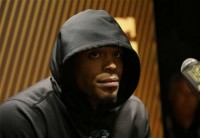
I’m not going to criticize Cam Newton and his performance at the post-Super Bowl press conference:
He was sullen and depressed from losing the biggest game of his life. In the background, you can hear a Bronco player bragging about how they shut down Cam Newton and the Panthers. He was literally asked the same question over and over again. Do you really expect him to be ecstatic and loquacious?
Of course not. The narrative will be either how he didn’t play well or how he was shut down. He has a long flight ahead of him. He’s 3,000 miles away from the Panther fans. It’s just a terrible situation.
Juxtapose that with the Mets losing the World Series. The team lost three games in which they had a lead with their seemingly invincible closer on the mound. Perhaps the cruelest defeat was Game Five when the Mets arguably had their ace carry a shutout into the ninth. They had a lead from two homeruns from their future superstar leftfielder. They blew the game like they blew the rest of the series. They lost in front of their home fans.
Cam Newton had to hear how he got beat. He got asked the same question repeatedly. Here’s the treatment the Mets players received:
The setting allowed the fans and team to celebrate a great season together. Yes, it would’ve been different had the Mets been on the road. Conversely, the passionate fans would then have a chance to celebrate their teams World Series title:
Did you hear or see any of the exuberance yesterday? No. That’s the effect of playing a game at a neutral site. There’s no rejoicing when your team wins. There’s no celebrating a season that fell just short. In short, there’s no shared experience.
In the end, baseball is about a journey. It’s a shared journey between the team and their fans. Football ignores their fans and leaves their players out to dry. It’s why baseball will always be superior.