As the trade deadline approaches, every team usually states that they need bullpen help, and those that are true contenders usually add an extra arm or two to the bullpen. For example, back in 1999, one of the biggest strengths for a Mets team fighting for the NL East and the Wild Card was their bullpen. Armando Benitez had taken over the closer role much earlier than anticipated. Turk Wendell and Dennis Cook were having excellent seasons. Pat Mahomes was a revelation as the long man in the bullpen. Ex-closer John Franco was expected to return form injury to help with the playoff push. Greg McMichael was having an off year, but he had previously been a valuable bullpen arm in a pennant race from his days with the Atlanta Braves. On top of that, the Mets had some young promising arms to go to down the stretch with Jason Isringhausen and Octavio Dotel (even if Bobby Valentine thought they were better suited and belonged in the rotation). Overall, the point being is the Mets did not need bullpen help.
Even with that being the case, a Mets team that was very active during the trade deadline made sure to acquire another arm for the bullpen by sending McMichael and Isringhausen for Billy Taylor. It turns out Billy Taylor was washed up, and he would not even be on the postseason roster thereby forcing the Mets to make do with the already good bullpen pieces they had. The Mets find themselves in a similar position than the 1999 Mets did.
The Mets bullpen is led to Jeurys Familia who is the best closer in the game. When needed, Familia can pitch two innings to get the big save that the Mets need. The primary eighth inning set-up man has been Addison Reed, who is only sporting a 2.26 ERA and a 0.912 WHIP. This duo has only lost one lead that has been given to them this year in 32 attempts. Behind them is Hansel Robles who has done everything the Mets have needed in the bullpen. He can come out and bail the Mets out of a bases loaded no out jam or pitch 3.2 terrific innings to save a Mets bullpen from a first inning injury to a starting pitcher. Jerry Blevins has been an extremely effective LOOGY allowing lefties to hit .210/.269/.310. By the way, he has been even better against righties limiting them to a .107/.188/.214 batting line.
Behind these pitchers are some very solid options. There is Jim Henderson, who was great before Terry Collins abused his arm. Henderson is currently in AAA on a rehab assignment. Seth Lugo has been absolutely terrific out of the bullpen in his two appearances. However, it is only two appearances, and there still remains a (remote) chance that he may wind up in the starting rotation with the Matt Harvey injury. There is Erik Goeddel, who even despite one poor performance this season, still has a career 2.75 ERA and a 1.054 WHIP. There is still Sean Gilmartin, who was an essential part of the Mets bullpen last year. He is a starter in AAA, but if the Mets are that desperate for major league relief help that they will swing a trade, they should pull up a known quantity to help the team where he is needed.
If the Mets will consider calling up players from the minors, there are some good options in AAA. Josh Edgin has a 2.45 ERA in the hitter friendly Pacific Coast League. Paul Sewald has taken over as the closer, and he has recorded nine saves. There is always the alluring Josh Smoker, who is having a down year but still sports a mid-nineties fastball.
Finally, in addition to all of these players, there is still Antonio Bastardo, who is going nowhere. It is doubtful a rebuilding team will want to add him into the mix with his high salary and poor production. The Mets are stuck with him, and they are going to be stuck with him for the full season, regardless of whether they make another move to add a reliever or not. In essence, Bastardo is the reason why people mistakenly believe the Mets need bullpen help. With that in mind, the best thing the Mets can do is to find a way to get Bastardo back on track. That will help the Mets bullpen more than them adding another reliever.
Overall, the Mets bullpen is in fine shape with four outstanding relievers and plenty of good options behind them. The Mets do not need a reliever. They need to fix Bastardo since he’s going to be here whether or not the Mets make a trade. With that in mind, the Mets should leave the bullpen as is and turn their attention to the teams other needs at the trade deadline.
Over the course of the season, Noah Syndergaard has averaged 98 MPH with his fastball. Many times a game, he will throw that fastball in excess of 100 MPH. However in his last start before the All Star break, Syndergaard’s fastball velocity dropped precipitously to 91 MPH. Given the fact that he has already been labeled a risk for Tommy John surgery and the fact that he has bone chips in his elbow, many feared the worst.
Fortunately for Syndergaard and the Mets, it was not the worst case scenario. Instead, Syndergaard has a dead arm which he attributes to the heavy workload he has received in the first half of the season. The best way to handle a dead arm is to give the pitcher an opportunity to rest their arm so they can get regain their velocity. For the time being, Syndergaard says, “I am just picking up a ball and playing light toss, nothing too crazy. I am taking it day by day and see how it goes.” (New York Daily News).
While Syndergaard is seeing how it goes, Jacob deGrom and Bartolo Colon will start the first two games out of the All Star Break. Syndergaard and the Mets will reassess how to proceed until after he throws a bullpen session on Friday. It is anticipated this bullpen session will be an abbreviated one as Syndergaard said, “I am at the point of the season where I don’t need to be throwing 30-35 pitch bullpens anymore. I am going to taper it back to 15-20, if that.”
This is part of a concerted effort for Syndergaard to be as fresh as possible as he can be for the rest of the season and to avoid succumbing to another dead arm. With that in mind, Syndergaard said, “I am going to take a step back, look at my routine every five days and take a play out of Bartolo’s playbook. He doesn’t throw bullpens, he takes it really light on his arm and every fifth day he is fresh as can be.”
For his part, Syndergaard believes this time off has been beneficial, and he believes he will be ready to pitch when called upon after the All Star Break saying, “I will be back to 100% once this break is over.” If that is the case, Syndergaard will be able to continue his outstanding season that has seen him go 9-4 with a 2.56 ERA and a 1.079 WHIP.
Editor’s Note: this was first published on metsmerizedonline.com
With homefield advantage on the line and the Mets in playoff position, Terry Collins managed the All Star Game like seemingly every other manager has previously managed the All Star Game. He put more of a premium on getting all the players in the game than winning the game. Well, everyone except his own players Jeurys Familia and Bartolo Colon. Other than the Mets players apparently being upset at this, it is hard to criticize Collins for how he managed the All Star Game. Still, there are many managerial decisions Collins has made in the first half of the season that invite scrutiny.
First and foremost, there is the way he handled Michael Conforto. First, he didn’t let him get any time playing right field in Spring Training. The end result of that was Collins putting Juan Lagares in right and Yoenis Cespedes in center on days that Curtis Granderson was given the day off. There really is no excuse for putting Lagares, possibly the defensive center fielder in the game, anywhere but center.
The other mistake is not letting Conforto hit against lefties until Madison Bumgarner took the mound. Collins was hampering his development by doing that. At the end of the day, this is the Mets best position player prospect, and in many ways, he was the second best hitter on the team. Collins was willing to sacrifice all that to get Lagares’ bat in the lineup instead of sitting an older Granderson who had the very platoon splits that worried Collins. By the way, Granderson is also 35 years old and could use the occasional day or two off. Conforto’s season began to fall apart, and he needed to be sent down to AAA. By the way, Collins is making the same mistake with Brandon Nimmo. However, it’s even worse with Nimmo as he’s doing it to get Alejandro De Aza‘s bat in the lineup.
While on the topic of developing players, Kevin Plawecki has faltered for yet another season under Collins’ tutelage. Last year, there were a number of excuses why Plawecki didn’t succeed from his being rushed to the majors to his sinus issues. This year, he had no such excuses, and he still didn’t produce. While Plawecki deserves a large amount of the blame, Collins certainly deserves some of it, especially when his position with Conforto is that he is not here to help players develop as major leaguers when the Mets have a win-now team.
Another major issue this year was Collins’ handing of Jim Henderson. Henderson was a feel good story that turned into a potential nightmare. The day after Henderson threw a career high 34 pitches, which is puzzling in its own right, Collins used Henderson to pitch in the very next game. He did it despite knowing that Henderson needed to be handled lightly due to his having two shoulder surgeries. He did it even after watching what happened with Johan Santana. Collins knew all of this, and yet he used Henderson in that spot as he said an April 13th game, the eighth game of the season, was deemed to be a must win game. Henderson’s production fell off after that, and now he is on the disabled list.
There was also his handling of Noah Syndergaard. Last year, the Mets wanted to initiate a six man rotation to alleviate some of the early innings Matt Harvey and Jacob deGrom pitched early in the season. The idea was to both keep them healthy and keep them fresh for the length of the season. To be fair, Collins use of Syndergaard in any one particular start has not been egregious. However, it was curious how he shoehorned Syndergaard into a relief appearance after Syndergaard was ejected throwing at Chase Utley. The Mets had an opportunity to rest their ace until his next start. Instead, Syndergaard got the adrenaline going and was ramped up in a relief appearance on his throw day. By the way, in Syndergaard’s last start his fastball velocity dropped to 91 MPH, and he left the game with a dead arm.
Speaking of how he is handling pitching, it is amazing that Collins took part in talking Steven Matz out of opting for season ending surgery to address the bone spurs in his elbow that has clearly hampered his pitching. Not only was Collins willing to risk Matz suffering a more severe injury, he’s also willing to put a limited pitcher on the mound every fifth day. Keep in mind that since the bone spurs became an issue, Matz has been 0-3 with a 5.05 ERA and a 1.430 WHIP. His slider usage has dropped from 13% to 3% of the time. It’s always troubling when a manager doesn’t protect his players. It’s even worse when he doesn’t protect the young injured ones.
There is also the curious drop in production this team has had since May 1st. Here’s how some of the Mets best hitters have fared since that point:
| April | Since | |
| Curtis Granderson | .241/.347/.471 | .238/.335/.453 |
| Neil Walker | .307/.337/.625 | .232/.318/.345 |
| Asdrubal Cabrera | .300/.364/.400 | .249/.305/.435 |
| Michael Conforto | .365/.442/.676 | .148/.217/.303 |
Now, there are many factors to this including some of these players getting nicked up a bit. There’s something to be sad for the natural ebbs and flows of a season as well. There should be some note about the injuries to the players surrounding them. However, with all that said, these players have had a significant drop off in production under Collins’ watch. Whether it was helping them make adjustments and finding days for them to get the rest they needed, Collins didn’t do that as their manager.
There have been other issues dealing with Collins in-game management that could be highlighted as well. To be fair and balanced, it should be pointed out that Eric Campbell, Ty Kelly, Matt Reynolds, and Rene Rivera have played far more games than the Mets ever wanted or expected them to play. It’s hard to expect a manager to win under those circumstances. It should also be noted that there were significant injuries to David Wright, Lucas Duda, and Matt Harvey which have further weakened the Mets.
Through all of that, Collins still has the Mets in a position to make the postseason. If he makes better decisions, and the Mets begin playing better, they should be in the postseason, and with that pitching staff, they still have a legitimate chance to return to the World Series.
Given the fact that the Mets weren’t going to have any players playing tonight, I wasn’t as excited for the All Star Game. However, it was still a baseball game with the best players in the game, so naturally, I tuned in to watch. Here are some quick thoughts:
Very cool to name the AL & NL batting champs after Rod Carew and Tony Gwynn. Even better to do it at the San Diego All Star Game.
Am I the only one who thought Collins was sitting Michael Conforto because the American League started a left-handed starter in Chris Sale?
The Terry Collins getting tired of the Royals’ hitters jokes after the Eric Hosmer and Salvador Perez homers were about as funny as Sophie’s Choice and as original as Carlos Mencia’s standup.
I still can’t believe Collins let Jose Fernandez pitch to David Ortiz after Fernandez said he was going to groove one in to Ortiz in a game with World Series homefield advantage on the line. Fortunately, he didn’t, and Ortiz walked.
Speaking of Ortiz, just go away already. I double down on those feelings after seeing how Tim Duncan retired today.
love how Terry Collins lifted all the Cubs starters – Anthony Rizzo, Ben Zobrist, Kris Bryant, and Addison Russell – as the game got close and late. You don’t want the Cubs playing with the World Series on the line.
By the way, remember when the Mets announced to everyone they were signing Zobrist – even after he already agreed to a deal with the Cubs?
As I learned during Game 3 of the World Series, the home team tapes the Stand Up to Cancer signs to each seat with a generic statement like “Survivors.” During the World Series, you could fill-out your own in the Jackie Robinson Rotunda. I was shocked there weren’t any “Tony Gwynn” signs in San Diego.
Speaking of the signs, it was classy for Collins, Tim Teufel, and other members of the Mets to hold up signs for Sandy Alderson. I did wonder where the signs for Shannon Forde were. By the way, it was really classy for Daniel Murphy to hold up a sign for “Sandy Alderson” with the way Alderson let it be known he didn’t want Murphy around:
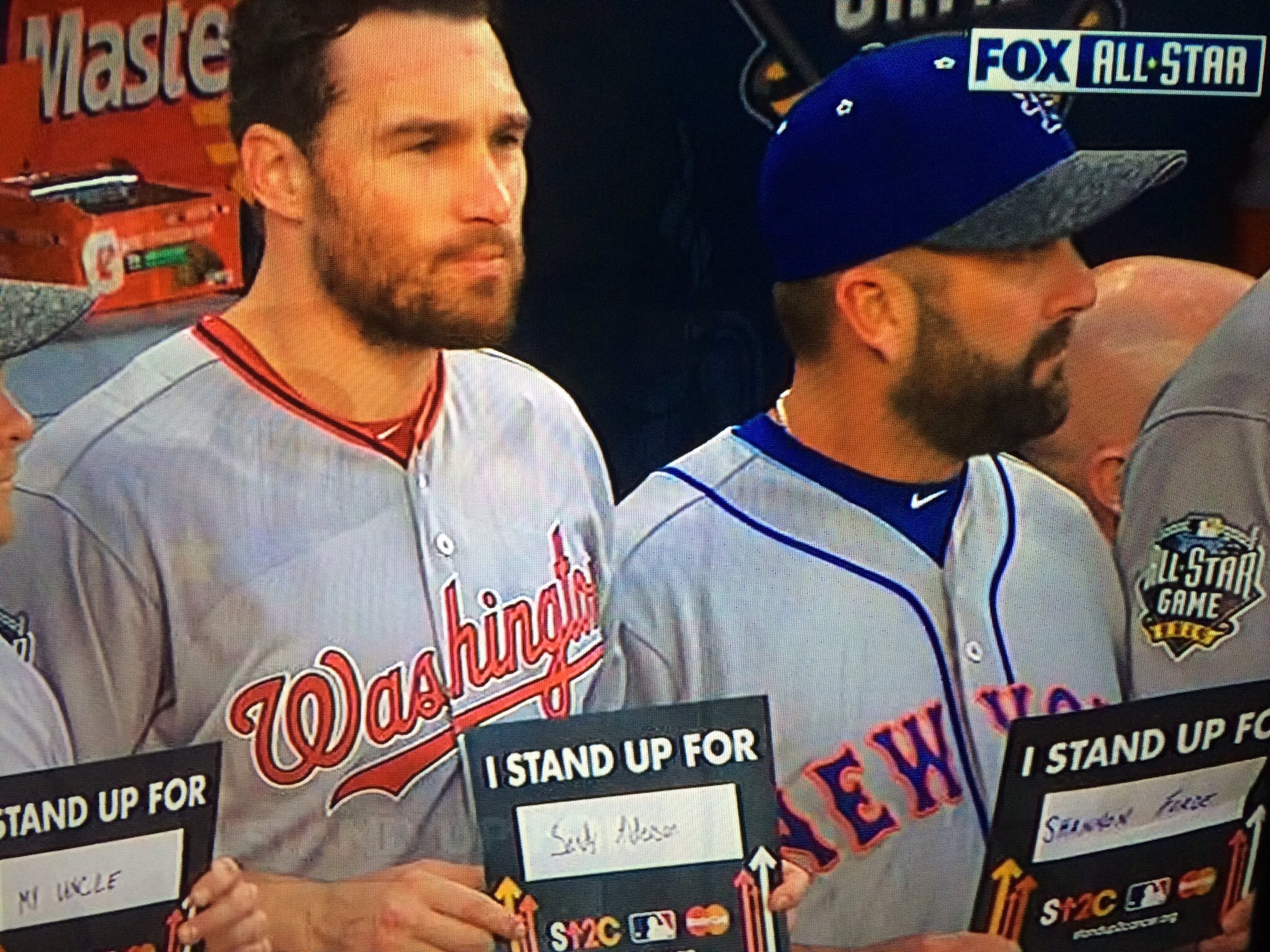
Speaking of Murphy, that Net Negative saved a run with a nice defensive play that Neil Walker doesn’t make. Just saying. It should be noted Murphy reached base in all three at bats, including being the first ever batter to be awarded first base after a replay in the All Star Game, as he’s clutch in the biggest moments.
It was fun being able to root for Murphy again. It was also great seeing Carlos Beltran appear in the game in what is likely to be the last one for the future Hall of Famer. He joined David Cone as the only players to appear for the Mets and Yankees in an All Star Game. Note, remember this on Friday.
Seeing the Jacob deGrom GEICO commercial reminded me of how great deGrom was in last year’s All Star Game.
I was shocked Mark Melancon wasn’t wearing his Mets hat when Collins brought him into the game in the seventh.
NL #squad. #LGM pic.twitter.com/xM2SIoilzb
— New York Mets (@Mets) July 12, 2016
Nice to hear the blurb about how Terry Collins wanted to get at least one representative from each team in the game and then not pitch Jeurys Familia or Bartolo Colon. Apparently, he thought Mets fans were content seeing just him. But hey, at least the fans of the other 14 teams were upset with him.
And that’s the thing, in essence, I tuned in to watch Terry Collins manage and try to figure out again why the Mets didn’t re-sign Daniel Murphy. In the process, the National League lost the game and homefield advantage in the World Series in a game that saw them leave 10 runners on base.
In that sense, the game wasn’t too dissimilar than watching a Mets game.
On January 29th, Matt Harvey appeared on Watch What Happens Live. It’s a celebrity and pseudo-celebrity talk show hosted by Andy Cohen, who seemingly produces everything on Bravo. Who knew that seven months later, Cohen would’ve been the only person from that night who would participate in the All Star festivities?
This is no slight on Harvey. For the second straight season, he pushed himself physically – perhaps beyond the limits.
Last year, Harvey was able to help pitch the Mets into the World Series where he pitched a game for the ages. This year he couldn’t do it. He struggled all year. First l, it was thought to be his mechanics. In the end, it turned out he has thoracic outlet syndrome requiring Harvey to have season ending surgery. As a result, Harvey will not be participating in the All Star festivities, nor will he be participating in this year’s postseason.
It’s a shame because he worked so hard to get back to this point after needing Tommy John surgery in 2013. It’s a shame as when he’s great, the Mets look like a team that can win the World Series. It’s a shame because Harvey has been a truly great pitcher that should be out there this week.
Except he couldn’t be. Instead, Andy Cohen is. That juxtaposition explains so much about what has ailed the Mets this year.
In 1985, Major League Baseball made the Home Run Derby a part of the All Star Game Festivities. Darryl Strawberry would become the first ever Met to participate in a Home Run Derby and the only Met to win one. He shared the title with Wally Joyner, who also hit four home runs. Needless to say, it was a much different back then.
No other Met who followed would ever win a Home Run Derby. In 1989, Howard Johnson‘s two home runs fell short of the three home runs hit by Ruben Sierra and Eric Davis. In 1993, Bobby Bonilla would fall short as well as his five home runs were two short of the seven hit by Juan Gonzalez and Ken Griffey, Jr. The Mets would not be close to winning until 2006 with David Wright.
It was that night in Pittsburgh that Wright seemed to be emerging from star to superstar. With Paul Lo Duca as hit pitcher, Wright would hit 16 homers in the first round. He made it all the way to the finals before losing to Ryan Howard. In 2013, when the All Star Game was hosted at Citi Field, Wright would acquit himself well hitting five home runs. However, he would not make it out of the first round. Not many would notice as Wright wasn’t the story of that Home Run Derby. It was Yoenis Cespedes flashing La Potencia:
Cespedes wowed the crowd with 17 first round homers en route to winning the 2013 Home Run Derby. It was on that night that Cespedes’ legend began. It was on that night that Mets fans began to become infatuated with him. Three years later, he’s now their best player, and with him goes their hopes of returning to the World Series.
With the Nationals starting a left-handed pitcher in Gio Gonzalez, Terry Collins was going to start Juan Lagares no matter what. On the one hand, Collins will tell you he wants Lagares’ bat in the lineup against lefties. In reality, Collins just doesn’t trust young left-handed hitters against left-handed pitching.
With that in mind, when Collins filled out the lineup card yesterday, he had Lagares in center, Curtis Granderson in right, and Alejandro De Aza in left. Collins started De Aza despite the fact that De Aza entered the game hitting .181/.252/.276. He started De Aza despite the fact that De Aza is a career .235/.299/.350 hitter against lefties. Looking at these numbers and just how poorly De Aza has played this entire year, Collins decided to start De Aza. In a shock to no one, De Aza was 0-3 on the day in a game that the Mets lost 3-2. There is really no justification for this decision other than the unsupported notion that Nimmo can not hit lefties.
Before his call-up, Nimmo was hitting .338/.338/.500 in 74 at bats against lefties. Given these stats, it’s fair to assume that Nimmo would be a better bet to hit a lefty than De Aza would. However, Collins isn’t willing to give him the chance. He would rather hamper a player’s development and stick with a veteran who has already proved he cannot do the job. It’s the same thing Collins did last year with Michael Cuddyer and Michael Conforto.
Last year, Cuddyer was just a shell of himself. He needed core muscle surgery. He had a knee injury that plagued him all year. Through all of it, Cuddyer hit just .259/.309/.391. It was a far cry from the career .277/.344/.461 career hitter he was. Despite Cuddyer showing he no longer could play up to the level he once could, Collins decided it was better to play him against lefties than it was to play the rookie Conforto who was hitting well in the majors. Collins made this decision despite the fact that Conforto was hitting .333/.414/.490 against lefties in AA. Still, for whatever reason Collins could conjure, he determined that Conforto was not able to hit lefties at the major league level. The idea got so stuck in his head that Collins followed the same plan coming into this season.
Then suddenly it happened. Conforto was no longer able to hit left-handed pitching he had not seen in quite a while. In 2016, Conforto hit .091/.128/.091 in his 44 at bats against lefties this season. This would then become part of a greater overall issue where Conforto stopped hitting all together. The seminal moment was the time Collins actually let Conforto hit against a lefty. In true Collins’ fashion, the lefty he chose was Madison Bumgarner. Conforto would go 0-5 on the day. He then went into a prolonged slump that saw him hit .148/.217/.303 over his next 44 games. In that span, Conforto went from hitting .365/.442/.676 on the season to hitting .222/.296/.431. The Mets were all but forced to send him down to the minors and call-up the left-hand hitting Nimmo.
Sure enough, Collins is repeating the same mistakes with Nimmo as he did with Conforto. Last year, it was to get Cuddyer at bats. This year, it is to get De Aza at bats. It didn’t make sense then, and it makes less sense now.
The most famed double play trio in Major League history was Joe Tinker, Johnny Evers, and Frank Chance. They were so renown that Franklin Pierce Adams would script a poem about them dubbed Baseball’s Sad Lexicon:
These are the three saddest possible words:
“Tinker to Evers to Chance.”
Trio of bears cubs, and fleeter than birds,
Tinker and Evers and Chance.
Ruthlessly pricking our gonfalon bubble,
Making a Giant hit into a double –
Words that are heavy with nothing but trouble:
“Tinker to Evers to Chance.”
As we all saw in the Future’s Game, the Mets are developing their own trio of young stars that people will wax poetic about for years to come.
For the first time ever, Amed Rosario, Dilson Herrera, and Dominic Smith took the field at the very same time. These are the very same three players that the Mets envision to be their own version of Tinker to Evers to Chance. It was easy to believe this is the future when Mets fans got to see the Future’s Game to watch Rosario make plays like this:
Great play ? @Amed_Rosario of the world team #FuturesGame Can't wait to see him with @Mets #DontBeSurprisedBeReady pic.twitter.com/3BJlYvDtkt
— MVVM Wear (@MvvmWear) July 11, 2016
This of course followed Herrera and Rosario helping the World Team put up a crooked number in the top of the ninth. Herrera hit an RBI single to put the World team ahead 5-3, and Rosario followed him with a single to load the bases. Both would eventually come home to score Seeing Herrera and Rosario get back to back base hits and score runs is something Mets fans will start seeing in the very near future.
Smith did his part to help USA win the game. He was one of the few players on the day that would play the entire game. As anticipated, he played a good defensive first base. He also had an RBI, which at the time had put USA up 2-0.
Overall, we saw each future Mets player contribute and help their teams try to win the game. Within the next few years, they will all take the field at the same time at Citi Field. Given their offensive capabilities, they will help their pitching staff get a lead in a game. Given their defense they will be able to turn a double play or two in the game. There will be excitement amongst the fans at Citi Field while the opposition and their fans will feel dejected as the Mets double play combination will give them “nothing but trouble.” Everyone else will shudder at the words:
Rosario to Herrera to Smith