
There is one thing you, me, and Juan Uribe have in common. We all love baseball. It was one of several great things we learned during the fun run that Uribe’s short tenure was with the Mets.
Back when the Mets first acquired Uribe, it was the first real sign of hope that the Mets could actually make the postseason. While we all knew the Mets had the pitching, injuries and ineffectiveness troubled the Mets offense. We never knew if or when David Wright was going to return. With Uribe, the Mets obtained a credible major league third baseman. His impact was felt almost immediately:
It was a fun run with Uribe. We learned he hated football, but he loved listening to the Backstreet Boys. He was fun to watch. He appeared to be a leader in the clubhouse. It’s easy to forget now, but if all the people in last year’s roster, he was the only one who had won a World Series. He was only one of two who ever played in the World Series (Curtis Granderson).
Overall, Uribe was more important than his .219/.301/.430 batting line. He was more important than his six homers and 20 RBI. Uribe was important because he provided the Mets with a credible third baseman. Uribe was important because he was the first sign that the Mets were ready, willing, and able to go for it in 2015. Uribe was important because he was great in the clubhouse.
A late season injury robbed him of much of his chance to contribute in the postseason. He did work his way back, made the World Series roster, and got to contribute with an RBI pinch hit single in the lone game the Mets won in the World Series.
Uribe brought an energy to the team. He was a joy to watch. He left an impact on the team. He left an impact on the fans. We were all better off for Uribe’s three months in a Mets uniform.
He’s now joining a Cleveland Indians team that’s very similar to what the 2015 Mets once were. I would not be surprised if the Indians had a good year next year. I’d be shocked if Uribe wasn’t a big part of that.
I’m going to miss Juan Uribe. He’s a big reason why the Mets are back . . . ALRIGHT!

After the Mets make a decision at catcher, the team appears like they will have between $82 – $96 million to build a roster and re-sign their pitching.
Looking at the roster, the Mets will need to obtain starters at the following positions: 1B, 2B, SS, and RF. David Wright is scheduled to make $15 million, so whether or not you believe he will be able to stay at the position, he will remain with the team in some capacity. Michael Conforto should still be with the team as the leftfielder. Finally, unless the Mets can move him, Juan Lagares and his $9 million salary will be the team’s centerfielder. The Mets organization is fairly well stocked with position players right now, and they might be able to fill out the roster with cheap, cost-controlled talent.
First Base
Somewhat controversely, Keith Law named Dominic Smith the 29th best prospect in all of baseball. He’s the first baseman of the future.
Accordingly to the scouting reports, Smith is a good defensive first baseman that should be able to hit. The debate really is whether he will hit for power. Whether or not he hits for power, people see him as being able to field the position and be a good major league hitter.
With Lucas Duda being a free agent in 2018, the Mets will need Smith to be ready. If he’s not ready, the Mets will need a stopgap. In either event, by the time the Mets pitchers start to become free agents, Smith should be the first baseman earning around $500,000.
Second Base
We have to assume that one of these years Dilson Herrera is going to transition from second baseman of the future to the Mets second baseman. With Neil Walker only having one year until free agency, it appears that time will be 2017.
Right now, Herrera has less than one year’s service time. For all the supposed newfound depth, it’ll probably be Matt Reynolds getting called up to the Mets. That will preserve his service time. It means that in 2019, Herrera should be the second baseman, and he will have accrued two full years service time. Unless he gets enough playing time, it appears like he will avoid Super Two status meaning he will be in the same $500 – $600 thousand range as Smith.
Shortstop
As far as organizational depth, the Mets seemingly have an embarassment of riches with two high end shortstop prospects with Gavin Cecchini and Amed Rosario. They also have the aforementioned Reynolds.
Given Asdrubal Cabrera‘s contract, Cecchini and Rosario are going to have time to develop on the minors. At a minimum, Cabrera is signed to be the Mets shortstop through the 2017 season. If he produces well, or the prospects need another year, Cabrera has an option that could keep him with the Mets through the 2018 season.
As such, neither Cecchini or Rosario will be arbitration eligible at the time the Mets pitchers start to reach free agency. Accordingly, the Mets will only have to spend around $500 thousand when the pitchers begin to become free agents.
Left Field
It seems Michael Conforto is the leftfielder of the past (2015), present, and future. He very well should be too. Even if Conforto doesn’t improve upon his 162 game averages he achieved as a 22 year old, who never played above AA, you’re getting a good defensive outfielder who will hit .270/.335/.506 with 26 homers and 75 RBI.
Fortunately, Conforto will not have accrued enough service time to achieve Super Two status. Unfortunately, Conforto will most likely become arbitration eligible the same time that the Mets pitchers are reaching free agency.
Looking over the past few years, there isn’t really a good comparable to Conforto. It seems that when teams have good young corner outfielders, they lock them up. With that in mind, although an admittedly imperfect comparison, J.D. Martinez is instructive.
In 2014, Martinez was 26 years old, and he hit .325/.358/.553 with 23 homers and 76 RBI in 123 games. He became arbitration eligible after this season, and he agreed to $3 million. In 2015, he had another good year hitting .282/.344/.535 with 38 homeruns and 102 RBI. He and the Tigers avoided an arbitration hearing. Martinez’s contract extension bought out the remainder of his arbitration years he’s due to make $6.75 million in 2016 and $11.75 million in 2017.
While we may or may not agree on whether Martinez is a good comparable, it would be fair to say Conforto is at least capable of hitting .272/.344/.535 by his age 25 season, if not sooner. If that’s the case, it would be fair to suggest Conforto could earn anywhere from $3 – $6 million in his first year of eligibility.
Right Field
Curtis Granderson‘s contract will expire after the 2017 season. Since he will be 37 heading into the 2018 season, it’s hard to imagine he will be re-signed to be the everyday right fielder.
Now, Wuilmer Becerra projects to be an everyday player. Scouts believe he has the bat to play the corner outfield spot. The issue as far as the Mets are concerned is how quickly the 21 year old minor leaguer will need before fulfilling that promise. Last year, Becerra played his first year in full season A ball. That’s a long trek to the majors by 2019.
So unless Brandon Nimmo can handle the corner outfield offensively, which unfortunately seems unlikely, the Mets will have to look outside the organization to fill that void.
If Becerra is still a well regarded prospect, the Mets are likely to bring in a player on a one to two year deal. In retrospect, depending on how he finishes out his contract, Granderson could be coaxed back on a one-year deal ata much lower contract price.
As a placeholder, let’s presume the cost of a right fielder would cost about $15 million. That’s what Granderson is slated to earn the last year of his contract.
Cost of the Projected 2019 Starting Lineup
If everything breaks right for the Mets, they will have a group of young, cost-controlled position players at the time their starting pitchers hit the free agent market. If this pans out, the Mets everyday position players would cost about $46.5 million.
That’s roughly what the Mets are paying their current starting infield. In total, the 2016 Mets starting lineup is due to be paid roughly $90 million. Essentially, the Mets will be spending half the amount of money on their starting lineup in 2019 than they will this season.
Overall, this leaves the Mets between $35.5 – $49.5 million to build a bench, a bullpen, and to pay their starting rotation if the payroll remains stagnant at the $140 million range.
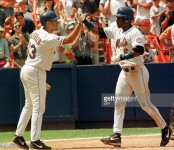
One of my favorite movies is Big Fish. One of the story lines in the movie is the relationship between Edward Bloom and the town of Ashton. I found myself thinking about that today when I learned about the passing of Tony Phillips.
When Edward Bloom first happens upon Ashton, he’s described as having arrived at the most beautiful town there is. Like a baseball field, Ashton was covered in impeccably manicured green grass. However, he’s arrived too soon. It wasn’t his time to be there yet. He should not have arrived until a different time. He moved on. When he returned, everything was different. The town was dilapidated. He stuck around for a while to help reinvigorate the town, but he had to eventually move on. He got back there too late.
Tony Phillips played 18 seasons hitting .266/.374/.389. In an average season, he hit 12 homers and 67 RBI. He put up these numbers while primarily playing the middle infield. In his career, he twice led the league in walks. He made no All Star teams in his career. He played for six teams. He retired in 1999 at the age of 40. Not too long thereafter, the A’s would revolutionize baseball by focusing on stats like OBP. Players like Tony Phillips would become coveted instead of being a nice player on your team.
Simply put, Tony Phillips played baseball before players of Phillips own skill set were appreciated. Right at the time when the Tony Phillipses of the world were seen as the very good ball players they were, it was his time to leave the green grass fields of Ashton. His skill set was recognized too late.
As for the Mets, Tony Phillips acquired him in a trade deadline deal in 1998. He played outfield on a team that needed corner outfielders. He played relatively effectively in his 52 games as a Met. Unfortunately, he and the Mets fell just short. Unsurprisingly, Phillips would finish his career with Billy Beane’s Athletics. He was where we all thought he belonged. He just got there too late.
Worse than that, Phillips has died too young at the age of 53. Hopefully, he’s now at the right place at the right time.
Rest in peace Tony Phillips.
In 2014, the Royals were 90 feet away from scoring the tying run of the World Series. Even though most agreed Alex Gordon made the right decision stopping at third, his decision became a topic of discussion when Madison Bumgarner got Salvador Perez to foul out to end the World Series.
The game tying run was forever stranded at third.
Fast forward to the 2015 World Series.
With the exception of Game 2, the Mets had a late lead in each game. They got to that point despite the Mets starting pitching not having one truly great game. In fact, the Mets starting pitching had been somewhat disappointing. With that said, they pitched well enough to put the Mets in position to win four of the five games.
Then the pitching showed up in Game 5. Matt Harvey shut down the Royals much in the same way Bumgarner had shut down the Royals. Jacob deGrom and Noah Syndergaard were ready to go for Games 6 & 7. Before the ninth inning, the Royals had a dejected look in the dugout. Even if they were up 3-1 in the series, they were in real trouble. The Mets great starting pitching had awoken.
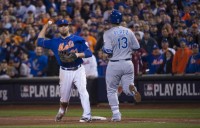
In the fateful ninth inning, Eric Hosmer was on third base. He was 90 feet away. Then this happened:
Hosmer had no business running there. None. He was the last out of the game. However, when 90 feet separated you from a World Series championship the previous year.
Yes, we heard it was about the scouting reports on Duda. The Royals scouts said the team should test Duda’s arm when they got the chance. However, that’s not what really happened. Hosmer described it somewhat differently:
We think about [losing the World Series] often. I’ve said it before and I’ll say it again, I think that’s kind of something we turn to mentally . . . . Everyone kind of relates to that and relates to how much that hurt.
***********
You’ve got to try to take a chance. With who was on the mound, Familia, hits are hard to come by, so, you know, you had to be aggressive. If it hadn’t worked out, I’d be answering some hard questions right now, but that’s the way we’ve been doing it all year. We’ve been taking chances, and found a way to get it done.
Hosmer admitted the end of the 2014 World Series impacted and drove the Royals throughout the 2015 season and World Series. The team was not going to let the tying run be stranded on third base. In 2015, the Royals strived to be more aggressive.
It’s now 2016, and now it’s the Mets turn to answer questions about why they lost the World Series. Naturally, one of the issues that arise is Lucas Duda’s throw:
Duda says the throw home in the World Series haunted him. Watched the play a few times on film. Still believes good throw gets him.
— Marc Carig (@MarcCarig) February 18, 2016
In reality, Duda’s throw didn’t cost the Mets the World Series. Overall, it was their defense. You can pinpoint to problems in each and every game the Mets lost.
The Mets have to let this fuel them in 2016 much in the same way the Royals were fueled by the way they lost in the 2014 World Series. They need to use it to be better defensively, to pay better attention to detail in the field. If the Mets do this, they can do what the Royals did. They can return to the World Series.
And when they return chances are Lucas Duda makes that throw home helping thereby helping the Mets win the 2016 World Series.

In 2016, the Mets attempt to return to and win the World Series. If they’re able to return to the World Series, they will become the 17th National League team to go to back to back World Series. Can you name the other teams that have completed the task? Good luck!
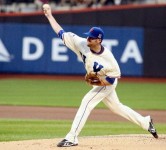
Almost. That’s the one word I think of when I think of Bobby Parnell‘s Mets career. He almost figured it out.
The Mets organization always thought of him as a reliever, but in 2009, when the team no longer had nothing to play for other than finding out who will be a part of the future, they let Parnell start some games. In his first home start, he pitched six shutout innings against the Giants. It was downhill from there. It didn’t mean Parnell was a bad pitcher, it just meant he was reliever.
It didn’t change the fact that the Mets had high hopes for him. They saw him as a future closer. He had the stuff for it. He put together some good seasons. Then he had the break he needed in his career. In 2011, he was mentored by Jason Isringhausen. The next two years would be the best years of his career. In 2013, he would fulfill what the Mets saw as his destiny. He became their closer.
It would be the best year of his career. He recorded 22 saves. He had a 2.16 ERA with a 2.33 FIP, a 166 ERA+, and a 1.000 WHIP. He was a reason for hope for 2014 and beyond. Well, almost. He had elbow problems going into the 2014 season. After one poor appearance, he had to be shut down and have Tommy John surgery.
He tried to come back in 2015, but he was ineffective. Up until his surgery, Parnell had a 96 MPH fastball with an 87 MPH slider, 84 MPH curve, and a 89 MPH split. Upon his return, his repertoire was a tick slower with a 94 MPH fastball, 82 MPH curve, and a 89 MPH split. His WHIP jumped to 1.958. His ERA+ was 59. Whereas Matt Harvey was given a year and a half to rehab, Parnell rehabbed for barely over a year.
He apparently needed more time. Once again, he was almost ready.
He’s a former Met now having signed with the Detriot Tigers on a minor league deal. He’s on a team that seemingly needs bullpen help each and every year. Hopefully for him, he’s ready. I hope he’s past being almost there.
He was a good Met. He had periods of effectiveness. It almost worked out well in New York.

In judging players, managerial moves, and the like, sometimes we forget that players are human beings. It was something I was again reminded of when I read about Jon Niese‘s statements in the Pittsburgh Post-Gazette about the 2016 season:
I should never have played that game. It [stunk] that I wasn’t there at the hospital. That’s when it all went downhill. I think that’s the thing guys don’t really realize with sabermetrics. If I wouldn’t have pitched in that one game, I probably would have stayed the course, stayed in a rhythm, but that just kind of knocked me off.
Now, Niese has a history of making excuses for his poor performances. However, he may not be off-base here.
Niese had a rough May, but he was turning things around. In June, he had a 3.00 ERA. Including the aforementioned start, Niese had a 2.87 ERA in the month of July. In that July start, he pitched three innings allowing six earned on eight hits. Looking at his stats, he’s right. His 2015 season went completely off the rails at that point.
After his son was born, he made 10 starts. He had a 4.99 ERA. Batters were tattooing him hitting .282/.344/.418. With Steven Matz returning from the DL, he was put in the bullpen. To his credit, it was a move Niese wanted to make.
There are several legitimate reasons why Niese had a terrible 2015. He claims it was being taken out of his rhythm. It’s possible. It’s also possible that it all had to do with the birth of his first child. I’m sure he was racked with guilt for not being there for his child’s birth. He had to do what he could do to help his wife when she was in another state.
Being a new parent is hard. It’s got to be even more difficult when you are so far away. You’re unable to see your child, to hold him, to see that little hand grab your finger.
This is what Niese was dealing with last year. A player who was renown for being a head case had even more on his plate. He then went on to have an absolutely miserable August and September. He was adjusting to life as a new father.
Niese is now in Pittsburgh. He’s with a new, perhaps better, pitching coach. His new pitching coach had shown he can work well in getting pitchers to resurrect their careers, to be better than they ever were before. He’s primed to have a much improved 2016.
By being in Pittsburgh, he’s also closer to his family. Things are settling down more at home. It’s bound to put him in a better frame of mind. It might be all Niese needed.
He’s only human after all.

Terry Collins grew up watching baseball in an era when you had batting average, homeruns, and RBI to judge hitters. There was W-L record, ERA, and strikeouts to judge pitchers. Back then, utilizing the eye test was justifiable as there was no way to really quantify all you are seeing.
It’s important to keep this in mind when analyzing Terry Collins’ opinions on advanced statistics:
It’s become a young man’s game, especially with all of the technology stuff you’ve got to be involved in. I’m not very good at it. I don’t enjoy it like other people do. I’m not going to sit here and look at all of these [expletive] numbers and try to predict this guy is going to be a great player. OPS this. OPS that. GPS. LCSs. DSDs. You know who has good numbers? Good [expletive] players.
This quote reminds me of when I talk baseball with my Dad. He’s actually two years older than Terry Collins.
Whenever I talk to my Dad about baseball, I sometimes refer to advanced statistics. I will refer to WAR, FIP, UZR, etc. When I refer to them, he looks at me incredulously. He doesn’t know what they are. He doesn’t understand them. He asks me how to calculate them. I will give him a cursory explanation, but I can’t give him the exact formula. He can’t sit down and calculate it with his calculator. He’d rather talk about the statistics in which he’s more conversant.
The strange thing is I became interested in part due to my Dad. Growing up, he always told me to take W-L record with a grain of salt. He told me OBP was more important than batting average. He told me this in the 80’s! Back then merely suggesting that was heresy.
Now, we’re well beyond OBP and ERA being the advanced statistics to analyze. In many ways, Terry Collins is right. The game of baseball has passed them by. These newfangled statistics really are for a younger generation. Yet, we can all still enjoy baseball in our own way.
We don’t really need advanced statistics to tell us Matt Harvey is a really good pitcher. Yes, advanced statistics will support that conclusion. I love sitting there and watching games with my Dad. I remember in 2013 when he said that he expected Matt Harvey to throw a no-hitter every time he goes out to pitch. One night, we were there when it almost happened.
I love hearing my Dad tell me about how impossibly great Tom Seaver was. I love hearing him tell me that despite that he wanted Jerry Koosman on the mound for a big game.
So yes, how we analyze the game has changed since my Dad was a kid. Not to mention that teams are even trained differently from the days of old, with new technology and tools like the baseball swing trainer V2 and others available for anyone who aspires to be a solid player. It still doesn’t mean he doesn’t know a great player when he sees one. It doesn’t mean he doesn’t have a wealth of knowledge when it comes to the game of baseball. It doesn’t mean I don’t love talking baseball with him.
There will come a time when there are new statistics I won’t understand. I’ll be too old and set in my ways to learn the new ones. My son will roll his eyes at me when I refer to someone’s WAR or UZR. There’s going to be new statistics that will make all I think I know obsolete. That’s fine as long as we’re talking baseball (hopefully about his career). That’s all that matters.
No matter what happens, no matter what new statistics arise, the game never passes you by. As long as there are fathers and sons talking baseball, the game will belong to each and every generation. It will be a shared experience.
With that said, hopefully one day, my son will be able to explain to me what LCS and DSD is before I begin ignoring all thess newfangled statistics.

There are legitimate reasons why you would say the Mets will not win the NL East. Fangraphs used its projection system to predict the Mets will finish behind the Nationals in the NL East.
Agree or disagree, at least we know Fangraphs has a rationalization for its conclusions. On the other hand, USA Today proudly flaunts they have no such projection formula. They just use the “human element” necessary in such projections to proclaim not only that the Nationals will win the NL East, but also that the Mets will miss the playoffs altogether.
Mets Aging Offense
One reason why USA Today sees the Mets falling behind the Nationals is an aging lineup with “six regulars on the wrong side of 30.” For what it’s worth, here’s a look at the Mets 2016 Opening Day starters:
- Travis d’Arnaud (27)
- Lucas Duda (30)
- Neil Walker (30)
- David Wright (33)
- Asdrubal Cabrera (30)
- Michael Conforto (22)
- Yoenis Cespedes (30)
- Curtis Granderson (35)
If we adhere to the axiom that a player’s prime is between 27-32, another way of saying what USA Today said was six of the eight Mets regulars are in their prime. Another way of saying what USA Today said is six of the eight Mets regulars are 30 and younger.
To put this in perspective, lets look at the Nationals 2016 projected lineup:
- Wilson Ramos (28)
- Ryan Zimmerman (31)
- Daniel Murphy (30)
- Anthony Rendon (25)
- Danny Espinosa (28)
- Jayson Werth (36)
- Ben Revere (27)
- Bryce Harper (23)
Three of the Nationals players are “on the wrong side of 30.” The average age of the eight Nationals regulars is 28.5. The Mets is 29.6. According to USA Today, that extra year is an indication that the Mets are in decline and the Nationals are on the rise.
Bartolo Colon: Fifth Starter
Personally, I am not the biggest Bartolo Colon fan. With that said, I can’t think of him making around 15 starts next year as a reason why the Mets will miss the playoffs.
Last year, Colon had an ERA+ of 89, and an FIP of 3.84. This makes him a below average starter. Keep in mind, he will only be in the rotation until July when Zack Wheeler has completed his rehab from Tommy John surgery.
The Nationals counter-part? Tanner Roark Roark is thrust into the starting rotating from the bullpen as the Nationals lost their second best starting pitcher, Jordan Zimmermann, to free agency. Roark had an ERA+ of 92 and a 4.70 FIP. In theory, Roark is keeping the spot warm for uber-prospect, Lucas Giolito. However, it should be noted Giolito has not yet pitched above AA.
Considering which statistic you choose, you can argue Roark is either just as bad or worse than Colon. As such, Colon is not a reason to say the Mets will finish behind the Nationals.
Thor’s Innings
One factor USA Today cited in saying the Mets should finish behind the Nationals is the scary prospect of Noah Syndergaard having to throw 50% more innings.
This is plain wrong. Last year, Syndergaard threw 150.0 innings in 24 major league starts. In the minors, he threw 29.2 innings in five starts. Does USA Today reay believe Syndergaard will throw 359.1 innings next year? The last pitcher to throw over 300 innings was Steve Carlton, and that was 36 years ago. The last pitcher to throw over 350 innings was Wilbur Wood in 1973.
No, Syndergaard threw 179.2 innings in 29 starts. If he averages roughly the same 6.1 innings per starts next year, and he makes 32 starts next year, he will only throw 19 more innings or 10% more innings.
Instead of Syndergaard’s innings, USA Today should’ve focused on Nationals starter Joe Ross. Last year was Ross’ first year in the majors. He made 13 starts with three relief appearances throwing 76.2 innings. In the minors, Ross made 14 starts and threw 76.0 innings. Between the two stints, he made 27 starts while pitching 152.2 innings. Next year, he will see a much greater percentage work increase than Syndergaard will.
Overall, if the increased workload is an issue for Syndergaard, it’ll be a bigger issue for Ross.
Matz’s Durability
Another factor mentioned for the Mets apparent downfall is the fact that Steven Matz has never thrown more than 140 innings in a season.
Well that is true. You know what else is true? In his entire pro career, Matz has a 2.25 ERA, including a 2.27 ERA in six starts with the Mets last year. Keep in mind, this is the Mets fourth starter and a favorite in the Rookie of the Year race.
Overall, USA Today is throwing cold water on the Mets rotation while ignoring the Nationals rotation issues. There are the aforementioned problems with Roark and Ross. Additionally, the Nationals saw Gio Gonzalez being to regress with a 1.423 WHIP last year. That’s an ugly number for a guy who has a reputation for struggling with command. Furthermore, he just hit that dreaded age 30 season.
Also, while Max Scherzer had an outstanding year last year, it should be noted it wasn’t perfect. Scherzer went 10-7 with a 2.11 ERA in the first half of the year. In the second half, he went 4-5 with a 3.72 ERA. Also, at age 31, he’s “on the wrong side of 30.”
Dusty Baker is a Magician
Last year, Matt Williams was worse than Jimmy Dugan was before he got into that fight with Dottie Henson as to whether or not Marla Hooch should bunt. Note, Jimmy Dugan was right. It very rarely makes sense to have a position player lay down a sac bunt.
Baker had earned the right to be a well regarded manager. However, he’s not a miracle worker.
He doesn’t make Anthony Rendon healthy for a full year as USA Today suggests. He also doesn’t make Steven Strasburg completely fulfill his potential making him a Cy Young winner. He doesn’t make Zimmerman or Werth healthy and productive. Yes, he can get the most from this admittedly talented Nationals team, but no, his presence alone doesn’t help this team overcome all of its issues. The only thing I would hazard a guess at is he would probably prevent Jonathan Papelbon from choking anyone in the dugout.
Picking Nits
Overall, USA Today has teams having a combine record of 2347-2430. Since baseball has no ties, any projection system should have teams as a whole with a .500 record. It’s an error. We all make them. With that said, with the decidedly one-sided analysis of the NL East, I believe it shows the attention to detail provided.
Conclusion
I’m not the typical Mets fan. The Nationals do scare me. You can concoct many a scenario in which the Nationals win the division. I just don’t think the one-sided analysis USA Today did was one of them.
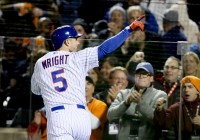
When David Wright came up in 2004, we thought every year was going to be like last year. Much like this year, we anticipated that each and every year Wright manned third base, the Mets would contend for a World Series.
As we know, it didn’t happen that way. A lot went wrong. The Mets came ever so close in 2006. They collapsed in 2007 and 2008. A poorly designed outfield, poor personnel decisions, and financial crisis ensued. Then, as things began to turn around, Wright injured his hamstring. Then he was diagnosed with spinal stenosis. Last year was his first trip to the World Series. This year may be his last year as a key contributor on a World Series team.
It could also be Wright’s last year to build his Hall of Fame credentials.
Third base is the least represented position in the Hall of Fame. Accordingly, standards are high to enter the Hall of Fame as a third baseman. The average of 13 Hall of Famers at the position had a career WAR of 67.5, a WAR7 (best seven years combined) of 42.7, and a JAWS of 55.1. Looking at the stats, Wright falls short. His career WAR is 50.1. His WAR7 is 40.0. His JAWS is 45.1. For a player that Mets fans believed would be a Hall of Famer, he now has an uphill climb.
WAR7
Looking at theses factors, it’s presumably easiest for Wright to increase his WAR7. To do so, he would need to have one year where he accumulates 2.7 more WAR that his seventh best season. Here are his seven best WAR seasons:
- 2007 – 8.3
- 2012 – 7.0
- 2008 – 6.8
- 2013 – 5.9
- 2005 – 4.8
- 2006 – 4.1
- 2009 – 3.2
For Wright to put his WAR7 within range, he would need to have one more season that is 5.9 or better. Wright last did that in 2013. That year Wright only played on 112 games. He hit .307/.390/.514 with 18 homers and 58 RBI. His 156 OPS+ was the best of his career. In that season, Wright missed a significant amount of time with a strained hamstring. Sounds just like his April 2015 hamstring injury that wouldn’t heal.
The Mets are hopeful that Wright can play 130 games in 2016. Judging from Wright’s 2013 season, it is certainly possible that Wright can have a 5.9 season again. A better and much stronger Mets lineup will assist him in that task.
Cumulative WAR
Going into the 2016 season, Wright has a career WAR of 55.1, which is presumably 12.4 behind the 67.5 career WAR he would need to be enshrined in the Hall of Fame.
This is where things may get a little tricky for Wright’s chances. Don Mattingly had back problems, and his once promising Hall of Fame career was over at 34. Lenny Dykstra had spinal stenosis, and his career was over at 33. David Wright is entering his age 33 season. Based on other player’s careers, he’s near the end of his career. If Wright plays past his age 34 season, he will be in uncharted territory.
Naturally, it is safe to assume Wright will not have a 12.4 WAR season thereby cementing his Hall of Fame case. To do that, Wright would have to match Babe Ruth‘s 1927 season when he hit 60 homeruns. No, if Wright is going to accumulate the needed 12.4 WAR, he’s going to have to remain healthy and effective. He’s going to have to manage his spinal stenosis.
Wright is currently signed until 2020. There are $90 million reasons why Wright will do all he can to finish that contract.
Presuming Wright does do that, he has five more years left in his career. In order to attain the necessary 12.4 additional WAR, Wright will have to average a 2.5 WAR a year for those five seasons.
In 2014, Wright played 134 games, and he was a 2.7 WAR player. In that season, he hit .269/.324/.374 with eight homers and 63 RBI. If Wright manages his back, and his treatments are effective, seasons like this over the next five years are certainly attainable.
Other Criteria
As Wright’s peak is over, there really isn’t anything he can do to improve his JAWS. With that in mind, we need to look at other areas that would improve Wright’s Hall of Fame case.
Unfortunately, he will be unable to surpass Mike Schmidt‘s 548 homeruns or even reach the once magic number 500 homeruns. He won’t catch Chipper Jones‘ 1,623 RBI. He won’t catch Brooks Robinson‘s 16 Gold Gloves at third base. It does not appear Wright will reach 3,000 hits as he would need to average 250 hits over the next five years to reach that number. No, it seems like the only thing that will help Wright is the narrative.
The best thing going for Wright is the fact that he will most likely play his entire career as a Met. Aside from Tom Seaver, Wright is making a case as the best player to ever play for the Mets. Here are his Mets rankings:
- Games Played – Second (307 behind Ed Kranepool)
- Runs – First
- Hits – First
- Doubles – First
- Homeruns – Second (17 behind Darryl Strawberry)
- RBI – First
In addition, Wright’s 50.1 WAR with the Mets is the second most any player has accumulated with the Mets; the most accumulated by any Mets position player. Even with Mike Piazza‘s recent election to the Hall of Fame, it appears that Wright is the team’s best position player.
So overall, Wright still has a legitimate shot at the Hall of Fame. His name will be atop all the major offensive catergories. His WAR and other catergories will put him on the cusp of election. A strong 2016 will get him a lot closer to those goals.
Winning a World Series in 2016 can’t hurt either.
Editor’s Note: this article also appeared on metsmerizedonline.com