Jacob deGrom
With homefield advantage on the line and the Mets in playoff position, Terry Collins managed the All Star Game like seemingly every other manager has previously managed the All Star Game. He put more of a premium on getting all the players in the game than winning the game. Well, everyone except his own players Jeurys Familia and Bartolo Colon. Other than the Mets players apparently being upset at this, it is hard to criticize Collins for how he managed the All Star Game. Still, there are many managerial decisions Collins has made in the first half of the season that invite scrutiny.
First and foremost, there is the way he handled Michael Conforto. First, he didn’t let him get any time playing right field in Spring Training. The end result of that was Collins putting Juan Lagares in right and Yoenis Cespedes in center on days that Curtis Granderson was given the day off. There really is no excuse for putting Lagares, possibly the defensive center fielder in the game, anywhere but center.
The other mistake is not letting Conforto hit against lefties until Madison Bumgarner took the mound. Collins was hampering his development by doing that. At the end of the day, this is the Mets best position player prospect, and in many ways, he was the second best hitter on the team. Collins was willing to sacrifice all that to get Lagares’ bat in the lineup instead of sitting an older Granderson who had the very platoon splits that worried Collins. By the way, Granderson is also 35 years old and could use the occasional day or two off. Conforto’s season began to fall apart, and he needed to be sent down to AAA. By the way, Collins is making the same mistake with Brandon Nimmo. However, it’s even worse with Nimmo as he’s doing it to get Alejandro De Aza‘s bat in the lineup.
While on the topic of developing players, Kevin Plawecki has faltered for yet another season under Collins’ tutelage. Last year, there were a number of excuses why Plawecki didn’t succeed from his being rushed to the majors to his sinus issues. This year, he had no such excuses, and he still didn’t produce. While Plawecki deserves a large amount of the blame, Collins certainly deserves some of it, especially when his position with Conforto is that he is not here to help players develop as major leaguers when the Mets have a win-now team.
Another major issue this year was Collins’ handing of Jim Henderson. Henderson was a feel good story that turned into a potential nightmare. The day after Henderson threw a career high 34 pitches, which is puzzling in its own right, Collins used Henderson to pitch in the very next game. He did it despite knowing that Henderson needed to be handled lightly due to his having two shoulder surgeries. He did it even after watching what happened with Johan Santana. Collins knew all of this, and yet he used Henderson in that spot as he said an April 13th game, the eighth game of the season, was deemed to be a must win game. Henderson’s production fell off after that, and now he is on the disabled list.
There was also his handling of Noah Syndergaard. Last year, the Mets wanted to initiate a six man rotation to alleviate some of the early innings Matt Harvey and Jacob deGrom pitched early in the season. The idea was to both keep them healthy and keep them fresh for the length of the season. To be fair, Collins use of Syndergaard in any one particular start has not been egregious. However, it was curious how he shoehorned Syndergaard into a relief appearance after Syndergaard was ejected throwing at Chase Utley. The Mets had an opportunity to rest their ace until his next start. Instead, Syndergaard got the adrenaline going and was ramped up in a relief appearance on his throw day. By the way, in Syndergaard’s last start his fastball velocity dropped to 91 MPH, and he left the game with a dead arm.
Speaking of how he is handling pitching, it is amazing that Collins took part in talking Steven Matz out of opting for season ending surgery to address the bone spurs in his elbow that has clearly hampered his pitching. Not only was Collins willing to risk Matz suffering a more severe injury, he’s also willing to put a limited pitcher on the mound every fifth day. Keep in mind that since the bone spurs became an issue, Matz has been 0-3 with a 5.05 ERA and a 1.430 WHIP. His slider usage has dropped from 13% to 3% of the time. It’s always troubling when a manager doesn’t protect his players. It’s even worse when he doesn’t protect the young injured ones.
There is also the curious drop in production this team has had since May 1st. Here’s how some of the Mets best hitters have fared since that point:
| April | Since | |
| Curtis Granderson | .241/.347/.471 | .238/.335/.453 |
| Neil Walker | .307/.337/.625 | .232/.318/.345 |
| Asdrubal Cabrera | .300/.364/.400 | .249/.305/.435 |
| Michael Conforto | .365/.442/.676 | .148/.217/.303 |
Now, there are many factors to this including some of these players getting nicked up a bit. There’s something to be sad for the natural ebbs and flows of a season as well. There should be some note about the injuries to the players surrounding them. However, with all that said, these players have had a significant drop off in production under Collins’ watch. Whether it was helping them make adjustments and finding days for them to get the rest they needed, Collins didn’t do that as their manager.
There have been other issues dealing with Collins in-game management that could be highlighted as well. To be fair and balanced, it should be pointed out that Eric Campbell, Ty Kelly, Matt Reynolds, and Rene Rivera have played far more games than the Mets ever wanted or expected them to play. It’s hard to expect a manager to win under those circumstances. It should also be noted that there were significant injuries to David Wright, Lucas Duda, and Matt Harvey which have further weakened the Mets.
Through all of that, Collins still has the Mets in a position to make the postseason. If he makes better decisions, and the Mets begin playing better, they should be in the postseason, and with that pitching staff, they still have a legitimate chance to return to the World Series.
Given the fact that the Mets weren’t going to have any players playing tonight, I wasn’t as excited for the All Star Game. However, it was still a baseball game with the best players in the game, so naturally, I tuned in to watch. Here are some quick thoughts:
Very cool to name the AL & NL batting champs after Rod Carew and Tony Gwynn. Even better to do it at the San Diego All Star Game.
Am I the only one who thought Collins was sitting Michael Conforto because the American League started a left-handed starter in Chris Sale?
The Terry Collins getting tired of the Royals’ hitters jokes after the Eric Hosmer and Salvador Perez homers were about as funny as Sophie’s Choice and as original as Carlos Mencia’s standup.
I still can’t believe Collins let Jose Fernandez pitch to David Ortiz after Fernandez said he was going to groove one in to Ortiz in a game with World Series homefield advantage on the line. Fortunately, he didn’t, and Ortiz walked.
Speaking of Ortiz, just go away already. I double down on those feelings after seeing how Tim Duncan retired today.
love how Terry Collins lifted all the Cubs starters – Anthony Rizzo, Ben Zobrist, Kris Bryant, and Addison Russell – as the game got close and late. You don’t want the Cubs playing with the World Series on the line.
By the way, remember when the Mets announced to everyone they were signing Zobrist – even after he already agreed to a deal with the Cubs?
As I learned during Game 3 of the World Series, the home team tapes the Stand Up to Cancer signs to each seat with a generic statement like “Survivors.” During the World Series, you could fill-out your own in the Jackie Robinson Rotunda. I was shocked there weren’t any “Tony Gwynn” signs in San Diego.
Speaking of the signs, it was classy for Collins, Tim Teufel, and other members of the Mets to hold up signs for Sandy Alderson. I did wonder where the signs for Shannon Forde were. By the way, it was really classy for Daniel Murphy to hold up a sign for “Sandy Alderson” with the way Alderson let it be known he didn’t want Murphy around:
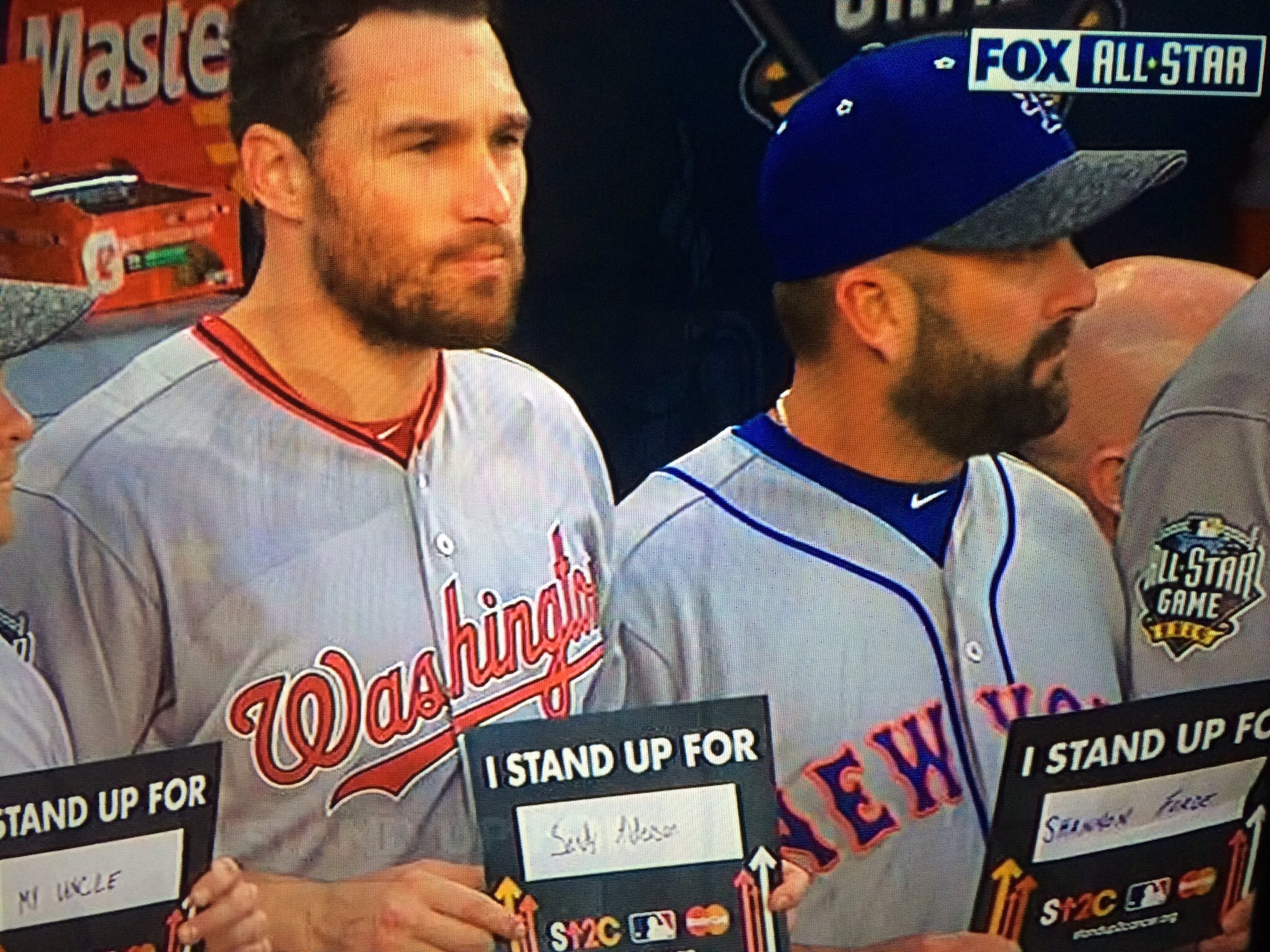
Speaking of Murphy, that Net Negative saved a run with a nice defensive play that Neil Walker doesn’t make. Just saying. It should be noted Murphy reached base in all three at bats, including being the first ever batter to be awarded first base after a replay in the All Star Game, as he’s clutch in the biggest moments.
It was fun being able to root for Murphy again. It was also great seeing Carlos Beltran appear in the game in what is likely to be the last one for the future Hall of Famer. He joined David Cone as the only players to appear for the Mets and Yankees in an All Star Game. Note, remember this on Friday.
Seeing the Jacob deGrom GEICO commercial reminded me of how great deGrom was in last year’s All Star Game.
I was shocked Mark Melancon wasn’t wearing his Mets hat when Collins brought him into the game in the seventh.
NL #squad. #LGM pic.twitter.com/xM2SIoilzb
— New York Mets (@Mets) July 12, 2016
Nice to hear the blurb about how Terry Collins wanted to get at least one representative from each team in the game and then not pitch Jeurys Familia or Bartolo Colon. Apparently, he thought Mets fans were content seeing just him. But hey, at least the fans of the other 14 teams were upset with him.
And that’s the thing, in essence, I tuned in to watch Terry Collins manage and try to figure out again why the Mets didn’t re-sign Daniel Murphy. In the process, the National League lost the game and homefield advantage in the World Series in a game that saw them leave 10 runners on base.
In that sense, the game wasn’t too dissimilar than watching a Mets game.
Back in 2010 when Jacob deGrom was drafted out of Stetson University as a shortstop, you would be hard pressed to find anyone in the Mets organization that truly believed deGrom would not only be a future Rookie of the Year, but also one of the top pitchers in baseball. In fact, deGrom wasn’t even seen as such when he was first called-up to the Mets in 2014.
At that point in time, the Mets were in a year of transition, and they were at the point of trying to figure out who could be a part of the team in 2015 when the Mets were really intent on becoming contenders. One of the players called-up was obviously deGrom who was was 4-0 with a 2.58 ERA and a 1.278 WHIP in seven starts in AAA. This was a marked improvement from the pitcher who was 4-2 with a 4.52 ERA and a 1.467 WHIP in 14 starts in AAA the previous year. During said 2013 season, deGrom had made 10 starts in AA going 2-5 with a 4.80 ERA and a 1.483 WHIP. Sure, there were reasons to expect he could eventually pitch in the majors. He was a four pitch pitcher that had a mid 90s fastball and a good slider.
When Dillon Gee went down with an injury, the 26 year old deGrom was called up to the majors to make a start in his stead. There was no timetable on how long deGrom was going to either stay in the majors or in the rotation. However, if push came to shove, the Mets were more inclined to move deGrom into the bullpen and let Rafael Montero stay in the rotation. At that point, Montero was seen as a much better and more polished prospect who had good command and was a groundball pitcher. What transpired was deGrom proved that his 2014 AAA season was no fluke. He went on to make 22 starts that season going 9-6 with a 2.69 ERA and a 1.140 WHIP en route to becoming the National League Rookie of the Year.
He had surpassed Montero who had not pitched as well in his opportunity and who dealt with some injuries thereby opening the door for deGrom to forever solidify not only his place in the rotation, but also the Mets plans.
Right now, the Mets have a pitcher in Matt Harvey who is injured, and that is going to open the door for a pitcher to get a chance to show that they are capable of being part of this Mets rotation. Much like in 2014, the prospects that are battling it out is a 26 year old in Seth Lugo who was never expected to be in this position and a 23 year old pitcher in Gabriel Ynoa who relies upon his control and groundballs to get outs. Much like in 2014, the Mets have deemed the younger pitcher to be the better prospect. In many ways, this could be the case of history repeating itself.
So far, Lugo has made one major league appearance. In that one relief appearance, he showed that he has the stuff to get hitters out at this level. Like deGrom, he has seemingly taken his game to the next level once he got called-up to the majors. Right now, the only thing that really separates him and deGrom is the fact that deGrom got his chance to establish himself in the major league rotation. Of course, it was easier for the Mets to give deGrom his shot in 2014 when the team was going nowhere. It’s a lot harder to justify such a decision when the team is in the thick of both the NL East and Wild Card races. And yet, with that in mind, the Mets should want to put the guys in the rotation that have the best chance to get batters out.
Arguably, that pitcher is Seth Lugo. He just needs to get the chance deGrom did to prove it.
The news that Matt Harvey may miss a significant amount of time due to the possibility that he may have thoracic outlet syndrom is devastating to not only Harvey himself, but also to the Mets rotation. While Harvey was struggling all year with a 4.86 ERA, he is also a pitcher who can rise up in big games. We have seen it time and time again with him whether it was him almost pitching a perfect game against the White Sox, being named the starter for the 2013 All Star Game, or his Game 5 of the World Series performance. He was an important part of the Mets, and if he has an extended absence, he is going to leave behind some pretty big shoes to fill.
As of right now, the Mets have not announced who will take Harvey’s spot in the rotation for Harvey’s next scheduled start. Fortunately, the Mets organization is fairly deep in major league capable starting pitching talent. Here is a list of the potential candidates:
Last year when the Mets were trying to manage Harvey’s innings, it was Verrett who temporarily took his place in the rotation. In Verrett’s four spot starts last year, he was a very respectable 1-1 with a 3.63 ERA. This included a brilliant performance Verrett had in Colorado limiting the Rockies to four hits and one earned run in eight innings. Unfortunately, Verrett has not had the same success as a spot starter this year. In his five spot starts, he is 1-3 with a 5.32 ERA. Part of those struggles may be attributed to the fact that Verrett has not been fully stretched out like he was when he took the ball for the Mets last year. Accordingly, if Verrett was stretched out and able to pitch every fifth day, it would be reasonable to assume he could pitch as well as he did as a spot starter last year – perhaps even better.
Verrett was picked over Gilmartin for the last spot in the Opening Day bullpen, and as a result, the Mets sent down Gilmartin to be a member of their AAA starting rotation. Last year, we saw that Gilmartin knows how to get major league hitters out. In 50 appearances, he was 3-2 with a 2.67 ERA, 1.186 WHIP, a 2.75 FIP, and a 143 ERA+. When he made multiple inning relief appearances last year, he was 3-1 with a 1.38 ERA and a 1.41 WHIP. The only caution with Gilmartin is he has not been as successful this year as he was last year. In his 13 AAA starts, he is 9-3 with a 4.72 ERA and a 1.336 WHIP. In his five major league relief appearances, Gilmartin has a 7.00 ERA and a 1.556 WHIP. However, it should be noted Gilmartin’s struggles started when he was being jerked back and forth between Las Vegas and the Mets, between relieving and starting. Before his first call-up, Gilmartin was 4-1 with a 2.58 ERA in the very hitter friendly Pacific Coast League. Overall, Gilmartin has shown he can get major league hitters out and pitch well as a starter.
When Harvey was put on the disabled list, the Mets called-up Lugo who dazzled in his two inning relief appearance. In that outing, Lugo used all five out his pitches to get a potent Cubs lineup out. He featured a 94 MPH fastball and a wicked curveball. He curveball was working so well he was able to get Anthony Rizzo to swing at a pitch that moved so much it would hit him on his back foot. He certainly has the tools to be an effective starter even if he hasn’t had the results in AAA this year. Given his repetoire and the ability to work with pitching coach Dan Warthen, the Mets just might have a pitcher who could blossom on the major league level similar to how Jacob deGrom did when he was called-up to the Mets in 2014.
If the Mets are going to turn to their prospects for a solution, Ynoa deserves some consideration as well. By any measure, the 23 year old Ynoa has been the Las Vegas 51s’ best starting pitcher. In a hitter friendly league, the Pacific Coast League All Star is 9-3 with a 3.92 ERA and a 1.353 WHIP in 17 starts. The only questions with Ynoa is if the Mets believe he is ready to make the leap to the majors and whether his ability to enduce groundballs is a good fit for a Mets infield whose players have limited range.
If the Mets are inclined to take a risk with a Lugo or a Ynoa, they may be inclined to give Montero one last shot. However, as we have seen with Montero, it gets harder and harder to justify giving him another opportunity. When he was with the Mets this past year, he had an 11.57 ERA and a 2.571 WHIP in his two appearances thereby more than justifying Terry Collins‘ almost outright refusal to put him into a game. Down in AAA, Montero is 4-6 with a 7.88 ERA and a 1.888 WHIP in 16 starts. This isn’t the same guy the Mets once thought had a bright future. Keep in mind, the Mets thought he had a future as far back as last year when he made the Opening Day roster as a member of the bullpen. Maybe just maybe giving this guy one last shot could wake him up, and it could bring out the best in him. It’s possible working closely with Dan Warthen may allow him to fulfill the promise he had when the Mets valued him as a prospect.
Overall, the Mets have many directions they could go. Each of the aforementioned starters could step-up and hold the fort until either Matt Harvey or Zack Wheeler is able to return from the disabled list to help lead the Mets back to the World Series. Ultimately, this is going to be an opportunity for one or more of these pitchers. It’s up to them to step up and stake a claim to a spot in the rotation. It’s up to them to make it hard for the Mets to remove them from the rotation much like deGrom did in 2014 when he won the Rookie of the Year Award. If one of these pitchers has a run like that, it would give the Mets six or seven terrific starters. That would be an amazing problem to have.
Editor’s Note: this was also published on metsmerizedonline.com
When the Mets signed Jose Reyes to predominantly play third base in David Wright‘s prolonged absence, many believed this would mean Wilmer Flores would find himself back on the bench. Today, Flores would have something to say about that.
In the second inning, Flores hit a bomb to left centerfield off Justin Nicolino to give the Mets a 1-0 lead. In the fourth, Flores hit another one to left center to give the Mets a 4-1 lead.
There was some excitement when he came up with the bases loaded in the fifth, and he worked a 3-1 count. Unfortunately, he hit a hot shot right at Don Kelly, who started the 5-5-3 double play. However, this double play wouldn’t mar what was a 2-4 day with the two solo homers.
Between Flores’ two homers and Curtis Granderson‘s two RBI single in the fourth, Jacob deGrom had all the run support he needed in his last start before the All Star Break.
For most of the afternoon, deGrom spent his time in and out of trouble. He was twice aided by timely double plays that prevented a run from scoring. Overall, it was a very good start that saw deGrom throw 117 pitches over seven innings allowing six hits, two earned, and two walks with seven strikeouts. The two runs were courtesy of Giancarlo Stanton.
Stanton killed the Mets like he did this entire three game series. He tied a major league record by having homers in his last four at bats, which included his first two at bats today. In total, eight of his last ten hits at Citi Field have been homers. He’s got three of the four longest homers at Citi Field. By the way, Yoenis Cespedes has the other:
Via @ESPNStatsInfo: pic.twitter.com/P6yTUuwqEY
— Adam Rubin (@AdamRubinMedia) July 6, 2016
Addison Reed and Jeurys Familia made sure of that Stanton wouldn’t cause any more damage. Reed struck out the last batter in the eighth to ensure Stanton couldn’t tie the game with another homer. Familia struck him out leading off the ninth en route to his 30th consecutive save to start the season.
The Mets 4-2 win moved them to 2.5 games up on the Marlins in the East and the Wild Card. The Mets will now look to make similar headway against the Nationals this weekend.
Game Notes: Reyes started at shortstop because Asdrubal Cabrera was up late last night due to a family illness. Reyes was 2-4 with two doubles and a run. Flores was shifted from first to third, and James Loney got the start. The Marlins challenged a call in the fifth, but the double play ruling on the field was upheld.
Mother Nature provided the rain, but it was the Mets bats that provided the thunder. The Mets hit five home runs within the first five innings going ahead 10-1.
It started in the second inning with James Loney and Asdrubal Cabrera going back-to-back off Cubs starter Jason Hammel. Cabrera would hit another homer off Hamel in the fifth. That would be the second homer in the inning. The first was a Yoenis Cespedes laser shot. Cespedes needed to hit that homer as Brandon Nimmo hit a home run in the fourth inning that was one foot farther than Cespedes’ shot yesterday:
.@You_Found_Nimmo will remember this one forever. His 1st career homer was crushed into the bullpen. #Mets #LGM pic.twitter.com/PXtfed68Bv
— New York Mets (@Mets) July 2, 2016
It was Nimmo’s first career home run and curtain call. He followed it up by making a nice defensive play in the fifth:
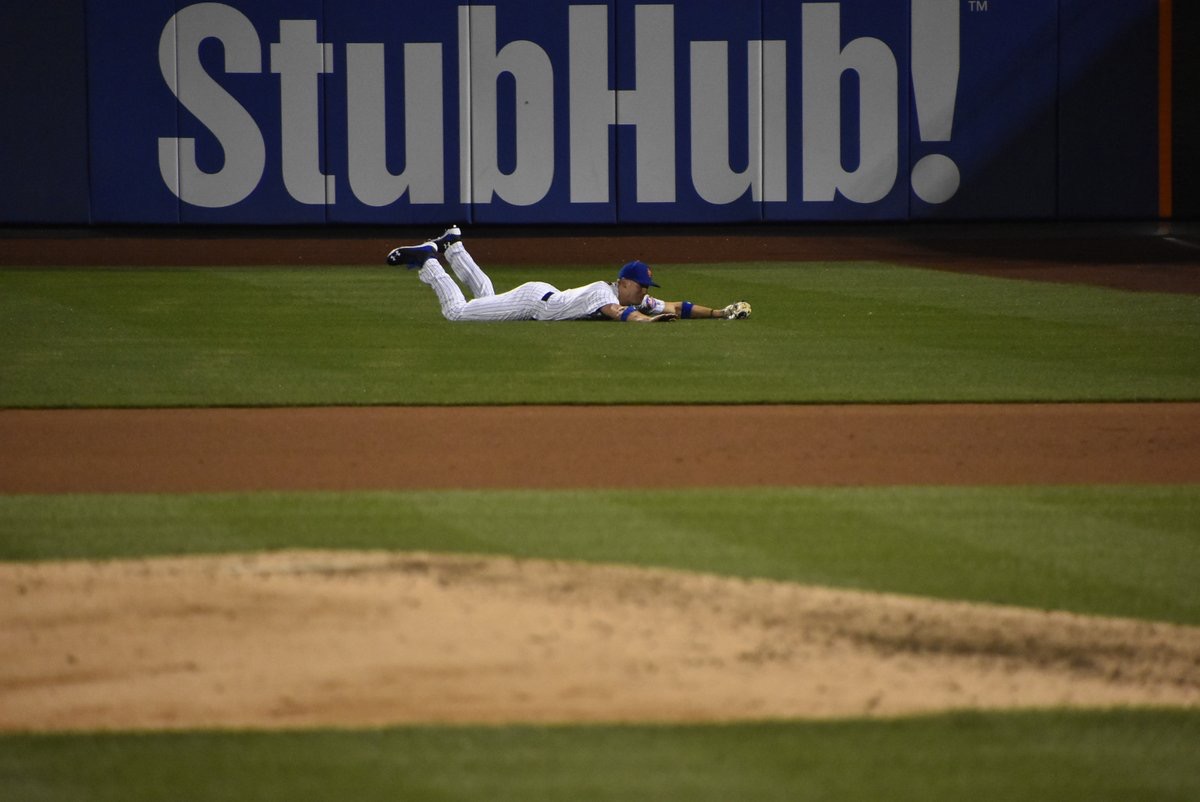
It was a terrific night for Nimmo and the Mets.
By the way, since I do point this out when it happens
Brandon Nimmo: 410th player in Mets history to hit a HR, has as many as Bartolo Colón
— Mark Simon (@MarkASimonSays) July 2, 2016
The beneficiary of all these runs was Jacob deGrom. It was about time the Mets scored some runs for him too. The Mets had not given him more than two runs of support since May 27th. He’s had the fourth worst run support in the majors this year with the Mets scoring 2.89 runs per game for him (Matt Harvey has the second least with 2.79).
deGrom would finally get his first win since April 30th. His ability to get this win was in doubt as there was a rain delay for over an hour before the third inning. Terry Collins sent him out there anyway, and deGrom lasted five innings allowing three hits, one earned, and one walk with seven strikeouts. The lone run he allowed was a solo home run off the bat of Kris Bryant. It’s possible deGrom could’ve gone more than five as he was only up to 85 pitches. However, once there was another rain delay in the sixth, the third one of the game, deGrom was done for the night.
Needless to say, deGrom pitched much better out of the delay than Hammel did. The Mets pummeled Hammel in this 10-2 win like they did in Game 4 of the NLCS.
Game Notes: Loney was 3-4 with two runs, three RBI, a double, and a homer. He was a triple short of a cycle. He actually hit one this year. It was a June 18th game against the Braves. Seth Lugo made his major league debut in the eighth inning wearing number 67. He became the first Met to ever wear that number. Lugo got it up to 97 MPH showing real promise out of the pen. He pitched two scoreless innings allowing two singles, a HBP, and striking out a batter. He also had his first balk falling off the mound before delivering a pitch.
David Wright attended his second straight game. For safety reasons, he watched the game from the bullpen.
As the 2015 season began, the Mets finally had reason to hope. The main reason for that hope was Jacob deGrom and Matt Harvey. At that time, there was the hope the Mets would eventually get contributions from Noah Syndergaard and Steven Matz, but no one knew what, if anything, either could contribute in 2015. No, the 2015 season was about deGrom and Harvey.
Seemingly out of nowhere, deGrom had a spectacular 2014 season that saw him win the Rookie of the Year Award. Due to his performance, Terry Collins slated him ahead of Harvey in the rotation. Throughout the 2015 season, deGrom justified that season going 14-8 with a 2.54 ERA and a 0.979 WHIP. He would be the lone Mets All Star, and he would be the story of the All Star Game striking out three batters on 10 total pitches. In the NLDS, he out-dueled both Clayton Kershaw and Zack Greinke to pitch the Mets into the NLCS. During that season, deGrom established that he is as good as any pitcher in baseball including his teammate Matt Harvey.
In his first start of the 2015 season, Harvey declared he was back by shutting down the Nationals over six innings allowing only four hits and walking one while striking out nine. Future MVP Bryce Harper would go hitless. He defeated former first overall pick Stephen Strasburg. That start set the tone for a season in which Harvey would go 13-8 with a 2.71 ERA and a 1.019 WHIP. Harvey carried this greatness forward in the postseason. In Game 5 of the World Series, Harvey showed the world why he’s a great pitcher. He shut down the Royals over eight innings while striking out nine. Once again, he gave Mets fans hope that the team could win the World Series.
The Mets need Harvey to give them hope again.
The Mets were absolutely bludgeoned last night with Noah Syndergaard on the mound. After the game, Syndergaard denied rumors that he is dealing with a bone spur issue in his pitching elbow. For his part, Steven Matz did not deny the issue. The question surrounding him was not only whether he could make his start tomorrow, but also whether he needed surgery. On a day like last nigh, you tend to focus on all the negativity surrounding the the Mets. The team is struggling offensively. They feel hour games back of the Nationals and back to third place in the National League East. There are questions abound about what is wrong with the Mets.
With a strong start tonight, Harvey can remind everyone what is right with the Mets. Harvey has a chance to turn around the Mets season like he has turned around his own season.
Harvey’s 2016 season got off to a nightmare of a start. In his first 11 starts, he was 3-7 with a gaudy 6.08 ERA and a 1.688 WHIP. Batters were teeing off on him to the tune of a .330/.376/.525 batting line. He was having difficulty striking anyone out. Finally, the mechanical flaw was found and fixed. In the five starts he made since fixing the mechanical flaw, Harvey has a 2.25 ERA and a 0.875 WHIP. Opposing batters have only hit .205/.237/.286 in that stretch. Simply put, Harvey is back. It’s a good thing too because the Mets desperately need him.
The Mets need Harvey to go out there tonight and shut down the Nationals like he’s done throughout his career. He needs to have a start like he did last April where he announces to the world that both Harvey and the Mets are back. He needs to combine with deGrom and carry the Mets rotation and team like everyone knows they can. As long as deGrom and Harvey pitch the way that they are capable, the Mets will have a legitimate shot at not only the postseason, but also another run to the World Series.
It’s time for Harvey to go out there tonight and remind everyone of that.
Editor’s Note: this was also published on metsmerizedonline.com