

On August 10th, with Michael Cuddyer coming off the DL, the Mets had to decide whether to send down Eric Campbell or Michael Conforto. It seemed both would have to be sent down anyway. Most believed that when David Wright came off the DL, the other player would have to be sent down to AAA.
I thought it should’ve been Conforto for many reasons. Principally, I thought if you’re going to have to send him down anyway, why not do it sooner to let him really work on some things in AAA where he can get more focused attention. In his infinite wisdom, Mark Simon basically said that we should worry about the second move when the time comes:
https://mobile.twitter.com/msimonespn/status/630832627109335040
It turns out he was right. No one should be surprised because he’s a smart guy and a fantastic follow. Anyway, he’s right because things are a little haywire with the Mets right now.
The bullpen is a mess right now. Logan Verrett was initially called up to take Bobby Parnell‘s spot in the bullpen. In reality, he was called up for one short relief appearance on his throw day and to make a spot start on Sunday so the team can skip Matt Harvey‘s Sunday start.
With the bullpen being short, the Mets decided they needed to call-up Dario Alvarez. I don’t know much about him. I’m not putting much stock in his performance last year. It was a small sample size. However, he was ranked as the Mets #22 ranked prospect. After a good start in Binghampton, he moved to Las Vegas where he’s been dominant with a 1.08 ERA, a 0.60 WHIP, and 16.20 K/9. This may turn out to be a great decision especially since Alvarez is a LHP.
Now, the Mets need to make a make room for Alvarez. Throughout the game on Friday, Gary Cohen suggested it would be Conforto. With him having to go down on Monday and the Rockies throwing a LHP on Saturday, meaning Conforto wouldn’t play, it seemed to be the right move. Then, as Mark Simon said, things began to work themselves out.”
First, Bartolo Colon was hit on the wrist and has a large bump there. It was severe enough that it merited getting an x-ray. Luckily, it’s not broken, but Colon said it did affect his pitching. He doesn’t want to have to skip a start, but I’m not ruling it out at this point. At some point, the Mets may need to consider putting him on the DL.
Speaking of the DL, Lucas Duda had to be pulled from the game with an aggravation of the same back injury. According to Adam Rubin, it may be Duda who winds up on the DL. It should be noted with the Mets not putting Duda on the DL when the problem first arose, they got a PH appearance, two games at DH, and six full innings at 1B. If he was initially placed on the DL, he would’ve been ready to come back on August 28th. Presumably, he would’ve been in better shape and not susceptible to a relapse. Instead, the Mets will get three games from Duda between August 13th and September 6th. Yet again, they’ve botched an injury situation.
With Duda presumably going to the DL, Conforto gets a reprieve. I wish the Mets would let him bat against lefties. It doesn’t make sense that they don’t, especially when they let Curtis Granderson do it. However, that’s another argument to re-hash at another time.
Let’s hope Colon and Duda get better. Let’s hope Conforto begins to produce better than his .224/.333/.448 triple slash line. Let’s hope Alvarez is effective. Mostly, let’s hope the Mets start reacting better to player injuries.
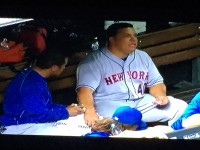
I’ve made it well known that I don’t think Bartolo Colon is a good pitcher anymore. Normally, I’d be apoplectic over his giving up seven earned in 3.2 innings.
Actually, you know what? I am apoplectic over it. Look at the photo. They had to ice and rub him just to get him out there. If you were watching it on TV, you saw that bump on his wrist get bigger and bigger. He should’ve been taken out when he was hit on the wrist in the second inning.
I don’t care if you’re one of the stud muffins or a bad 42 year old pitcher, the team does not have the right to put a player out there and risk significant injury. I’m even more incredulous because the Mets have a short bullpen and want to skip Matt Harvey‘s Sunday start. Also, if the Mets want a six man rotation, I’m certain that included Colon and not Logan Verrett.
Also troubling for the Mets, Lucas Duda left the game in the seventh with the game very much in doubt. Hopefully, it has nothing to do with his back.
Lucky for the Mets, Yoenis Cespedes unleashed his “Feats of Strength.” He went 5-6 with a stolen base, double, three homeruns (one grand slam) and seven RBIs. Two homers were to CF and the other went to RF. it would’ve been 6-6 if not for a terrific running catch by Carlos Gonzalez in the ninth. Going into the ninth, Cespedes had a chance for the HR Cycle (solo, two run, three run, grand slam). The Murphy SF took care of that. He was also a triple short of the cycle. Car-Go’s catch took care of that.
The rest you need to know? the six inning, Travis d’Arnaud and Michael Conforto hit solo homeruns off former Met Gonzalez German. Sean Gilmartin was marginally effective and got the win. Hansel Robles wasn’t good, but he only gave up one run. The Mets added an insurance run in the eighth with a Wilmer Flores [standing ovation] RBI double scoring Cespedes (who else?). Daniel Murphy would knock in the last run with a ninth inning sacrifice fly. Tyler Clippard and Jeurys Familia locked down the eighth and ninth to secure the 14-9 win.
It’s funny with everything going on tonight, the thing that threw me for a loop was seeing Jose Reyes bat second. The only other person not to put Reyes in the leading spot was Jerry Manuel. That’s not good company for Walt Weis.
Overall, my favorite part of the night was in the top of the sixth. Despite burning a challenge earlier in the game, Walt Weiss came out to challenge a safe call on a Curtis Granderson stolen base attempt. It was a little ironic because the early failed challenge involved Granderson throwing out Nick Hundley at the plate to end the fifth inning. I think the umpires got the call wrong even if it was upheld on replay.
Anyway, Walt Weiss has no challenges left. It doesn’t stop him. The umpires went forward with the replay, which did confirm the call. Gary Cohen and Keith Hernandez were livid and rightfully so. There were a few times I thought Keith was going to drop an expletive. In this mess of a game it gave me a chuckle.
The win gave me a smile. I have a huge grin due to the Nationals loss, and the Mets expanding their lead to five games.

For the first time since 2008, the Mets are in a pennant race. Fans have lost their minds and started magic number counts, debating playoff rosters, and setting playoff rotations. This is a good thing, and certainly I’m not immune to it myself.
Currently, the Mets are 64-56 with a four game lead in the division. In 2008, they had the same record through 120 games and were tied for first place with the Phillies. In 2007, the Mets were 67-53 with a three game lead in the division. Long story, short, there’s nothing to celebrate yet . . . especially when those earlier Mets teams were better. Thankfully, those Phillies teams were better also.
Using straight winning percentage, the Mets are on pace for an 86-76 season. For the Nationals to tie, they would have to go 26-16 (.619). I don’t care how bad they’ve been lately; they are certainly capable of that. As I like to do at times, let’s dig a little deeper.
The Mets have 18 home games left and 24 road games left. With a home winning percentage of 66.67%, they will go 12-6 at home the rest of the way. With a road winning percentage of 38.60%, they will go 9-15 on the road the rest of the way. Adding it all up, this equates to a final record of 85-75 (not that different). Again, the Mets aren’t running away with anything.
Since August 1st, Yoenis Cespedes‘ first game with the Mets, the team has gone 11-6 (SSS Alert!), which is a fairly unsustainable winning percentage of 64.71% (over 162 games that equates to a 105-57 record). Of course, if they kept that up, they would go 27-15 the rest of the way, and the Mets will run away with the division with a 91-71 record. I can’t imagine the Nationals, no matter how talented they are, running off a 31-11 clip.
Now, it’s not really unrealistic the Mets have a terrific run to end the year. The Mets have 33 games against teams with a sub .500 record. They have gone 41-22 (.651) against those teams. There are only nine games against teams with a .500 or better record left on the schedule. This includes six against the Nationals. The Mets are 23-34 (.404) against such teams. Working the math out, the Mets will go 25-17 the rest of the way. That means the Mets will finish 89-73. This forces the Nationals to go from a .500 team to a team playing .643 ball just to tie the division.
For what it’s worth, 89-73 is how the Mets finished in 2008. They were one game worse in 2007. You know what? Those aren’t harbingers. They’re the records for completely different teams. Those Mets teams were being chased by different teams. Those seasons are in the rear view mirror. Let’s leave them there.
If we’re going to be concerned, let’s be concerned with the bullpen. Let’s be concerned with the handling of the rotation. Let’s be concerned with Terry Collins. Let’s not get ourselves concerned with the Ghost of Baseball Past.
Let’s just have fun and enjoy the ride.

We all know the Mets are in bullpen trouble and they’re mismanaging the situation. You know the only way it could be worse? Putting Noah Syndergaard in the bullpen.
In 18 starts, he’s 7-6 with a 3.17 ERA. He’s got an ERA+ of 119, which loosely translated makes him 19% better than the league. He has a 9.5 K/9, which is better than Matt Harvey and Jacob deGrom. His FIP is 3.16, which equates to him being a great starting pitcher. On a team with a weak bullpen, he averages 6.1 innings per start. On top of all of this, he’s going to finish within his innings limits.
Now, please tell me why we should pull him from the rotation? Is it because we don’t want to be successful? Is it because we think Steven Matz MIGHT be better? Is it because we’d rather him make a few appearances pitching one inning a piece over six starts at six plus innings a piece? Fact is, there is no good reason.
We know the Mets have a weak bullpen. One way to mitigate that is to keep the weak arms in the bullpen. You do that with pitchers, like Syndergaard, who go deep into games. I like out-of-the-box thinking, but I also like ideas that make sense.
Syndergaard belongs in the starting rotation.

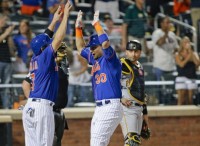
With David Wright set to come off the DL on Monday, it seems as if Michael Conforto‘s days are numbered. This series against the Rockies will be his last until September.
First things first, with Terry Collins’ inane handling of Conforto, it seems Conforto will only play two games. Since Eric Campbell was sent down on August 10th, Conforto will only have started in seven of eleven games. Regardless of his inactivity, Conforto has made contributions. There was the homerun against the Rays and the one against the Pirates.
He will be missed. I believe he was missed during his time on the team. Let’s enjoy this weekend because he’ll be gone for two weeks.
Considering the issues with the Mets bullpen, I thought today’s quiz should focus on the top Mets’ relievers by appearances. Good luck!

We may soon find out how bad the Yoenis Cespedes trade was. With an injury to Daniel Norris, the Tigers are pondering calling-up Michael Fulmer.
This is salt in the wound after watching Terry Collins throw away the last game in Baltimore. In part, that is because of the ineptitude of the Mets front office in handling the innings restrictions. If Fulmer is truly ready, he could have been used for a spot start over Logan Verrett. This way the Mets bullpen, in the middle of a pennant race, wouldn’t be understaffed for a full week.
There’s also the possibility if Fulmer stayed with the Mets organization, he wouldn’t be called up to make a spot start. Correction, there is no way they would call him up. Considering they won’t consider Steven Matz in the bullpen, they wouldn’t consider Fulmer there either; especially with the intriguing possibility of Vic Black.
Also, don’t misconstrue this as me saying I don’t want Cespedes. It was a sign to the Mets fans and players the team was all-in. The Mets took off since that time. However, this is a question of whether the Mets had to give up Fulmer. I still say they didn’t. Sandy Alderson balked and the departing GM didn’t. This trade could very well haunt them.
So in the history of John Smoltz and Jeff Bagwell, the Mets may get a glimpse of what could have been part of their future.

My favorite part of this year is seeing my son becoming a baseball fan. At night before bed, he asks to watch baseball. He says, “Go Mets!” He’s starting to understand what is happening.
Last night, right after his bath, he identified his second baseball player, Daniel Murphy. In the fifth inning, Murphy hit an RBI single briefly putting the Mets ahead. When it happened, my son said, “Murphy hit ball.” Later in the game, my son was again able to identify who Murphy was.
This is special to me because of how great Murphy was when I was lucky to meet him and what he personally had to deal with when his child was born. Upon meeting Murphy, I told him my wife was expecting. He signed an autograph for him and gave me a baseball that I could use to teach him how to play.
So no matter what happens, I’ll always root for Murphy. He was incredibly kind and generous to my and my then unborn son. I’m glad my son now recognizes him so he can root for him too.
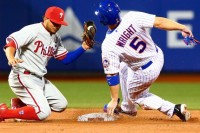
I’m not the first, and I’m not going to be the last to compare David Wright and Don Mattingly. My goal today is to hopefully be a little more nuanced than a side by side comparison. Rather, I want to see exactly how back problems deteriorated Mattingly’s abilities.
Normally, I would use Lenny Dykstra as a comparable because he also has spinal stenosis. However, I don’t know if I can trust any of his stats with his steroids usage. We do know like Wright, Mattingly suffered from a low back injury. The nature of the two injuries are different, but they are both chronic problems.
It appears the problems first surfaced in 1987. In that year, Mattingly went from a 7.2 WAR to a 5.1 WAR player. In essence, he went from a superstar to an All Star player. He would then quickly deteriorate into just a “good” player. Mattingly’s back worsened in 1990, and with that he became a -0.3 player, which translates to a bad player. For the rest of his career, Mattingly would be nothing more than a solid starter. He retired at the early age of 34.
Wright has had a terrific career, arguably better than Mattingly. In 2007 and 2008, Wright was a superstar player, as per WAR. In 2009, the Mets moved to Citi Field and Wright was nothing more than a solid starter. In 2010, Wright suffered a broken back. Unlike Mattingly, Wright would rebound from his back injury to put up superstar numbers again in 2012 and 2013.
Last year, Wright regressed again. However, last year it was a shoulder injury and not a back injury. This year it was discovered that Wright has spinal stenosis. We don’t know if it’s related to the 2010 injury.
What I do know is that Wright and Mattingly are two different players. We have seen that Wright once overcame a back injury, a different back injury, to return to superstar form. Mattingly never did. So yes, both are popular New York corner infielders. Both have back injuries.
However, they are two different players with two different back injuries. We shouldn’t be comparing them to determine how the rest of Wright’s career is going to proceed. Wright is a different player and person.
I’m nervous about Wright, but after 2012 and 2013, I won’t bet against him.