

There are two choices for 4. The first is Ron Swoboda, who was a key contributor to the 1969 Mets World Series victory:
However, my choice for Magic Man Number 4 will be Lenny Dykstra:
I chose Dykstra mostly because I got to see him play. I chose him because he was amazing in the 1986 postseason.
In the NLCS, he hit .304/.360/.565. He hit a walk off two run homerun in Game 3 of the NLCS to give the Mets a 6-5 win. He got the Game 6 ninth inning rally started with a leadoff triple. Everyone who watched this NLCS discuss the importance of winning in six with NLCS MVP Mike Scott scheduled to pitch Game 7.
In the World Series, Dykstra hit .296/.345/.519. Strangely enough, Dykstra was so big in big games that this was his worst ever postseason series. Dykstra lead off Game 3 in Boston with a homerun. This was important as the Mets came to Boston after losing the first two at Shea.
When Dykstra did all of this, he was only 23 years old. It shows that it’s not an issue of experience come October. Rather, it’s an issue of who has ice water running through their veins. This is important to keep in mind because the Mets run largely rests with their young pitching.
The young pitching has met every challenge thus far. As Dykstra shows us, they will meet the challenges they face en route to the World Series.

Sounds absurd doesn’t it? Michael Conforto has exceeded everyone’s expectations this year. He’s been a huge part of the team. However, he’s been used strictly as a platoon player. It’s probably because he’s hitting .167/.231/.167 against lefties this year, albeit in only 13 plate appearances.
Normally, this wouldn’t be an issue, but the Dodgers will be starting three lefties in the NLDS. If Clayton Kershaw starts Games 1 & 5, that means Conforto won’t start in four of the five NLDS games. I don’t think the Mets will prep Conforto for the lefties either. On clinch day, the Reds had a lefty on the mound, and Conforto was the only lefty who wasn’t in the lineup.
The question that arises is what use can Conforto be as a bench player? Even with his surprising defensive ability, he’s not a late inning defensive replacement; that’s Juan Lagares‘ job. That leaves him for pinch hitting and double switch and pinch hitting duties.
You could argue that role may be better left to Kirk Nieuwenhuis, who can play CF, or Eric Campbell, who’s right handed. Campbell is also versatile, which could be useful after the Juan Uribe injury. Both Nieuwenhuis and Campbell are also more accustomed to being bench players that sit for long stretches at a time.
However, this neglects Conforto’s limited work as a bench player. Conforto has hit .333/.429/.500 in seven plate appearances as a pinch hitter. Also, he’s just a better player than Nieuwenhuis and Campbell. When you’re selecting your playoff roster, you want your best players on the roster, even if they’re not going to play as much as they should.
However, if he’s left off the roster I’m not going to take issue. Anytime a player is potentially not going to play four out of five games, there should be a discussion whether there’s a player available who can better serve the team.
I just don’t think there is a better player than Michael Conforto.

I think it is helpful to use the Cy Young guidelines when selecting each leagues top relievers. There are some other things I will consider.
I will consider both set-up men and closers. However, I will give slightly more weight to closers. We have seen time and time again there are players that have been terrific set-up men become shaky closers. Additionally, there should be weight to innings pitched. The more innings you play, the more important you are to a team.
Overall, my hope is to choose the best overall relievers whether or not they are closers.
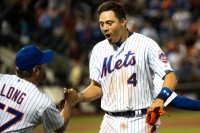
It’s an off-day, but that doesn’t mean you can’t work on your Wilmer Flores cheers. This one is useful because at a game you might have something in your hand at a game:

In 1969, the Mets had a platoon at third base with the rookie left handed batter Wayne Garrett and our Magic Man Number 5 Ed Charles:
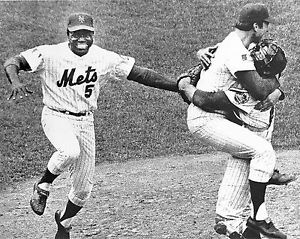
The Glider was a good major league player for the Kansas City Athletics and the New York Mets. His major league debut was the same year as the Mets first ever season. His last ever game was Game 5 of the 1969 World Series. He went out a winner.
His last year reminds me of the current Michael Conforto–Michael Cuddyer situation. The older player takes a step back to let the better, younger player shine. It helped lead the Mets to a World Series in 1969. Hopefully, the Mets will win it all again this year.
Lets Go Mets!

Now, I’m on the record as not thinking Homefield is an advantage to the Mets. Overall, I think the Mets may be better served by stating the NLDS in Los Angeles. However, I am excited to see the Mets go for it.
Also, I have to admit I am excited at the idea of seeing Citi Field rocking for its first playoff game. Also, I had a lot of fun doing the Magic Number countdown for the divisional title. Unlike the last time, I am not focusing on the bad players on bad years. Mets fans are celebrating.
Instead, I’m focusing on Mets who have won the World Series because that’s the goal. I can’t truly focus on players I’ve seen because I wasn’t born in 1969, and I was too young to completely remember 1986.
Normally, the magic number is calculated by determining the point in which a team obtains its goal outright. Because the Mets win the season series against the Dodgers, the Mets only need to have the same exact record as the Dodgers.
Homefield Magic Number: 5

I thought I knew Jon Niese. I thought he was the guy who was weak mentally and made excuses for his poor outings. After the Mets clinched, we found out he’s a guy that will do whatever he can to win:
Jon Niese approached Terry Collins about pitching out of the bullpen — not the other way around. He'll start doing so this week. #Mets
— Anthony DiComo (@AnthonyDiComo) September 27, 2015
Niese has been a starter for his entire career. He made his one and only relief appearance in 2011. This is no small gesture on his part even if he knows it’s his only chance to be on the playoff roster. If he does make the roster, what will his bullpen role be?
Well, for starters, we know, he won’t be a set up guy for Jeurys Familia. Those roles are firmly in the hands of Addison Reed and Tyler Clippard (back willing). If either of them faulter, the Mets could go with multiple inning appearances from Familia or go to Hansel Robles. That means the bullpen spots remaining are long man and LOOGY.
I’m not sure he qualifies as a LOOGY. For his career, lefties hit .262/.314/.397 off of him. This year lefties are hitting .285/.325/.431 off of him. By comparison, lefties are hitting .169/.217/.351 off of Robles. I’m not sure if Terry Collins would be willing to use Robles as a LOOGY in the playoffs.
He may feel inclined to use the only effective lefty reliever he has: Sean Gilmartin. He’s been better than Niese against lefties, but not by much. Lefties hit .264/.316/.341 off of him. It’s probably one of the reasons he became the long man. Gilmartin and Niese will face some competition for that role against Bartolo Colon.
Unlike Colon, Niese is moving to the bullpen now. It’s possible with him being able to max out for one inning, he will be much better against lefties. He may be better against righties for that matter. Niese has occasionally liked to drop his arm angle. If some effectively, he could be another Pedro Feliciano. If not, at least he tried.
Honestly, I hope he makes it. Of all the pitchers on the Mets staff, he’s been here the longest. I’m glad he’s getting his chance. I hope he makes the most of it.

Now that the Mets have clinched the NL East, the time is fast approaching to set the NLDS roster. Keep in mind, this is for the NLDS only. The Mets can the roster if they advance to the NLCS.
I’ve made some changes to my prior analysis. The reason is due to injuries to players like Juan Uribe. Another reason was the possibility that Jon Niese and Bartolo Colon may move to the bullpen.
Note, this is not what I would do, but rather, what I think the Mets will do. I am taking into consideration the Dodgers lefty heavy starting rotation and lineup. Without further ado, here’s my best guess:
Catchers
Infielders
3. Lucas Duda
6. David Wright
7. Ruben Tejada
Outfielders
10. Michael Cuddyer
11. Yoenis Cespedes
12. Juan Lagares
Pinch Runner
14. Eric Young, Jr.
Rotation
15. Matt Harvey
16. Jacob deGrom
17. Noah Syndergaard
18. Steven Matz
Bullpen
19. Jeurys Familia
20. Tyler Clippard
21. Addison Reed
22. Hansel Robles
23. Sean Gilmartin
24. Jon Niese
25. Bartolo Colon
I’m not 100% confident in this. I could see Uribe getting healthy enough to play knocking EY, Lagares, or Johnson out of the lineup. With all the lefties, I could see Eric Campbell or Dilson Herrera (3-4 with a walk, a homer, two runs, and a two RBIs on Sunday) making the team as well.
I also think there is real competition and consideration for the last three bullpen spots. Erik Goeddel has been great all year (when healthy). Carlos Torres is a Terry Collins’ favorite, who may make the team if healthy. Logan Verrett has made his car all year bouncing between starting and reliever. If Colon takes Matz’s spot in the rotation, there will be more bullpen spots because the Mets won’t put Matz in the bullpen.
No matter who is on the roster I’m excited for the playoffs again. Lets Go Mets!

Overall, I think the criteria I would look at in voting for a Rookie of the Year is similar to the criteria to the MVP Award. To sum up, I will be looking at the following:
- The total amount of games played;
- The total value of the player (offense, defense, character); and
- Pitchers may be considered for the award.
However, to me that’s not enough. I believe the Rookie of the Year is a delicate balance between who played the best and who’s the best player. How much weight do you place on games played and how effective a player plays in those games?
I think test is Bob Hamelin over Manny Ramirez and the 1994 Rookie of the Year Award. Sure, by some measures Hamelin had a better year, but even then, we knew Manny was the better player. It looks wrong, but the result might’ve been right. Personally, I probably would’ve voted for Hamelin, but I would’ve changed my mind several times right up to the deadline.
I can tell you the AL ROY race is the main reason I’m still holding onto my ballot right now. I just hope I make the right decision.

I’ve been one of the few who defended Matt Harvey. One of the reasons was because he was doing what he needed to do to pitch in the playoffs and not ruin his career.
The backlash was insane. People were calling for the Mets to cut him. Some wanted him traded for cents on the dollar. Most said they could never forgive him. There were discussions on what Harvey needed to do to gain back the fans trust. By the way, this just wasn’t fans, it was also the media. It seems it was also his teammates, which I just don’t understand.
Last Sunday against the Yankees he was dominant for five innings before getting lifted. When the bullpen blew it, the fans went after Harvey. These same people were awful quiet yesterday. They cheered and praised Harvey for pitching into the sixth.
I’m just happy he proved me right. Harvey considered the clincher to be an important game, and he went deep into the game. Terry Collins wanted to take him out after six, but Harvey said no. He needed the extra inning to get ready for the playoffs. Harvey showed he’s going to do what he needs to get ready for the playoffs.
Matt Harvey doesn’t owe us an apology. He did what he said he was going to do. If anything, he deserves the apology.