Musings

Excuse me for a moment. I’m going to rip a page right out of the script from A Time to Kill:
I want to tell you a story. I’m going to ask you all to close your eyes while I tell you the story. I want you to listen to me. I want you to listen to yourselves. Go ahead. Close your eyes, please. This is a story about a Mets pitcher. He comes to Spring Training after a big year, and he is upset with his contract. He wants to get paid what he thinks he deserves, but he is forced to accept what the Mets give him. In his first Spring start, his velocity is down. He’s unhappy with his contract, and he still has more work to do in Spring Training to get ready for the season. Can you see him. I want you to picture that Mets pitcher. Now, I want you to imagine he’s Jacob deGrom.
Look, everyone assumes it’s Matt Harvey who is going to be difficult to agree to a contract extension. It’s his off-the-field social life that gets highlighted, and for some, it creates the presumption that he does not do all he can do to be prepared for the 2016 season.
However, this Spring Training, it’s been deGrom who has complained about his salary, which is something Harvey didn’t do. He was the Mets pitcher that went out his first start and didn’t have people espousing that he’s in mid-season form.
Note, this is definitively not a criticism of deGrom. He has done nothing to deserve criticism. I take no umbrage with him wanting to get paid what he thinks he’s worth. I applaud him wanting to sign an extension to stay with the Mets. I will not read anything into one Spring Training start. So far in his young career, deGrom has been ready to pitch when called upon.
It should also be noted Harvey has also stated he would be open to signing an extension to stay with the Mets. Of course when Harvey says it, people are dismissive of the concept. The real difference between Harvey and deGrom is perception.
With the innings limit drama last year, deGrom is seen as a team first guy, and Harvey is seen as a me first guy. I’m not sure that characterization is entirely fair. Harvey pitched all postseason, and he never asked out of a game. Rather, he wanted the ball.
The Mets are blessed to have three aces. They all want to win, and they are doing what is necessary to win a World Series. Let’s just enjoy them instead of creating narratives that they don’t want to be here, or that they only care about themselves.
It’s not fair, and it’s not right. It’s time for Mets fans to press the reset button on their relationship with Harvey.

There are no dumb questions. In some respects, the question itself is more enlightening than the answer itself.
That is the case with Matt Harvey being asked if “he can finally just be a ‘regular guy’ again.” That’s a loaded question. Does this mean him being a regular guy like you or me (or you)? Does this mean him being just one of the guys in the clubhouse? Does this mean Harvey returning to his old self after his first complete year back from Tommy John? Seriously, it’s a loaded question.
The fact of the matter is Harvey will never be just a “regular guy.” He’s been a lightning rod. He was the first pitcher called-up. He gave Mets fans hope. He started an All Star Game, had an incredible 2013, and pitched that incredible World Series game. His innings and starts have been an issue. He’s got a boisterous agent and a high profile off the field. So no, Harvey never was and never will be a regular guy.
That’s a good thing.
At his core, Harvey is an ace. Aces are cut from a different material than the rest of us. They go to the mound with a certain swagger that some would call arrogance. His lone job is to get you out. It’s not a problem for him because he’s better than you are. He believes each pitch has a purpose. Each pitch is unhittable. His mindset is important. His stuff puts him on a different level than everyone else.
So no, Harvey is not a regular guy. I wouldn’t have it any other way.
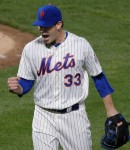
So far, the big Matt Harvey story of the preseason is the return of his vaunted slider. According to Harvey, he did not have it for most of last year.
For what it’s worth, Spring Training is always full of stories pumping up players. Every player appears to be in the best condition of their life. Players are healthier than they have ever been in their career. They’re either ready to build upon a strong season or put a tough season behind them. Does the supposed return of Harvey’s slider fit into that catergory?
In 2013, Harvey’s breakout season, he was 9-5 with a 2.27 ERA, 0.931 WHIP, 157 ERA+, 2.01 FIP, and a 9.6 K/9. He threw his slider 18.5% (504 total) of the time. Rather than try to explain how his slider moved, here’s a two graphs from Brooks Baseball showing the vertical and horizontal movement of Harvey’s 2013 slider:
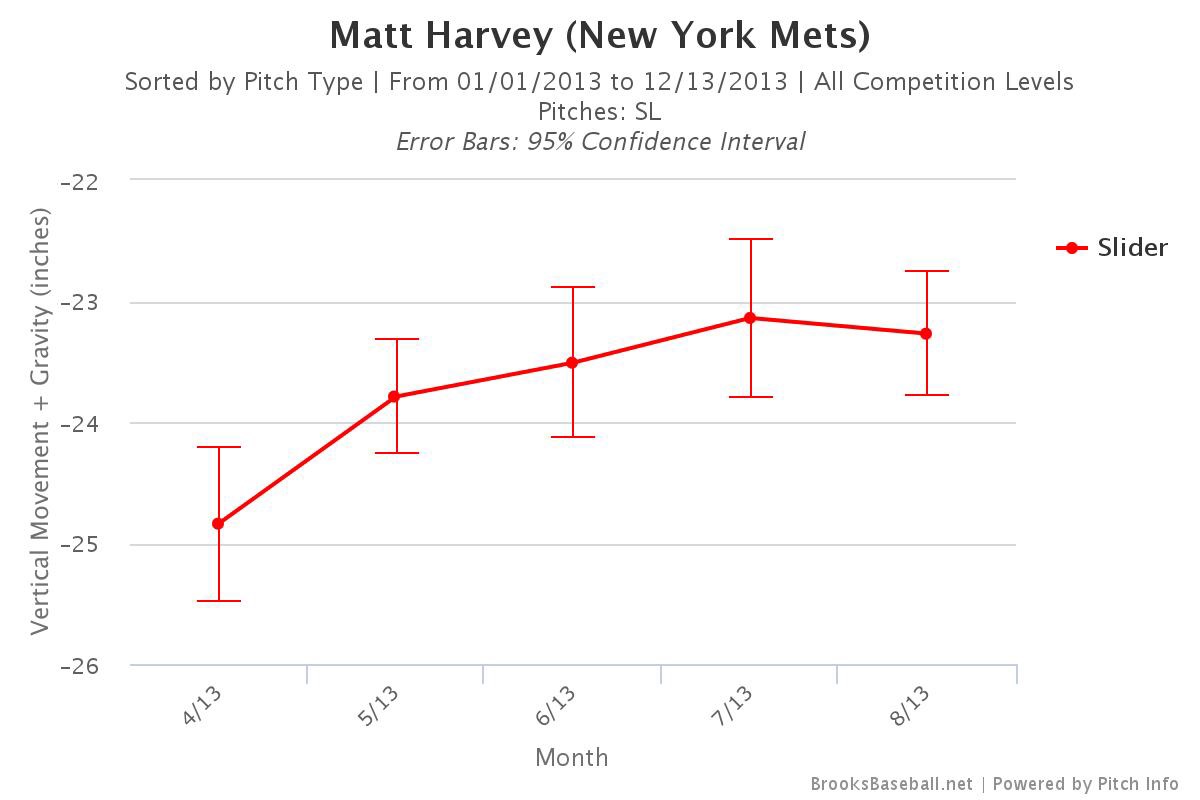
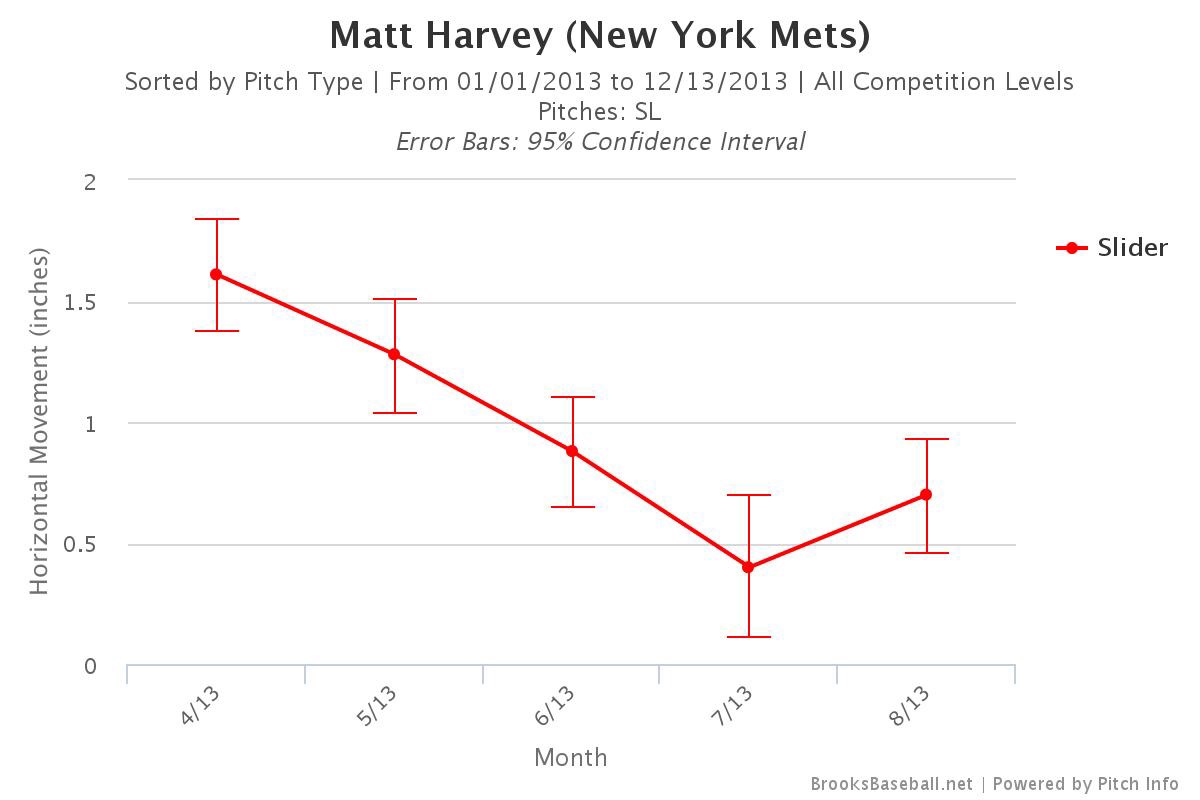 When Harvey threw his slider, it was swung at 49.01% of the time. When batters swung at the pitch, it was fouled off 15.8% of the time. It generated a swing and miss 17.66% of the time, and it was put into play 16.88% of the time. When contact was made, it typically generated a groundball. He only allowed two homeruns off of the pitch. In sum, it was a terrific pitch for him.
Now, if we use Harvey’s word that his slider didn’t return until the last quarter of the season, it means he didn’t have his slider until August. Again, using Brooks Baseball, here are graphs showing the vertical and horizontal movement of Harvey’s slider:
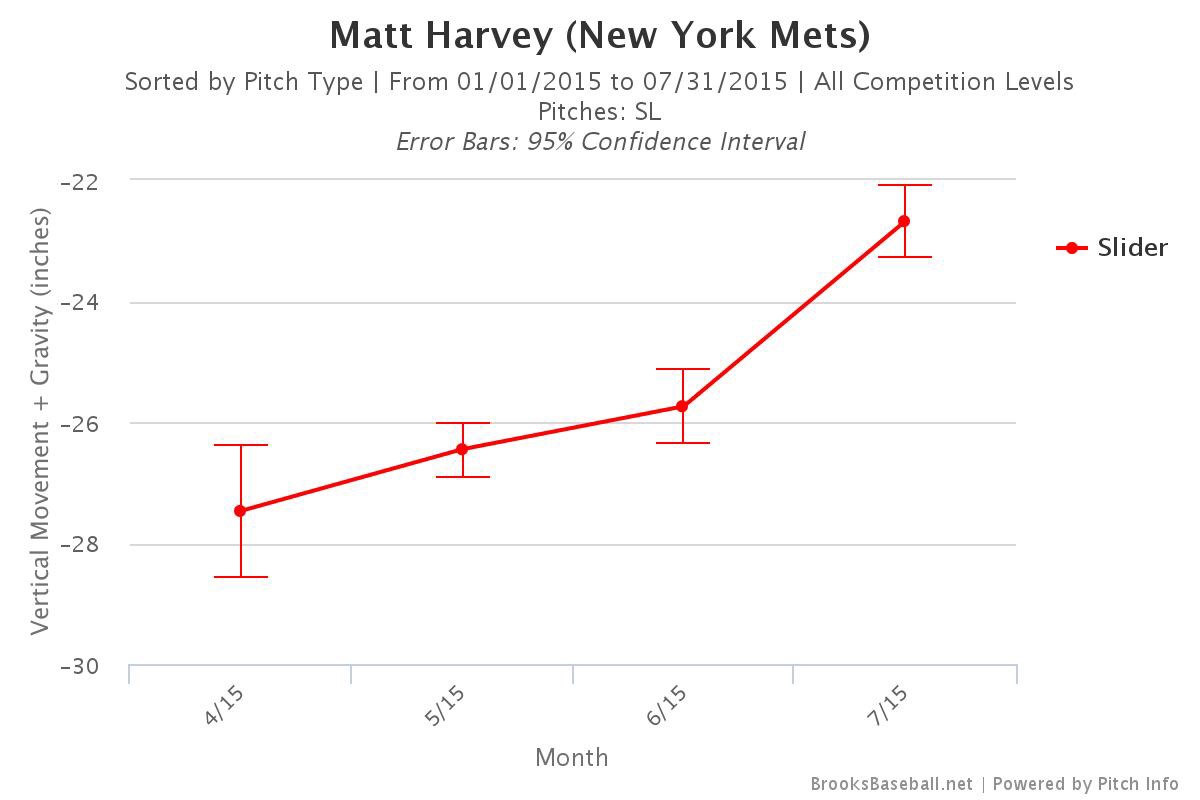
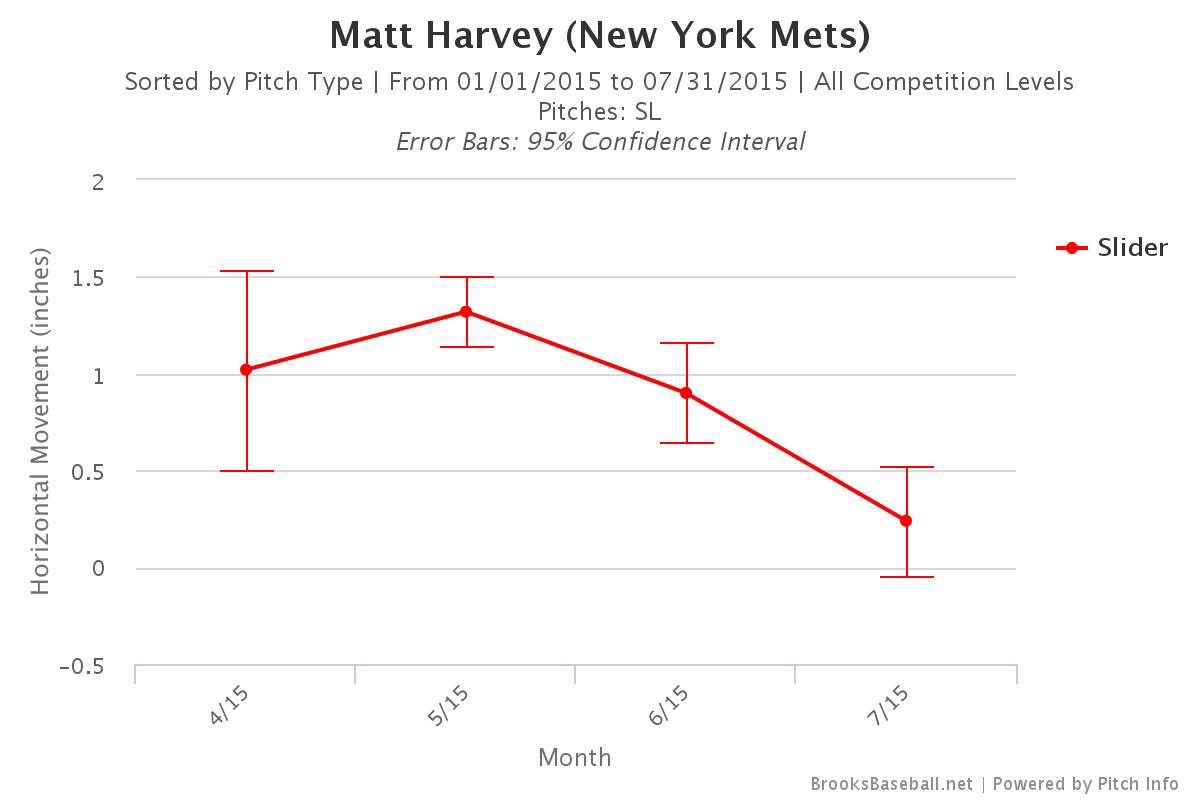
Taking a cursory look, Harvey’s slider had less horizontal and vertical movement. Unsurprisingly, the pitch was not as effective for Harvey.
From April to July, Harvey threw this slider less frequently than his old slider. His slider usage rate dropped from 18.5% to 15.12%. During these months, Harvey relied much more heavily on his fastball. Part of the reason for that might’ve been his lack of confidence with his slider.
When Harvey did throw his slider, it was swung at 43.92% of the time. When batters did swing at the pitch, they fouled it off 9.12% of the time, swung and missed 17.57% of the time, and put it in play 17.57% of the time. While the new slider did generate more groundballs, it did also generated less swings and misses.
More importantly, it needs to be reiterated that Harvey did not have the confidence in this pitch that he did in 2013. To an extent, it changed what he was as a pitcher, and the results showed. From April until July, Harvey went 9-7 with a 2.91 ERA, 1.06 WHIP, and an 8.5 K/9.
Harvey said he found his slider sometime in August. Here’s how his slider moved from August through the postseason:
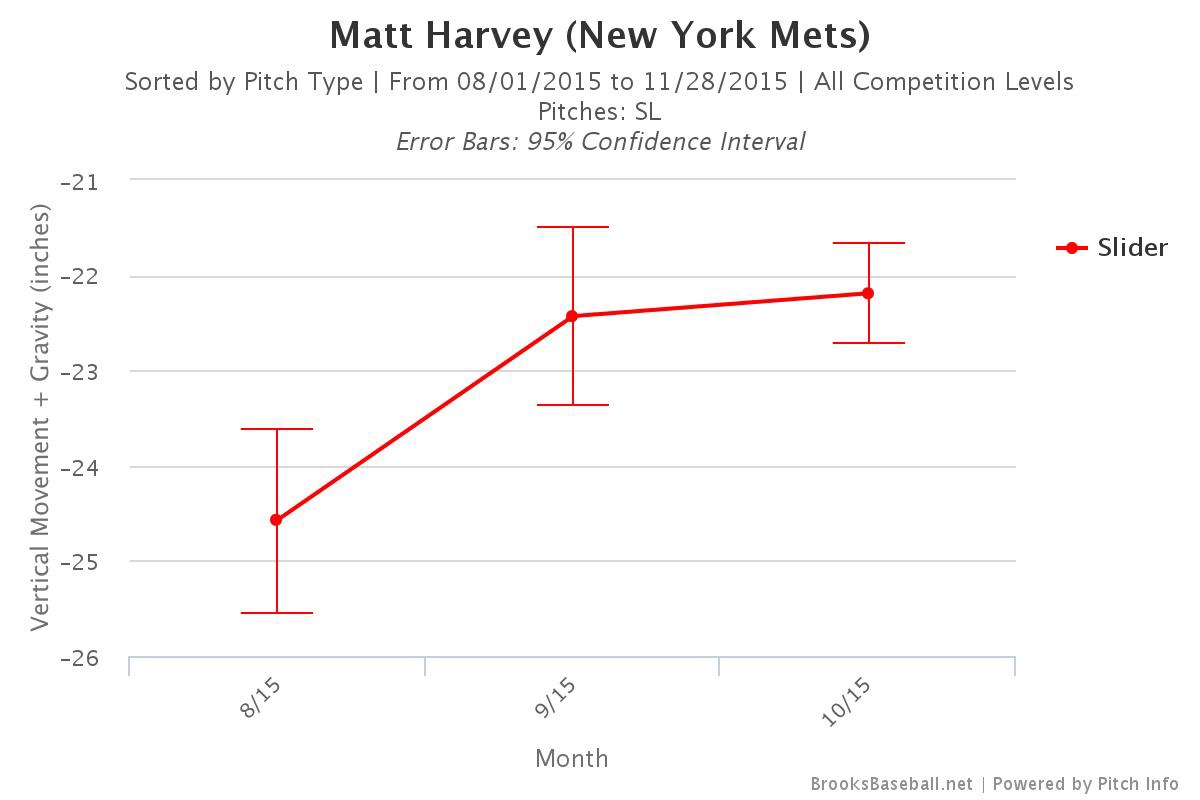
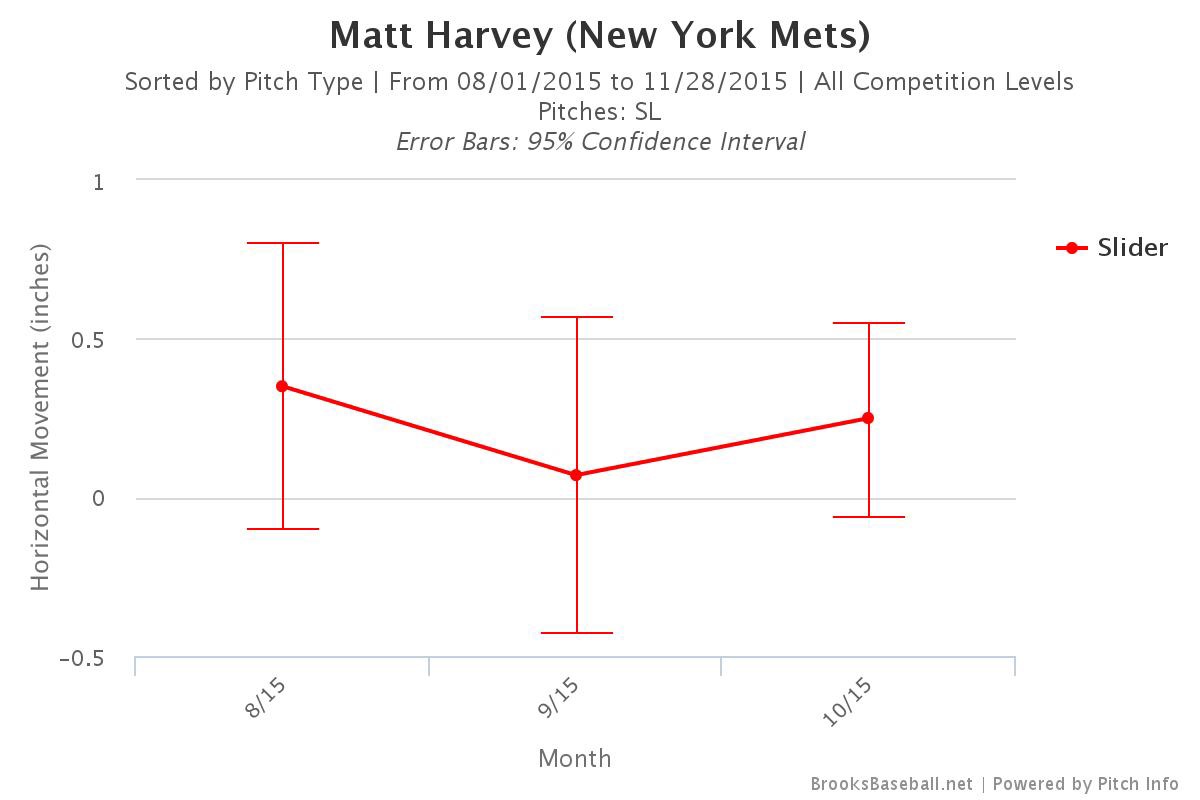 Looking at the charts, Harvey’s slider appeared to get its movement back, especially in August. What is surprising is that Harvey used his slider even less frequently than he had done in the first five months of the season. His slider usage rate dropped to 13.10%.
When he did throw it, it was more effective. Batters swung at the slider 53.03% of the time. When batters did swing at the pitch, it was fouled off 15.91% of the time, swung and missed 18.94% of the time, and put in play 18.94% of the time. Harvey’s rediscovered slider was able to generate a similar percentage of groundballs as he had between April – July.
To close out the regular season, Harvey was 4-1 with a 2.24 ERA, 0.927 WHIP, and a 10.1 K/9. While we should always be careful of drawing conclusions from short sample sizes, it appears that the 2013 Cy Young caliber version of Harvey is back.
Judging from Harvey’s first Spring Training start, he still has his slider. With that, Harvey should have increased confidence, and more importantly better stuff out there in the mound. Now that the slider will be back for a full season, Harvey is back in the Cy Young discussion (if he ever left), and he is primed to dominate the National League.
In 2015, Matt Harvey became the pitcher who has thrown more innings than any other pitcher post-Tommy John surgery. In fact, he became only the fifth pitcher to throw more than 200 innings in the first year post-Tommy John surgery. The other four are:
- Tommy John 207.0 IP
- Jake Westbrook 202.2 IP
- Adam Wainwright 213.2 IP
- John Lackey 215.1 IP
Last year, Harvey had a very good year in his first year back. In determining how next season will go, we should look to these other four pitchers as they are the only other pitchers who have thrown as many innings as Harvey has after Tommy John surgery.
Tommy John
As we all know, Tommy John was the first pitcher to return from Tommy John surgery. Obviously, he had a successful return as physicians have continued to perform the surgery to resuscitate pitchers’ careers.
In 1974, John’s last season before surgery, he went 13-3 with a 2.59 ERA and a 1.144 WHIP. He had a 2.74 FIP and a 132 ERA+. He only lasted 22 starts throwing 159.0 innings before shutting it down, having the sugery, and missing the 1975 season.
In 1976, John returned to the Dodgers. He went 10-10 with a 3.09 ERA and a 1.295 WHIP. He had a 3.08 FIP and a 109 ERA+. He made 31 starts and threw 207.0 innings. He returned, and he was able to pitch. However, he did not pitch nearly as well as he had prior to the surgery.
In 1977, John returned to form. He was 20-7 with a 1.248 WHIP. He had a 3.05 FIP and a 138 ERA+. He made 31 starts throwing 220.1 innings. He finished second in the Cy Young voting. He was better than he was pre-surgery.
With Tommy John, we saw a pitcher get better the second year after his surgery. Also, looking over the rest of his career, John was able to pitch until he was 46 years old. Accordingly, we can reasonably conclude that the 200 innings post-surgery did not negatively impact his career. We can also reasonably conclude that John was better and stronger than those 200+ innings.
Jake Westbrook
In 2008, Westbrook was only able to make five starts before needing Tommy John surgery. In 2007, his last presumably healthy season, he pitched 152.0 innings going 6-9 in 25 starts with a 3.12 ERA, 1.408 WHIP, 4.33 FIP, and a 105 ERA+.
From 2004-2006, Westbrook had pitched over 200 innings in each season with an ERA+ ranging from 93-127. In the 2004-2007 timeframe, Westbrook had a 91.69 MPH fastball, 81.69 MPH change, 80.55 MPH curve, and an 88.40 MPH cutter.
When Westbrook returned from surgery in 2010, he threw 202.2 innings over 33 starts between the Indians and the Cardinals. He had a 4.22 ERA, 1.337 WHIP, 4.22 WHIP, and a 93 ERA+. Upon his return, he threw a 91.07 MPH fastball, 79.63 MPH change, 83.56 MPH slider, 79.78 MPH curve, and an 86.07 MPH cutter.
The following season, Westbrook made 33 starts pitching 183.1 innings. He went 12-9 with a 4.66 ERA, 1.533 WHIP, 4.25 FIP, and an 80 ERA+. He had a 90.76 MPH fastball, 80.22 MPH change, 79.52 MPH curve, 86.44 MPH cutter.
Westbrook’s career would only last two more seasons. He never again reached 200 innings in a season. He didn’t have the rebound Tommy John seemed to have, but then again, Westbrook was never the pitcher John was.
Adam Wainwright
In 2010, Wainwright went 20-11 with a 2.42 ERA, and a 1.051 WHIP in 230.1 innings. He had an ERA+ of 160 and an FIP of 2.86. He was an All Star, finished second in the Cy Young voting, and was a top 20 MVP candidate. He would also need Tommy John surgery after this season.
Before the surgery, Wainwright’s repertoire included a 91.73 MPH sinker, 83.56 MPH change, 74.69 MPH curve, and a 86.44 MPH cutter. With this repertoire, he had consecutive seasons of 200+ innings pitched, 19+ wins, and a sub 2.65 ERA.
After rehabbing during the 2011 season, Wainwright returned to throw 213.2 innings between the regular season and playoffs. Wainwright would go 14-13 with a 3.94 ERA and a 1.248 WHIP in 198.2 innings in the regular season. He had a 96 ERA+ and a 3.10 FIP. He returned with a 90.70 MPH sinker, 84.25 MPH change, 74.50 MPH curve, and an 86.07 MPH cutter.
The following year, Wainwright seemed to return to his pre-Tommy John form. He was 19-9 with a 2.94 ERA and a 1.068 WHIP. He led the league with 241.2 innings pitched. His ERA+ was 127, and his FIP was 2.55. He threw a 92.08 MPH four seamer, a 91.06 MPH sinker, 84.56 MPH change, 76.12 MPH curve, and an 88.60 MPH cutter. He was an All Star, a Gold Glover, a top 20 MVP candidate, and he finished second in the Cy Young voting.
Wainwright followed this up with a strong 2014. He would miss most of 2015 with a torn Achillies. Like Tommy John, he was a much better pitcher the second year after Tommy John surgery.
John Lackey
There was a time it was thought that Lackey forgot how to pitch when he signed a contract with the Red Sox.
In 2009, Lackey’s last year with the Angels, he was 11-8 in 176.1 innings over 27 starts. He had a 3.83 ERA, 1.270 WHIP, 115 ERA+, and a 3.73 FIP. He threw a 92.11 MPH four seamer, 91.83 MPH sinker, 85.68 MPH change, 82.68 MPH slider, and a 79.37 MPH curve.
Interestingly in the two years prior to his surgery, Lackey threw a 92.06 MPH four seamer, 91.42 MPH sinker, 84.83 MPH change, 85.53 MPH slider, and an 80.02 MPH curve. He went 26-23 with a 5.26 ERA, 1.504 WHIP, 82 ERA+, and a 4.21 FIP. While he made 33 starts pitching 216.0 innings in 2010, he was only able to make 28 starts while pitching 160.0 innings in 2011.
In 2013, he returned to throw 215.1 innings between the regular season and postseason. In the regular season, he was 10-13 in 29 starts throwing 189.1 innings. He had a 3.52 ERA, 1.157 WHIP, 117 ERA+, and a 3.86 FIP. He threw a 92.64 MPH four seamer, 92.04 MPH sinker, 84.19 MPH change, 86.28 MPH slider, and an 80.33 MPH curve.
Lackey followed this up with a strong 2014. In 2014, he pitched 198.0 innings going 14-10 in 31 starts between the Red Sox and Cardinals. He had a 1.278 WHIP, 102 ERA+, and a 3.78 FIP. He pitched an additional 13.1 innings in the postseason giving him 213.1 innings total. He threw a 92.7 MPH four seamer, 92.24 MPH sinker, 84.43 MPH change, 84.49 MPH slider, and a 79.10 MPH curve.
Lackey had an even better 2015. Like John and Wainwright, Lackey got better the second year away from Tommy John. As such, in three of the four test cases, pitchers who threw 200 innings in the first year post Tommy John improved the second year after surgery.
Matt Harvey
Matt Harvey has thrown more innings than any other pitcher who has had Tommy John surgery. He’s also the youngest of the group, and he throws the hardest.
In 2013, Harvey was the All Star Game starter and an early Cy Young candidate. In the abbreviated season, he finished fourth in the Cy Young voting. Before he was shut down, he went 9-5 in 26 starts pitching 178.1 innings. He had a 2.27 ERA, 0.931 WHIP, 157 ERA+, and a 2.01 FIP. His FIP lead the league. Before he was shut down, he threw a 96.63 MPH four seamer, an 87.79 MPH change, a 90.50 MPH slider, and an 84.25 MPH curveball.
When Harvey returned, he threw a 96.46 MPH four seamer, 88.78 MPH change, 90.24 MPH slider, and an 84.35 MPH curveball. So, Harvey did return with similar velocity than he had before the surgery. That may be, in part, due to the fact that he had about 18 months of rehab as opposed to the year of rehab he predecessors had.
In the regular season, Harvey pitched 189.1 innings in 29 starts. He went 13-8 with a 2.71 ERA, 1.000 WHIP, 136 ERA+, and a 3.05 FIP. Looking over these numbers, Harvey’s stuff might’ve returned, but he still had a period of adjustment. While he had respectable numbers, he did not produce results similar to what he did in 2013. By judging by the previous pitchers, we can reasonably expect Harvey to return to his 2013 levels.
So overall, now that he has a year under his belt, and he has his full arsenal at his disposal, Matt Harvey is primed to have a Cy Young caliber 2016.
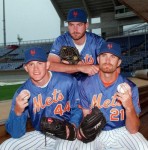
The year was 1996. The Mets were supposed to open the season with a trio of pitchers dubbed Generation K. Jason Isringhausen, Paul Wilson, and Bill Pulsipher were all supposed to usher in the next era of great Mets pitching. They were supposed to win multiple Cy Youngs and World Series titles.
It never happened.
Bill Pulsipher
Pulsipher was the first to arrive on the scene. In his first year in AA, a 20 year old Pulsipher pitched 201.0 innings. The prior year he only pitched 139.2 innings. The following year, 1995, Pulsipher would pitch in AAA and get called up to the majors. He threw 218.1 innings. Pulsipher wouldn’t pitch in 1996 as he had a torn ligament in his pitching elbow.
In Pulsipher’s rookie year, he made 17 starts. He never reached that plateau again. His last major league appearance came in 2005 when he was 31 years old. When Pulsipher made those five appearances, it was the first time he pitched in the big leagues since 2001. Pulsipher finished his career going 13-19 with a 5.15 ERA in 46 starts and 60 relief appearances.
Paul Wilson
Unlike Pulsipher, Wilson burst on the scene in 1996. He was the first overall pick in the 1994 draft after dominating at Florida State. In 1995, Wilson pitched his first season of professional ball, and he pitched well in his 186.2 innings. So well in fact, that the Mets called him up to the majors. He went 5-12 with a 5.38 ERA in 26 starts. His season would end as he needed arthroscopic surgery to repair a torn labrum in his pitching shoulder.
Wilson would never pitch for the Mets again. He would be part of a trade on 2000 for a fourth outfielder in Bubba Trammel and a bullpen arm in Rick White. He finished his career going 40-58 with a 4.86 ERA in 153 starts and 17 relief appearances.
Jason Isringhausen
Without a doubt, Isringhausen had the best career of the Generation K pitchers, and he had to go to the bullpen to do it.
Isringhausen burst on the scene in 1995. In 14 starts with the Mets, he went 9-2 with a 2.81 ERA. Even though he only pitched in half a season, he was so impressive that he finished fourth in the Rookie of the Year voting. While he may not have been the most heralded pitcher of Generation K, he had the most success out of all of them when he was first called up. However, that success would not last as like the other two pitchers, Isringhausen’s arm was a ticking timebomb.
In 1994, the year before Isringhausen pitched in the majors, he threw 193.1 innings. The year before? He threw only 90.1 innings. In his career, Isringhausen would need shoulder surgery and three Tommy John surgeries. This doesn’t even include surgery for a broken wrist because he lost a fight with a water cooler.
Isringhausen would eventually make two All Star teams due to his work as a closer. He would record 300 saves. The last seven were with the Mets in 2011 when he came back on a minor league deal. At that point, he served as a mentor to a young bullpen. It was a nice bookend towards the end of his career. The former young hothead with arm troubles became a veteran leader.
Generation K
These three heralded young pitchers were ruined by the Mets organization. They were needlessly pushed beyond their limits in the minors and majors. As a result, they had a series of shoulder and elbow injuries. The heralded trio would never appear in the same rotation.
Epilogue
It’s been four years since Isringhausen has retired, and now people want to interview him when we talk about how prospects should be handled. Here’s what he revealed about how those Mets handled prospects:
Jason Isringhausen: In the minors if we didn't pitch 9 innings, we got a talking to. We didn't watch pitch counts as much as we do today
— MLB Network Radio on SiriusXM (@MLBNetworkRadio) March 3, 2016
Twenty years later, the Mets have a new trio, who for some reason don’t have a great nickname like Generation K. While Jacob deGrom and Matt Harvey have had Tommy John surgery, the Mets handle their young aces much better now. They took better care of their pitchers during the rehabilitation process. Last year, we saw deGrom and Harvey team up with Noah Syndergaard to pitch the Mets into the World Series.
This was supposed to happen 20 years ago. It’s happening now. So next time, the Mets are too patient with a player, or a player or his agent voice concerns over a pitcher’s workload, remember Mets fans were robbed of seeing three aces in one staff due to over usage of the young pitchers.
I’m sure innings limits, six man rotations, and skipped starts will be a story line at some point in 2016. When it does, embrace it because the Mets not using that forward thinking might’ve cost at least one World Series title. Young pitchers are fragile, and they need to he handled as such. If you don’t, the workload could lead to injuries and/or ruined careers. Next thing you know, the window to win a World Series is slammed shut.
I’m not willing to see another chance go by the wayside due to some meaningless starts again.

Considering how the Mets have structured their roster, there is only one positional battle happening in Spring Training. That battle is over the last two spots in the bullpen.
With the Mets having no spots open on the 40 man roster, the players they select may very well have to come from the roster. If they don’t, they will be forced to expose some of their young talented pitching to waivers. One such candidate would be Jeff Walters.
Walters is a very interesting case. He’s 28 years old. In each and every level of the minors he has pitched, he has been old for that level. In 2014, he made a brief appearance in AAA, and he was terrible. Most likely, that was because he was injured. In June 2014, he had Tommy John surgery. He returned a year later, and he was dominant in AA going 2-0 with a 1.96 ERA and a 1.091 WHIP in 17 appearances. He impressed the Mets enough that they added him to the 40 man roster.
The main reason is he has talent. His fastball, although straight, can top 95 MPH. He couples that with a power slider. If nothing else, Walters seems to fit with the Mets organizational philosophy.
At some point, you have to question if Walters is worthy of a spot on the 40 man roster. This season may be that point. It’s early in Spring Training, but there’s something to be said for the fact that he’s made more appearances this Spring than anyone else. Long story, short, he’s going to get a good hard look this Spring. With his stuff, the Mets should give him a good look.
Most likely, he begins the year in AAA. He will get a chance there to impress the Mets to get called up in case anyone is injured or falters in the bullpen. It happens every year, which means if Walters pitches to his ability, he will get a shot this year. When he does get that shot, he has to make the most of it because right now, he’s too old to be a prospect, and the Mets are desperate for 40 man space.
Walters still has time to leave an impact on the Mets coaching staff before they go north. He needs to make the most of it.
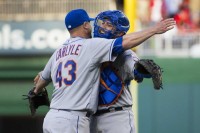
It was Opening Day last season. Jenrry Mejia was injured and could not pitch. Terry Collins had to turn to someone to close out the Mets 3-1 win over Washington. He turned to the 37 year old Buddy Carlyle, who earned his first career save.
In some small measure, Collins pick was to reward Carlyle for an absolutely terrific 2014 season.
Carlyle really came from nowhere. He had been 11-12 with a 5.58 ERA in his seven year major league seasons. He played one year in Korea, one year in Japan, and one year in the Dominican Winter Leagues. In the two years prior to joining the Mets, Carlyle pitched in AAA. There was no reason to believe that Carlyle could help the Mets in 2014. Then again, there was no reason to believe the bullpen that was constructed would need Buddy Carlyle.
Carlyle got called up at the end of May. He would go on and pitch 31.0 innings in 27 appearances. Carlyle would finish the year with a sparkling 1.45 ERA. He was supposed to be a part of the 2015 bullpen and build upon his success. Instead, Carlyle recorded the one save and had season ending hip surgery.
Well Carlyle is back with the Mets on another minor league deal. There’s two open bullpen spots, and at least in theory, Carlyle is a candidate for the job. He has a history of pitching well for the Mets, and they thought enough about him that they invited him to come back on a minor league deal with an invitation to Spring Training.
Carlyle is 38 years old. As of right now, it appears he’s ticketed for AAA to start the season. I always have an immense amount of respect for players like this. Guys who could easily quit and go home. He’s had a tough career, had some success, and have suffered injuries. It’s never easy for the Carlyle’s of the world, yet he is going to force baeeball to tear the uniform off his back. At that point, he’ll look to play elsewhere. He will play until someone says he can play no more.
That’s admirable. Baseball is better with the Buddy Carlyles of the world. People who scratch and claw just to be average, just to be a part of something. When he finally retires, it’ll be a blurb in the newspaper instead of him having an elaborate press conference.
Before that point, I hope Carlyle gets one last chance to pitch for the Mets. I hope he can walk off the field, under his own terms, with his head held high. With all he’s done to be here, he deserves that chance. I’m rooting for Buddy Carlyle.
I’m sure Jedd Gyorko could be the answer to many questions. However, I’m fairly positive he’s not the answer to the question, “Who should be your starting shortstop?”
With the injury to Jhonny Peralta, Gyorko is the Cardinals starting shortstop. Unless the Cardinals make a move, Gyorko will be the shortstop for the next two to three months. Now, Gyorko was never anything more than an average second baseman which a career -1.5 UZR over his three year career. That doesn’t bode well for his chances to be a good to adequate shortstop. Like most, I’m assuming if any team can make it work, it’s the Cardinals.
With that said, it’s a good time for the Mets to call the Cardinals. From all the reports this Spring, it appears that the Mets might be looking to move on from Ruben Tejada. It’s probably the right move too.
Last year, Tejada had an impressive finish to the season. Although never mentioned as such, he was part of the reason why the Mets rallied to win the NL East. His gruesome injury in the NLDS was a rallying cry for the Mets and Mets fans throughout the postseason. However, he’s on the last year of his deal, and he’s an expensive backup eating up a spot on the 40 man roster.
The Mets right now have absurd depth at the shortstop position. Asdrubal Cabrera is penciled in as the starter the next two years. Wilmer Flores grew into the role and handled the position very well when pressed into shortstop duty again in the postseason. Former second round pick Matt Reynolds is competing for a utility role in the majors. On top of that, the Mets have two big shortstop prospects in Gavin Cecchini and Amed Rosario. Long story short, the Mets don’t need shortstop depth.
What they do need is 40 man roster space. So far, Jim Henderson is having a nice Spring and may be on the inside track to locking down a spot on the Opening Day bullpen. The Mets are talking about letting Kevin Plawecki start the year in AAA. This means, as of right now, Johnny Monell would open the year as the backup catcher. There’s a problem with Henderson and Monell making the Opening Day roster.
Neither player is on the 40 man roster, and the Mets have no spots open. Even if the Mets placed Zack Wheeler on the 60 day DL, the Mets would still need to drop someone else from the 40 man roster to add both Henderson and Monell. This could be accomplished by trading Tejada.
It seemed like Tejada turned a corner last year. Unfortunately, with one dirty play he is back on the bench, and frankly, occupying a roster spot the Mets need. It may not seem fair. It may seem cruel, but it’s time for the Mets too move on from Tejada. They should do it now with the Cardinals having a need, and the Mets wanting to maximize the return they would receive for Tejada.
Editor’s Note: this article also appeared on metsmerizedonline.com
After his first game against the Mets, Daniel Murphy acknowledged the reason he’s a former Met is the presence of Dilson Herrera as the second baseman of the future. The real question is why did the Nationals want Murphy?
They were losing their shortstop Ian Desmond to free agency. They were set at second with Danny Espinosa. They had other second base options with Anthony Rendon and Yunel Escobar in the event the team wanted to shift Espinosa to shortstop this year to allow Trea Turner additional time to develop into the role. Looking over their roster and organization, Murphy didn’t specifically address what they needed. Dusty Baker disagrees with that assertion:
As long as [the Mets] don’t change too much of their personnel, he could be a tremendous asset to us. I mean, we took one of their spiritual leaders, one of their team leaders. And we didn’t take him; they gave him to us.
The Nationals see Murphy as a big part of the reason why they can beat the Mets. The Nationals organization had to face Murphy 19 times a year for a little more than six years. Even without an obvious fit, the Nationals signed Murphy.
With Murphy in the fold, the Nationals like their chances. As Nationals GM Mike Rizzo stated:
We’re trying to knock them off. They knocked us off the mountain. We were the champs two of the last four years, they’re the champs right now. We feel we match up with them very well. Since 2012, I think we are [49-26] against them, so we know we’ve done well against them. I like where we are at. When healthy we can compete against anybody. We feel good about ourselves.
The Mets are still the prohibitive favorites to win the NL East. They have perhaps the best pitching staff the Mets have ever had . . . and that’s saying something. They look to have a better offensive team. They now have the experience after last year’s pennant.
However, the division is far from a lock. The Nationals still have the reigning NL MVP and a very good rotation. They also have Murphy, and we have all seen what he can do in big games. There’s going to be 19 of them during the regular season.
The Nationals got him for not only these games but all the others in between to help them win the NL East.

The Mets just completed their first week of Spring Training games, and David Wright never stepped foot on the field. He might not for another two weeks. This is the beginning of what is the new normal for Wright.
This is going to be Wright’s first full season with spinal stenosis. He has to learn how to manage the condition over the course of a full 162 game season. Last season, Wright had difficulty playing three games in a row. He needed several hours just to get ready for one game. All of this is mentally and physically draining. However, there was a benefit to him having to go through it last year. He now knows what to expect and how to manage the spinal stenosis better.
That process began this offseason with more physical therapy for Wright. It meant he started training for the season later than he normally does. It also means he will wait a while before playing in any games. He’s feeling things out.
Wright needs to shorten his pregame routine. He needs to find a way to keep up his stamina so he can handle playing three games or more in a row. He needs to learn when he should sit and when he can go out there and play. He’s learning what his body will permit him to do. In many ways, this is like Wright’s rookie season all over again. He is once again looking to discover if he can play in the major leagues.
The hope is that Wright is healthy and productive when he is able to play. The hope is Wilmer Flores can play well enough to permit Wright to take days off when needed without the Mets worrying how they’ll replace his production. Most of all, the hope is that the Captain will be there ready and physically able to lead the Mets in the postseason to a World Series title.
So if he needs two more weeks, that’s fine. If he can’t play until May, that’s fine too. It’s better to take the time now than rush it and lose him for almost a full season again. The goal here is to have a healthy David Wright in the postseason.
Wright should take all the time he needs.
Editor’s Note: this was first published on metsmerizedonline.com