
Today is Star Wars Day (May the Fourth – get it?). In celebration of the day, here are the Mets alter egos from Episode VII: The Force Awakens:
Yoenis Cespedes – Poe Dameron
- Both Poe and Cespedes were renown for their incredible air power (Cespedes- HR, Poe – pilot). Both were thought to be gone only to return to the joy of everyone. We now know victory is certain.
Matt Harvey – Kylo Ren
- Both were once the most powerful apprentices only to have a younger one with long hair and more powers usurp them. Despite their most recent losses, they will be heard from again.
Noah Syndergaard – Rey
- Both were lost in the desert (Thor – Vegas, Rey – Jakku). Neither knew when they were going to be able to find their next lunch. Both are extremely powerful and are only now starting to realize it.
Michael Conforto – Finn
- Neither were supposed to be here. Neither were supposed to show any signs of greatness. Instead, they broke the mold and carved out a new path for themselves.
Curtis Granderson – Han Solo
- They’ve been around a long time, but they are still as cool as ever. It may be surprising, but they are in the thick of things like they always were. The only problem is there are some young upstarts (Granderson – Conforto, Han – Kylo Ren), who may push them aside. However, before that time comes, they will be heard from again.
Bartolo Colon – Chewbacca
- All these years later, they may be a step slow, but they still are large and in charge. One moment you’re questioning what something so old can do to you. The next, you’re getting your arm or bat taken from you.
Captain David Wright – General Leia Organa
- Years ago, they thought they had accomplished it all as the young, brash good looking people they were. Unfortunately, they didn’t. There’s still more work to be done. The difference is now they have to be the leaders and show a new generation how it’s done.
Logan Verrett – BB8
- Both are taking over for someone else’s role (Verrett – Sean Gilmartin, BB8 – R2D2), and they are performing admirably.
Zack Wheeler – R2D2
- Both are sitting around, shut down, but both still have a very important role to play.
Jacob deGrom – C3PO
- Both have problems with their arms (deGrom – decreased velocity, C3PO – it’s red) and no one knows how it happened. No worries. They’re back and better than ever.
Dan Warthen – Maz Kanata
- Both seem to have the secrets needed to unlock people’s secret powers and lead them on the path to greatness. Plus they kinda look alike.

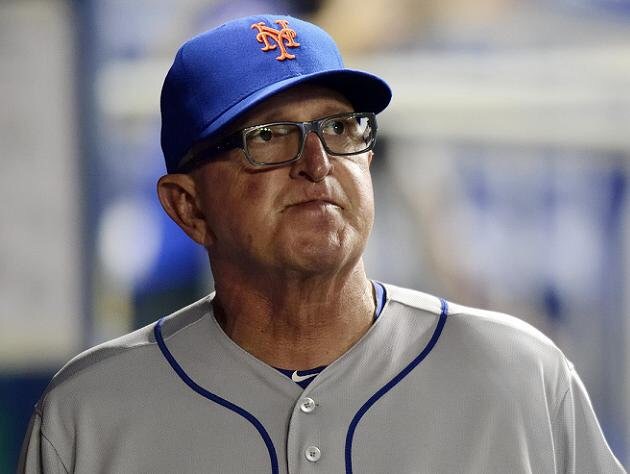
Terry Collins – Admiral Ackbar
- Both seem like this has all passed them by, but they have returned. They came back and led their people to great victories (Collins – NL, Ackbar – blowing up the Starkiller Base). Now if only Collins had screamed, “It’s a trap!” in Game 5 of the World Series . . . .
Lucas Duda – Captain Phasma
- Their roles are relatively overlooked. Both are large and intimidating presences that can destroy you in the blink of an eye.
Juan Lagares – Snap Wexley
- Both have been here since the new generation’s fight began, but they’ve been pushed aside by Poe/Cespedes who gets all the focus and glory.
Mike Piazza – Luke Skywalker
- The time has come where their greatness has now become the stuff of legends. They are now at the shrines where it all began (Piazza – Cooperstown, Luke – first Jedi temple)
Note, there are no Mets compared to Supreme Leader Snoke or General Hux as they just seem pure evil with no chance for hope. With that said, I think there’s enough room here for one more:
Chase Utley – General Hux
- Their sole intent is to destroy everything for their victory regardless of the consequences. Actually, that’s not true. The more amoral pain and violence inflicted the better. The good news is that no matter what they do, they will ultimately fail.

So who broke Matt Harvey, and what in the world is Dan Warthen doing to fix it? Seriously, Harvey has talked about struggling with his mechanics since the beginning of the year. Nothing has been fixed.
Tonight, Harvey had diminished velocity. His location was off. The immoral Braves offense was making solid contact against him. The Braves came into tonight’s game averaging 3.2 runs per game, and they’ve only hit five homeruns all season. Sure enough, Harvey allowed eight hits, three earned, and two walks with four strikeouts over 5.2 innings. He allowed the immortal Mallex Smith to hit a homerun.
Before the night started, Terry Collins did point out that Harvey was sick. Side note, if he was sick and clearly didn’t have it, why did he go out for the sixth? Anyway, if Harvey’s sick, he does deserve some benefit of the doubt. However, two things should be noted before giving him the benefit of the doubt: (1) the Harvey of old would’ve toyed with no-hitting this team; and (2) this start was not unlike most of Harvey’s other starts. Harvey came into the game with a 4.76 ERA, and he left the game with a 4.76 ERA. Once again, Harvey had a rough sixth.
https://twitter.com/bbtn/status/727670040573706241
As bad a night as Harvey had, Kevin Plawecki had just as bad, if not an even worse night, than Harvey. The third run of the game scored on a Harvey wild pitch. In reality, Plawecki didn’t get down on a pitch in the dirt and let the ball go through the wickets. While stolen bases are also a function of the pitcher’s ability to hold on runners, Plawecki did allow three stolen bases. To be fair, two of them were on a double steal he can no chance.
If that wasn’t bad, Plawecki was terrible at the plate as well. He was 0-2 at the plate. In the fifth, when Asdrubal Cabrera got the Mets first hit off of Matt Wisler, he hit into an inning ending double play. Overall, when the highlight of your day is getting hit by a pitch, you know you had a terrible day.
Speaking of the Mets offense, there were a lot of hard hit balls. Unfortunately, most of them were hit right at someone. Still, the Mets were one-hit, and they struck out four times. Not a good night.
Not a good night for Collins either. He left Harvey in too long. He also failed to make an important challenge. In the fateful sixth, A.J, Pierzynski challenged Yoenis Cespedes‘ arm. Pierzynski was ruled safe on a bang-bang play. There was no challenge.
He was out. pic.twitter.com/8CqQyj1KdA
— metsfan, fully vaxxed and masked (@metsfan) May 4, 2016
Pierzynski would then score on the aforementioned Harvey wild pitch.
Overall, tonight reminded me of that scene in Pleasantville when the basketball team finally lost a game. Everyone stood around saying, “Can’t win them all,” when someone noted that they really had won them all. I really thought the Mets could realistically go 19-0 against this Braves team. They won’t.
Hopefully, the Mets put this ugly game behind them as they march to 18-1 starting tomorrow.
Game Notes: Harvey may or may not have been using chewing tobacco. This would be a good test of the NYC smokeless tobacco ban.
So far this year, MLB has suspended two likeable players for PEDs.
The first was Chris Colabello. He tested positive for Turinabol (clinically referred to as dehydrochlormethyltestosterone). He claimed he didn’t know how it happened:
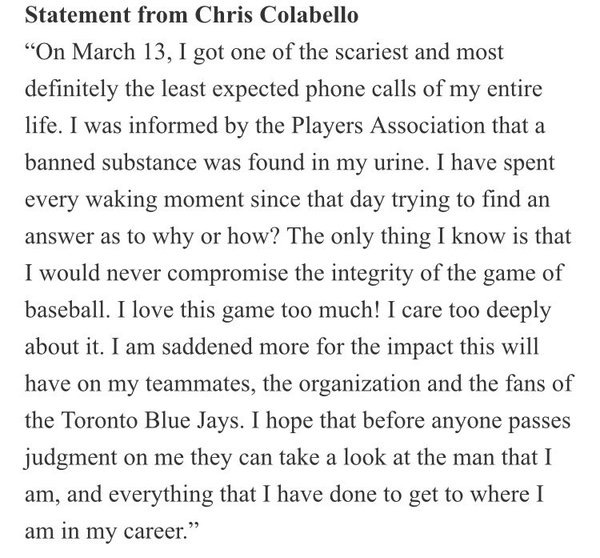
Colabello said he only took supplements given to him and approved by the Blue Jays strength and conditioning staff. Reading this, you have to feel bad for the guy. He did the right thing, and yet, he still was suspended.
However, as reported by Arden Zwelling of SportsNet, it’s not realistic to believe Colabello didn’t know what he was taking. Turinabol was taken off the market in 1990 and is only available on the black market.
This past week it was announced Dee Gordon was suspended for using two anabolic steroids, testosterone and clostebol. Like Colabello, he tested positive despite being careful:
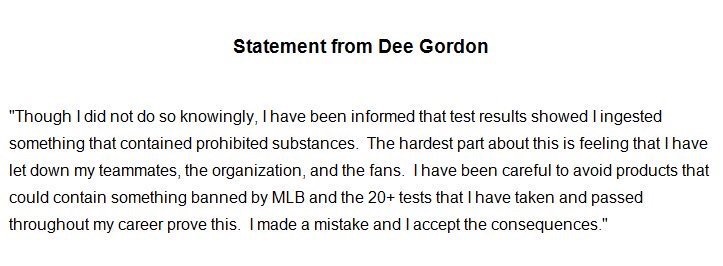
Unlike Colabello, Gordon dropped his appeal. Apparently, he felt there was no point pursuing it considering the suspensions are upheld the vast majority of the times. Like Colabello and many before him, Gordon is making the claim that he was taking the tainted supplement.
According to Will Carroll of Fan Duel, Gordon’s claims are false. The drugs Gordon tested positive for are typically used in combination with other steroids like HGH. Now, we don’t know if he was using HGH or something else, but we do know he tested positive for something used with other steroids. As such, it’s hard to believe he only took these two steroids accidentally and wasn’t using anything else.
Colabello and Gordon seemed to be victims at the outset, but in reality, they’re not. They’re doing the same thing each and every player has done since the inception of PED testing and penalties. They are doing the game a disservice. They are doing a disservice to the fans. They are doing a disservice to their teammates and their fellow players as a whole.
Sooner or later, there will truly be a false positive, if it hasn’t already happened. The aggrieved player will preach his innocence. No one will believe him due to the Colabellos and Gordons of the world.
On April 26th, Amed Rosario gave everyone a glimpse as to why he’s a great player who will play and thrive in the majors one day.
Rosario was the driving force in the St. Louis Mets’ 10-5 win over the Charlotte Stone Crabs. In the game, he went 3-5 with a run, triple, homer, and four RBI. He was just a singe short of the cycle. It was a big games in what has been a terrific season this has been for Rosario. He’s hitting .322/.351/.563. In just 21 games, he’s tied his career high in homers. He’s one triple short of tying his career high in that catergory.
So far this year, Rosario is the Florida State League’s leader in triples, hits, and total bases. He’s second in the league in RBI and slugging. These numbers are impressive for any prospect. They’re more impressive when you consider he’s 20 years old, which makes him about three years younger than the average age of the players in the league. It’s even more impressive when you consider there were questions about his bat when Rosario signed as a 17 year old out of the Dominican Republic.
When Rosario was signed, his defense was seen as a given, if not elite. However, teams were splits as to whether Rosario would ever hit. So far in his minor league career, he has quieted these concerns. This year he’s starting to show he could be a good hitter in the big leagues.
Despite how far he’s come offensively, and his terrific day at the plate, Rosario wasn’t patting himself on the back:
We won but im having a hard time letting go of my E6. It didnt cost us the game but I've made errors this year that I would make in my sleep
— Amed Rosario (@Amed_Rosario) April 27, 2016
No, Rosario is focusing on how he can improve his game. He’s thinking about what he needs to do to become a better player. It’s not only an example of why he’s become a much better hitter, it’s also an example why he will continue to become a much better player. It’s part of his #DontBeSurprisedBeReady mantra.
Rosario expects a lot out of himself. He’s his own biggest critic. This is why he’s going to be a terrific major league player one day.
Editor’s Note: this was first published on metsminors.net
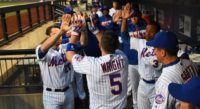
After an Opening Night loss, most people were writing the epilogue to David Wright‘s career. Since that point, Wright has played well. He’s getting on base, hitting homeruns, and playing good baseball. He constantly reminds us, his career isn’t over:
Twenty year old me never would’ve thought I’d say, “Thank God the Mets get to play the Braves 19 times a year,” but here we are. The Mets get to beat up on an awful Braves team 19 times a year. The Mets starting beating up on the Braves immediately:
Yoenis Cespedes‘ and David Wright‘s homers were tattooed.
Back to back! Cespedes saw Wright hit a 106mph homer, so he decided to hit a 106mph homer of his own. pic.twitter.com/bfKert3HWS
— CitiFieldHR (@CitiFieldHR) May 2, 2016
As for Cespedes, his homer was a new Mets record:
Yoenis Cespedes: fastest player to 25 HR with Mets (77 G). Previous fastest? Carlos Delgado: 88 G. via @EliasSports pic.twitter.com/njYSdGDvzg
— ESPN Stats & Info (@ESPNStatsInfo) May 2, 2016
Speaking of Carlos Delgado, this was the first time the Mets hit three homers in the first inning of a game since 2006. How you take that is up to you, but I choose to think of that as a good omen.
Speaking of slugging Mets first basemen wearing the number 21, this was the fourth time this season Lucas Duda was involved in back-to-back homeruns. The Mets have gone back-to-back five times this year.
After the first inning, the Mets bats quieted down a bit. Nothing of note really happened unless you want to count Wright singling off the face of Reid Brignac in the
As for Bartolo Colon, he did what he does best. He beat a really bad team handily. Colon pitched eight shutout innings allowing seven hits, no walks, and seven strikeouts. Colon had only thrown 99 pitches, but Terry Collins pulled him out. Jeurys Familia would pitch the ninth. He allowed a run to spoil the shutout, but would hold on to preserve the 4-1 victory.
Colon put on a show on the mound and at the plate:
BARTOLO EXIT VELOCITY!!!!!!!!!!!!!!!!! pic.twitter.com/tBtpW1Otr4
— Cut4 (@Cut4) May 3, 2016
Yes, this happened again:
#BigSexy, pure concentration. pic.twitter.com/xM2tq4tg6t
— MLB GIFS (@MLBGIFs) May 3, 2016
Congratulations are in order to Colon for his 220th career win. He broke the tie with Pedro Martinez for the second most wins by a Dominican pitcher. Juan Marichal is in first place with 243 wins. For the Mets, it was their 16th of the year and are 4-0 against the Braves.
Game Notes: Eric O’Flaherty is officially a Brave again as he pitched a scoreless seventh. Both he and Kelly Johnson received their NL Championship rings before the game. Neil Walker stole his first base as a Met in the eighth.
Yesterday, the Mets faced a left-handed starter for just the third time this year. They have faced Adam Conley, Brandon Finnegan, and Madison Bumgarner. In addition, the Mets have faced lefty relievers here and there. Seemingly, the Mets have struggled against lefties.
On April 13th, Conley limited the Mets to four hits while allowing no earned runs and striking out nine over six innings. It should be noted that last year, Conley had similar success against a somewhat different Mets lineup. Last year, Conley pitched seven innings against the Mets allowing three hits, no runs, and six strikeouts.
On April 26th, Finnegan dominated the Mets over the first six innings. In those six innings, he allowed three hits, no runs, and three strikeouts. The outing was very impressive until he was over extended in the seventh inning. In the seventh, he allowed a walk, a single, and a laser of homerun off the first pitch he threw to pinch hitter Yoenis Cespedes. Finnegan is a former first round pick and a well regarded prospect.
On May 1st, Bumgarner got the better of Noah Syndergaard and the Mets. Bumgarner allowed six hits, two earned, two walks, and nine strikeouts in 6.2 innings. This should surprise no one. Bumgarner is one of the absolute best pitchers in the game. It can be argued he almost single-handedly won the 2014 World Series. You’re going to have bad days against Madison Bumgarner.
That’s the point. The Mets have faced some tough lefties. You know what’s interesting? The Mets have hit still hit lefties in general pretty well.
According to Baseball Reference, the Mets have hit .266/.339/.442 with a 118 OPS+ against lefties. Against righties, the Mets are hitting .254/.329/.448 with a 114 OPS+. Looking over these numbers, the Mets are just as likely to hit righties as they are lefties. It’s easy to lose sight of that after Madison Bumgarner, a lefty, pitches well against the Mets.
So yes, the Mets have had some struggles against three pretty good lefties. No one should read too much into those games. You can point to three different games this season the Mets struggled against three pretty good righties. Mets fans know better than anyone right now that good pitching is going to beat good hitting.
Overall, the Mets have a good offense. There’s no reason to believe based upon these three starts the Mets can’t hit lefties. In fact, the stats show they can.
Editor’s Note: this article was also published on mesmerizedonline.com
The Mets are in the midst of a stretch of 17 straight games without a day off. On Thursday, they’re flying out to the west coast for an eleven game road trip. Madison Bumgarner was on the mound. With all these factors present, it’s difficult to take umbridge with Terry Collins’s lineup on Sunday. There were many factors to consider.
With that said, his outfield alignment was inexcusable.
The Mets had Michael Conforto in left, Yoenis Cespedes in center, and Juan Lagares in right. Collins put the 2015 American League Gold Glove leftfielder in centerfield and the 2014 National League Gold Glove centerfielder in rightfield. With the exception of maybe Conforto, everyone was out of place.
First off, it should be acknowledged Cespedes isn’t a good centerfielder. By his own admission, he prefers to play left. He averages a – 3.2 UZR in and a -4 DRS in center. Coincidentally, those were his numbers playing center for the Mets last year. Long story short, Cespedes is a below average centerfielder. He’s only out there because the Mets value his bat over Lagares’ glove.
Lagares’ glove? It’s transcendent. When he won the Gold Glove in 2014, he had an 18.6 UZR and a 26 DRS. Those numbers are all the more incredible when you consider this was his second best defensive season. However, Cespedes’ problem is his bat. He’s a career .262/.298/.365 hitter. Against righties, he’s even worse hitting .253/.285/.339. It’s hard to justify keeping that bat in the lineup everyday. It’s why the Mets not only traded for Cespedes, but it’s also a factor why the Mets re-signed him.
When Cespedes and Lagares have played in the outfield with Curtis Granderson, Cespedes has been in left while Lagares has been in center. That’s perfect. Each player is playing their best defensive position. Even better, you have three plus defenders in the outfield. This only works because Granderson is a rightfielder. Conforto is not.
Neither Conforto or Cespedes have played rightfield in a major league game. In fact, despite his appearance in the 2015 Future’s Game, Conforto has only played in left. Therefore, Lagares was left as the only outfielder with any experience in right. Coming into Sunday’s game, he has exactly 16 games and 89 innings of experience in right. Fourteen of those games were in 2013 when Collins actually believed Matt den Dekker was a better defensive centerfielder than Lagares.
It doesn’t make sense for Lagares to play anywhere other than centerfield. It makes less sense that Collins considered the idea in Spring Training and is following through on it. When Collins put Cespedes in center last year and put Lagares in right, he explained Lagares was the only one who played there previously. While that excuse might’ve worked in 2015, it should not work this year.
The Mets had an entire offseason andSpring Training to prepare for this situation. Either Conforto or Cespedes could’ve received some rightfield reps to permit Collins to have some level of comfort in placing them in rightfield. It’s what the Mets did with Wilmer Flores in teaching him first base. Now, Flores has shown the Mets they can feel comfortable putting him at firstbase. It’s what the Mets needed to do with Comforto.
No, instead the Mets decided to ignore the issue despite them being very aware that moments like this would arrive. The Mets actually believed that Lagares in right was a better idea than teaching the position to Conforto. Why the Mets foresaw this issue and decided it was in the team’s best interests to play their Gold Glovers out of position is beyond logic.
Fortunately, this decision didn’t affect outcome of the game on Sunday. Hopefully, this will be the last time we see that happen. The Mets shouldn’t weaken their team defense due to a 14 game sample size.
That didn’t take long, did it?
Michael Conforto is the best position player on the Mets.
Conforto was drafted tenth overall in the 2014 draft. He was in Double-A last year. He played in the Future’s Game. The Mets organization swore up and down that he was not ready to make the jump from Double-A to the majors despite trotting the likes of Darrell Ceciliani in the outfield. Finally, the Mets reached a breaking point, and they were forced to call him up.
As a rookie, Conforto hit .270/.335/.506 with 14 doubles, nine homeruns, and 26 RBI. That was good for a 132 OPS+ and a 135 wRC+. He was better than advertised defensively with a 7.5 UZR and a 9 DRS. He had a 2.1 WAR in a little over one-third of a season. He showed off a strong and accurate arm in the outfield. He went on and had a terrific World Series including hitting two homeruns in Game Four.
So far this year, he’s even better. Overall, he’s hitting .343/.427/.614 with 10 doubles, three homeruns, and 15 RBI. His OPS+ is 178 and his wRC+ is 175. He’s already at a 1.1 WAR. He’s hitting the ball harder than anyone in the big leagues. Everyone expected him to improve this year, but he’s improving at a much faster rate than anyone realistically could’ve hoped or expected. In fact, he’s playing like a seasoned veteran.
As Neil Walker told Kevin Kernan of the New York Post:
His mental preparation is that of a seasoned veteran. That is something you rarely see. Days like today, he’s hitting balls off the left-field wall and then catching a changeup out front and hitting it out to right. That is just devastating to pitchers. It’s fun to watch because he’s doing this at 23. The sky is the limit for a guy like that. He’s as humble as they come.
Very quickly, Conforto has gone from the guy the Mets were too afraid to call up to the gut they’re too afraid to have out of the lineup. He has already arguably become the best position player on the Mets.