Musings
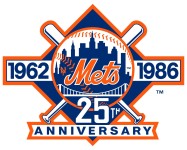
Yesterday, the Mets announced that the Mets will wear the iconic 1986 racing stripe jerseys every Sunday home game this season. I love these jerseys, but it does seem odd that the team is wearing these jerseys each and every Sunday.
The Mets everyday left fielder, Michael Conforto, was born on March 1, 1993. At that time, the only members of the 86 Mets still around were Dwight Gooden and Howard Johnson. Gooden’s Mets career was effectively over at that point. He was a shell of his former self due to drug abuse and injuries. HoJo was only a utility player on the 86 team. The main contribution he made that year was being the on deck batter when Ray Knight scored off of Mookie Wilson‘s little dribbled up the first base line.
It seems odd to me to see Conforto wearing a 25th anniversary patch that was created for a team seven years before he was born.
Again, if the Mets want to do this, they should do it right. Update the patch to commemorate the 30th anniversary of the 1986 World Series championship. This way it truly becomes an homage to the 1986 team that it was intended to be. Furthermore, the jerseys will look more appropriate when you purchase them.
Speaking of purchasing one, which I intend to do, there are two problems with the jerseys. The first is the diaper effect of the jerseys:
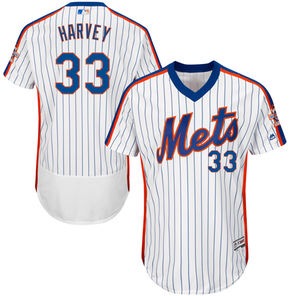
The next is if you don’t want the diaper, you don’t get the patch, nor do you get the option to personalize it:
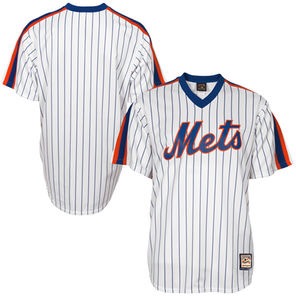
One last note, am I the only one that thinks it’s going to look absurd to see Tim Teufel effectively wearing Darryl Strawberry‘s jersey?
Overall, I love that these jerseys are back. I think the Mets were smart making them the Sunday jerseys. I hope they return in 2017. I just wish they were updated to be the tribute the Mets wanted them to be.

No matter how you slice or dice it, the Mets have gone from an under .500 team to taking over New York in one year. How did they do it?
For starters, the Mets went to the World Series. They went on a magical run and came up just short. Additionally, they have assembled a roster that is more than capable of returning to the World Series this year, but also in years to come. Just as important as all of this, the Mets have a team that is good to the fans. Even after a loss in the World Series, they came out to share the moment with the fans. The fans love this team, and the feelings seem mutual.
One major reason why the fans love the team is the larger than life personalities on the team.
Matt Harvey travels across the talk show circuit like he’s got a movie about to be released even though “The Dark Knight Rises” was released in 2012. No, it’s not a coincidence that the movie was released the year he was first called up to the majors.
After the World Series, Noah Syndergaard took his own victory tour going to each New York stadium letting them know he owned the city. He actively accepts and plays off the Thor superhero moniker bestowed upon him. He knows what everyone thinks about when they think if him, and then he goes about playing along on Twitter:
Spring Training packing checklist:
-glove✔️
-spikes✔️
-mjolnir?✔️
-lunch box ?— Noah Syndergaard (@Noahsyndergaard) February 4, 2016
RT @statcast Your eyes did not deceive you. @Mets starters just throw harder than the rest.https://t.co/tqILsn0vDg pic.twitter.com/cjnAm0Dl6e
— Noah Syndergaard (@Noahsyndergaard) February 4, 2016
By the way, before he came to the majors, he was thought of as the quiet one.
Overall though, no one moves the needle more than Yoenis Cespedes. He’s got swagger. Say what you will about him, but he is just cool. There are people and players that have that aura. Whatever you want to call it, Cespedes had it. Speaking of which, did you see that car?!?!?
This is Yoenis Cespedes's vehicle today. Unreal. pic.twitter.com/oUMz9HNEP5
— Robert Brender (@robertbrender) February 23, 2016
More shots of Cespedes's new three-wheel ride. Mets teammates even came out to see it. pic.twitter.com/29CkA5Srqf
— Andrew Beaton (@andrewlbeaton) February 23, 2016
Harvey has a Maserati, and people don’t even notice it. For what it’s worth, Harvey could’ve driven a Honda Civic today. No one noticed. Do you realize how big of a person or personality you need to be to make people not notice Matt Harvey?
That’s why the Mets own New York. They get it. They accept and return the fans’ love. They have a certain cool about them. They’re confident. They’re fun. They’re awesome on and off the field.
That’s why the Mets own New York.
(Photo from Mets Twitter account)

Today finally felt like baseball is not that far away. Pitchers and Catchers have already reported. The temperature was in the 50’s. And the Mets were playing pepper:
A perfect morning in PSL. ⚾️ #Mets #SpringTraining pic.twitter.com/fcVu9f7a6Z
— New York Mets (@Mets) February 22, 2016
Pepper games bring me back to when I was a kid. Back then, before teams realized they could use the area behind homeplate for advertising, there was a simple notice to everyone at Shea Stadium:
NO PEPPER GAMES
Go back and watch a classic Mets game from the 80’s. The sign is there clear as day. Remember, this was back in a day and age where you could smoke in the stands and grab a beer on the way out of the ballpark. That’s fine as long as you don’t play pepper.
I’m sure there was avoid reason like fan safety, but it doesn’t seem like baseball without pepper games. Whenever you watch a baseball documentary like “When It Was a Game” or Ken Burns’ “Baseball” there was the old black and white footage of players playing pepper.
I still remember playing pepper with my Dad and brother down at the park. I remember doing it at baseball practice. I’m such a baseball nut that when the weather got nice, some friends and I would have a catch and play some pepper. When my son gets older, I plan on doing it with him.
These are the things I look forward to with my son. When the weather gets nice, I want to have a catch with him outside. I want to pitch to him and see that lefty bat in action hitting line drives all over the place. I want to play pepper.
Most of all right now, I’m ready for baseball. The cool Spring days to the warm Summer nights. The cold endless October evenings. Baseball season is upon us. Time to break out the mitts. Time to break out the bats. Time to get that arm warmed up to toss the call around.
I’m ready. I know my son is as well.

Heading into the 2015, the Mets selected Sean Gilmartin in the Rule 5 Draft. Even though he is left-handed, he never developed into the LOOGY some might’ve imagined him to be. He has reverse splits.
Rather than handing him back to the Twins, the Mets allowed Gilmartin to carve himself a role in the bullpen. He became a very dependable long man in the bullpen. He had a good year pitching 57.1 innings in 50 games. He had a 2.67 ERA, 1.186 WHIP, 2.75 FIP, and a 139 ERA+. At least based upon his past performance, he’s earned the right to reprise his role as the long man in the pen. He’s earned the right to be on the Opening Day roster.
Is that what is best for the Mets or Gilmartin going forward? Now that the Mets have kept Gilmartin for a full year, they can send him to the minors this year. The Mets can now choose to decide between whether Gilmartin should be a reliever or a starter.
Barring injury [knock on every piece of wood within a three mile radius of you right now], the Mets rotation is set. It’s loaded. There is no way Gilmartin will out pitch any of the top four starters. Until Zack Wheeler returns from Tommy John surgery, which should be around June, the Mets will go with Bartolo Colon as the fifth starter. Presumably, he will be the spot starter or injury replacement from that point forward.
However, that doesn’t mean the Mets won’t need quality minor league starting pitching depth. It’s still possible Wheeler could have a set back in his rehab and/or struggle when he returns. Colon will turn 43 in May. Tom Verducci has already named Noah Syndergaard as a candidate to befall the [disproven] Verducci Effect. Always remember the old adage that you can never have enough pitching.
Logan Verrett, who had briefly departed the Mets after being picked in the Rule 5 Draft, performed well in spot start duty last year. He also performed well in the bullpen. He’s in the same predicament as Gilmartin. They’re both good enough to pitch in a major league rotation, but they’re got good enough for this Mets rotation. They’re both performed well in the bullpen, yet the Mets bullpen is stronger possibly obviating the need for starters to pitch in the bullpen.
So overall, Gilmartin and Verrett may very likely start the year in AAA Las Vegas as starting pitchers. The Mets may send them there to have them stretched out in case disaster strikes in the long or short term. If there’s a problem with the bullpen, they can also get called up to fill that role. Overall, it’s better to be stretched out than it is to need to be stretched out.
So overall, while Gilmartin is one of the 12 best pitchers in the Mets, he may very well best help the Mets by starting the season in the minors. Starting being the operative term.
This time of year we get announcements that seem like news. When they’re said, it had to be covered because it is the team making an announcement. For example, when the Arizona Diamondbacks announced Zack Greinke as their Opening Day starter, it was met with a collective eye roll.
I felt the same way when the Mets announced Hansel Robles would most likely make the Opening Day roster.
Of course he is. Robles kept getting better and better last year. In the second half, he pitched 31.1 innings in 31 appearances. He had a 3.16 ERA with a 0.894 WHIP and a 12.1 K/9. He limited batters to a .171/.246/.450 batting line. Over the whole year, he showed an ability to get both righties and lefties out.
The issue isn’t whether Robles will be on the Opening Day roster. It should be what his role should be. Robles should be given the eighth inning.
Right now, that spot is being given to Addison Reed. For his career, Reed has a 4.01 ERA, 1.261 WHIP, and a 9.3 K/9. Like Robles, he is effective against righties and lefties. However, his performance is typically uneven over the course of a year.
The other option is newly signed Antonio Bastardo. In his career, he has a 3.58 ERA, 1.198 WHIP, and an 11.0 K/9. Although he’s a left, he shares Robles’ and Reed’s ability to get both righties and lefties out. The one caution with Bastardo is he seems to be an every other year player. Following his ERAs, his ERA is around 4.00 in even numbered years, and it is under 3.00 in odd numbers years. His ERA+ in those years support the every other year scenario. We’re heading into the 2016 season.
Just judging on the statistics, Robles should pitch the eighth inning. However, 31 appearances is a very small sample size to make such a judgment. It’s even more so when you consider that you’re moving him ahead of two established relievers the Mets are paying quite well. There’s so thing else to consider, Robles has dominating stuff.
Robles repertoire includes a 96 MPH fastball, 87 MPH change, and an 88 MPH slider. Each one of these pitches became more effective as Robles learned how to incorporate the quick pitch. That quick pitch is another reason why Robles should pitch the eighth.
Jeurys Familia also likes to use the quick pitch. It’s come to the point that batters are aware that he’ll do it. They have to come prepared each and ever at bat. Same goes for when Robles is on the mound. The Phillies will tell you that goes doubly for Familia.
However, it’s one thing to prepare for it. It’s a whole other thing to have seen it in an earlier at bat. If Robles comes in during the sixth or seventh inning, he’s bound to use the quick pitch. He needs to use it to be his most effective. Whether or not Familia needs it is a whole other question all together. He likes using it.
A batter having seen the quick pitch in a game is bound to be more prepared for it later in the game. The batter will be most prepared for it when the game is on the line. With that said, why let these batters be better prepared to face Familia’s quick pitch? The Mets shouldn’t. Instead, the Mets should keep Robles and Familia as close together as possible.
Robles has the stuff. He has the results. It’s better for Familia. Robles should pitch the eighth in 2016.
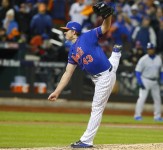
Pitchers and catchers have already reported, and the reporting date for position players is soon approaching. While everyone is settling in, the Mets coaching staff is already trying to plan out the 2016 season:
The Mets have Addison Reed penciled in as the eighth-inning guy to begin the season, according to pitching coach Dan Warthen.
— Mike Puma (@NYPost_Mets) February 20, 2016
Judging on his performance in his limited time with the Mets last year, Addison Reed was lights out. In 17 appearances, he had a 1.17 ERA, a 1.043 WHIP, a 2.74 FIP, an impossibly high 322 ERA+, and a 10.0 K/9. Between his performance, and his history of being an effective closer, Reed is a natural choice to take over eighth inning duties.
However, it should be noted that performance was uncharacteristically good for Reed. In his career, Reed has a 4.01 ERA, 1.261 WHIP, 3.41 FIP, 102 ERA+, and a 9.3 K/9. Accordingly, even if Reed benefitted from working with the Mets coaching staff, he would still be due for a regression back to the numbers he’s accumulated over his five year career. What’s interesting is that looking over Reed’s career, we may be able to see when it’s coming. Here is his ERA and WHIP by each month of his career:
- March/April 2.52 ERA & 1.195 WHIP
- May 4.74 ERA & 1.260 WHIP
- June 5.90 ERA & 1.336 WHIP
- July 3.66 ERA & 1.156 WHIP
- August 2.08 ERA & 1.049 WHIP
- September/October 5.21 ERA & 1.543 WHIP
Reed seems to be at his best at the beginning of the year and after the All Star Break. He tends to wear down after the breaks and with increased use. Last year was an exception. He actually had a very good September. It was perhaps the best month of his career. He had it in a pennant race. He did it with a new team.
So yes, it’s possible that Reed has figured something out, and now, he can be more consistent during the year. He did work on adding a splitter to his repertoire last year. Maybe the Mets were able to help get the most out of him. It’s possible he rose to the challenge that was presented to him. It’s more likely that Reed will put up similar numbers to those he has put up during the majority of his career.
If that’s the case, Reed will start out great and then regress. If that happens, fans should be patient with him. From his career, we can see that he will turn things around. He will be re-energized after the All Star Break. He has shown the ability to pitch well in a pennant race.
Whether or not Reed lasts the year as the eighth inning guy is inconsequential. What matters is that he is effective when it counts most. Judging from his career, 2016 is going to be a bumpy ride. However, fans should be patient with him. He’s shown us that he can produce when it counts most. At the end of the day, that’s all we want.
So with that said, Mets fans should be patient with him. If 2015 is any measure, he will reward that patience.
One of the fun things about Spring Training is the guy who plays so well, he forces his way onto the Opening Day roster.
In 1996, Butch Huskey hit nine homeruns in the Spring forcing the Mets to make him the Opening Day rightfielder even though he never previously played the position. In 2004, Tyler Yates had a 0.64 Spring Training ERA to get the fifth starter’s job. Yates beat out bigger Mets prospects like Aaron Heilman and Grant Roberts.
These players weren’t even darkhorse candidates to win the positions they ultimately attained on the Opening Day roster. Yet, they were able to win their jobs because they were that good in the Spring. More importantly, the Mets had a spot for these players. The Mets were held competitors for these positions, and these players performed so well that the Mets had no choice but to give them the job.
Looking over the 2016 Mets, there’s only one spot up for competition, and that’s in the bullpen. Right now with Jeurys Familia, Addison Reed, Antonio Bastardo, Jerry Blevins, and Hansel Robles, there are two spots up for grab. The names you’re apt to hear are Sean Gilmartin, Logan Verrett, and Erik Goeddel. Each pitched well out of the bullpen last year and deserve consideration.
Another name that deserves consideration is Jim Henderson.
If you don’t recognize the name, it’s understandable. He’s only pitched in 14 games in the majors the last two years due to a shoulder injury and subsequent surgery. Those 14 games were two years ago when he registered a 7.15 ERA. With all that said, Henderson should not be disregarded. He has a legitimate shot at making the Mets Opening Day roster.
Prior to the shoulder injury, Henderson was a very good reliever. Between 2012 and 2013, he made 97 appearances. He had a 2.98 ERA, 1.180 WHIP, 3.03 FIP, 133 ERA+, and 11.9 K/9. He only allowed 0.9 HR/9. In 2013, when the Brewers made him the closer, he recorded 28 saves.
He can help the Mets. Now that he has completed his rehab, he has a fastball that can touch 95 MPH. He knows how to strike guys out. For his career, he has just dominated righties. He has limited them to .183/.241/.284. At a minimum, he can be a specialist to get out tough right handed batters. Ideally, he can be the Chad Bradford to Blevins’ Pedro Feliciano. In order for that to happen, he just needs to get an opportunity.
Fortunately for him, Terry Collins seems like he is going to give Henderson a legitimate shot. As he told Anthony DiComo of MLB.com:
His history is very intriguing. I know he’s a couple of years out of sugery now, which we’re hoping makes a big difference. I saw him inMilwaukee, and he was very, very good. I’m just hoping we can catch lightening in a bottle.
It’s fair to say, Henderson has impressed Collins. It’s half the battle. All Henderson has to do now is go out there and perform this Spring Training. Like Huskey and Yates, he has to dominate in the Spring. He has to give the Mets no choice but to put him on the roster.
Editor’s Note: this article also appeared on metsmerizedonline.com

There was a time when the Mets used to own New York. They had the better and more exciting team. They regularly outdrew the Yankees. Somtime between The Worst Team Money Could Buy and the 80’s Mets getting the band back together in the Bronx sparking a new Yankee dynasty, the Yankees reclaimed New York.
The Yankee dynasty is over. Derek Jeter retired. The Mets have all the exciting young arms. They won the division and had a magical run to the World Series. It seems that, yes, finally, the Mets once again own New York:
https://twitter.com/jareddiamond/status/700723325828354049
It was the largest crowd at Spring Training the Mets have had since those glory days of the 80’s.
The Mets taking over New York isn’t surprising. It was bound to happen sooner or later. What is surprising is the Yankees aren’t even putting up a fight. Look at their offseason:
- No major league free agent signings;
- Trading for alleged woman beater Aroldis Chapman; and
- Eliminating the ability to purchase tickets on Stub Hub while insulting fans in the process.
I know it’s not like the Yankess did nothing. The 2016 Yankees look to be better than the 2015 version with moves like the Starlin Castro trade. The Yankees still have a $221 million payroll. They could very well compete in the division.
They’re just not competing for ownership of New York. It’s something George Steinbrenner never would’ve tolerated.
He hated losing to the Mets in any way, shape, or form. When the Mets had the much touted Generation K, he pushed Derek Jeter forward to prove the Yankees had their own fertile farm system. He bristled when the Mets beat the Yankees . . . in Spring Training! George Steinbrenner would not have sat idly by the year after the Mets advanced further in the playoffs. Last time that happened, Steinbrenner dragged Roger Clemens out of semi-retirement and called-up Joba Chamberlain giving us the “Joba Rules”
Most assume that if George Steinbrenner was still alive, he would’ve responded to the 2015 season with a spending spree. He would’ve had either David Price or Zack Greinke. Possibly both. Ben Zobrist and Jason Heyward would’ve still signed when the same team, only that team would’ve been the Yankees, not the Cubs.
Chances are even in the face of such a spending spree, the Mets would’ve been the better team. They most likely still would be taking over New York. The only difference is the Yankees would’ve put up a fight. The Yankees are going down with a whimper. Worse yet, they’re telling their fans they don’t want them sitting in seats they’ve never sat in before.
That’s fine. Something tells me many of these fans will be sitting in seats they’ve never sat in before. Only now, those seats are in Citi Field. All are welcome aboard the bandwagon. Trust me when I say there are going to be a lot of them.
The Mets once again own New York.

There is one thing you, me, and Juan Uribe have in common. We all love baseball. It was one of several great things we learned during the fun run that Uribe’s short tenure was with the Mets.
Back when the Mets first acquired Uribe, it was the first real sign of hope that the Mets could actually make the postseason. While we all knew the Mets had the pitching, injuries and ineffectiveness troubled the Mets offense. We never knew if or when David Wright was going to return. With Uribe, the Mets obtained a credible major league third baseman. His impact was felt almost immediately:
It was a fun run with Uribe. We learned he hated football, but he loved listening to the Backstreet Boys. He was fun to watch. He appeared to be a leader in the clubhouse. It’s easy to forget now, but if all the people in last year’s roster, he was the only one who had won a World Series. He was only one of two who ever played in the World Series (Curtis Granderson).
Overall, Uribe was more important than his .219/.301/.430 batting line. He was more important than his six homers and 20 RBI. Uribe was important because he provided the Mets with a credible third baseman. Uribe was important because he was the first sign that the Mets were ready, willing, and able to go for it in 2015. Uribe was important because he was great in the clubhouse.
A late season injury robbed him of much of his chance to contribute in the postseason. He did work his way back, made the World Series roster, and got to contribute with an RBI pinch hit single in the lone game the Mets won in the World Series.
Uribe brought an energy to the team. He was a joy to watch. He left an impact on the team. He left an impact on the fans. We were all better off for Uribe’s three months in a Mets uniform.
He’s now joining a Cleveland Indians team that’s very similar to what the 2015 Mets once were. I would not be surprised if the Indians had a good year next year. I’d be shocked if Uribe wasn’t a big part of that.
I’m going to miss Juan Uribe. He’s a big reason why the Mets are back . . . ALRIGHT!

After the Mets make a decision at catcher, the team appears like they will have between $82 – $96 million to build a roster and re-sign their pitching.
Looking at the roster, the Mets will need to obtain starters at the following positions: 1B, 2B, SS, and RF. David Wright is scheduled to make $15 million, so whether or not you believe he will be able to stay at the position, he will remain with the team in some capacity. Michael Conforto should still be with the team as the leftfielder. Finally, unless the Mets can move him, Juan Lagares and his $9 million salary will be the team’s centerfielder. The Mets organization is fairly well stocked with position players right now, and they might be able to fill out the roster with cheap, cost-controlled talent.
First Base
Somewhat controversely, Keith Law named Dominic Smith the 29th best prospect in all of baseball. He’s the first baseman of the future.
Accordingly to the scouting reports, Smith is a good defensive first baseman that should be able to hit. The debate really is whether he will hit for power. Whether or not he hits for power, people see him as being able to field the position and be a good major league hitter.
With Lucas Duda being a free agent in 2018, the Mets will need Smith to be ready. If he’s not ready, the Mets will need a stopgap. In either event, by the time the Mets pitchers start to become free agents, Smith should be the first baseman earning around $500,000.
Second Base
We have to assume that one of these years Dilson Herrera is going to transition from second baseman of the future to the Mets second baseman. With Neil Walker only having one year until free agency, it appears that time will be 2017.
Right now, Herrera has less than one year’s service time. For all the supposed newfound depth, it’ll probably be Matt Reynolds getting called up to the Mets. That will preserve his service time. It means that in 2019, Herrera should be the second baseman, and he will have accrued two full years service time. Unless he gets enough playing time, it appears like he will avoid Super Two status meaning he will be in the same $500 – $600 thousand range as Smith.
Shortstop
As far as organizational depth, the Mets seemingly have an embarassment of riches with two high end shortstop prospects with Gavin Cecchini and Amed Rosario. They also have the aforementioned Reynolds.
Given Asdrubal Cabrera‘s contract, Cecchini and Rosario are going to have time to develop on the minors. At a minimum, Cabrera is signed to be the Mets shortstop through the 2017 season. If he produces well, or the prospects need another year, Cabrera has an option that could keep him with the Mets through the 2018 season.
As such, neither Cecchini or Rosario will be arbitration eligible at the time the Mets pitchers start to reach free agency. Accordingly, the Mets will only have to spend around $500 thousand when the pitchers begin to become free agents.
Left Field
It seems Michael Conforto is the leftfielder of the past (2015), present, and future. He very well should be too. Even if Conforto doesn’t improve upon his 162 game averages he achieved as a 22 year old, who never played above AA, you’re getting a good defensive outfielder who will hit .270/.335/.506 with 26 homers and 75 RBI.
Fortunately, Conforto will not have accrued enough service time to achieve Super Two status. Unfortunately, Conforto will most likely become arbitration eligible the same time that the Mets pitchers are reaching free agency.
Looking over the past few years, there isn’t really a good comparable to Conforto. It seems that when teams have good young corner outfielders, they lock them up. With that in mind, although an admittedly imperfect comparison, J.D. Martinez is instructive.
In 2014, Martinez was 26 years old, and he hit .325/.358/.553 with 23 homers and 76 RBI in 123 games. He became arbitration eligible after this season, and he agreed to $3 million. In 2015, he had another good year hitting .282/.344/.535 with 38 homeruns and 102 RBI. He and the Tigers avoided an arbitration hearing. Martinez’s contract extension bought out the remainder of his arbitration years he’s due to make $6.75 million in 2016 and $11.75 million in 2017.
While we may or may not agree on whether Martinez is a good comparable, it would be fair to say Conforto is at least capable of hitting .272/.344/.535 by his age 25 season, if not sooner. If that’s the case, it would be fair to suggest Conforto could earn anywhere from $3 – $6 million in his first year of eligibility.
Right Field
Curtis Granderson‘s contract will expire after the 2017 season. Since he will be 37 heading into the 2018 season, it’s hard to imagine he will be re-signed to be the everyday right fielder.
Now, Wuilmer Becerra projects to be an everyday player. Scouts believe he has the bat to play the corner outfield spot. The issue as far as the Mets are concerned is how quickly the 21 year old minor leaguer will need before fulfilling that promise. Last year, Becerra played his first year in full season A ball. That’s a long trek to the majors by 2019.
So unless Brandon Nimmo can handle the corner outfield offensively, which unfortunately seems unlikely, the Mets will have to look outside the organization to fill that void.
If Becerra is still a well regarded prospect, the Mets are likely to bring in a player on a one to two year deal. In retrospect, depending on how he finishes out his contract, Granderson could be coaxed back on a one-year deal ata much lower contract price.
As a placeholder, let’s presume the cost of a right fielder would cost about $15 million. That’s what Granderson is slated to earn the last year of his contract.
Cost of the Projected 2019 Starting Lineup
If everything breaks right for the Mets, they will have a group of young, cost-controlled position players at the time their starting pitchers hit the free agent market. If this pans out, the Mets everyday position players would cost about $46.5 million.
That’s roughly what the Mets are paying their current starting infield. In total, the 2016 Mets starting lineup is due to be paid roughly $90 million. Essentially, the Mets will be spending half the amount of money on their starting lineup in 2019 than they will this season.
Overall, this leaves the Mets between $35.5 – $49.5 million to build a bench, a bullpen, and to pay their starting rotation if the payroll remains stagnant at the $140 million range.