Tom Seaver
With the induction of Mike Piazza and Ken Griffey, Jr. coupled with Alan Trammell having fallen off the ballot, some of the glut that has been there in year’s past is no longer there. Still, there are a number of people on the ballot who are deserving of Hall of Fame induction.
Before addressing who I did and who I did not vote for, it should be noted that I am not one who believes steroids users should be inducted into the Hall of Fame. However, I do believe there needs to be some evidence of usage if you are going to deny someone of a vote. For far too long Piazza was denied induction despite the complete lack of credible evidence against him. This fate has also befallen Jeff Bagwell. And no, my opinion on this did not change with the induction of Bud Selig. One mistake should not beget another.
For example, Jesse Haines is considered one of the worst selections in major league history. However, he is not used as a door to induct any starter with a 200 wins and an ERA above 3.50. If that was the case, David Cone and Dwight Gooden would be kicking themselves over retiring before getting those last six wins.
That is why I typically compare players to the average Hall of Famer at that position. Saying someone is similar to the worst player inducted only serves to reduce the quality of the players inducted. To compare everyone to the best of the best excludes players who had truly remarkable careers. With that said, I compare players to the average with some caveats. First, you should get extra credit for postseason play. Second, you should get extra credit for doing something better than anyone has at that position. Third, winning hardware and awards do matter. Note, I only treat those as bonuses and not detractors.
With that long preamble, here are the players I voted for in last year’s IBWAA balloting. After re-examining the respective cases, I am once again voting for the following players:
Career Stats: 17 seasons, .313/.400/.565, 471 2B, 62 3B, 383 HR, 1,311 RBI, 230 SB
Advanced: 72.6 WAR, 44.6 WAR7, 58.6 JAWS
Awards: 7X Gold Glove, 3X Silver Slugger, 5X All-Star, 1997 NL MVP
While Mark McGwire was generally seen as the test for whether steroids players would be inducted into the Hall of Fame, Walker has been the test case for players that have put up terrific offensive numbers at Coors Field. So far, Walker has been penalized for playing in Coors Field, and many people have disregarded someone who has been one of the best right fielders to every play the game.
In his heyday, Walker was not only an outstanding hitter, he was an outstanding fielder as evidenced by his Gold Gloves. He was one of the most complete players of his generation. Despite that, he is being discounted due to Coors Field where players put up proverbial video game numbers.
Yes, Walker did benefit from playing in Coors Field. In his career, Walker was a .381/.462/.710 hitter. However, it should be noted that on the road for his career, Walker was a 278/.370/.495 hitter. Furthermore, in his six years with the Expos at the beginning of his career, he hit .281/.357/.483. Reggie Jackson, who was a first ballot inductee, was a career .262/.356/.490 hitter. Walker’s road and Expos numbers compare very favorably to Jackson.
With the Jackson comparison, the MVP Award, the Gold Gloves, and the advanced stats, Walker should be inducted into Cooperstown.
Stats: 17 seasons, .290/.356/.500, 560 2B, 47 3B, 377 HR, 1,518 RBI, 94 SB
Advanced: 55.2 WAR, 35.6 WAR7, 45.4 JAWS
Awards: 4X Silver Slugger, 5X All Star, 2000 NL MVP
There are many good reasons not to vote for Kent. He was a corner infielder masquerading as a second baseman. The advanced stats certainly don’t match up to the standard for induction into the Hall of Fame. All of this is very true, but I voted for him anyway.
The reason is Kent is the best slugging second baseman in major league history, and he’s the best hitter at the position next to Rogers Hornsby. Among second baseman, he’s hit the most home runs, fourth most doubles, third highest RBI, and the second highest slugging percentage. When you add the 2000 MVP to the picture, there is enough there to say Kent deserves induction into Cooperstown.
Stats: 20 seasons, 216-146, 3.46 ERA, 83 CG, 22 SHO, 22 SV, 1.137 WHIP, 3,116 K
Advanced: 79.9 WAR, 49.0 WAR7, 64.5 JAWS
Awards: 6X All-Star, 1993 NLCS MVP, 2001 WS MVP
Many could look upon Schilling’s career, and they could lament over a relatively low win total and high ERA. However, that is only the tip of the iceberg when it comes to Schilling.
Looking at Schilling’s advanced numbers, he certainly has done enough to earn induction into the Hall of Fame. His WAR and JAWS are above the average for Hall of Fame pitchers. His 127 ERA+ is the same as Tom Seaver‘s. In terms of more traditional stats, Schilling is in the Top 15 on the career strike out list. He is also has the second best K/BB ratio among players eligible for the Hall of Fame. These numbers alone should warrant induction.
On top of that, Schilling is the definition of a Big Game Pitcher. In his postseason career, Schilling was 11-2 with a 2.23 ERA and a 0.968 WHIP. In the World Series, Schilling was 4-1 with a 2.06 ERA and a 0.896 WHIP. He has won an NLCS MVP and a World Series MVP. He was a key member of three World Series winning clubs. Between his postseason heroics and his regular season dominance, Schilling is a Hall of Famer.
Overall, if we are being honest, the reason Schilling won’t be inducted this year or the upcoming years will be a result of his post-career actions.
Stats: 18 seasons, 270-153, 3.68 ERA, 57 CG, 23 SHO, 1.192 WHIP, 2,813 K
Advanced: 83.0 WAR, 44.5 WAR7, 63.8 JAWS
Awards: 6X Gold Glove, 5X All-Star
At age 39, Mussina finally got to the elusive benchmark of 20 wins in a season. Judging from that year, it appeared he had an extra couple of years left in him to go make a run at 300 like many in his shoes would have. Certainly, with his conditioning and the like, he had at least three years left in him to get it, and if he had, he likely would have been elected into the Hall of Fame without much of a fight.
However, Mussina did not get to that magical number leaving us to examine what was an interesting and a very good career.
To appropriately view Mussina, it needs to be within the context of his era. Mussina not only played during the Steroids Era, but he also pitched in a bandbox like Camden Yards for the majority of his career. It is a huge reason why that despite his relatively high 3.68 ERA for Hall of Fame standards, Mussina has a career 123 ERA+. His 123 ERA+ is the same as Juan Marichal who pitched in a different era, had a career 2.89 ERA, and was a inducted his fourth time on the ballot.
Mussian’s ERA+ is also much higher to first ballot Hall of Famer Nolan Ryan and his 112 ERA+. What is interesting about that is despite being completely different pitchers with very different careers, Mussina and Ryan have similar cases from an advanced stat point of view. Despite having pitched in nine more seasons than Mussina, Ryan actually trails Mussina in career WAR. Ryan also trails Mussina in WAR7 and JAWS.
This is not to diminish Ryan’s career. He was a first ballot Hall of Famer for a reason. He was a 300 game winner with more strikeouts and no-hitters than anyone in baseball history. Despite these tremendous stats, it is arguable that Mussina was a the superior pitcher to Ryan. When you can create a valid argument why someone was a better pitcher than a no-doubt Hall of Famer like Ryan, you belong in the Hall of Fame; and ultimately, that is why Mussina belongs in Cooperstown.
There are many factors to consider when voting for a candidate today. At this point, they have all be regurgitated and discussed at length, and hopefully, you have made your decision based upon sound criteria. However, if you are looking for a reason to change your mind or reason to have your mind made up for you, or you really want to base this important decision on how the Mets have fared with a Republican or a Democrat in office, you are in luck. Here is how the Mets have performed under each President in their 54 year history:
| President | Seasons | Record | Win % |
| John F. Kennedy | 1962 – 1963 | 91 – 231 | 0.283 |
| Lyndon B. Johnson | 1964 – 1968 | 303 – 506 | 0.375 |
| Richard M Nixon | 1969 – 1974* | 478 – 433 | 0.525 |
| Gerald R. Ford | 1974* – 1976 | 263 – 277 | 0.487 |
| Jimmy Carter | 1977 – 1980 | 260 – 388 | 0.401 |
| Ronald Reagan | 1981 – 1988 | 662 – 573 | 0.536 |
| George H.W. Bush | 1989 – 1992 | 386 – 423 | 0.477 |
| William Jefferson Clinton | 1993 – 2000 | 562 – 506 | 0.526 |
| George W. Bush | 2001 – 2008 | 651 – 643 | 0.503 |
| Barack Obama | 2009 – 2016 | 630-666 | 0.486 |
* Nixon resigned from office August 9, 1974
Here are the cumulative results:
| Party | Record | Win% |
| Democrat | 1,846 – 2,297 | 0.446 |
| Republican | 2,440 – 2,349 | 0.510 |
Here are some interesting Mets postseason facts when there was a Democrat or Republican in the White House.
Democrat Postseason Facts
- The two times the Mets have been to back-to-back postseasons was when there was a Democrat in the White House (1999 & 2000 – Clinton; 2015 & 2016 – Obama)
- The Mets have only had an NLCS MVP when there was a Democrat in the White House (Mike Hampton – 2000; Daniel Murphy – 2015)
- The Mets have only won the division once (2015) with a Democrat in office. The other three postseason appearances were as the Wild Card.
- The Mets have appeared in four total postseasons and two World Series. The Mets are 21-17 in postseason games with the following records per round:
Wild Card Game 0 – 1 NLDS 9 – 4 NLCS 10 – 4 World Series 2 – 8
Republican Postseason Facts
- The Mets have won their only two World Series with a Republican in office (1969 – Nixon; 1986 – Reagan)
- In all five of their appearances in the postseason with a Republican in office, the Mets were the National Leauge East champions.
- In three of the five appearances, the Mets won 100+ games with the high water mark coming in 1986 with 108 wins
- In four of the five seasons the Mets appeared in the postseason with a Republican in office, the Mets had the best record in the National League (1973 is the exception). In two of those seasons (1986 & 2006), the Mets had the best record in baseball.
- In total, the Mets have appeared in five postseason and three World Series. The Mets are 30-20 in those postseason games with the following records per round:
NLDS 3 – 0 NLCS 16 – 12 World Series 11 – 8
If you wish to mainly focus on player performance over how the team has fared during each administration, Mets players have received more awards during Republican leadership:
Cy Young Award
- Republican 4 (Tom Seaver 1969, 1973, & 1975; Dwight Gooden 1985);
- Democrat 1 (R.A. Dickey 2012)
Rookie of the Year
- Republican 3 (Seaver 1967; Jon Matlack 1972; Darryl Strawberry 1983; Gooden 1984)
- Democrat 1 (Jacob deGrom 2014)
Rolaids Relief Man
- Republican 2 (John Franco 1990; Armando Benitez 2001)
- Democrat 0
Sports Illustrated Man of the Year
- Republican 1 (Seaver 1969)
- Democrat 0
Gold Gloves
- Republican 14 (Tommie Agee 1970; Bud Harrelson 1971; Keith Hernandez 1983 – 1988; Ron Darling 1989; Carlos Beltran 2006 – 2008; David Wright 2007 – 2008)
- Democrat 6 (Doug Flynn 1980; Rey Ordonez 1997 – 1999; Robin Ventura 1999; Juan Lagares 2014)
Silver Sluggers
- Republican 14 (Hernandez 1984; Gary Carter 1985 – 1986; Strawberry 1988; Howard Johnson1989 & 1991; Mike Piazza 2001 – 2002; Jose Reyes 2006; Beltran 2006 – 2007; Wright 2007 – 2008)
- Democrat 5 (Piazza 1998 – 2000; Edgardo Alfonzo 1999; Hampton 2000)
Roberto Clemente Award
- Republican 2 (Carter 1989; Carlos Delgado 2006)
- Democrat 2 (Al Leiter 2000; Curtis Granderson 2016)
From the Front Office side, Republicans have a 2-1 edge in executive of the year with Johnny Murphy winning in 1969, Frank Cashen winning in 1986, and Sandy Alderson winning in 2015. Baseball America named the Mets the top organization in baseball once in a Republican (1984) and once in a Democratic (1995) term.
As a general rule of thumb, the Mets and their players have performed better with a Republican in office. As you enter the voting booths today, take that as you will. Hopefully, you have more sound criteria for choosing your candidate.
With the Cubs facing the daunting task of heading back home down 0-2 in the World Series, Jake Arrieta stepped up and pitched the most important game of his life. Arrieta pitched 5.1 no-hit innings to help the Cubs even the series at 1-1 and to capture home field advantage. Arrieta was the pitcher to carry a no-hitter that deep into the World Series since Jerry Koosman pitched six no-hit innings against the Baltimore Orioles in Game 2 of the 1969 World Series.
Koosman’s performance was much more dominating and important than Arrieta’s. Whereas the Cubs are favored in this year’s World Series, the 1969 were about as big of underdogs as you get. The Orioles lineup featured two Hall of Famers in Brooks Robinson and Frank Robinson. They had a rotation featuring Mike Cuellar, Dave McNally, and future Hall of Famer Jim Palmer. This was about as tough a team you could face. This was a team so tough, they beat Tom Seaver 4-1 in Game 1 of the World Series. Going into the World Series, you presumption was the Mets needed Seaver to win each and every single one of his starts to even have a chance, and not even that happened.
With the Game 1 victory, the Orioles appeared as if they were going to steamroll through the Mets much in the same fashion they had done to the Los Angeles Dodgers three years before and would do the following year to the Cincinnati Reds. Koosman’s 8.2 innings two hit masterpiece changed all of that. It completely changed the tone of the World Series and the momentum. Without this performance, the Mets may not have had the same energy and belief in themselves. It’s quite possible we don’t see either of Tommie Agee‘s catches or Ron Swoboda‘s for that matter.
While Koosman was not named the MVP of the series, that honor would go to Donn Clendenon, his performance was the most important factor in the Mets changing the script and winning the World Series in five games. In that World Series, Koosman not only established himself as a great Met, he also established himself as the first big game pitcher in the franchise’s history. Without him the Mets never win the 1969 World Series.
Coincidentally, without Koosman, the Mets also don’t win the 1986 World Series.
On December 8, 1978, the Mets traded Koosman to his hometown Minnesota Twins in exchange for Greg Field and a left-handed pitcher named Jesse Orosco. Today is the 30th Anniversary of the Mets winning their second World Series. The Mets would not have been able to win that World Series without Orosco’s three wins, and his gutsy win in Game 6, of the NLCS. They would not have won without his standing on the mound to close out Game 7.
Neither the 1969 or the 1986 World Series would have been possible without Koosman. With it being the 30th Anniversary of the 1986 World Series victory and with Arrieta’s peformance, we were again reminded of that.
Growing up, my family did not always go to Opening Day. It was sometimes difficult for my Dad to get off of work, and even if he could, we had my mother insisting that my brother and I could not miss a day of school just to go to a Mets game. What eventually happened is that my father, brother, and I usually found ourselves going to the last game of the season, which usually falls on a Sunday.
When you go to Opening Day, there is always hope. Even when your team stinks, you can find some reason for hope. I remember thinking back in 1993 that the 1992 Mets season was just a fluke. Bobby Bonilla was certainly going to be better. Howard Johnson was back in the infield where he belonged. This could be the year Todd Hundley and Jeff Kent break out. The team still had Dwight Gooden, Sid Fernandez, and Bret Saberhagen with John Franco in the bullpen. It turns out the 1993 team was even worse than the 1992 team.
The last game of the season always has an interesting feel to it. When we went to the final game of the season, it was more of a farewell to an awful season. Being ever the optimist, we still had hope for a bright future with Pete Schourek throwing eight brillant innings to cap off a Mets six game winning streak. It seemed like 1994 was going to be a big year in baseball. It was, but that’s a whole other story.
There was the devastating 2007 finale. Heading into that game, most Mets fans believed that despite the epic collapse, the Mets were going to take care of the Marlins. They just snapped a five game losing streak behind a brilliant John Maine performance and the offense coming alive to score 13 runs. Even better, the Phillies seemed to be feeling the pressure a bit with them getting shut down by Matt Chico and a terrible Marlins team. The sense was if the Mets won this game, the Phillies would feel the pressure and lose their game. Even if the Phillies won their game, the Mets would beat the Phillies and return to the postseason like everyone expected.
After Tom Glavine laid an egg, which included out and out throwing a ball into left field trying to get Cody Ross, who was going to third on the original throw to home. At 5-0, the Mets were still in the game. David Wright was having a torrid September. Carlos Delgado and Carlos Beltran were big game players. I don’t think Moises Alou made an out that entire month. With that in mind, I turned to my father, and I said to him, “If the Mets allow one more run, the game is over . . . .” As the words left my mouth, Jorge Soler allowed a two run double to Dan Uggla. Sure, they would play eight and a half more innings, but the collapse was over right then and there.
That 2007 finale hung over the 2008 finale. Mets fans were probably a bit more optimistic than they had a right to be. The day before Johan Santana took the ball with three days rest, and he pitched a complete game three hitter. The Mets had Oliver Perez going in the finale. Back then, this was considered a good thing. The offense was clicking again. However, that bullpen was just so awful. The Mets were relying on Luis Ayala to close out games, and believe it or not, his 5.05 ERA and 1.389 WHIP was considered a steadying presence to an injury ravaged bullpen. Beltran would hit a huge home run to tie the game, but the joy wouldn’t last. Jerry Manuel, just an awful manager, turned to Scott Schoeneweis to gave up the winning home run to Wes Helms (Mets killer no matter what uniform he wore), and then aforementioned Ayala gave up another one that inning to Uggla to seal the deal at 4-2.
Fittingly, the last out was made by Ryan Church. He was the same Mets player the Mets flew back and forth to the West Coast despite him having a concussion. Remember the days when the Mets didn’t handle injuries well? Nevermind. In any event, I was one of the few that stayed to watch Tom Seaver and Mike Piazza close out Shea Stadium. Many disagree, but I thought it helped.
Last year, was just a celebration. The Mets had already clinched the NL East, and they were off to their first postseason since 2006. The only thing left was the Mets winning one more game to get to 90 wins. The 90 wins was window dressing, but the shift from 89 to 90 is just so satisfying. It means more than 86 to 87 wins or 88 to 89 wins. That 90 win mark is an important threshold for the psyche of teams and fans.
This year was something different altogether. In terms of pure baseball, the Mets entered the day tied with the Giants for the first Wild Card with the Cardinals just a half a game behind (tied in the loss column). The night before the Mets had seen Sean Gilmartin and Rafael Montero combine to put the team in a 10-0 hole that the Las Vegas 51s just couldn’t quite pull them out from under. Still, that rally had created some buzz as did Robert Gsellman starting the game. However, there was the shock of the Jose Fernandez news that muted some of the pregame buzz.
After the moment of silence, there was a game to be played, and it was just pure Mets dominance.
Gsellman would pitch seven shutout innings allowing just three hits and two walks with eight strikeouts. More amazing than that was the fact that he actually got a bunt single. For a player that can only bunt due to an injury to his non-pitching shoulder, the Phillies sure acted surprised by the play. Overall, it was a great day by Gsellman who was helped out by the Mets offense and a little defense along the way:
It was that type of day for the Mets. After Saturday’s pinch hit home run there was a Jay Bruce sighting again on Sunday. On the day, he was 2-4 with two runs and a double. It was easily the best game he had as a Met. His second inning double would start the rally that ended with James Loney hitting an RBI groundout. Then, as Cousin Brucey would say, “the hits just keep on comin’!” No, that was not just an allusion to the Phillies pitchers who hit three batters in the game. It refers to the Mets offense.
Curtis Granderson hit a fourth inning solo shot to make it 2-0. It was his 30th of the year making it the first time the Mets have had a pair of 30 home run outfielders since, really who even knows? In the fifth, T.J. Rivera plated a run with an RBI single. Later in the fifth, Jose Reyes would the first of his two RBI bases loaded walks. Overall, the big blow would come in the seventh off the bat of Asdrubal Cabrera:
Asdrúbal does not believe in taking his foot off the gas pedal. #GrandSlam #LGM https://t.co/ruyz0Y7Ioh pic.twitter.com/ejUGq7vIRW
— New York Mets (@Mets) September 26, 2016
The grand slam put the capper on not just the game, but a pretty remarkable season at home where the Mets were 44-37 on the season. The Mets also hit 193 homers at home, which was the most ever hit at Citi Field, and more than any the Mets ever hit at Shea Stadium in any one season:
The final home game of the season is over, here are the all 193 home runs hit in Citi Field this season. pic.twitter.com/KHfkv3lXFP
— CitiFieldHR (@CitiFieldHR) September 25, 2016
In the eighth, the Mets just poured it on with some of the 51s getting into the game. Gavin Cecchini was hit by a pitch, Brandon Nimmo and Ty Kelly walked, and Eric Campbell got another RBI pinch hit. Throw in a Michael Conforto two RBI double, and the Mets would win 17-0. Exiting Citi Field, you got the sense this was not the last time you would see this team at home. As it stands now, the Mets back to being a game up on the Giants, and the Cardinals fell to 1.5 games back.
There haven’t been many final games to the season like this one, and I’m not sure there ever will be. Overall, it was a great way to close out the regular season at Citi Field. However, for right now, it is not good-bye like it was in 1993, and it certainly isn’t good riddance like it was in 2007. Rather, this game had more of a feeling of, “See you again soon.”
On August 22, 1973, the Mets won their second game in a row to raise the Mets record to 57-67 leaving them 6.0 games out in the National League East behind the first place St. Louis Cardinals.
From that point forward, the Mets would be the hottest team in baseball going 25-12 carrying them to an unlikely division championship. The Mets rode the hot streak to beat the Big Red Machine 3-2 in a best of five NLCS, and they came within a win of disrupting the Oakland A’s dynasty.
The popular story was the Mets were spurred by Tug McGraw screaming “Ya Gotta Believe!” after a M.Donald Grant “pep talk” in July. However, the truth is that team just got healthy at the right time, and when the team was at 100%, they were among the best teams in baseball.
During that year, the team was hampered by injuries. Jerry Grote, John Milner, Bud Harrelson, and Cleon Jones all missed significant time. Rusty Staub player through injuries all year. On top of that phenom Jon Matlack was having a down year a year removed from winning the Rookie of the Year Award. He was joined by Jerry Koosman in having a surprising down year. Willie Mays looked to be every bit of his 42 years of age. Young fill-ins like Don Hahn just were not producing. The Mets were forced to do anything they could do to improve the team like releasing dead weight like Jim Fregosi. About all that went right that season for the Mets was Tom Seaver; that and the fact that no one ran away with the division allowing the Mets to enter the postseason with an 82-79 record.
Isn’t that what this Mets season has been. With Matt Harvey, David Wright, Lucas Duda, Adrubal Cabrera, and Yoenis Cespedes, we have seen this Mets team be hampered time and again by injuries. We have seen countless Mets play through injuries like Noah Syndergaard and Steven Matz with their bone spurs. We’ve seen replacements like Eric Campbell, Ty Kelly, and Matt Reynolds not play up to snuff. Players like Travis d’Arnaud and Michael Conforto had surprising down years. About the only thing that has gone right for the Mets this year is the fact that Jacob deGrom has continued to pitch like an ace, and the fact that no one has ran away with the second Wild Card spot.
Maybe, just maybe, this is 1973 all over again. That 1973 team was much further back in both the standings and more teams to leapfrog in the standings. All they needed to do was to get healthy and to get hot. Right now, with Cespedes back and hitting home runs for the Mets again, this team is healthy, and they are on the verge of getting hot. If that happens, the Mets can very well take that second Wild Card spot and get into the postseason.
As we saw in 1973 as well as last year, with great Mets pitching, the Mets can beat anyone in the postseason. They can shock the world. Anything is possible so long as they get hot and get into the postseason.
It was a muggy and rainy day that might’ve lead to the game being called on any other night.
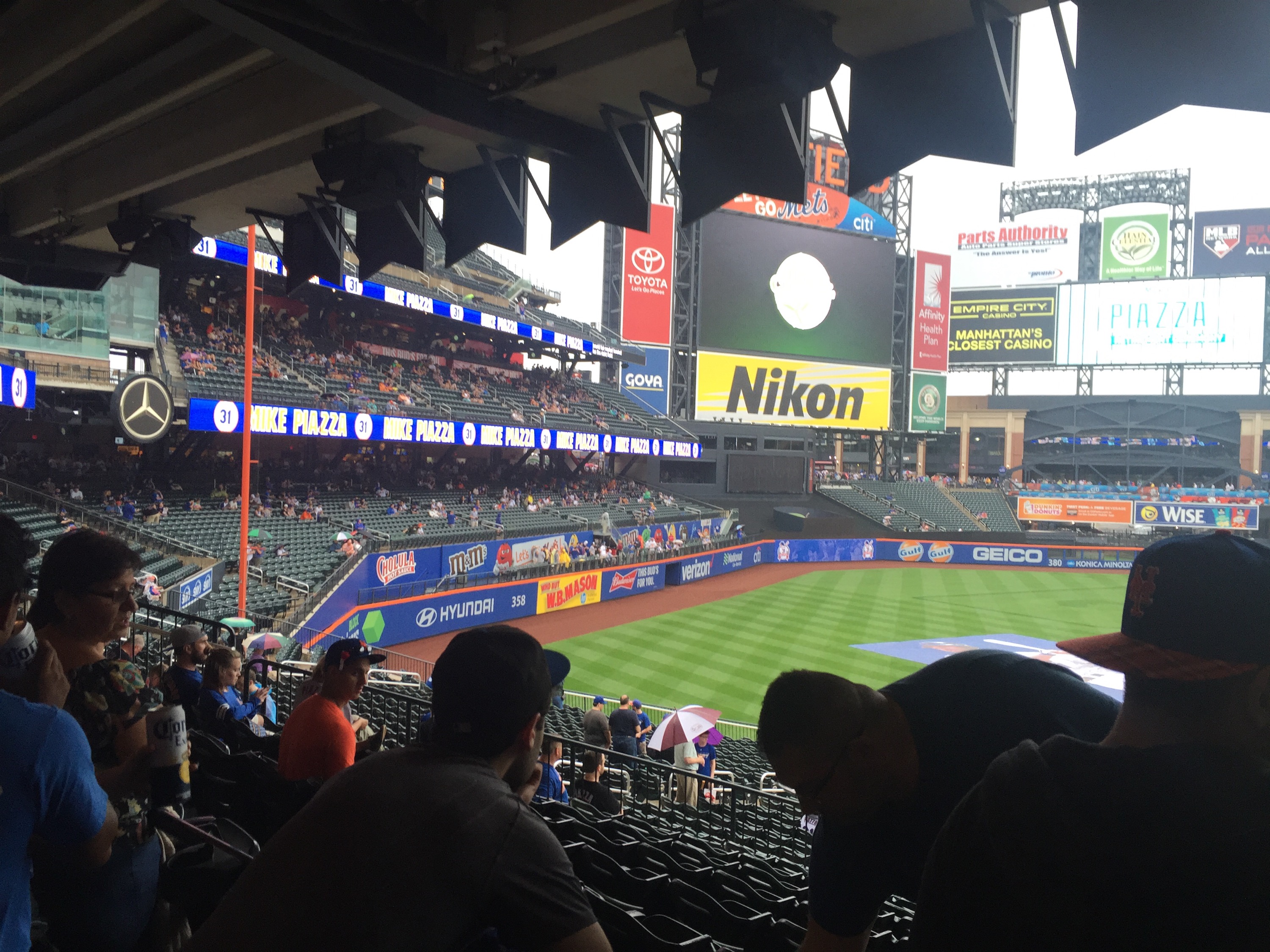
But they weren’t going to call this game as it was the night the Mets were retiring Mike Piazza‘s number 31. With the 31 inside a home plate mowed into centerfield, the Mets were ready, and nothing was going to stop the night.
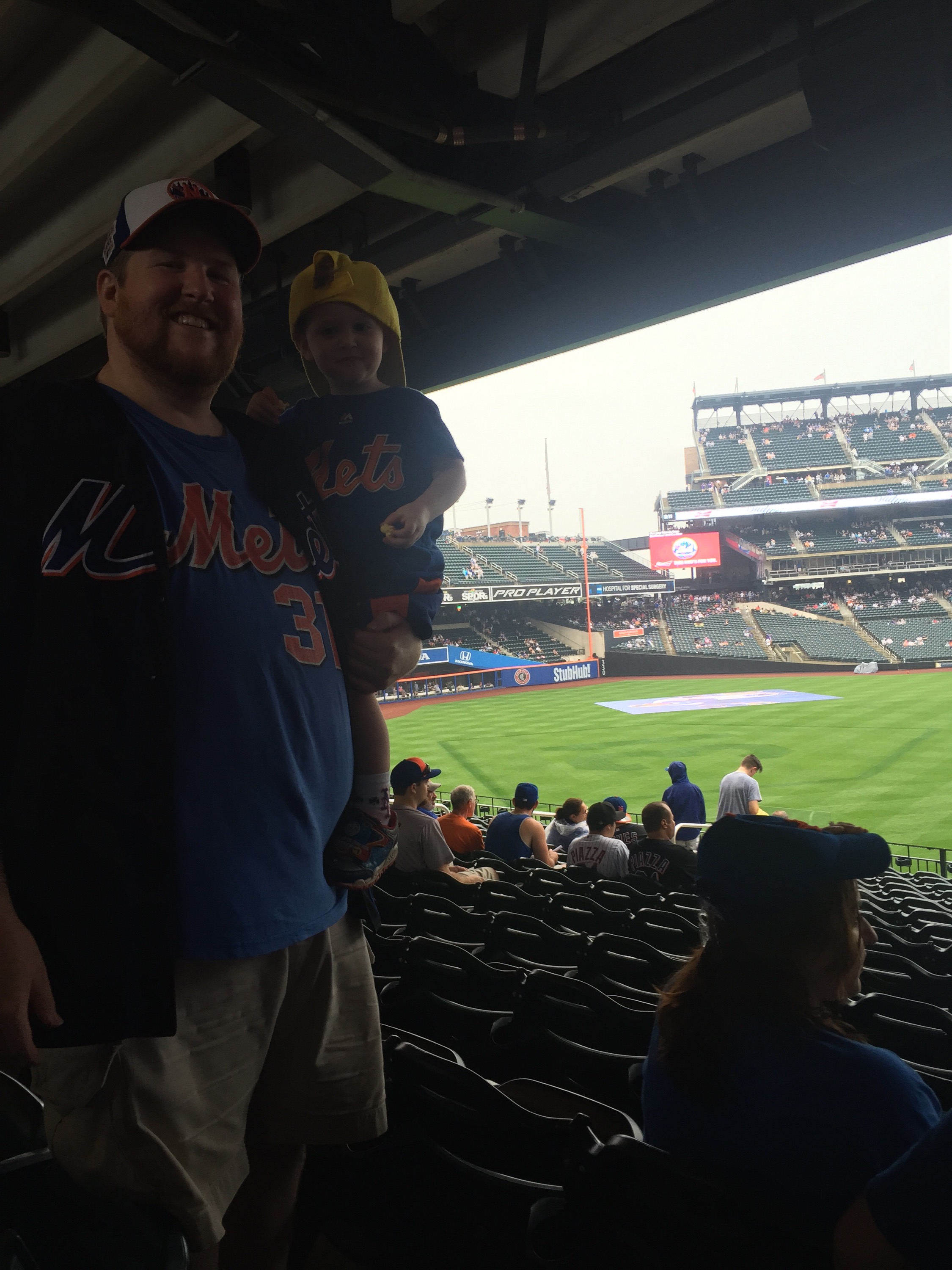
The ceremony was just about perfect with a video featuring Piazza standing at the spot home plate once stood at Shea Stadium
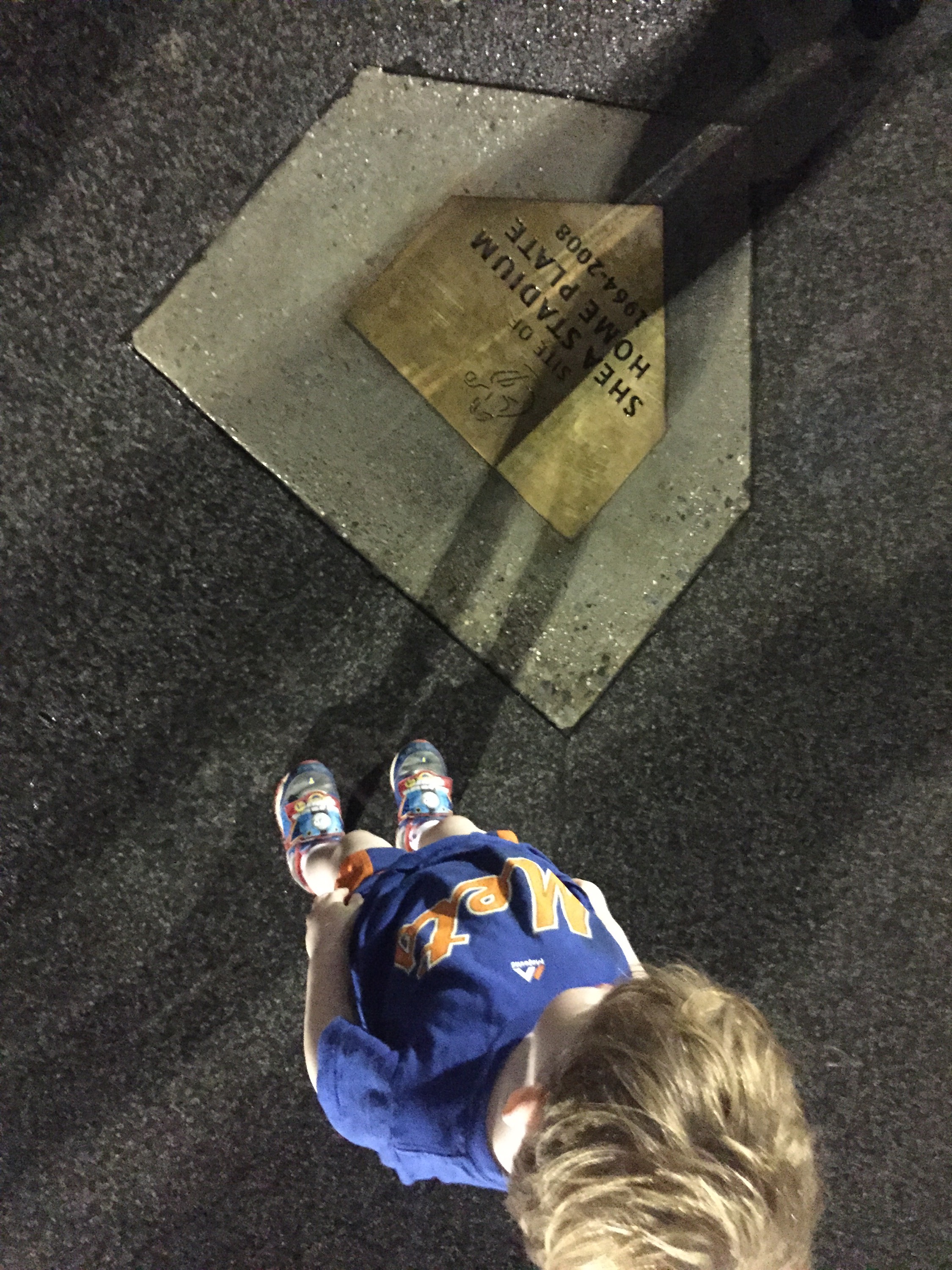
We had to visit it after the game.
Then Piazza would come through the Mets dugout that seemed to have most of the players there, and the crowd erupted.
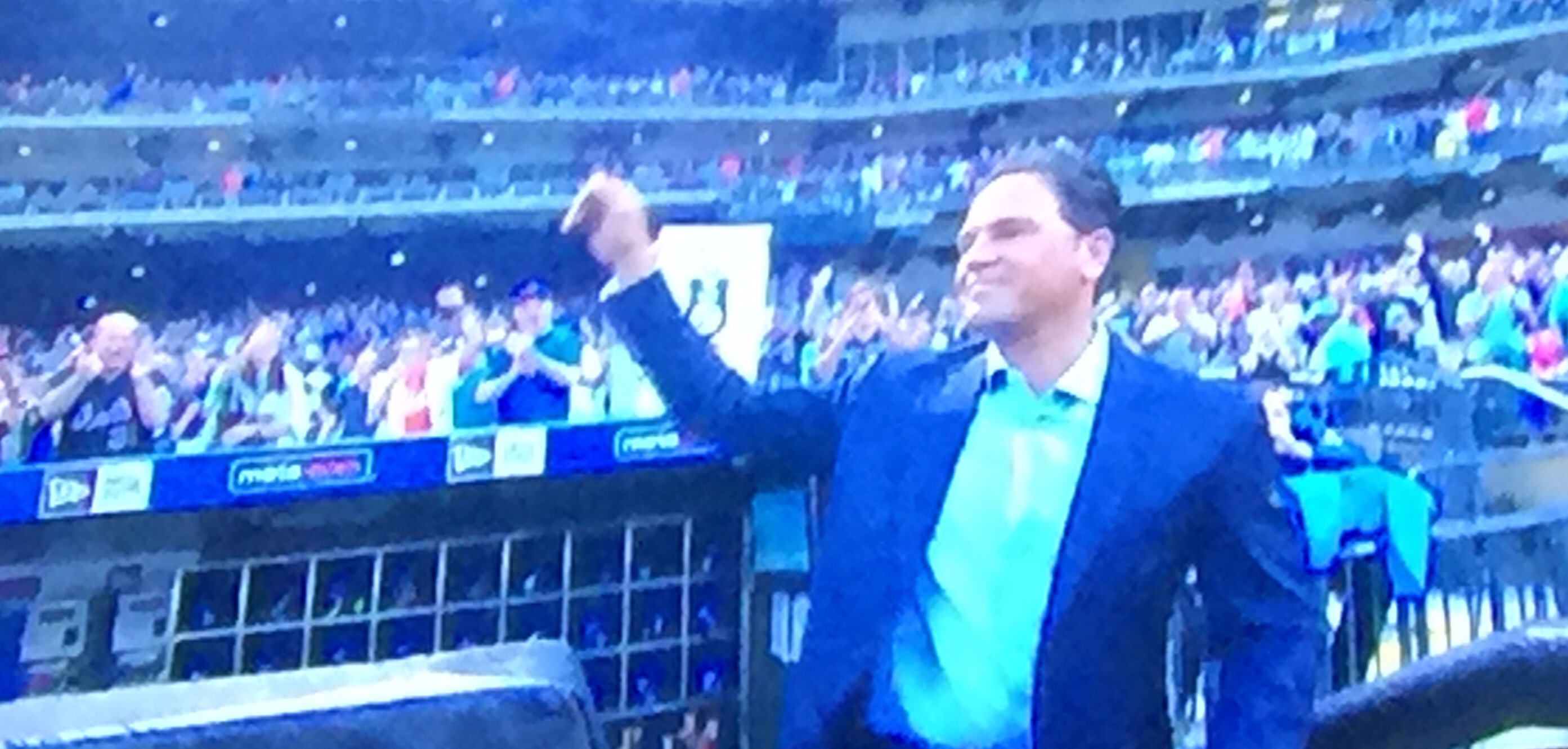
Every little touch was perfect from the aforementioned 31 in centerfield to his 31 prominently featured on the Home Run Apple.
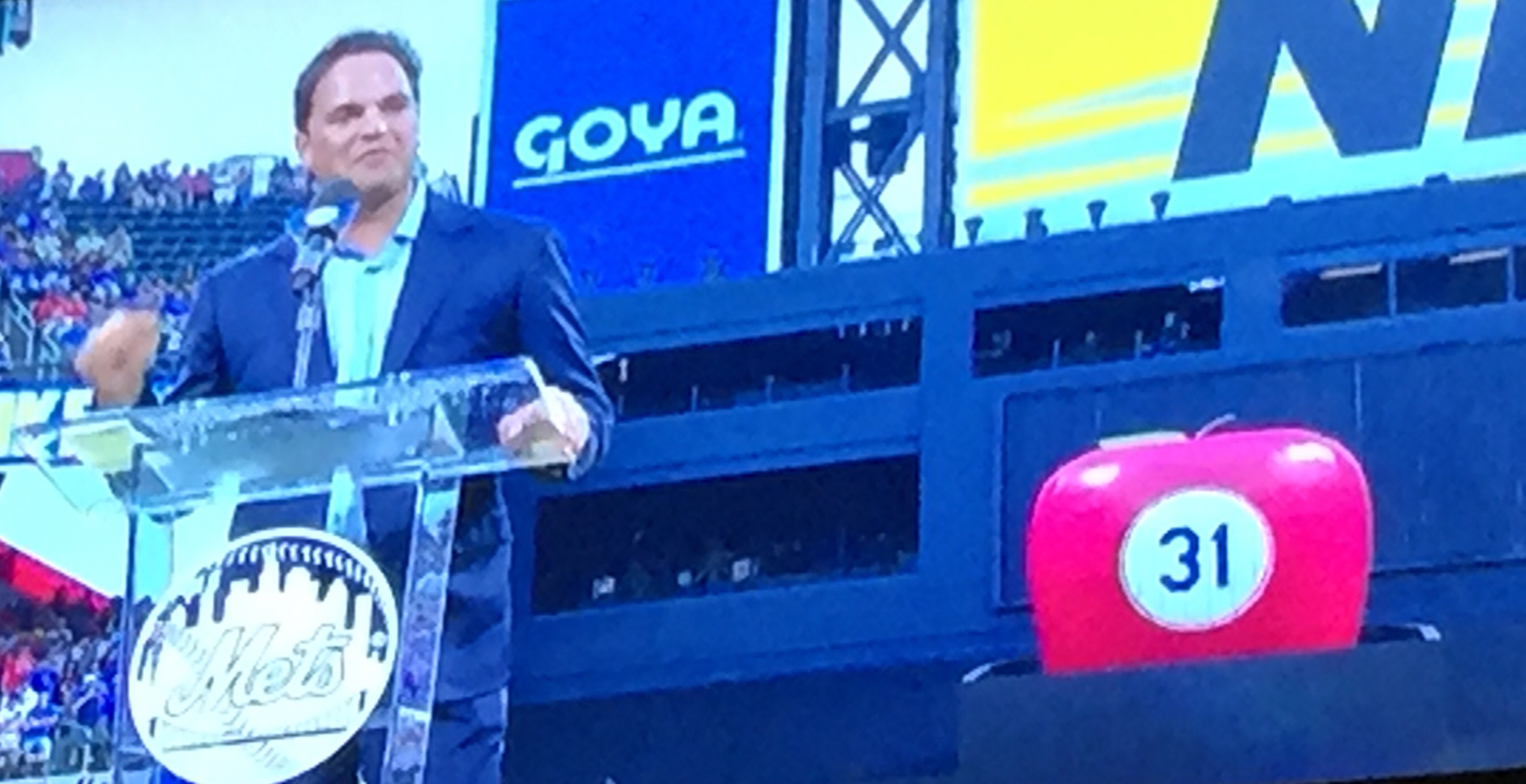
The video introducing him was spot on making sure to put an emphasis on his post 9/11 home run
The only thing missing from the tribute was Mets fans giving him a curtain call after he homered off former teammate and fellow Hall of Famer Pedro Martinez.
Speaking of former teammates, there was some surprise that there weren’t more of his old Mets teammates there. Frankly, I was shocked there was no John Franco, but you don’t know the scheduling issues that would prevent people from coming. For example, you know White Sox manager Robin Ventura would never be able to make it.
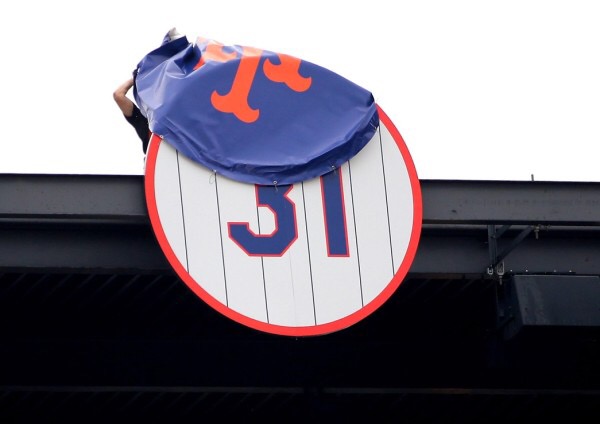
You still didn’t notice it too much with who was there. There was old fan favorite Cliff Floyd. The best Mets second baseman of all time Edgardo Alfonzo. The last player there was the first Mets pitcher Piazza ever caught, Al Leiter. Since leaving the Mets, Leiter was never treated properly by Mets fans for how great a Met he was, but on this day, he would be with a loud standing ovation. Then we finally saw the number unveiled:
 Piazza then had to speak. Many times, he seemed speechless at the outpouring of affection he received. Other times, Mets fans would not even let him speak during his speech:
Piazza honored everyone including the fans. He took in the moment as Mets fans did as well. His induction to Cooperstown was a coronation, but this was a celebration with 42,207 of his closest friends. There would be no roomfor booing as Piazza would remind the fans when he brought up the Wilpons. That’s the power of Piazza – he can get the fans to stop booing the Wilpons.
He gave a poignant speech letting the fans know that for as long as his 31 hangs in Citi Field, he will be with all of us. As he parted, he tried to inspire everyone saying that whenever the team needs inspiration, they need only look up to left field and remember that old Mikey is with them.
After he threw out the first pitch from home plate to Leiter, it was game time
Yes, there were some jokes about Piazza not doing it to Alfonzo at second. The real joke was what followed. The team either didn’t listen or was too undermanned to draw from these inspirational words.
The game itself. It was never going to match the beauty of that ceremony, but it didn’t need to be that ugly. The team never heeded his parting advice.
Given how the Mets have been playing, and the lineup that was put out there, the loss was no surprise. The Mets starter AAA cast-off Justin Ruggiano in center, a reall defensively challenged Kelly Johnson at first, a 43 year old Bartolo Colon on three days rest, and of course Neil Walker. Not even facing the worst starter in baseball Jorge De La Rosa could revive this offense.
It was just a brutal game that saw Terry Collins get tossed in the fourth, and frankly, most Mets fans didn’t stay for much longer than that it a 7-2 loss.
Overall, the only thing worse than the loss was knowing that Tom Seaver was physically unable to attend the ceremony. It was still a great night, and years from now, I will always remember seeing this for the first time.
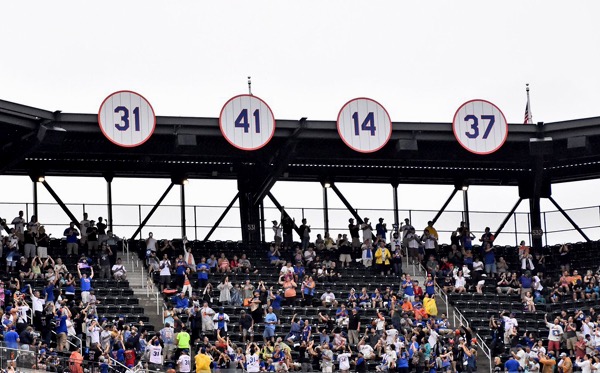
Game Notes: Jose Reyes was put on the DL before the game.
Today, Mike Piazza joins Tom Seaver as the only Mets player to have his number retired. He also joins Gil Hodges and Casey Stengel as the only Mets to have their number retired. He will also join Jackie Robinson, William Shea, and Ralph Kiner in what has become the Mets “Left Field Legends Landing”
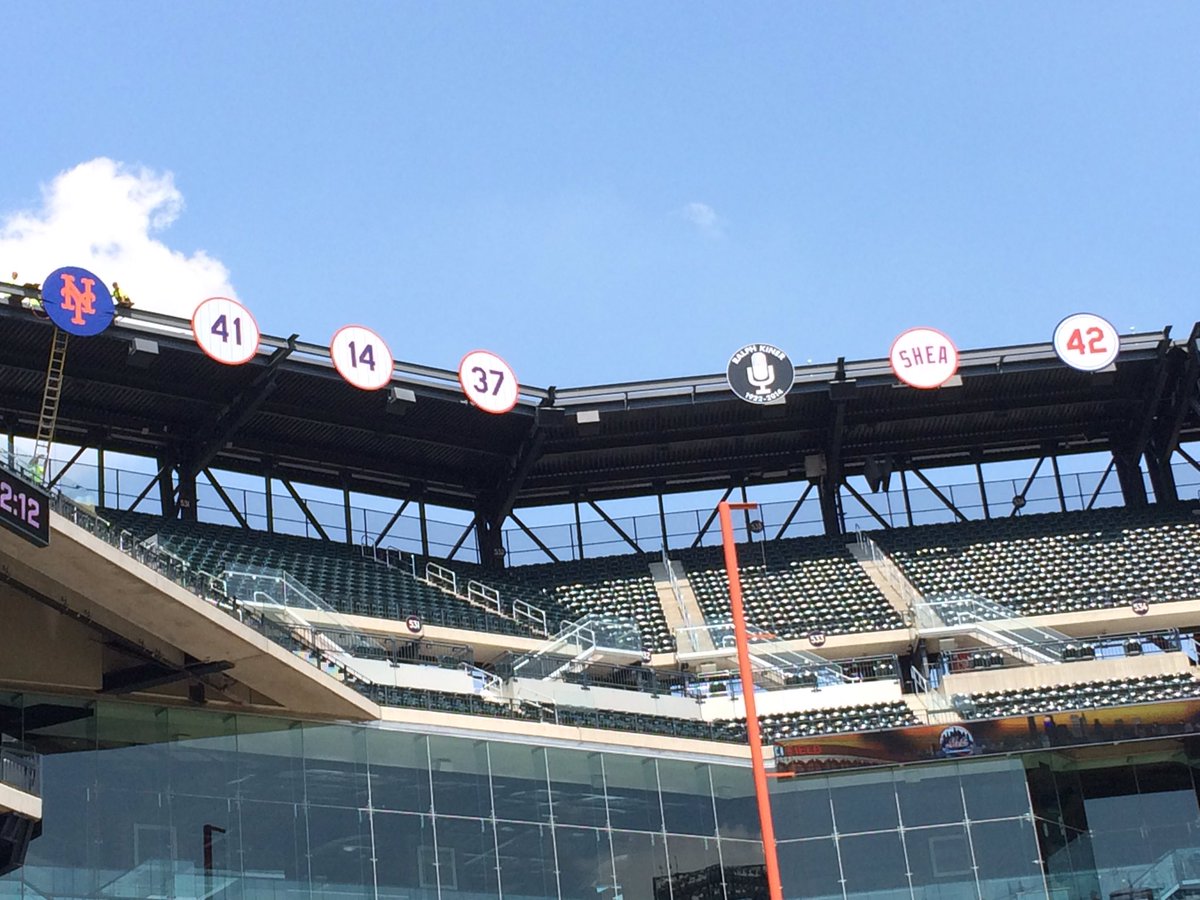
* Photo courtesy of Jeremy Posner.
At least that is what I am calling it.
Piazza is there because he was just inducted into the Baseball Hall of Fame as a Met. He was the second Met all-time and their first position player. He is there because he helped take a “nice little team” and led them to back-to-back postseason appearance for the only time in Mets history. No Met will ever wear his number again due to him being the greatest hitting catcher of all-time who has hit more homers than any catcher in baseball history. He is there for the post 9/11 homer, for all the other important homers, and what he meant to Mets fans. Today, Piazza will officially have his number retired. Personally, I cannot wait to go to Citi Field and cheer him like I did all those games I attended in the late nineties and early 2000s. It couldn’t have happened to a better man or a better Met.
Congratulations Mike Piazza.
The only thing we know right now about Mike Piazza‘s retired 31 is that it is going to be in the Left Field Legends Landing in front of Tom Seaver‘s number 41.
* Photo courtesy of Jeremy Posner
For whatever reason, the Mets are changing how the retired numbers are displayed. It used to be in the order the numbers were retired, and now with Piazza’s ceremony on the horizon, the Mets have changed it to reverse order. It’ll be interesting to see if that is how it remains. What is also interesting is that the Mets have tipped their hands, and they have shown that they are going to do a “uniform” display of the retired numbers:

What is interesting about that is Piazza never specifically wore that jersey. Sure, the Mets would occasionally wear pinstripes during Piazza’s tenure with the Mets, but when they did the number had a dropshadow.
Instead of the jersey number as the Mets will most likely display it, the Mets should have gone with the black jerseys to represent not just Piazza, but also the specific Mets era in which he played:
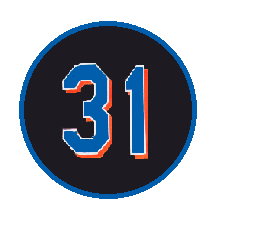
That’s the jersey Piazza wore in his first playoff game with the Mets (road version of the black jerseys in Game 1 of the 1999 NLDS). It was a game the Mets won highlighted by an Edgardo Alfonzo grandslam. It was the jersey he was wearing when Robin Ventura hit the Grand Slam single. It was the jersey he wore when he hit the three run homer to cap a 10 run eighth inning rally that saw the Mets overcome an 8-1 deficit against the hated Braves. It was the jersey he wore when the Mets won the 2000 Pennant. It was the jersey he wore when he broke Johnny Bench‘s record for most home runs by a catcher. And yes, it was the jersey he wore when he hit the post 9/11 home run.
Overall, if you conjure up your favorite moment of that era or of Piazza in a Mets uniform, chances are the Mets were wearing the black uniforms. It doesn’t really matter that Piazza wore the snow white jerseys more than any other jersey. The Mets need for symmetry should not outweigh properly representing history, and remember, it was their idea to have the black jerseys in the first place. Instead, the 31 that will forever hang in the Left Field Legends Landing should be the Mets black jersey as that is the jersey that most fans associate with Piazza.
Unfortunately, that is not what is going to happen, and with it the Mets will fail to properly reflect their history.
On August 11, 1992, the Mets had a day to honor Tom Seaver for being inducted into the Baseball Hall of Fame. Considering he was the best pitcher in Mets history, you would think the honor of starting that game would go to Dwight Gooden, who was the only Mets pitcher who would break any of Seaver’s records. David Cone was another terrific choice given how great a pitcher he was for the Mets. Bret Saberhagen would have been fitting as he was a two time Cy Young winner and a former World Series MVP. Even Sid Fernandez could have fit the bill as it was his Game Seven performance that helped prevent Seaver from winning one last ring in 1986.
Instead, it was Eric Hillman, who was making his first ever major league start on a dark and rainy night that drove away most of the fans who should have been there to celebrate with Seaver. To be fair, that game would’ve been called almost any other night had it not been Seaver’s night. Between the weather, and who was going to be honored, it was a difficult situation for a young pitcher. Hillman was up to the challenge pitching eight scoreless innings to help defeat the first place Pittsburgh Pirates.
With Monday’s rainout, the Mets will be in a similar position for Mike Piazza‘s number retirement ceremony.
It was supposed to be Noah Syndergaard. Who better to celebrate the career of the Mets rock star catcher than to have the Mets rock star starting pitcher? Who better to honor the power Piazza showed at the plate than the power pitcher who can routinely throw over 100 MPH? The long haired starting pitcher dominating the opponents should have started the game honoring the long haired dominant hitter. It was all too perfect to be true. With the rain, it’s not going to happen.
Instead, the Mets are most likely going to get a spot starter making his first ever major league start similar to what happened with Eric Hillman on Tom Seaver’s night. It just seems to go that way on a night when the Mets honor their Hall of Famers.
The start could to to Seth Lugo, who has pitched extremely well out of the bullpen in his four appearances this year. Gabriel Ynoa could be summoned from the minor leagues to make his first ever start as could his Las Vegas 51s teammate Robert Gsellman. Whoever it turns out to be, they have some large shoes to fill. No, not Syndergaard’s, the 6’10” Hillman’s. Whoever the Mets give the chance to make his first ever career start needs to go out there and put up a dominant performance like Hillman’s to allow the fans to celebrate deep into the night.
Every major league team that has been around long enough has three faces to their franchise. The first is The Immortal player. He is the player you first think of when you mention a franchise. The next is the Living Legend. This player is the one that is revered by young and old. He is the player that throws out the first pitch at first home game of the World Series. He’s in the Hall of Fame, and his number is retired. The last is the best or most popular player on the team. He is the player that has been traditionally dubbed the Face of the Team. Here are a few examples:
| New York Yankees | |
| Immortal | Babe Ruth |
| Living Legend | Derek Jeter |
| Face of the Team | Alex Rodriguez |
| Boston Red Sox | |
| Immortal | Ted Williams |
| Living Legend | Pedro Martinez |
| Face of the Team | David Ortiz |
| St. Louis Cardinals | |
| Immortal | Stan Musial |
| Living Legend | Bob Gibson |
| Face of the Team | Adam Wainwright |
| Los Angeles Dodgers | |
| Immortal | Jackie Robinson |
| Living Legend | Sandy Koufax |
| Face of the Team | Clayton Kershaw |
Yesterday, with Mike Piazza‘s formal induction into the Baseball Hall of Fame and with Tom Seaver unable to attend the Hall of Fame ceremony he loves to attend, the Mets now how their own triumvirate.
Not only is Mike Piazza a Hall of Famer who is about to have his number retired by the Mets, he has also become the Mets resident Living Legend. It’s why he was the former player who threw out the first pitch prior to Game Three of the World Series. Every big moment for the Mets from here on out is going to prominently feature Mike Piazza much in the same way we have seen through the years with players like Ernie Banks, Stan Musial, Yogi Berra, Willie Mays, Hank Aaron, and once upon a time Tom Seaver.
It’s unfortunate to see Seaver unable to travel to attend the ceremony and host his table of 300 game winners, including friend and former teammate Nolan Ryan, from his day like he loved so dearly. It’s sad that he can’t travel cross-country to throw out the first pitch for any of the World Series games or to sit in the owner’s suite and cheer on The Franchise’s Franchise. It’s almost a surety that he will be unable to attend Piazza’s Number Retirement Ceremony this weekend. In some ways, that makes him like Gil Hodges and Casey Stengel – gone but not forgotten.
No one can ever forget Seaver. He’s the best player to ever put on a Mets uniform. He’s The Franchise. He’s quite possibly the greatest right handed pitcher to ever play the game. He is the pitcher who has received more Hall of Fame votes than anyone in baseball history. He is an Immortal. No one, not even Piazza, can ever knock him off that perch.
He is joined by the Living Legend Mike Piazza and the current Face of the Mets Franchise, be it David Wright, Yoenis Cespedes, or Noah Syndergaard to become one of the three all important faces of the Mets franchise. In that way, the Mets have become an older major league franchise with a history worth celebrating.