Matt Harvey
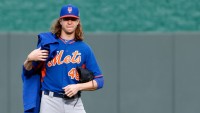
The Mets have a $140 million payroll. The strength of the team is its young, cost-controlled pitching. The pre-arbitration pitchers make little money by baseball standards. However, their $500,000+ salary should allow them to live comfortably.
Families make a lot less than that, and they can put a roof over their families heads and put food on the table. One of the crazy things a family is able to afford, even with relatively modest means, is a mattress for everyone. When they go away to places like Florida, they can stay at places that have decent mattresses. So with that said, why can’t the Mets and their players?
Last year, Steven Matz almost missed the postseason because he injured his back sleeping on a Barcalounger. Yesterday, Jacob deGrom missed his Spring Training start because he tweaked his back sleeping on a mattress that was too soft. He was able to throw a bullpen. He then counseled with Matt Harvey who, like Baby Bear, had a mattress recommendation that is just right.
I know, I know. We should calm down. Matz was able to pitch in the postseason, and deGrom was able to pitch a pain free bullpen. However, I get nervous because it’s the dumbest things that interfere with a great or potentially great season.
The 1987 Mets never got traction with their pitchers missing time. Most notably was Dwight Gooden and his cocaine suspension. Aside from Gooden, I think every Met pitcher had an injury including the guy who threw batting practice.
In 1988, the Mets returned to form, but there was a strange injury that hurt their chances at another World Series title. On the day the Mets clinched the NL East, Bob Ojeda, who was amazing in 1986, nearly severed the middle finger on his pitching hand while trimming the bushes in his front yard. The Mets, who dominated the Dodgers in the regular season, lost the NLCS in seven games.
In 2006, Duaner Sanchez suffered a season ending shoulder injury during a late night cab ride to get a late night bite. This caused a number of moves to try to replace his spot in the bullpen. In the seventh inning of Game Two of the NLCS, Guillermo Mota shook off Paul Lo Duca and threw a change up that Scot Spiezio turned into a game tying triple. In Game Seven, Aaron Heilman allowed Yadier Molina to hit the series winning homerun. It’s possible Sanchez would’ve closed the door in either situation. Instead, he was unavailable.
The overriding point is that it’s not just the Tommy John surgeries that kill your chances. It’s also the yard work and can rides. It’s the unforeseen problems that arise. Maybe the Mets win in 1988 if Ojeda hires a gardener. Maybe the Mets win in 2006 if Sanchez orders room service. I don’t want to say maybe the Mets win in 2016 if their pitchers had better mattresses.
If in the equipment manager, I’m ordering a mattresses that Harvey recommended for every player. The 2016 season cannot be derailed by a bad mattress.

Man today’s players just don’t respect the game or their opponents. Years ago, they never would’ve celebrated on the field:
Yes, that’s Kirk Gibson celebrating a homerun off of Goose Gossage. That was from the 1984 World Series. You know what I couldn’t find anywhere? Gossage condemning Gibson for the celebration. Sure, it would seem like sour grapes, but he had a platform then and didn’t use it.
Now? Well now, the Hall of Famer rails against how players today celebrate. He called Jose Bautista and Yoenis Cespedes and their celebrations to be an embarrassment and disgrace to the game. He’s apparently taking issue with the bat flips:
Gossage comes off like an old man lamenting how things were better in his day. He is remembering the days when if you hit a homerun, you put your head down and rounded the bases. No one out there showed any emotion so as to not show anyone up. They knew if they did the pitcher was going to stick one in your ear. The thing is that he has selective memory. Additionally, times have changed.
In an ESPN the Magazine interview with Tim Keown, Bryce Harper shared his thoughts on player celebrating on the field:
Baseball’s tired. It’s a tired sport, because you can’t express yourself. You can’t do what people in other sports do. I’m not saying baseball is, you know, boring or anything like that, but it’s the excitement of the young guys who are coming into the game who have flair. If that’s Matt Harvey or Jacob deGrom or Joc Pederson or Andrew McCutchen or Yasiel Puig — there’s so many guys in the game now who are so much fun.
Jose Fernandez is a great example. Jose Fernandez will strike you out and stare you down in the dugout and pump his fist. And if you hit a homer and pimp it? He doesn’t care. Because you got him. That’s part of the game. It’s not the old feeling — hoorah . . . if you pimp a homer, I’m going to hit you right in the teeth. No. If a guy pimps a homer for a game-winning shot . . . I mean — sorry.
If a guy pumps his fist at me on the mound, I’m going to go, ‘Yeah, you got me. Good for you. Hopefully I’ll get you next time.’ That’s what makes the game fun.
Overall, Harper’s thoughts represent a a change in the culture of baseball.
Players today are more apt to celebrate on the field. Their celebrations are more elaborate. When these celebrations happen, players seem to take it the same way Heyward says he takes it.
Sure, there are current players who feel differently than Bautista, Cespedes, and Heyward. Apparently, there were people like Kirk Gibson who felt differently than Goose Gossage when it came to celebrating a homerun back in the day when Gossage pitched.
If this is the current culture of the sport, we should all accept it. As long as these bat flips don’t result in players getting plunked, who are we to judge? In fact, what Harper states is that the celebrations fuel him to get the pitcher the next time. If these celebrations are both fun and bring out the best in everyone on the field, how can this be anything but good for baseball?
For baseball’s part, they seem to be embracing it showing the bat flips in commercials and putting them on YouTube. Baseball is going it because the culture has changed from the time Goose Gossage has played the game. Players want to celebrate, and fans want to see it.
The culture of baseball has changed whether or not the Goose Gossages of the world approve.
Editor’s Note: this article first appeared on metsmerizedonline.com

Going into the 2016 season, there is one fear each and every Mets fan has. We dare not speak its name, but that doesn’t change the fact that it’s still present. That fear is that a pitcher will get seriously injured.
Looking at this year’s list of pitchers who could befall the dreaded “Verducci Effect,” Noah Syndergaard headlines that list. If Syndergaard was to suffer a season ending injury requiring Tommy John surgery? it would greatly hinder the Mets chances of winning not only the World Series, but also making it to the postseason. It’s something that not just Mets fans fear, but as Anthony DiComo of MLB.com reports, Syndergaard fears it also:
I’ve thought about it quite a bit. But I trust myself to put my body in the right situations to be able to perform at a healthy level.
The fear is justified. Syndergaard threw 65.2 innings more last year. He throws over 95 MPH more than anyone in the game. He’s working to add the fabled Warthen Slider to his already dominant repertoire. Name a risk factor for UCL years requiring Tommy John surgery. Syndergaard meets most if not all of them.
One risk factor not readily discussed is the team he plays for. Look at the projected Mets rotation when healthy: Matt Harvey, Jacob deGrom, Noah Syndergaard, Steven Matz, and Zack Wheeler. Put aside Syndergaard for a moment. What do the other four have in common? They are all hard throwing pitchers under the age of 30 who have already had Tommy John surgery.
Go outside this group. Since Warthen took over as the Mets pitching coach, the following homegrown Mets have sustained arm injuries: Jon Niese (shoulder), Dillon Gee (shoulder), Jeremy Hefner (two Tommy John surgeries), Rafael Montero (shoulder), Bobby Parnell (Tommy John), Josh Edgin (Tommy John), Jack Leathersich (Tommy John). There are more, but you get the point.
Now, is this an organizational problem since Warthen took over, or is it just bad luck? Could this all have been avoided? Back in the 60’s and 70’s the Mets developed pitchers like Tom Seaver, Jerry Koosman, Nolan Ryan, and Jon Matlack. These pitchers threw more innings than the pitchers today, and yet, Matlack was the only one of this group that suffered an arm injury.
In the 80’s, the Mets had Dwight Gooden, Ron Darling, Sid Fernandez, Rick Aguilera, Randy Myers and David Cone. Of this group, only Doc and Cone had arm issues. It should be noted that Doc had many other issues as well, and Cone’s problem was an aneurysm later in his career.
In the 90’s, Generation K was a bust, and the Mets haven’t developed the caliber of starting pitchers like they have in the past until now. However, this generation seems to befall injuries far more often than their predecessors. Is it organizational? Is it bad luck? Is it preparation? For his part, Harvey wonders what if:
I think now, there are things I could have done better in high school or in college to maybe prevent it. But I don’t know. I’m not saying [Syndergaard] works that much harder than everybody else, because we all work hard. I think as time progresses, guys pay more attention to stretching the shoulder, strengthening the shoulder. If I could go back — I don’t know if this would’ve prevented me from having [surgery], but if I could go back and really do 20 extra minutes of stretching and arm care, you never know what could happen.
That’s the thing. We really don’t know why one guy suffers elbow and shoulder injuries while others don’t. Is it preparation? Is it good genes? Is it just good luck? Much time, energy, and money has been spent on this issue, and yet pitchers still get injured. Pitchers get injured despite teams doing everything in their power to try to prevent it.
It will help Syndergaard being in a clubhouse with players who have had Tommy John surgery. They each will have advice for him on why they suffered the injury and what they could’ve done differently. More importantly, Syndergaard appears to be a hard worker who takes the health of his arm very seriously. There is no doubt he is doing everything he can do to avoid the dreaded Tommy John surgery.
Based on what we’ve seen, if anyone can avoid it, it’s him.
Editor’s Note: this article was first published on metsmerizedonline.com

Excuse me for a moment. I’m going to rip a page right out of the script from A Time to Kill:
I want to tell you a story. I’m going to ask you all to close your eyes while I tell you the story. I want you to listen to me. I want you to listen to yourselves. Go ahead. Close your eyes, please. This is a story about a Mets pitcher. He comes to Spring Training after a big year, and he is upset with his contract. He wants to get paid what he thinks he deserves, but he is forced to accept what the Mets give him. In his first Spring start, his velocity is down. He’s unhappy with his contract, and he still has more work to do in Spring Training to get ready for the season. Can you see him. I want you to picture that Mets pitcher. Now, I want you to imagine he’s Jacob deGrom.
Look, everyone assumes it’s Matt Harvey who is going to be difficult to agree to a contract extension. It’s his off-the-field social life that gets highlighted, and for some, it creates the presumption that he does not do all he can do to be prepared for the 2016 season.
However, this Spring Training, it’s been deGrom who has complained about his salary, which is something Harvey didn’t do. He was the Mets pitcher that went out his first start and didn’t have people espousing that he’s in mid-season form.
Note, this is definitively not a criticism of deGrom. He has done nothing to deserve criticism. I take no umbrage with him wanting to get paid what he thinks he’s worth. I applaud him wanting to sign an extension to stay with the Mets. I will not read anything into one Spring Training start. So far in his young career, deGrom has been ready to pitch when called upon.
It should also be noted Harvey has also stated he would be open to signing an extension to stay with the Mets. Of course when Harvey says it, people are dismissive of the concept. The real difference between Harvey and deGrom is perception.
With the innings limit drama last year, deGrom is seen as a team first guy, and Harvey is seen as a me first guy. I’m not sure that characterization is entirely fair. Harvey pitched all postseason, and he never asked out of a game. Rather, he wanted the ball.
The Mets are blessed to have three aces. They all want to win, and they are doing what is necessary to win a World Series. Let’s just enjoy them instead of creating narratives that they don’t want to be here, or that they only care about themselves.
It’s not fair, and it’s not right. It’s time for Mets fans to press the reset button on their relationship with Harvey.

There are no dumb questions. In some respects, the question itself is more enlightening than the answer itself.
That is the case with Matt Harvey being asked if “he can finally just be a ‘regular guy’ again.” That’s a loaded question. Does this mean him being a regular guy like you or me (or you)? Does this mean him being just one of the guys in the clubhouse? Does this mean Harvey returning to his old self after his first complete year back from Tommy John? Seriously, it’s a loaded question.
The fact of the matter is Harvey will never be just a “regular guy.” He’s been a lightning rod. He was the first pitcher called-up. He gave Mets fans hope. He started an All Star Game, had an incredible 2013, and pitched that incredible World Series game. His innings and starts have been an issue. He’s got a boisterous agent and a high profile off the field. So no, Harvey never was and never will be a regular guy.
That’s a good thing.
At his core, Harvey is an ace. Aces are cut from a different material than the rest of us. They go to the mound with a certain swagger that some would call arrogance. His lone job is to get you out. It’s not a problem for him because he’s better than you are. He believes each pitch has a purpose. Each pitch is unhittable. His mindset is important. His stuff puts him on a different level than everyone else.
So no, Harvey is not a regular guy. I wouldn’t have it any other way.

So far, the big Matt Harvey story of the preseason is the return of his vaunted slider. According to Harvey, he did not have it for most of last year.
For what it’s worth, Spring Training is always full of stories pumping up players. Every player appears to be in the best condition of their life. Players are healthier than they have ever been in their career. They’re either ready to build upon a strong season or put a tough season behind them. Does the supposed return of Harvey’s slider fit into that catergory?
In 2013, Harvey’s breakout season, he was 9-5 with a 2.27 ERA, 0.931 WHIP, 157 ERA+, 2.01 FIP, and a 9.6 K/9. He threw his slider 18.5% (504 total) of the time. Rather than try to explain how his slider moved, here’s a two graphs from Brooks Baseball showing the vertical and horizontal movement of Harvey’s 2013 slider:
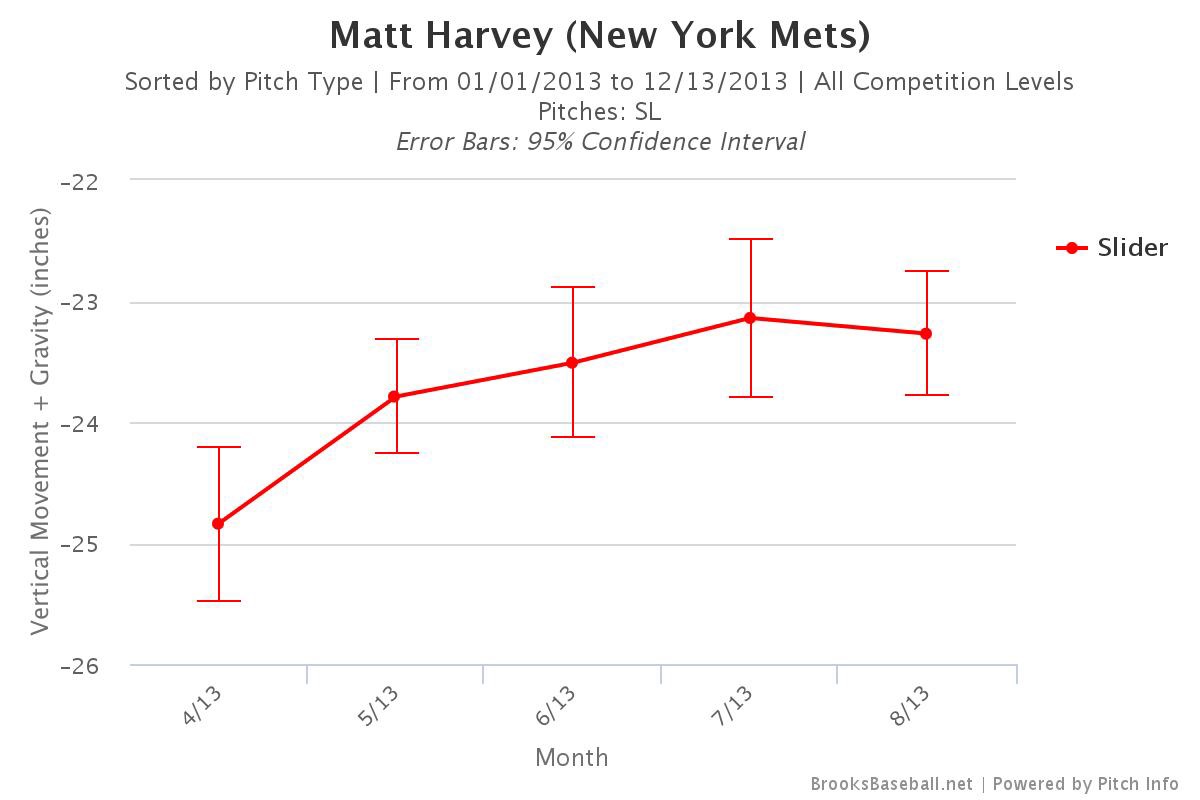
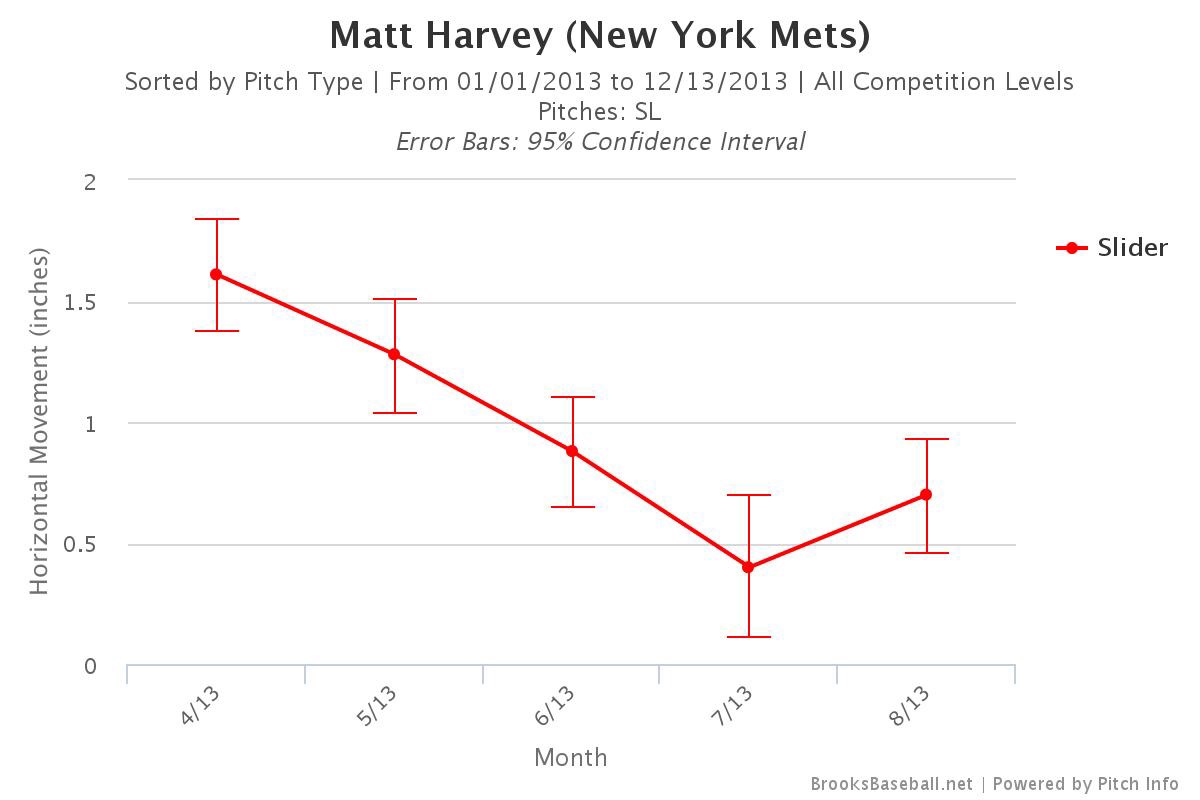 When Harvey threw his slider, it was swung at 49.01% of the time. When batters swung at the pitch, it was fouled off 15.8% of the time. It generated a swing and miss 17.66% of the time, and it was put into play 16.88% of the time. When contact was made, it typically generated a groundball. He only allowed two homeruns off of the pitch. In sum, it was a terrific pitch for him.
Now, if we use Harvey’s word that his slider didn’t return until the last quarter of the season, it means he didn’t have his slider until August. Again, using Brooks Baseball, here are graphs showing the vertical and horizontal movement of Harvey’s slider:
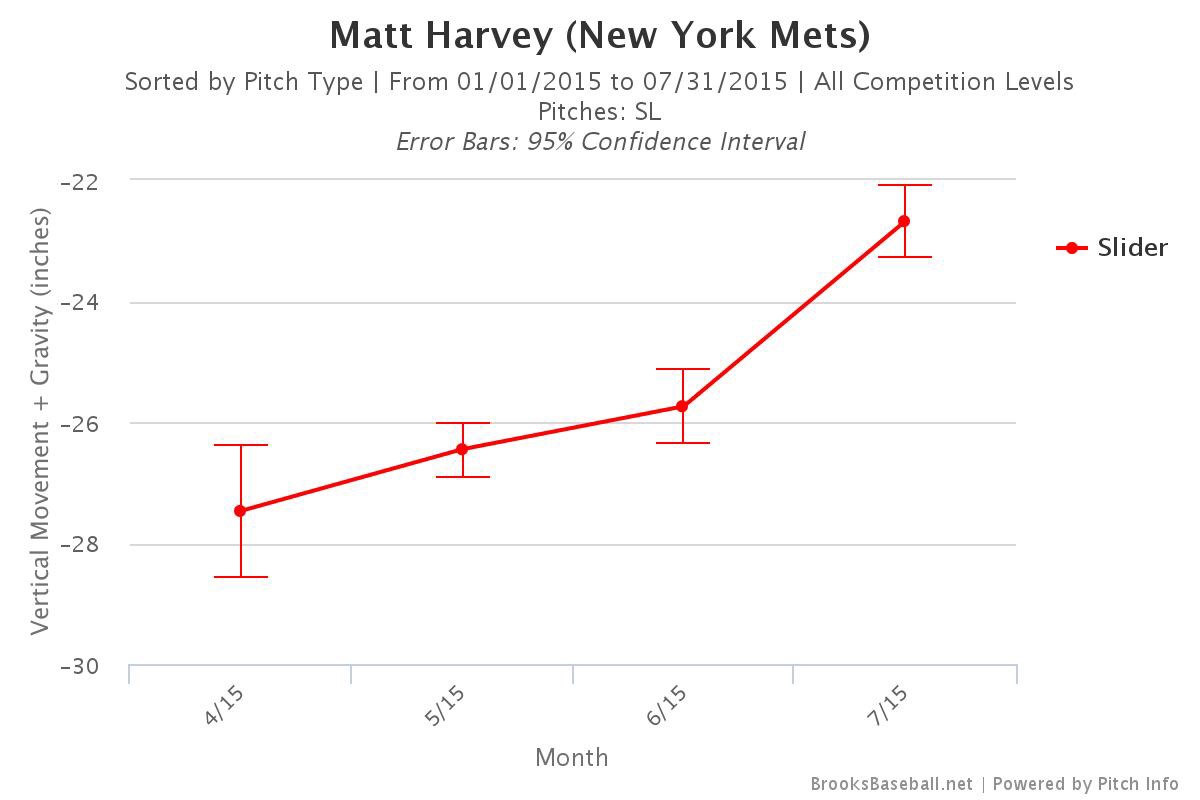
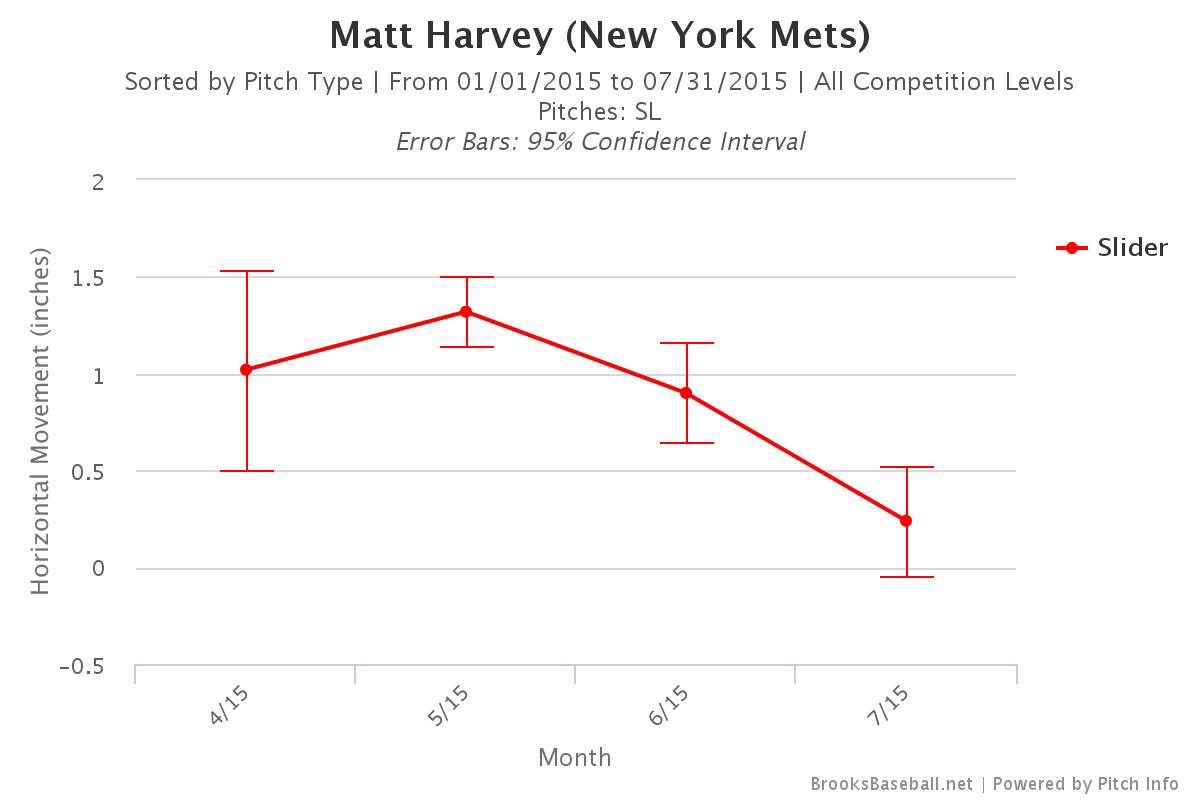
Taking a cursory look, Harvey’s slider had less horizontal and vertical movement. Unsurprisingly, the pitch was not as effective for Harvey.
From April to July, Harvey threw this slider less frequently than his old slider. His slider usage rate dropped from 18.5% to 15.12%. During these months, Harvey relied much more heavily on his fastball. Part of the reason for that might’ve been his lack of confidence with his slider.
When Harvey did throw his slider, it was swung at 43.92% of the time. When batters did swing at the pitch, they fouled it off 9.12% of the time, swung and missed 17.57% of the time, and put it in play 17.57% of the time. While the new slider did generate more groundballs, it did also generated less swings and misses.
More importantly, it needs to be reiterated that Harvey did not have the confidence in this pitch that he did in 2013. To an extent, it changed what he was as a pitcher, and the results showed. From April until July, Harvey went 9-7 with a 2.91 ERA, 1.06 WHIP, and an 8.5 K/9.
Harvey said he found his slider sometime in August. Here’s how his slider moved from August through the postseason:
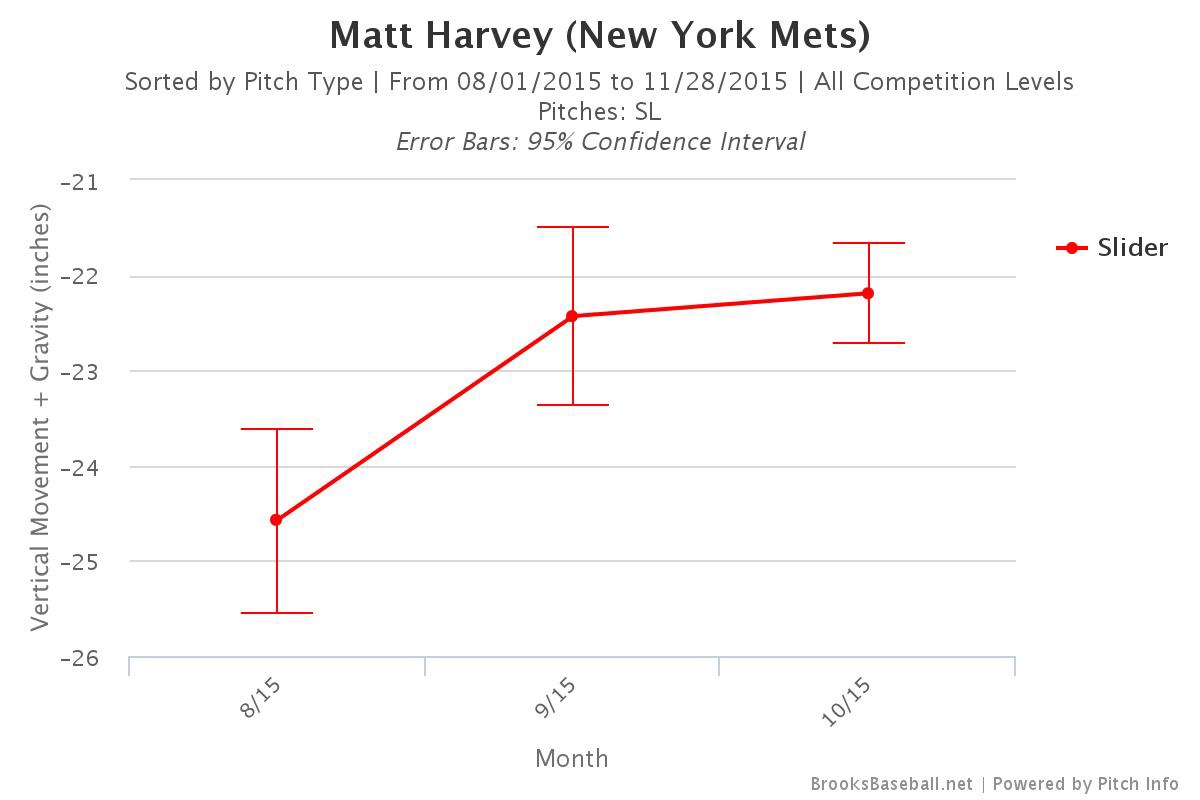
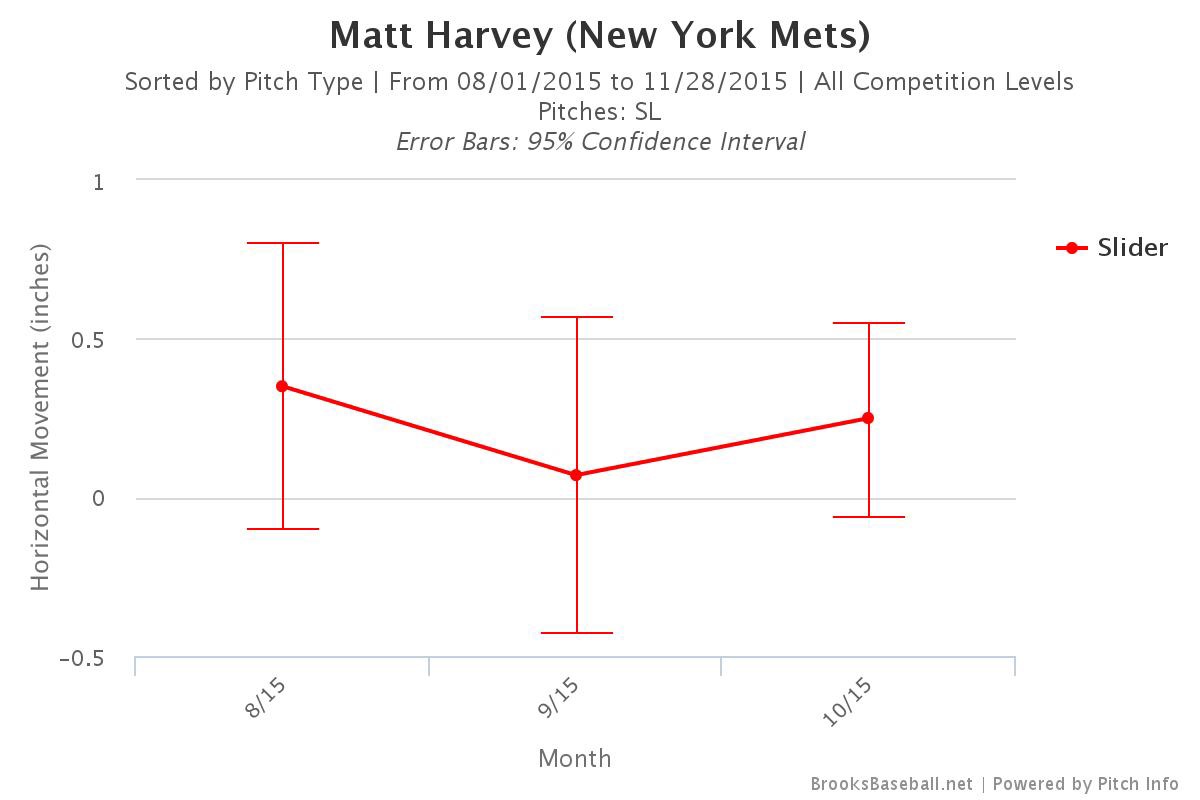 Looking at the charts, Harvey’s slider appeared to get its movement back, especially in August. What is surprising is that Harvey used his slider even less frequently than he had done in the first five months of the season. His slider usage rate dropped to 13.10%.
When he did throw it, it was more effective. Batters swung at the slider 53.03% of the time. When batters did swing at the pitch, it was fouled off 15.91% of the time, swung and missed 18.94% of the time, and put in play 18.94% of the time. Harvey’s rediscovered slider was able to generate a similar percentage of groundballs as he had between April – July.
To close out the regular season, Harvey was 4-1 with a 2.24 ERA, 0.927 WHIP, and a 10.1 K/9. While we should always be careful of drawing conclusions from short sample sizes, it appears that the 2013 Cy Young caliber version of Harvey is back.
Judging from Harvey’s first Spring Training start, he still has his slider. With that, Harvey should have increased confidence, and more importantly better stuff out there in the mound. Now that the slider will be back for a full season, Harvey is back in the Cy Young discussion (if he ever left), and he is primed to dominate the National League.
In 2015, Matt Harvey became the pitcher who has thrown more innings than any other pitcher post-Tommy John surgery. In fact, he became only the fifth pitcher to throw more than 200 innings in the first year post-Tommy John surgery. The other four are:
- Tommy John 207.0 IP
- Jake Westbrook 202.2 IP
- Adam Wainwright 213.2 IP
- John Lackey 215.1 IP
Last year, Harvey had a very good year in his first year back. In determining how next season will go, we should look to these other four pitchers as they are the only other pitchers who have thrown as many innings as Harvey has after Tommy John surgery.
Tommy John
As we all know, Tommy John was the first pitcher to return from Tommy John surgery. Obviously, he had a successful return as physicians have continued to perform the surgery to resuscitate pitchers’ careers.
In 1974, John’s last season before surgery, he went 13-3 with a 2.59 ERA and a 1.144 WHIP. He had a 2.74 FIP and a 132 ERA+. He only lasted 22 starts throwing 159.0 innings before shutting it down, having the sugery, and missing the 1975 season.
In 1976, John returned to the Dodgers. He went 10-10 with a 3.09 ERA and a 1.295 WHIP. He had a 3.08 FIP and a 109 ERA+. He made 31 starts and threw 207.0 innings. He returned, and he was able to pitch. However, he did not pitch nearly as well as he had prior to the surgery.
In 1977, John returned to form. He was 20-7 with a 1.248 WHIP. He had a 3.05 FIP and a 138 ERA+. He made 31 starts throwing 220.1 innings. He finished second in the Cy Young voting. He was better than he was pre-surgery.
With Tommy John, we saw a pitcher get better the second year after his surgery. Also, looking over the rest of his career, John was able to pitch until he was 46 years old. Accordingly, we can reasonably conclude that the 200 innings post-surgery did not negatively impact his career. We can also reasonably conclude that John was better and stronger than those 200+ innings.
Jake Westbrook
In 2008, Westbrook was only able to make five starts before needing Tommy John surgery. In 2007, his last presumably healthy season, he pitched 152.0 innings going 6-9 in 25 starts with a 3.12 ERA, 1.408 WHIP, 4.33 FIP, and a 105 ERA+.
From 2004-2006, Westbrook had pitched over 200 innings in each season with an ERA+ ranging from 93-127. In the 2004-2007 timeframe, Westbrook had a 91.69 MPH fastball, 81.69 MPH change, 80.55 MPH curve, and an 88.40 MPH cutter.
When Westbrook returned from surgery in 2010, he threw 202.2 innings over 33 starts between the Indians and the Cardinals. He had a 4.22 ERA, 1.337 WHIP, 4.22 WHIP, and a 93 ERA+. Upon his return, he threw a 91.07 MPH fastball, 79.63 MPH change, 83.56 MPH slider, 79.78 MPH curve, and an 86.07 MPH cutter.
The following season, Westbrook made 33 starts pitching 183.1 innings. He went 12-9 with a 4.66 ERA, 1.533 WHIP, 4.25 FIP, and an 80 ERA+. He had a 90.76 MPH fastball, 80.22 MPH change, 79.52 MPH curve, 86.44 MPH cutter.
Westbrook’s career would only last two more seasons. He never again reached 200 innings in a season. He didn’t have the rebound Tommy John seemed to have, but then again, Westbrook was never the pitcher John was.
Adam Wainwright
In 2010, Wainwright went 20-11 with a 2.42 ERA, and a 1.051 WHIP in 230.1 innings. He had an ERA+ of 160 and an FIP of 2.86. He was an All Star, finished second in the Cy Young voting, and was a top 20 MVP candidate. He would also need Tommy John surgery after this season.
Before the surgery, Wainwright’s repertoire included a 91.73 MPH sinker, 83.56 MPH change, 74.69 MPH curve, and a 86.44 MPH cutter. With this repertoire, he had consecutive seasons of 200+ innings pitched, 19+ wins, and a sub 2.65 ERA.
After rehabbing during the 2011 season, Wainwright returned to throw 213.2 innings between the regular season and playoffs. Wainwright would go 14-13 with a 3.94 ERA and a 1.248 WHIP in 198.2 innings in the regular season. He had a 96 ERA+ and a 3.10 FIP. He returned with a 90.70 MPH sinker, 84.25 MPH change, 74.50 MPH curve, and an 86.07 MPH cutter.
The following year, Wainwright seemed to return to his pre-Tommy John form. He was 19-9 with a 2.94 ERA and a 1.068 WHIP. He led the league with 241.2 innings pitched. His ERA+ was 127, and his FIP was 2.55. He threw a 92.08 MPH four seamer, a 91.06 MPH sinker, 84.56 MPH change, 76.12 MPH curve, and an 88.60 MPH cutter. He was an All Star, a Gold Glover, a top 20 MVP candidate, and he finished second in the Cy Young voting.
Wainwright followed this up with a strong 2014. He would miss most of 2015 with a torn Achillies. Like Tommy John, he was a much better pitcher the second year after Tommy John surgery.
John Lackey
There was a time it was thought that Lackey forgot how to pitch when he signed a contract with the Red Sox.
In 2009, Lackey’s last year with the Angels, he was 11-8 in 176.1 innings over 27 starts. He had a 3.83 ERA, 1.270 WHIP, 115 ERA+, and a 3.73 FIP. He threw a 92.11 MPH four seamer, 91.83 MPH sinker, 85.68 MPH change, 82.68 MPH slider, and a 79.37 MPH curve.
Interestingly in the two years prior to his surgery, Lackey threw a 92.06 MPH four seamer, 91.42 MPH sinker, 84.83 MPH change, 85.53 MPH slider, and an 80.02 MPH curve. He went 26-23 with a 5.26 ERA, 1.504 WHIP, 82 ERA+, and a 4.21 FIP. While he made 33 starts pitching 216.0 innings in 2010, he was only able to make 28 starts while pitching 160.0 innings in 2011.
In 2013, he returned to throw 215.1 innings between the regular season and postseason. In the regular season, he was 10-13 in 29 starts throwing 189.1 innings. He had a 3.52 ERA, 1.157 WHIP, 117 ERA+, and a 3.86 FIP. He threw a 92.64 MPH four seamer, 92.04 MPH sinker, 84.19 MPH change, 86.28 MPH slider, and an 80.33 MPH curve.
Lackey followed this up with a strong 2014. In 2014, he pitched 198.0 innings going 14-10 in 31 starts between the Red Sox and Cardinals. He had a 1.278 WHIP, 102 ERA+, and a 3.78 FIP. He pitched an additional 13.1 innings in the postseason giving him 213.1 innings total. He threw a 92.7 MPH four seamer, 92.24 MPH sinker, 84.43 MPH change, 84.49 MPH slider, and a 79.10 MPH curve.
Lackey had an even better 2015. Like John and Wainwright, Lackey got better the second year away from Tommy John. As such, in three of the four test cases, pitchers who threw 200 innings in the first year post Tommy John improved the second year after surgery.
Matt Harvey
Matt Harvey has thrown more innings than any other pitcher who has had Tommy John surgery. He’s also the youngest of the group, and he throws the hardest.
In 2013, Harvey was the All Star Game starter and an early Cy Young candidate. In the abbreviated season, he finished fourth in the Cy Young voting. Before he was shut down, he went 9-5 in 26 starts pitching 178.1 innings. He had a 2.27 ERA, 0.931 WHIP, 157 ERA+, and a 2.01 FIP. His FIP lead the league. Before he was shut down, he threw a 96.63 MPH four seamer, an 87.79 MPH change, a 90.50 MPH slider, and an 84.25 MPH curveball.
When Harvey returned, he threw a 96.46 MPH four seamer, 88.78 MPH change, 90.24 MPH slider, and an 84.35 MPH curveball. So, Harvey did return with similar velocity than he had before the surgery. That may be, in part, due to the fact that he had about 18 months of rehab as opposed to the year of rehab he predecessors had.
In the regular season, Harvey pitched 189.1 innings in 29 starts. He went 13-8 with a 2.71 ERA, 1.000 WHIP, 136 ERA+, and a 3.05 FIP. Looking over these numbers, Harvey’s stuff might’ve returned, but he still had a period of adjustment. While he had respectable numbers, he did not produce results similar to what he did in 2013. By judging by the previous pitchers, we can reasonably expect Harvey to return to his 2013 levels.
So overall, now that he has a year under his belt, and he has his full arsenal at his disposal, Matt Harvey is primed to have a Cy Young caliber 2016.
The year was 1996. The Mets were supposed to open the season with a trio of pitchers dubbed Generation K. Jason Isringhausen, Paul Wilson, and Bill Pulsipher were all supposed to usher in the next era of great Mets pitching. They were supposed to win multiple Cy Youngs and World Series titles.
It never happened.
Bill Pulsipher
Pulsipher was the first to arrive on the scene. In his first year in AA, a 20 year old Pulsipher pitched 201.0 innings. The prior year he only pitched 139.2 innings. The following year, 1995, Pulsipher would pitch in AAA and get called up to the majors. He threw 218.1 innings. Pulsipher wouldn’t pitch in 1996 as he had a torn ligament in his pitching elbow.
In Pulsipher’s rookie year, he made 17 starts. He never reached that plateau again. His last major league appearance came in 2005 when he was 31 years old. When Pulsipher made those five appearances, it was the first time he pitched in the big leagues since 2001. Pulsipher finished his career going 13-19 with a 5.15 ERA in 46 starts and 60 relief appearances.
Paul Wilson
Unlike Pulsipher, Wilson burst on the scene in 1996. He was the first overall pick in the 1994 draft after dominating at Florida State. In 1995, Wilson pitched his first season of professional ball, and he pitched well in his 186.2 innings. So well in fact, that the Mets called him up to the majors. He went 5-12 with a 5.38 ERA in 26 starts. His season would end as he needed arthroscopic surgery to repair a torn labrum in his pitching shoulder.
Wilson would never pitch for the Mets again. He would be part of a trade on 2000 for a fourth outfielder in Bubba Trammel and a bullpen arm in Rick White. He finished his career going 40-58 with a 4.86 ERA in 153 starts and 17 relief appearances.
Jason Isringhausen
Without a doubt, Isringhausen had the best career of the Generation K pitchers, and he had to go to the bullpen to do it.
Isringhausen burst on the scene in 1995. In 14 starts with the Mets, he went 9-2 with a 2.81 ERA. Even though he only pitched in half a season, he was so impressive that he finished fourth in the Rookie of the Year voting. While he may not have been the most heralded pitcher of Generation K, he had the most success out of all of them when he was first called up. However, that success would not last as like the other two pitchers, Isringhausen’s arm was a ticking timebomb.
In 1994, the year before Isringhausen pitched in the majors, he threw 193.1 innings. The year before? He threw only 90.1 innings. In his career, Isringhausen would need shoulder surgery and three Tommy John surgeries. This doesn’t even include surgery for a broken wrist because he lost a fight with a water cooler.
Isringhausen would eventually make two All Star teams due to his work as a closer. He would record 300 saves. The last seven were with the Mets in 2011 when he came back on a minor league deal. At that point, he served as a mentor to a young bullpen. It was a nice bookend towards the end of his career. The former young hothead with arm troubles became a veteran leader.
Generation K
These three heralded young pitchers were ruined by the Mets organization. They were needlessly pushed beyond their limits in the minors and majors. As a result, they had a series of shoulder and elbow injuries. The heralded trio would never appear in the same rotation.
Epilogue
It’s been four years since Isringhausen has retired, and now people want to interview him when we talk about how prospects should be handled. Here’s what he revealed about how those Mets handled prospects:
Jason Isringhausen: In the minors if we didn't pitch 9 innings, we got a talking to. We didn't watch pitch counts as much as we do today
— MLB Network Radio on SiriusXM (@MLBNetworkRadio) March 3, 2016
Twenty years later, the Mets have a new trio, who for some reason don’t have a great nickname like Generation K. While Jacob deGrom and Matt Harvey have had Tommy John surgery, the Mets handle their young aces much better now. They took better care of their pitchers during the rehabilitation process. Last year, we saw deGrom and Harvey team up with Noah Syndergaard to pitch the Mets into the World Series.
This was supposed to happen 20 years ago. It’s happening now. So next time, the Mets are too patient with a player, or a player or his agent voice concerns over a pitcher’s workload, remember Mets fans were robbed of seeing three aces in one staff due to over usage of the young pitchers.
I’m sure innings limits, six man rotations, and skipped starts will be a story line at some point in 2016. When it does, embrace it because the Mets not using that forward thinking might’ve cost at least one World Series title. Young pitchers are fragile, and they need to he handled as such. If you don’t, the workload could lead to injuries and/or ruined careers. Next thing you know, the window to win a World Series is slammed shut.
I’m not willing to see another chance go by the wayside due to some meaningless starts again.

When we talk about the Mets locking up their young pitching, the general consensus is Jacob deGrom is the person most likely to sign an extension before he hits free agency.
For his part, deGrom has said he is open to an extension. He is the oldest pitcher of the group. His agent isn’t Scott Boras. He’s not a local kid who grew up rooting for the Yankees. deGrom seems more affable than a Matt Harvey, so most assume he will re-sign with the Mets at a somewhat discounted rate. Well, today that notion flew out the window:
Statement from Brodie Van Wagenen, Jacob deGrom's agent. pic.twitter.com/6ARbCyaUeb
— Marc Carig (@MarcCarig) March 4, 2016
Let’s not overstate the meaning of this. deGrom thought he was worth more than the $607,500 he is going to be paid next year. He wasn’t going to agree to it, but under the Collective Bargaining Agreement, he had no recourse but to not sign the deal. As is their right, the Mets accepted deGrom’s decision and then told him he was going to be paid that amount whether he liked it or not.
This is not a strain in the relationship between deGrom and the Mets. The only thing that can be gleaned from this is deGrom is not willing to sign an under-value market contract. So what is his market?
The Mets will not have to pay deGrom next year until he hits arbitration as a Super Two player. Judging from Harvey’s first year of arbitration, he will be slated to receive around $4.325 million. If deGrom fights for much more than that, we will all know the type of fight the Mets will have when deGrom gets closer to free agency.
As it stands, deGrom will become a free agent two years after Harvey. When Harvey does become a free agent, it will be around the time the Mets could begin talks with deGrom on an extension to buy out his remaining years of arbitration and a couple of years of his free agency.
When deGrom does hit free agency, he will be 32 years old. If he signs two years prior to free agency, he will be 30 years old. We saw this offseason that 30 year old pitchers can receive massive free agent deals. David Price just signed a 7 year $217 million contract with an opt out after three years. For his part, Zack Greinke, 32, signed a six year $206 million contract. These two pitchers are being paid between $30 – $35 million per year.
Now, deGrom doesn’t have Price’s or Greinke’s credentials . . . yet. deGrom won the Rookie of the Year award in 2014. He was the star at the All Star Game in 2015. He finished Top 10 in Cy Young voting. He had a historic start to the postseason out-dueling Clayton Kershaw in Game One. He then beat the aforementioned Greinke in Game Five. If deGrom continues on this path, he will certainly be worth something in the ballpark of $30 million per year. deGrom’s actions today certainly points to him not wanting anything less than what he thinks he is worth.
Now, on an extension, the Mets can manipulate how much deGrom earns when and try to give him deferred money. However, it is fair to assume deGrom could command close to an average annual value of $30 million per year. As it stands, it appears the Mets will have between $35.5 – $49.5 million to spend on pitching and a bench.
Therefore, as it stands, if deGrom is going to insist on an extension at what he perceives as his value, as is his right, the Mets will have to expand the payroll beyond $140 million to lock up their pitching.

In honor of Dr. Seuss’ birthday, here is my adapted Mets Dr. Seuss story to read with your little Mets fan.

“One Strike, Two Strikes, Three Strikes, You’re Out”
One Strike. Two Strikes. Three Strikes. You’re out.
Yes. Some are curves. And some are fast. Some are slow. Some are from Matz.
Some are from Jake. With strikes batters take. Even if these are batters that rake. Why do batters who rake take pitches from Jake? I do not know. Maybe the pitch did break.
Some pitchers are thin. Colon is fat. The fat one can pounce off the mound with the agility of a cat.
From here to there, from here to there, strikeouts are everywhere.
Some strikes bring heat. The heat is neat and sends batters to their seat.
Oh me! Oh my! Oh me! Oh my! What a lot of strikes go by.
Some are two seamers. Some are four. Some are just mean and batters want no more.
How do they do it? I cannot say. But I bet the pitchers trained very hard along the way.
We see the pitches come. We see the pitches go. Some are fast. And some are slow. Some are high. And some are low. Not one of them is like another. Don’t ask us why. Go ask your mother.
Say! Look at the strikeouts? One, two, three . . . . How many strikeouts do I see? One, two, three, four, five, six, seven, eight, nine, ten. The pitcher has eleven. Eleven! That’s nothing new. The next pitcher will do it too!
Swing! Swing! Swing! You ever see such a thing? Not one swing hit anything. But we know the pitchers have the ball on the string. The string makes the ball do anything. So . . . if you like to Swing! Swing! at anything just swing at the ball on a string and the strikeouts will sting.
Who am I? My name is Thor. When I strike someone out. I want more. It is so good. It is so right. The batters strike out all day and night. And when I strike them out, Oh Dear! The batters have had it up to here!
We like the strikes. We like them in threes. Each strike sets up a hitter, you see. We like the strikes and this is why: the strikes makes outs and batters go bye-bye.
Hello there, Zack. How do you do? Tell me, tell how do you plan your attack? How did you do that? Was the pitch new? Please tell me Zack. I do not like this batter at all. A lot of strikes the umpire did call. A National, a Phillie, a Marlin, a Brave. Oh! He’s out! The strikeout was my fave!
Oh dear! Oh dear! The batter is in fear. How does the pitcher throw that sphere? Why did the crowd just cheer? It seems another strike out is near. Say look! The ball did reappear. But he is out. So you can cheer. Again, cheer for the strikeouts my dear.
The batter is old. The batter is cold. The pitcher has a pitch that is bold. The pitch is off. The batter will fold. The pitch is off. The batter did fold. The pitcher’s pitch was bold. The batter is cold. The batter is old. And now the story of the at bat has been told.
The batter took a look. His confidence is shook. On the pitch, he did look. On the pitch, he did look. It was a hook, and the confidence was shook. We saw him sit and give a look. He took a look at the hook and he shook. The hook did the deed for the pitch the batter just took. SO . . . what good is a look at the hook he just took?
The batters were out, and they’ll lose some sleep. But not even counting sheep will help them sleep. By the light of the moon, by light of the star, they struck out all night on pitches near and far. They would never walk. Sitting in the dugout they are.
I do not like this ump so well. All he does is yell, yell, yell. This game is turning into a route. When the Mets strike all the batters out. The batters are quiet as a mouse. All they can do now is rouse.
At our house, we have stands. Those stands are full of fans. With two strikes, the fans give the pitcher a hand. Hands from fans is very good. Have you heard a hand from fans? You should.
I like to play. How I like to play! So, if I may, I play everyday. In May, I play everyday. I play everyday in May.
It is fun to win if you win with a grin. I grin and win with pitchers who do everything. I grin wide, and the batters heads hang low, their swings were so bad, and too slow.
This batter I think will blink. His strikeout will be written in ink. He really does stink. He hates to stink, and stink, and stink. The stink makes his face turn pink. The pink from the stink is after a pitcher’s wink. The batter hates the stink, the pink, and the wink. SO . . . if you really stink, the pitcher will give you a wink, after the strikeout is written in ink.
Hop! Hop! Hop! The batter went plop. Familia likes to hop from batter flop to batter flop. Familia hops from the mound and then . . . Hop! Hop! The ball goes from the catcher to third and around. Familia likes to hop all day and night from mound to ground and ground to mound. Why does he hop, hop, hop? The rally did stop.
Shush! Shush! Shush! Shush! Groan! Groan! Groan! Groan! Pitchers have fans making hitters shush and groan. All batters who shush and groan will have better luck when they return home.
Who is this Met? Say! He doesn’t break a sweat. You may never yet met a Met, I bet, who will let a batter make him sweat.
Did you ever make a batter see red? Did you ever strike a batter out and send them to bed? Did you ever have a batter shaking his head wondering how? Well, Mets pitchers can do it. They know how. If you ever did, you should. These things are fun and fun is good.
Hello! Hello! Are you there? Hello? You’re up to bat, hello! I said hello. Can you hear me Joe? Oh no. I can not hear you at all. I did not hear your call at all. I was not paying attention; want to know why. I’m not willing to face a Mets pitcher. Good-bye!
From near to far, from here to there, the Mets are striking batters out everywhere. These young Mets are called aces. They strike out the batters each one faces. Their pitches are fast . . . so fast, they say, they strikeout batters everyday.
Who am I? I’m the Dark Knight. I throw the ball with great might. My slider has bite and the spin is real tight. When I pitch to strikeout a batter without much fight, I pitch the ball at the right height. Then I say, “You have no fight against a slider that will bite!” And I give batters great fright as they strike out all night. So . . . if your plight is my might all night, you might swing with fright at the pitches from the Dark Knight.
Our house is a place called Citi. During each game all we feel for batters is pity. Would opponents like to play against our pitchers in a game? Come down! There’s only one great pitching staff in town.
Look at we did in the park in the dark. We only win at home. A visitor’s chances of winning are stark. We will win at our house. The win totals will grow and grow. All of baseball will take notice. Our pitching prowess will you will soon know.
And now good night. It is time to sleep. Our pitchers will soon put you to sleep as the hole you’re in is too deep. Today is gone. Today was fun. Tomorrow is another one. Every day, from here to there, Mets pitchers are striking out batters everywhere.