The Mets have three big holes due to three players going down with significant injuries. Lucas Duda has a stress fracture in his back. David Wright has a herniated disc in his neck in addition to his spinal stenosis. Travis d’Arnaud has a torn rotator cuff in his throwing shoulder.
With this in mind, the Mets have to answer a few questions as the trade deadline approaches:
- Are any of the three players likely to return?
- Do the Mets have viable internal options to replace that player?
- What is out there on the trade market?
Working backwards, we see the biggest name on the trade market is going to be Jonathan Lucroy.
Lucroy is having a terrific year this season hitting .304/.361/.515 with nine homeruns and 28 RBI. It shouldn’t be a surprise that Lucroy is playing this well as he is better in even numbered years than odd numbered years since he became a full time starter in 2011. In 2012, his OPS+ was 132; in 2014, it was 131, and this year it is 132. In short, we can reasonably expect Lucroy to keep this up.
Lucroy’s just as successful behind the plate. He is a good pitch framer. He’s gunned down 42.9% of would be basestealers. Simply put, Lucroy is as much of a complete catcher as there is in the game. He’s also a massive upgrade over d’Arnaud’s replacements.
Since d’Arnaud’s last game on April 25th, Rene Rivera and Kevin Plawecki have combined to hit .190/.273/.289. While they have been good pitch framers, and Rivera has been a stabilizing force behind the plate, Plawecki and Rivera have both established themselves as poor hitting backup catchers. The Mets need a starting catcher that can hit. That was supposed to be d’Arnaud. It could be Lucroy now.
With that said, the Mets should pass on Lucroy despite his being better than any of the Mets catchers.
The reason the Mets can do this is because d’Arnaud has begun playing in rehab games, and he has had no setbacks this far. He will begin catching in rehab games soon. As per baseball’s 20 game rehab rule, d’Arnaud is set to return to the Mets on Sunday, June 26th at the latest.
Assuming he’s healthy, d’Arnaud can continue being a good overall catcher. He’s a better than average pitch framer. He’s coming off a .268/.340/.485 season. He hit three homeruns in the postseason last year. The only issue that remains is if he can throw out base stealers with his injured shoulder. With the way Mets pitchers hold on base runners, that may not be as big an issue as one might normally believe.
With his injury history, there may come a point in time the Mets decide to move on from d’Arnaud. That time may come sooner rather than later. However, now is not that time. The Mets have bigger issues.
James Loney has been a fine stopgap at first base, but he’s still only hitting .250/.302/.350. He’s not the long term solution. Wilmer Flores has done a yeoman’s job at third hitting .389/.450/.500. He is been much better with his approach at the plate. He is working the counts and starting to draw some walks. He also has an unsustainably high .500 BABIP leading you to believe he is due for a regression back to the .255/.292/.385 career hitter he is. Overall, the Mets continue to have long term holes at first and third with no one really knowing when or if Wright and Duda can return.
Accordingly, the Mets need to husband their resources so they can make a move to acquire a third and/or first baseman. That’s not Lucroy UNLESS the Mets feel comfortable paying the huge price he’ll command on the trade market to play first base . . . a position he has only played 43 games in his seven year career.
Editor’s Note: this was first published metsmerizedonline.com
There are many skills you need to have as a father that you never thought you would need. One skill I’ve rarely if ever seen discussed is being skilled in carnival games.
You go to a fair, carnival, or the Jersey Shore, there are games all over the place with these massive prizes that are bright, vibrant colors intended to catch your child’s eye and make them beg you to win it for them. At this point, your choice is clear – you either deal with the kid who is begging and/or throwing a tantrum over the prize they’ll never use, or you shell out a lot of money trying to win that prize. On a hot and sticky June day, the former really isn’t much of an option.
Fortunately, for me, I’m really good at carnival games. What was once a useless skill is now of vital importance. Two months ago, it was the ring toss. Today, it was Down a Clown. We’ve all seen some version of it somewhere:


Note: not the actual game played today.
Essentially, you get bean bags to try to knock down three clowns. Most fail. Even people who are good at baseball or have decent aim fail. The reason they fail is the big windup. Instead, they need to throw it more like a catcher. Think Paul Lo Duca pitching to David Wright in the 2006 Homerun Derby.
You just want to have that catcher’s snap throw. The shorter the windup, the less likely you’re going to be off target.
In any event, I got it first try, and my son was first given an inflatable Yankees bat, which I’m proud to say he didn’t want. Instead, we walked away with an inflatable hammer:
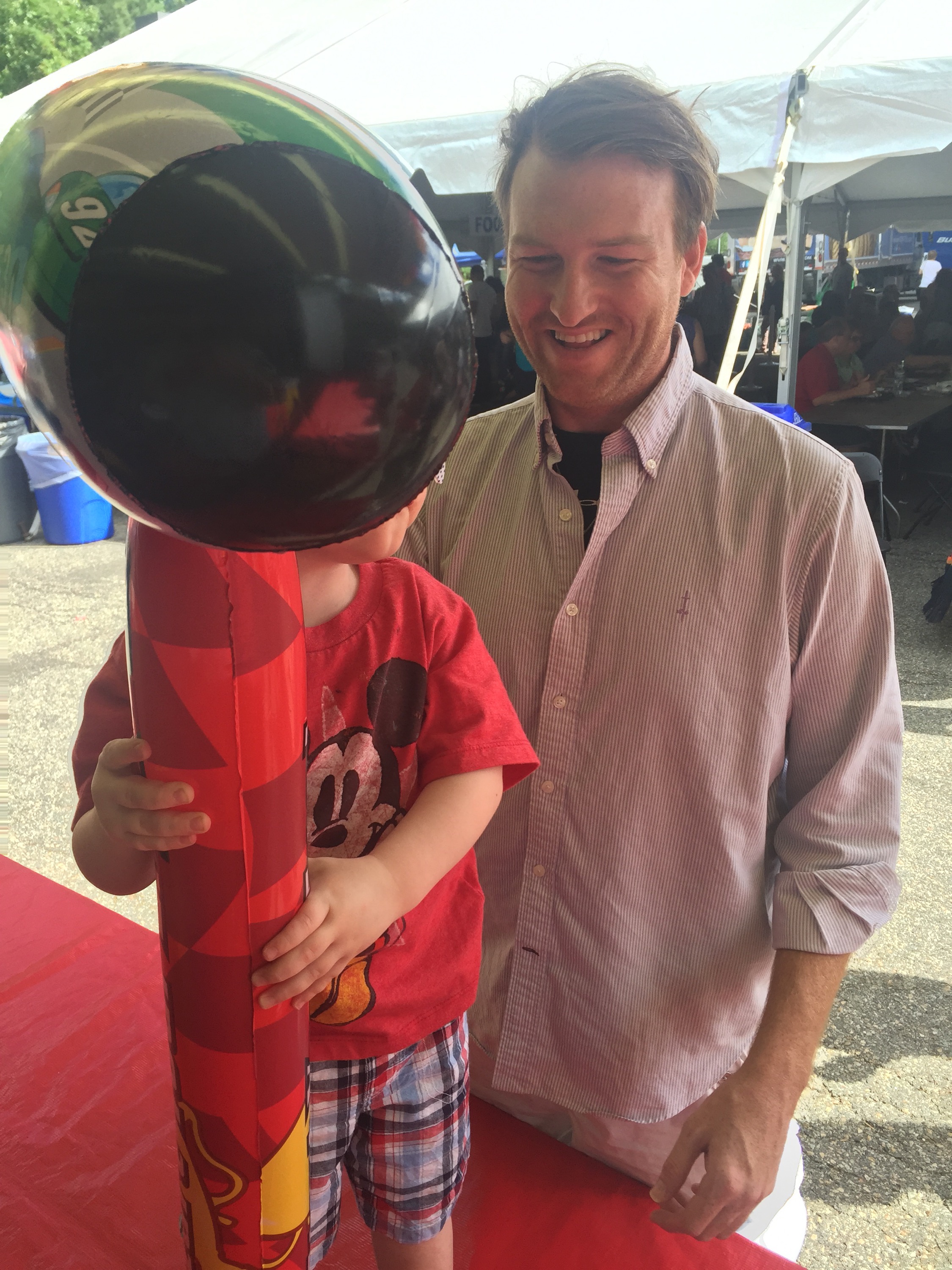
It sure was fun blowing that thing up while my brother was trying to deflate it at the same time. It was also fun giving a two year old what really amounted to an inflatable weapon. With that said, happy son means we all had fun!
Better yet, we didn’t have to see the putrid effort the Mets put up on Sunday. At least now, we have the tool to hammer some fundamentals into them.
There’s been a new addition to some family friendly chain restaurants like Red Robin and Chilis. It’s called a Ziosk:

Initially, when my son was younger, I thought these were a godsend. If you need something, just order it from the Ziosk or hit the button to summon your server. Instead of waiting for your server to pay your check, you can pay right from the Ziosk. It was absolutely amazing.
Now? Not so much.
The Ziosk is more than an ordering service. It also has a lot of games for purchase. It gets added right onto your bill. Better yet, it’s right at your two year old’s eye level. It’s a distraction. It appears to be a toy for them. It’s not.
Basically, the Ziosk is a parent of a toddler’s worst nightmare. It’s exacerbated by the fact that there really is no place on the table to hide it. It’s just there the entire meal. Getting two year olds to focus can be a frustrating experience at times. It’s even worse with a giant distraction at the table. That’s what the Ziosk is.
Fortunately, when you want to leave with your child upset over his/her inability to play with the Ziosk, you can use the Ziosk to pay the check and get out of there. In that respect, I guess the Ziosk has served its purpose of being convenient.
To their credit, the Mets have built an organization deep with pitching talent. When you do that, you are eventually going to be faced with a difficult decision over who to keep and who to trade, who to promote and who to keep down, and who to protect and who to expose in the Rule 5 Draft. These are difficult and challenging decisions. With that said, this is why the front office is paid the money that they are paid. This past year the Mets had a choice between protecting Matthew Bowman or Jeff Walters in the Rule 5 Draft.
Bowman was a 2012 13th round selection out of Princeton University. He is a four pitch pitcher with no real outstanding out pitch. He was projected as a back of the rotation starter for a Mets organization that is deep in pitching talent. Therefore, if Bowman was ever going to make it to the majors, he was going to have to make it in the bullpen as a swing guy like a Logan Verrett or a Sean Gilmartin. With that in mind, the Mets decided to protect the player who had already had success in the bullpen.
That was their 2010 seventh round selection out off the University of Georgia, Jeff Walters. Walters possessed a 95+ MPH fastball with a hard slider he had difficulty controlling. In 2013, he had a breakout season in AA going 4-3 with a 2.01 ERA and a 1.017 WHIP. In 2014, he was promoted to AAA, and he struggled mightily. As it turned out, Walters needed Tommy John surgery costing him the end of the 2014 season and the beginning of the 2015 season. When he returned, he started working his way back up the Mets minor league system starting with Savannah. He ended the year in AA where he went 2-0 with a 1.96 ERA and a 1.091 WHIP in 18 innings.
Now, it was likely that either Bowman or Walters were going to be picked in the Rule 5 draft given their repertoire and success in the minor leagues. You could’ve easily made a case for either player. The Mets chose Bowman. Unfortunately, the Mets chose wrong.
With the Cardinals this year, Bowman has been pitching well out of the bullpen. In his 19 appearances, he is 1-1 with a 3.60 ERA and a 1.080WHIP. Batters are only hitting .232/.286/.347. To put it in perspective, current Mets reliever Jim Henderson is a 1-2 with a 3.52 ERA and a 1.348 WHIP. Batters are hitting .221/.313/.384 against him. So overall, Bowman has not only pitched well this year, but he has also pitched well enough to be considered for the current Mets bullpen, which has been good all year.
Walters, on the other hand, has not been very good. Walters reported to AAA where he has pitched in 26 games going 0-2 with a 9.22 ERA and a 2.268 WHIP. Due to the Mets current roster crunch with the various injuries at the major league level, Walters was the natural choice to remove from the 40 man roster. Unfortunately, Walters hasn’t rewarded the Mets faith in him when they selected him over Bowman.
This predicament only serves to highlight the fact that the Mets have a strong minor league system. Hopefully, Walters will rebound and return to the form the Mets had seen from him in AA. In the meantime, Bowman continues to have success for the Cardinals. Fortunately, the Mets decision to keep Walters over Bowman hasn’t served to come back and bite them. Hopefully, it never will.
Editor’s Note: this was first published on metsminors.net
The Mets and Logan Verrett were in a difficult spot. With the doubleheader, some questionable bullpen management during the week, and Jim Henderson‘s torn nail, Verrett was going to have to go past the point he was probably comfortable going.
Verrett’s last appearance was June 7th. His last start was May 14th. He had not thrown more than 75 pitches since April 19th. This was not a recipe for success. It was exacerbated by Verrett going up against a good Brewers offense in a hitter’s park. The results were not good.
Verrett lasted four innings throwing 87 pitches. He was victimized by the walk and the longball. He allowed four walks and three homeruns. The homeruns to Chris Carter and Ryan Braun could be reasonably anticipated. The homerun to opposing pitcher Wily Peralta, even if Verret was absolutely spent, was just plain ponderous. It was an absolute no doubter to dead center.
.@WilyPeralta38 just wanted to remind everyone that #PitchersRake! https://t.co/iFkDx4McUo pic.twitter.com/T2M3TVF0vc
— Milwaukee Brewers (@Brewers) June 11, 2016
Verrett finished the inning, but he could go no further. Hansel Robles came in and pitched a scoreless fifth and sixth. Antonio Bastardo pitched the final two innings making sure to put the game out of reach along the way allowing three runs on two homers.
This means the Mets bullpen is down three pitchers tomorrow. It could be four depending on Henderson’s finger nail. Addison Reed has pitched three innings over the last three days. Same goes for Jeurys Familia. The Mets are in need of a fresh arm. To do that, someone has to go down.
Robles and Verrett are the only two players with options. Robles threw far fewer pitches, and he has shown the ability to recover fast in his young career. Therefore, the choice is Verrett. However, the problem isn’t who to send down, it’s who to call up.
The Mets could call up Erik Goeddel who was good with the Mets last year with a 2.43 ERA and a 0.990 WHIP. However, he’s struggling in AAA last year. Josh Edgin has not allowed a run this year, but he’s still coming back from Tommy John surgery. Rafael Montero and Sean Gilmartin could go multiple innings, but they will not be available with each having made a start the past two nights.
It’s a tough position to be in, but it’s no tougher than scoring three runs in five innings against a truly terrible pitcher:
Blame Verrett all you want but the Mets did nothing against a pitcher who entered the game with a 6.79 ERA & a 1.934 WHIP
— Mets Daddy (@MetsDaddy2013) June 11, 2016
It’s frustrating to watch even with Curtis Granderson having a great game:
Granderson just became the 3rd Met with a single, triple, homer & stolen base in the same game, joining @20Hojo (8/4/89) & Reyes (6/23/10).
— Ed Leyro (@Studi_Metsimus) June 11, 2016
It’s still not as frustrating as watching the Mets constantly playing short-handed. It’ll continue with Neil Walker leaving the game with back problems. It’ll continue with a spent and somewhat injured bullpen. The Mets could solve one problem by sending down Verrett and caling someone else up.
They won’t. It’s frustrating, even more frustrating than watching the Mets not take advantage of a very bad pitcher.
Despite the Pirates being in the thick of the Wild Card race, and there being no reason to expect for them to drop out of the race, Jon Heyman wrote in his Today’s Knuckleball article that the Pirates could be willing to part with David Freese at the trade deadline. Due to the Mets injury situation, Heyman linked Freese to the Mets.
Assuming that Freese is truly available, and the price is reasonable, Freese would be a solid addition to the New York Mets.
For his career, Freese is a career .277/.346/.418 hitter with a 112 career OPS+ and 115 wRC+. His 162 game averages are 30 doubles, 15 homeruns, and 77 RBI. With the exception of a poor 2013 season, which has proven to be an outlier, Freese has been an average defensive third baseman. Over the course of his career, Freese has been a good hitter and a solid defender. He would be a benefit to almost any team with postseason aspirations.
Here’s the catch: Freese has been even better this year.
This year, Freese is hitting .292/.373/.427 with a 127 OPS+ and a 124 wRC+ in 51 games. This could be construed as a small sample size, but there are some underlying numbers that suggest his current batting line will be sustainable over the course of a full season. First, Freese is still beating up on lefties like he has done his whole career. He has faced lefties in 21 games this year, and he is hitting .366/.409/.610 against them. For a Mets team that has been having some difficulty against lefties, especially with the Nationals Gio Gonzalez, adding Freese’s bat would be beneficial.
However, Freese’s numbers are not just reflective of his facing lefties. Freese is also hitting better against rightes. For his career, Freese has been a .269/.337/.401 hitter against righties. He is now hitting .269/.362/.369 against them. It’s a moderate, but important, improvement. The underlying reason for this improvement may be his approach at the plate. Freese has been hitting a lot of groundballs this year. Freese is hitting the ball on the ground 64.2% of the time. Normally, in this age of the shift, this could be construed as a negative. Many times, we have seen batters like Curtis Granderson pull balls in to the shift. That isn’t the case with Freese. Historically, Freese has hit the ball to all fields. In fact, over the course of his career, Freese pulls the ball 35.1% of the time, hits it up the middle 36.4% of the time, and goes to the opposite field 28.5% of the time. In essence, it is hard to defend a player like that with the shift.
One of the corresponding factors to Freese hitting more groundballs is his hitting fewer flyballs. Typically, unless you are hitting the ball over the fence, flyballs are turned into outs. With Freese hitting fewer flyballs there is a decreased chance he will hit into an out. The increased groundball rate coupled with the decreased flyball rate are strong factors in Freese’s high .397 BABIP. Typically, the league average is .300, which would lead many to believe that Freese is due for a regression. Even if that were to happen, keep in mind Freese’s career BABIP is .342. In essence, he is someone who’s natural talents led to a higher BABIP. Therefore, even if Freese were due for a regression, it wouldn’t be as drastic as one might believe it to be.
Another benefit to adding Freese is the fact that he’s a more versatile player now. Since he has joined the Pirates, Freese has also played at first and second in addition to third. Thereofr,e even if David Wright and Lucas Duda were to return to the Mets completely healthy, Freese would still be an useful player off the bench.
Overall, Freese appears to be a better hitter and a more versatile fielder. He’s exactly the type of player the Mets should be looking to add to the team. The only thing standing in the way of that happening is the Pirates. They first have to make him available, and the Mets need to be willing to meet their demands. That is much easier said than done.
Editor’s Note: this was first published on metsmerizedonline.com
As Lou Brown said, “Ok, we won a game yesterday. If we win today, it’s called ‘two in a row.’ And if we win again tomorrow, it’s called ‘a winning streak’ . . . . It has happened before!” That’s where Matt Harvey . He’s on a streak of good starts.
On May 30th, he pitched seven innings allowing two hits, no runs, and one walk with six strikeouts. On June 5th, he pitched seven innings allowing four hits, one earned, and no walks with three strikeouts. Tonight, he pitched six innings allowing two hits, one earned, and two walks with eight strikeouts. That’s three straight starts allowing one run or less. That’s vintage Harvey.
Harvey did get some help in the third when replay overturned a run:
https://twitter.com/mlbreplays/status/741439922691706881
Initially, the umpires ruled Aaron Hill got in under Kevin Plawecki‘s tag. Upon replay, it was ruled Hill was out, and the run was taken off the board. The Brewers would have to wait until the fifth to score.
Ex-Met Kirk Nieuwenhuis hit a one out triple to right, and he would score on Ramon Flores‘ sacrifice fly to left field. It was going to take a good throw to get Kirk out, but Alejandro De Aza was not up to the task. First, it got caught in his glove. Next, he double clutched. Finally, the throw was up the first base line. It was just one part of a bad game for De Aza.
In the first, he erased a Curtis Granderson leadoff walk by hitting into a double play. In the fifth Brewers starter, Junior Guerrera, intentionally walked Granderson to load the bases with two outs to face De Aza. De Aza grounded out meekly to second. Overall, he was 0-5.
Overall, the Mets batters weren’t hitting well. Even when Kelly Johnson hit a double in first at bat back with the Mets, he followed it up with a TOOBLAN. With no force play, he was slow (somewhat frozen) on a ball hit to the shortstop. He was tagged out, and Harvey was nailed at first ending the inning.
FINALLY, in the sixth the Mets gave Harvey some run support after not giving him any run support in 15 innings. Yoenis Cespedes did this:
433 Feet of Love.
From, @ynscspds #LGM pic.twitter.com/7Z391YzADo
— New York Mets (@Mets) June 11, 2016
He hit a laser to right center tying the game at 1-1. Unfortunately, that was all the run support Harvey would get as Nieuwenhuis did this to Johnson:
Harvey had a great start and a no decision. It would become a battle of the bullpens. It was a battle of escape acts.
Hansel Robles entered the game in the seventh, and it appeared like his struggles were going to continue. It was first and second with no outs with the newly minted Mets killer Nieuwenhuis at the plate. Robles struck him out, and then he got the next two batters to fly out to get out of the jam. Antonio Bastardo followed up with a 1-2-3 eighth.
Jeremy Jeffres did his Robles’ impersonation in the ninth by getting out of a bases loaded no out jam. First, Plawecki popped up to second. Neil Walker pinch hit for Bastardo and struck out looking. Granderson then meekly grounded out to second.
It was then Jim Henderson‘s turn for the Houdini act. He issued a one out walk to Jonathan Lucroy, who was pinch run for by Keon Broxton. Broxton would easily steal second, and he would go to third on a comedy of errors. Plawecki would bounce the ball 10 feet short of second, and the ball would go through Johnson’s legs allowing Broxton to go to third. After a walk to Chris Carter, he struck out Nieuwenhuis on three straight pitches, and he got Hill to ground out to end the inning.
Henderson was then pressed for a second inning out of the pen despite his injury history. The reason was unavailable after pitching three innings in today days, and Logan Verrett will start tomorrow due to the doubleheader. After walking the leadoff hitter Flores, Henderson had to leave the game with what appeared to be a blister. That made it Jerry Blevins turn to get out of the jam.
After a sac bunt, Blevins had a runner on second with one out, and he threw a pitch in the dirt. Flores took off for third, and he made it safely for a split second. Matt Reynolds, who was double switched into the game when Blevins entered the game, kept the tag on Flores, so when Flores oversold third, he was out. Rally over.
Wilmer Flores then cleared the Flores’ good surname in the 11th. He ripped a one out double pushing Asdrubal Cabrera to third. After Johnson was intentionally walked, the Mets found themselves in the same situation as they did in the ninth – bases loaded and no outs. Plawecki fouled out, and then all hell broke loose.
Reynolds hit a sharp liner at Jonathan Villar, who dropped it. He flipped the ball to Scooter Gennett, who stepped on second while Flores was standing there. By Gennett stepping on the bag, Johnson was out, but the Brewers didn’t know it. They didn’t know it because the second base umpire somehow called him safe. They got Johnson, who was already out, in a rundown. While this was happening Cabrera scored making it 2-1. Keith Hernandez put it best when he said everybody had to do back to school.
Jeurys Familia then came in and recorded his 21st save in his 21st chance to end all of this tomfoolery.
Game Notes: Harvey is the all-time leader for winless starts in which he’s allowed one run or less through a pitchers first 78 starts. It gets better:
This seems hard to fathom: Matt Harvey is now 15-5 with 16 no-decisions in his career in starts allowing one run or fewer.
— Adam Rubin (@AdamRubinMedia) June 11, 2016
Well, it appears that Matt Harvey will be gone in 2019 if not sooner. According to Jon Heyman of Today’s Knuckleball, a Mets impression of Harvey is, “He’s Gone.”
What we don’t know is why. Is Harvey gone because he is intent on testing free agency? Is Harvey gone because the Mets don’t like the negative media attention that surrounds him? Is Harvey gone because there are clubhouse conflicts? Is Harvey gone because the Mets just don’t want to spend the money? Is Harvey gone because the Mets believe his early season struggles are more indicative of a decline than a mechanical issue? Fact is, we don’t know, and we may never know.
What we do know is that the Mets were lucky to have Harvey. He was the first piece of the Mets turnaround when he burst on the scene in 2013. He had amazing game after amazing game. He almost pitched a perfect game against the White Sox, and he started the All Star Game. His return in 2015 was a key part of the Mets winning the division and going to the World Series. He almost willed the Mets to victory in Game 5. Time and again, Harvey has delivered. The hope is that he can help the Mets deliver a World Series title before he departs.
The hope now is that if the Mets are intent on moving on from Matt Harvey that they at least lock up Jacob deGrom and Noah Syndergaard. Both players have been just as instrumental as Harvey has been in this great turnaround. Unfortunately, according to Heyman, the Mets haven’t approached either one of them about a long term contract. Hopefully, the Mets will. This team is built on pitching, and they will need to keep some of these guys. However, it seems like Harvey will not be one of them.
With that said, we should all enjoy Matt Harvey while we all can.
In 1989, we were on a family vacation to Philadelphia at the same time the Mets were playing at the Vet. When my Dad picked up the free hotel newspaper, he noticed that Frank Viola was the Mets scheduled starter. It doesn’t take much for my Dad to want to take us to a Mets game. That night, my Dad wanted to take us to the game because we had an opportunity to see a former World Series MVP and Long Island native take the mound.
There haven’t been many players from Long Island who have played in the big leagues. The best player that comes to mind is Hall of Famer Craig Biggio. There are even fewer that play for the Mets. There was the aforementioned Viola. There has also been John Valenin and John Lannan, both of whom had less than stellar Mets careers. However, last year, Steven Matz burst onto the scene.
Like my Dad, I took my son to see Matz’s first game at Citi Field. It was an event with him pitching 7.2 innings allowing five hits, two earned, and two walks while striking out six. He was also 3-3 at the plate with a double and four RBI. It was a glimpse into what a special player he was going to become. So far in his young career, Matz is 11-2 with a 2.36 ERA. There are many reasons why Matz is so good. There have been many that have helped him along the way including his AAA pitching coach Frank Viola.
After the first day of the MLB draft tonight, it appears that Viola is going to get a couple more Long Island players to help out.
With the 19th selection, the Mets selected Freeport native Justin Dunn. Like most, I really don’t know that much about Dunn other than the published scouting reports. Here is all I’ve seen of him pitch so far:
On a special note, he is slated to pitch tonight for Boston College in the NCAA Baseball Super Regionals against Miami at 5 P.M. That game will be televised on ESPNU.
The other pitcher the Mets drafted was Anthony Kay who went to high school at Ward Melville. This is the same high school that Matz attended. They were not classmates as Kay was in 8th grade when Matz was a senior. It seems like the Mets have liked Kay for a long time:
The Mets drafted Anthony Kay in 2013 in the 29th round but were unable to sign him. They now get him with the #31 overall pick.
— Michael Mayer (@mikemayer22) June 10, 2016
Again, like Dunn, I don’t know much about Kay other than the scouting reports. Unlike Dunn, we’re not going to be able to see him pitch as UConn has already been eliminated. In the interim, if you are interested in seeing him pitch, here is a clip:
Sooner or later, we will get to see both Dunn and Kay pitch so long as they are able to agree to terms with the Mets. If so, it is likely they will be placed on the Brooklyn Cyclones roster where they can pitch close to home (closer for Dunn). Whether or not the fact that these players grew up as Yankee fans is irrelevant. What matters is that these local players are with the Mets now, and they are going to help the Mets in the future.
With the way things are going, they may eventually be joined by a couple of other Long Islanders since it is suddenly becoming a breeding ground for Mets pitching.
Other than David Wright and Steven Matz, the Mets players grew up rooting for another team. That includes Matt Harvey, who grew up as a Yankee fan.
Do you know what Harvey’s Yankee fandom has to do with his pitching? Absolutely nothing. He just wants to win. He pitched more than anyone did post-Tommy John surgery. He gave it his all during the postseason. He may have grown up a Yankees fan, but right now, all he wants to do is to get a World Series ring with the Mets.
This dumb issue reared its head when the Mets selected Justin Dunn in the first round. He’s a Long Island kid from Freeport that grew up rooting for the Yankees. This will have no bearing on how he will pitch for the Mets when he gets to the big leagues. Oh, and by the way, I think he’s just a little excited to be a Met:
When you get picked 19th overall in the #MLBDraft with 34 of your brothers there with you!https://t.co/8fc04P6QIj
— BC Baseball (@BCBirdBall) June 10, 2016
Dunn just proves that these guys are excited to be Mets no matter who they rooted for growing up. He wants to be a Met, and that’s all that matters at the end of the day.