Throughout the season, I attempted to grade the different Mets players performances for each month of the season. In determining the year end grades, the aggregate of the monthly grades given was considered, but it wasn’t conclusive. For example, one player’s awful month could be more than offset by having an incredible month. Also, those decisions were made in the heat of the moment. There has been a cooling off period in giving these finals grades, and with that, there is time for reflection. It should also be noted the Wild Card Game did have some impact on these grades as that game was part of the story of the 2016 Mets. Overall, the final grades assessed considered the monthly grades, but also took into account that player(s) overall impact on the Mets season (good or bad). For the fourth set of grades, here are the Mets utility players:
Early on in the season, Flores mostly struggled with getting limited playing time. It was difficult cracking into the starting lineup when Neil Walker, David Wright, and Asdrubal Cabrera playing well in April. As the season progressed, and the Mets became more and more injured, notably Wright and Lucas Duda, Flores was needed, and he really stepped up.
Where Flores really thrived was being used as a platoon option against left-handed pitching. Against lefties, Flores would hit an astounding .340/.383/.710 with four doubles, 11 homers, and 28 RBI. If you extrapolated those numbers of the course of a full 162 game season, Flores would’ve hit 36 homers and 93 RBI. That would have made him the best hitter in the Mets lineup this season. However, Flores’ numbers were nowhere near that as he struggled against right-handed pitching hitting .232/.289/.353 with 10 doubles, five homers, and 21 RBI. It should be noted Flores had 107 plate appearances against lefties and 228 plate appearances against righties.
For the season, Flores hit .267/.319/.469 with 14 doubles, 16 homers, and 49 RBI. Flores’ numbers were an upgrade over his 2015 numbers. Given how he has progressed each year over his career, and the fact that he is only 25 years old, we should see an improved Flores at the plate in 2017.
Even with some optimism, there is some doubt. Despite his improvement at the plate, he still didn’t walk enough, and he doesn’t hit right-handed pitching enough to play everyday. While he made marked improvements at shortstop as the 2015 season progressed, Flores regressed there defensively in 2016. In fact, Flores did not play all that well defensively at any position; although, he did show some promise at first base.
Part of the reason for Flores foibles could be he’s prone to the occasional gaffe (similar to Daniel Murphy). It could be him trying to do too much, it could be him having more faith in his abilities than he probably should, it could be his high effort level, or it could be something different altogether. Whatever it is, it was front and center when Tim Teufel made the baffling decision to send Flores home during that September 10th game against the Braves. It was absolutely a bad send, but it quite have possibly been a worse slide. Flores going in head first against a catcher like A.J. Pierzynski lead to his season-ending injury which required surgery to remove the hook of the hamate bone in the offseason.
The best thing you can say about Flores in the 2016 season was he was missed. During the Wild Card Game, the Mets were one bat short against Madison Bumgarner. With Flores’ stats against left-handed pitching, he could have gotten that one key hit the Mets needed to win that game. Except, he was injured and unable to play. The hope is he learns from this experience and comes back a better player in 2017.
After Ruben Tejada was released on the eve of the season, Campbell was a surprise member of the 25 man roster. Unfortunately, Campbell was not up to the task as he regressed yet another season. In 40 games, Campbell hit .173/.284/.227 with one double, one homer, and nine RBI. While the Mets organization was high on him to start the year (at least higher on him than most people), he didn’t do enough to justify their faith in him. It was his play that forced the Mets to go out and get James Loney to play first base after Duda’s injury.
Despite the fans apparent hatred of him, he still has use as minor league depth, and if used in small doses, he could have some benefit to a major league team as a pinch hitter and very part time player. Simply put, he was asked to do too much in 2016. That was one of the reasons he was removed from the 40 man roster, and it is why he is a minor league free agent at the moment.
Reynolds numbers during the 2016 season were lackluster. In 47 games, he only hit .255/.266/.416 with eight doubles, three homers, and 13 RBI. Still, it is hard to call Reynolds first 47 games in the major leagues disappointing because he did show some promise.
In his limited duty, Reynolds did show himself to be the Mets best major league ready defensive shortstop in the entire Mets organization. He also played well at second, third, and left field despite his playing a vast majority of his professional career at shortstop. In fact, the first ever game Reynolds played in left field was at the major league level. All Reynolds did in that game was play a representative left field and hit the game winning home run.
In 2016, Reynolds showed he could potentially be a major league bench player. As a former second round pick, many might have wanted more from Reynolds than what he has shown. That is not entirely fair at this point because he’s only played 47 games as a major leaguer, and in those 47 games, he showed he deserves another shot to be a major leaguer. With that in mind, despite his numbers being disappointing, Reynolds did have a succesful 2016 season, and we should look forward to what he can contribute in 2017 and beyond.
Ty Kelly C+
Just making it to the major leagues after his long odyssey in the minor leagues was a major accomplishment. And even though he made it to the majors as a result of a rash of injuries, he did earn his way to the majors with his hot hitting in Las Vegas. While he initially struggled, Terry Collins finally figured out what he was, and Kelly began to thrive.
Despite his being a switch hitter, Kelly was really best suited to facing left-handed pitching. While the sample size is really too small to derive a definitive conclusion, it should be noted Kelly put together much better at-bats from the right-hand side of the plate than he did from the left. As he faced more left-handed pitching, Kelly’s numbers improved, and he finished the season hitting .241/.352/.345 with a double, a triple, a homer, and seven RBI in 39 games.
In the field, while Kelly was used all over the place, and he performed better than anticipated. His best positions were probably third and left field. Unfortunately, Kelly did not demonstrate sufficient power to play at either of those positions. It should be noted that Kelly isn’t going to be a regular at the major league level. Rather, he is a bench player, so it is quite possible, his relative lack of power may not be as big an issue for him.
Ultimately, Kelly was rewarded for his hard work and resilence. He was rewarded not just with getting called-up to the majors, but also by being put on the Wild Card Game roster. In a season with a number of highlights for him, his seventh inning pinch hit single certainly has to rank well up there.
Editor’s Note: the grades for April, May, June, July, August, and September/October can be found by clicking the links. If you want to see the prior entries, here is the link for catchers, and here is the link for middle infielders.
If you reset yourself back to 2007, your impression of Curt Schilling was that he was a big game pitcher. Your first real memory of him was him striking out the first five batters he faced in the 1993 NLCS en route to the Phillies going to the World Series and Schilling winning the MVP. In 2001, Schilling combined with Randy Johnson to beat the Yankees in seven games to win the World Series. He and Johnson would shared the World Series MVP. In 2004, Schilling would be best remembered for the bloody sock that permitted him to win an important Game 6 that would help the Red Sox become the first team to overcome an 0-3 deficit in a postseason series.
He was not only a big game pitcher, he was also a great pitcher. Over his 20 year career, he was 216-146 with a 3.46 ERA and a 1.137 WHIP. In the postseason, Schilling was 11-2 with a 2.23 ERA and a 0.968 WHIP. He has three World Series rings to go with the aforementioned MVP awards. This is an exceedingly strong Hall of Fame case.
Schilling has an even stronger case when you go deeper into the numbers. The average Hall of Famer starting pitcher has a 73.9 career, WAR, 50.3 WAR7, and a 62.1 JAWS score. For his career, Schilling has a 79.9 career WAR, 49.0 WAR7, and a 64.5 JAWS score. Based upon those numbers it appeared as if Schilling may eventually be inducted into the Hall of Fame.
The voting history certainly looked that way. In 2013, Schilling’s first year on the ballot, he garnered 38.8% of the vote. Schilling has seen an uptick each subsequent year with him getting 52.3% of the vote last year. Certainly, with the remaining years on the ballot, it would seem as if he was eventually going to be elected. That may no longer be the case.
Since his retirement, Schilling has been a lightning rod. His 38 Studios went bankrupt, and Schilling faced a lawsuit from the State of Rhode Island. He became an outspoken, if not controversial, voice during in his retirement. His tweets have led to multiple suspensions and eventual firing from ESPN. With Schilling no longer being employed by ESPN, he has not had any need to choose his words more carefully (if he ever felt the need). His latest transgression was promoting the idea of lynching journalists. Schilling did later state it was sarcasm, but the damage was already done.
Prominent journalists like Jon Heyman and Mike Vaccaro noted that they may not vote for Schilling for the Hall of Fame again this year. They are hardly alone. While Schilling should likely clear the 5% threshold and remain on the ballot, it is clear the momentum towards him being elected to the Hall of Fame has come to a screeching halt. If that is indeed the case, it won’t be the first time Schilling believes his personal beliefs and politics have hurt his Hall of Fame chance.
Assume for a minute that Schilling is right, should his personal politics and “sarcasm” prevent his election into the Hall of Fame? Those who say yes will undoubtedly invoke the character clause, and there is good reason for that. The character clause has been used to prevent gamblers like Shoeless Joe Jackson and Pete Rose from induction into the Hall of Fame. It is currently being used to prevent steroids players like Barry Bonds and Roger Clemens out of the Hall of Fame. Seeing how it was applied, it could then be extended for people of poor moral fiber like Schilling is believed to be.
Except it hasn’t quite worked that way. Cap Anson was the genesis of the ridiculously named “Gentleman’s Agreement” that kept black players out of baseball until Jackie Robinson broke the color barrier. Rogers Hornsby was alleged to be a member of the KKK. Roberto Alomar and Kirby Puckett had been involved in domestic violence disputes. Mickey Mantle was a drunk who played games hungover. Paul Molitor used cocaine. Each of these players took part in these activities while playing, and each one of them was inducted into the Hall of Fame. This doesn’t even take half of the things Babe Ruth was thought to have done during his career. The character clause wasn’t invoked as the character clause has been taken to mean cheating the game.
So no, the character clause should not prevent Schilling’s induction. Even with that said, it is going to be a factor because writers are human. More importantly, with players like Bonds and Clemens not getting elected into the Hall of Fame, there is a backlog of candidates forcing writers to leave worthy player(s) off of their ballot. If you find yourself in that situation, why not Schilling? You know he’s not going to garner enough support this year, so why let that stop another worthy candidate, like Tim Raines, from getting elected? It is a fair and reasonable position.
Ultimately, I hope it doesn’t come to that. In my opinion, Schilling was a Hall of Famer, and I think the Hall of Fame electorate was progressing in that direction. While people are critical of the writers, they did elect players like Eddie Murray and Jim Rice who were famously cantankerous with the media (but not to the level of Schilling’s tweet). With that in mind, if Schilling is not elected to the Hall of Fame this year or the next or ever, he will have no one to blame but himself.
By his own words, Schilling believed his actions and beliefs hurt his chances of getting elected in the past. When he sent that last Tweet, he should have known it would again have a profound impact. There will be many who point fingers at different writers for not voting for Schilling, but that blame will be misplaced. It was Schilling who knew the potential consequences of his actions, and he did it anyway. Ultimately, Schilling is his own worst enemy when it comes to his not being elected in the Hall of Fame.
Back in 1962, the New York Mets were having their inaugural season while a 20 year old from Appleton, Minnesota was drafted into military service. Being drafted into the military would forever change the future for Jerry Koosman and the New York Mets.
While Koosman was stationed at Pere Marquette State National Park, Koosman had taken and passed the officer’s test. While awaiting his orders, fate would intervene. Koosman’s dentist, who was a commanding major general of the Minnesota National Guard, helped arrange a transfer where the talented left-hander could play baseball for the military. With that, Koosman was transferred to Fort Bliss. The dentist intervening changed everything. As Koosman said, “Most of those guys didn’t come back. I was two weeks from having my destiny changed.” (Irv Goldfarb, SABR.org).
At Fort Bliss, Koosman’s catcher was a Queens native named John Luchese. As luck would have it, Luchese’s father was an usher at newly built Shea Stadium. Luchese would write to his father about the talented left-hander he was catching in the military, and Luchese’s father would pass along the information to Mets executive Joe McDonald. Upon receiving the tip, the Mets dispatched a scout to the base to see Koosman pitch. Eventually, the Mets would sign Koosman, and upon Koosman’s discharge, he would officially become a member of the New York Mets.
Koosman would have a strange odyssey through the minor leagues before making the Opening Day roster in 1967. Koosman would have a terrific year, and he would finish second in the Rookie of the Year voting to Johnny Bench. This was the beginning of a terrific Mets career for Koosman. The highlight of which was Koosman recording the final out of the 1969 World Series.
In Koosman’s 12 year Mets career, he was 140-137 with a 3.09 ERA and a 1.219 WHIP. He was a member of the 1969 World Series champions, and he was a member of the Ya Gotta Believe! 1973 pennant winning Mets. He is the all-time leader in wins, games started, innings pitched, strikeouts, complete games, and shutouts by a Mets left-handed pitcher. In 1989, he was inducted into the Mets Hall of Fame.
This all began because Koosman was ready to sacrifice his life in service to this country. LIke many veterans, we owe him a debt of gratitude for his service.
On a personal note, Koosman was always a favorite of my father, who served in Vietnam. During my father’s tour of duty, he was awarded the Purple Heart. He is now a DAV, and in retirement, he volunteers at his local VA. On this day, I thank all veterans, especially my father, for their service to this county.
With Donald Trump having defeated Hillary Clinton in Tuesday’s election, a Republican has returned to the White House. Hopefully, that means the Mets are primed to win a World Series. In any event, a presidential election and a Mets season has come to a close. Just like past presidential elections, there was one Mets player who played better than the rest. Can you name the Mets players who had the best season in an election year? Good luck!
Ron Hunt, Tom Seaver, Jon Matlack, Lee Mazzilli, Keith Hernandez, David Cone, Sid Fernandez, Bernard Gilkey, Edgardo Alfonzo, Al Leiter, Johan Santana, David Wright, Noah Syndergaard
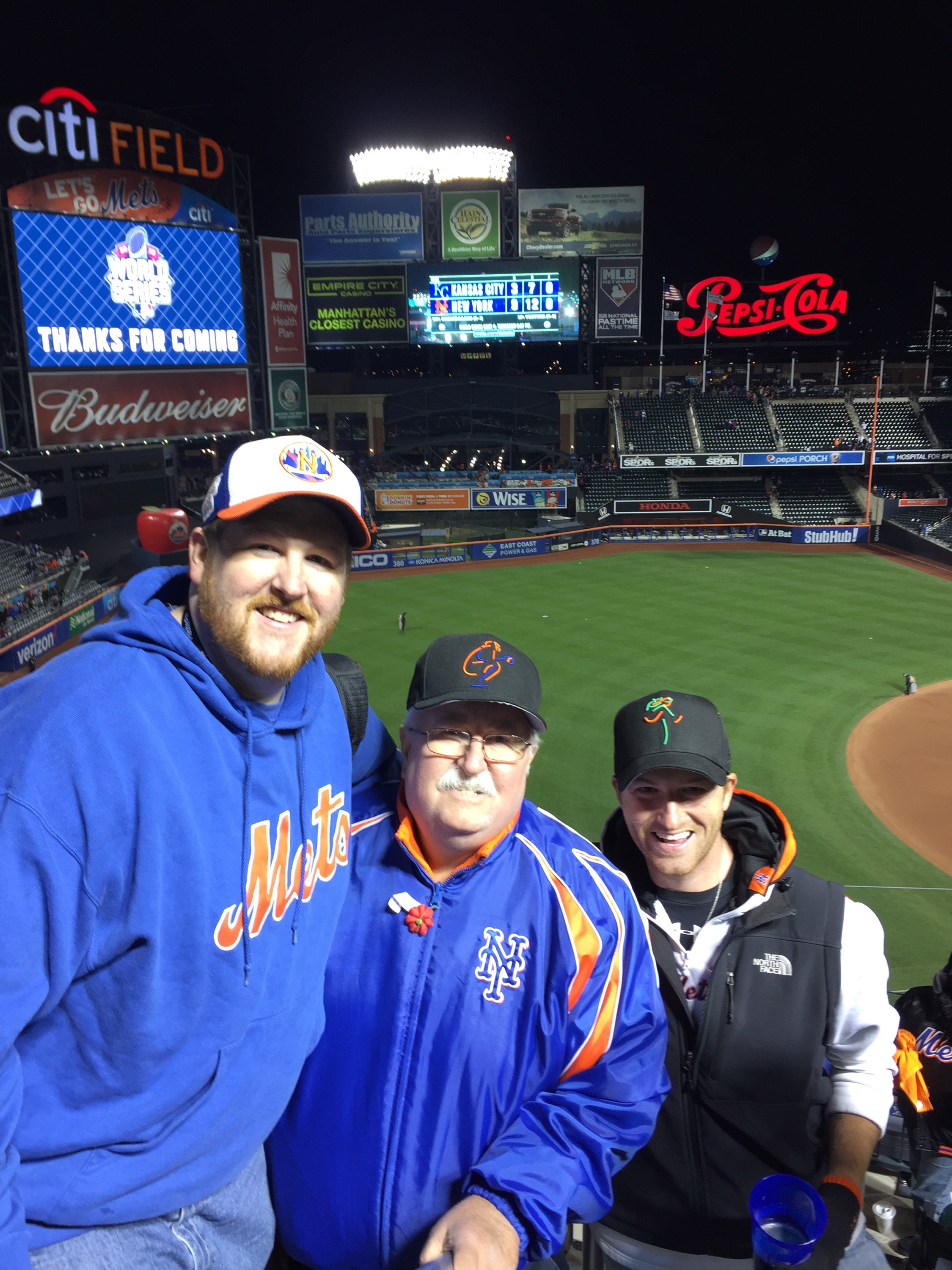
Today, I honor one former member of the Mets above and beyond all others. My father. He was a vendor the first year Shea Stadium was opened. A few short years later he would be drafted to fight in the Vietnam War.
After basic training, he was dropped right into a battle, a battle that would claim the life of many men. One of these men was someone he knew from basic training. I still remember my Dad telling this story just crying on the battlefield. This was just his first day in Vietnam.
During the war he would be exposed to Agent Orange, fall ill with Dengue Fevrr, and be exposed to Tuberculosis. He would see many more people die. This wasn’t even the worst of what would happen to him overseas.
He had to give the order. He was told who to designate who was to go up front. There was a suspicion the field was booby trapped. My father was supposed to be further back, but he stayed closer to the petrified soldier. It put my father in harm’s way as that petrified soldier tripped a booby trap.
The shrapnel is still in my father’s arms and legs. He has deep scars in his arms and legs. As he jokes, he has too different hands. The damaged muscles and nerve endings will do that. One leg is shorter than the other. As he once put it to me, he’s in pain everyday of his life. He’s one of several Disabled American Veterans (DAV).
It was a miracle he even survived. He has a severed artery in his leg. He got “lucky” that his artery was contracting at the time of impact. If it wasn’t, he would’ve bled out before the medical helicopters could arrive. It was a miracle he even survived. Making it even more of a miracle I’m here today.
After he got out of the army, he went back to school. He started a career, got married, and raised a family. He put two kids through school, and he is now a grandparent to a child of the same name. Whenever I see that final scene in “Saving Private Ryan,” I think of my Dad. He really did earn his second chance at life even if he still carries the physical and emotional scars from what seems like a lifetime ago.
My Dad never did forget the men he served with. He still keeps in contact by phone and at the reunions. It was at a reunion that he had a moment to say thank you to someone my family owes everything to. It was the medic who kept my Dad alive until he could receive the life saving emergency surgery he needed.
My Dad and mother wanted to take him and his wife to dinner. They went to dinner, but the medic and his wife wouldn’t let my Dad pick up the check, after all my Dad flew out all that way to attend a reunion in the medic’s backyard. I joke with my Dad he now owes this man his life and a meal. My Dad laughs, but he’s quick to remind me after all this man has done for all of us the last thing he wanted to do was to insult the man.
My Dad is now retired. It is no wonder that he volunteers his time at the VA. He’s doing his part to honor and support our veterans as we all should.
So today, if you see or know a veteran, please reach out to them and thank them for their service. If not for each and every one if them, we would not be where we are today enjoying the lives we lead. I know for sure I wouldn’t.
Editor’s Note: this was originally published last year on Veteran’s Day.
The biggest question mark heading into the 2017 season is who is going to play second base for the New York Mets. Neil Walker handled the job quite well, and there has been interest from both sides on a reunion. We should know more about the potential for a reunion after Monday’s deadline for Walker to either accept or to reject the $17.2 million qualifying offer. While that decision hangs in the balance, along with Walker’s return, the Mets have to investigate all options for the position. Here are some candidates:
INTERNAL OPTIONS
2016 Stats: .333/.345/.476, 4 2B, 3B, HR, 16 RBI, 33 G
For many the 27 year old Rivera is the natural choice to become the Mets second baseman should Walker depart in free agency. In Rivera’s time with the Mets, he showed the ability to square up the ball at the plate, hit the ball gap-to-gap with some power, and he played better than expected defensively. Moreover, when there was a vacancy at the position due to a number of injuries, Rivera rose from the pack, and he staked his claim. He was the second baseman in the Wild Card Game, and he got a huge double in the game (that went for naught).
Still, there are a number of holes in Rivera’s game. He is never going to draw enough walks to justify playing everyday. Over the course of a full season, his defense may not look as good as it did in a very short sample size. Moreover, he is not the type of hitter that will hit for enough power to overcome those deficiencies. Overall, Rivera has shown he can play in the major leagues. Unforunately, he has not shown enough for the Mets to give him the second base job.
2016 Stats: .267/.326/.443, 13 2B, 4 3B, 8 HR, 24 RBI, 9 SB, 60 G
With the Mets having picked up Reyes’ option, we know he is going to be a part of the 2017 Mets. What we don’t know is exactly where he is going to play. Most likely, he is insurance for David Wright‘s back. However, if Walker should depart in free agency, he could move back to the middle infield and become the starting second baseman.
That is probably not the best idea for the Mets. Last year, Reyes had marked platoon splits. From the right-hand side of the plate, Reyes hit .380/.456/.740. From the left-hand side of the plate, Reyes only hit .239/.293/.371. This is more than just a small sample size. These numbers are emblematic of a downward trend for Reyes from the left-hand side of the plate since 2014. While the hope is Reyes can fix these issues with Kevin Long, much in the same way as Walker did with Long in 2016, it is far from a guarantee it will work out as well. Looking at the numbers, along with his diminishing range, Reyes best help to the Mets may just be a super-sub.
2016 Stats: .267/.319/.469, 14 2B, 16 HR, 49 RBI, SB, 103 G
Essentially, everything said about Reyes goes double for Flores. He absolutely kills left-handed pitching (.340/.383/.710) while struggling against right-handed pitching (.232/.289/.353). At 25, Flores still has upside, and he has power in his bat, but at this point in his career, those intangibles do not outweigh the struggles he has defensively. Like Rivera and Reyes, Flores is probably best suited to the bench.
2016 AAA Stats: .325/.390/.448, 27 2B, 2 3B, 8 HR, 55 RBI, 117 G
With the rise of Amed Rosario, Cecchini is going to have to move to second base if the former first round pick is ever going to become a starter for the Mets at the major league level. It is fair to say Cecchini’s bat is there. He is a player that can work the count, and he can drive the ball from gap-to-gap. The hope is that as the 22 year old ages, some of those gappers become homers as he develops physically.
Therein lies the issue with Cecchini. Is he really read to play in the majors after just four games in September? Better yet, is he ready to play second base after not having played more than two consecutive days at the position in his professional career. Given the fact this Mets team has World Series aspirations, the answer to the question is most likely “no.” With that Cecchini is better suited to being the starting second baseman in AAA next year and awaiting his opportunity.
2016 Stats: .280/.336/.474, 30 2B, 3B, 23 HR, 62 RBI, 141 G
This is the most unlikely internal option to play second base for the Mets next season. He is signed through next year, and he has a reasonably 2018 option the Mets could exercise should Rosario not be ready to take over by then. The mentioning of Cabrera serves to acknowledge the reality that his range is subpar for the position, and with his knee injuries last year, we should not expect it to get any better. In fact, his range may eventually force the Mets to move him. It is also possible Rosario has another outstanding season in the minors, and he may force his way onto the Mets roster next year. Even if neither situation presents itself, moving Cabrera to second would give the Mets a number of options on the free agent and trade market.
FREE AGENTS
2016 Stats: .285/.335/.446, 29 2B, 3 3B, 22 HR, 86 RBI, 21 SB, 156 G
Desmond bet on himself when he took a one year deal from the Rangers, and he had an All Star season. However, it should be noted that came as an outfielder. It should also be noted Desmond has not played second base since his five games there in 2009. While the Mets could shift Cabrera to second to permit Desmond to return to short, it should be noted Desmond is an even worse defensive shortstop than Cabrera and Reyes.
The other issues with Desmond are the fact that he did most of his damage in the first half, and he did most of his damage at the Ballpark at Arlington. When you also consider the fact that he received a qualifying offer from the Rangers, the Mets would probably be better suited to looking elsewhere this offseason.
2016 Korean Stats: .330/.391/.558, 22 2B, 3 3B, 26 HR, 104 RBI, 118 G
With Korean players having succeeded in the major leagues the past few seasons, it is possible the Mets could be inclined to sign Hwang this offseason. Even with that said, under Sandy Alderson, the Mets have been reticent to attempt to sign foreign players to be everyday players for their major league club. Additionally, while Hwang has middle infield experience, it is at shortstop. In reality, he is more of a third baseman, and at 29 years old, it is difficult to gauge whether he could even make the transition to second.
2016 Stats: .252/.319/.396, 26 2B, 3 3B, 14 HR, 52 RBI, 138 G
Yeah, this is never going to happen. Moving on.
That’s just the issue – the middle infield market really is Walker and then no one else. With that in mind, the Mets best option might just be bringing back Walker and hoping his surgically repaired back can withstand the rigors of playing everyday. If not, the Mets are going to have to turn to some type of platoon that features a number of players we do not know can handle the position defensively, and almost all of whom hit much better against left-handed pitching.
Throughout the season, I attempted to grade the different Mets players performances for each month of the season. In determining the year end grades, the aggregate of the monthly grades given was considered, but it wasn’t conclusive. For example, one player’s awful month could be more than offset by having an incredible month. Also, those decisions were made in the heat of the moment. There has been a cooling off period in giving these finals grades, and with that, there is time for reflection. It should also be noted the Wild Card Game did have some impact on these grades as that game was part of the story of the 2016 Mets. Overall, the final grades assessed considered the monthly grades, but also took into account that player(s) overall impact on the Mets season (good or bad). For the third set of grades, here are the Mets middle infielders:
If the month began with an “A,” you knew Walker was going to be great. In April, he hit .307/.337/.625 with nine homers and 19 RBI. In August, he hit .389/.450/.667 with six homers and 10 RBI. In the months that did not begin with an “A,” Walker wasn’t as good. From May 1st – July 31st, Walker hit .242/.322/.369 with eight homers and 26 RBI. Basically, Walker was feast or famine at the plate.
On the positive side, Walker became a dangerous hitter from the right-hand side of the plate for the first time in his career. That played a large role in him tying his career high with 23 homers despite him only playing in 113 games. The other positive note was that Walker played some of the best second base of his career. Basically, when Walker was on, he was one of the best second baseman in the game.
Unfortunately, when he wasn’t on top of his game, he wasn’t a very good player. We could chalk it up to him being a streaky player, but with this being his first season with the Mets, we really don’t know that to be true. More likely, Walker’s struggles were related to his back. He stated there were periods of time over the summer his feet were numb. That would more than explain his issues. It also explained why he opted for season ending surgery despite him being hot at the plate and the Mets trying to get into the Wild Card picture.
Overall, Walker hit .282/.347/.476 with 23 homers and 55 RBI in 113 games. These were good numbers from a player that at times was a very pleasant surprise during the season. It is unknown if he will re-sign with the Mets. No matter what his future plans are, Walker left an overall positive impression during his time in Flushing.
Lost in Cabrera’s hot streak to end the season was the fact he was not great for most of the season. Up until August 1st, when the Mets finally put him on the disabled list, Cabrera was only hitting .255/.308/.410 with 13 homers and 33 RBI. Those 33 RBI are astounding when you consider he seemingly went the entire summer without getting a hit with a runner in scoring position. To make matters worse, his defense just was not good. He had a -4.2 DRS and a -7 DRS at the position. To put those numbers in perspective, people were frustrated with Wilmer Flores at the position in 2015, and he had a -2.5 UZR and a -10 DRS.
Essentially, for most of the season, the Mets got an older version of Flores. However, there were two things missing: (1) the 30 Cabrera did not have Flores’ upside; and (2) the tears. The best you can say about Cabrera was he made all of the routine plays, which made everyone feel as if he was the better option. It did not matter he couldn’t get to as many balls – he just looked better at the position. In reality, he wasn’t any better than Flores was. That was at least true until Cabrera came off the disabled list.
From August 19th until the end of the season, Cabrera was the best hitter in baseball. During that stretch, Cabrera hit .345/.406/.635 with 10 homers and 29 RBI. If not for Cabrera’s hot hitting, the Mets probably don’t claim one of the Wild Card spots. This month and a half long stretch was so good, it made you forget about the middling to poor play the preceded it. Keep in mind that even with this insane stretch, Cabrera still hit .280/.336/.474 with 23 homers and 62 RBI.
With Cabrera signed for one more year (with an option after that), the hope is that Cabrera’s knee is completely healed (it did not require offseason surgery), and that he can be more like the guy he was to finish the year than the player who was not very good to start the year.
With the Mets poorly crafting a bench to start the season, they were unable to withstand the long DL stints of Lucas Duda and David Wright. Accordingly, the Mets traded for Johnson in what is looking like it will become an annual tradition.
Johnson’s second stint with the Mets was better than his first. In 82 games, Johnson hit .268/.328/.459 with nine homers and 24 RBI. He did most of his damage as a part time player over the summer. At that time, he was a key contributor off the bench who could be relied upon in a spot start or a pinch hitting appearance. Unfortunately, with the Walker and Flores season ending injuries, Johnson was asked to do more, and he showed why he was better as a bench player.
In the final month of the season, Johnson played in 22 games hitting .208/.255/.313 with one homer and four RBI. Heading into the Wild Card Game, he informed the Mets he didn’t feel comfortable playing first base thereby leaving the team with James Loney at first base. It was a huge decision in a game the Mets were shut out by Madison Bumgarner.
Once again, Johnson did enough to show the Mets he should return in the 2017 season. However, given how the Mets do business, it appears as if they are more comfortably trading away another Akeel Morris type of prospect over giving him a market deal and strengthening their bench.
Rivera went from being constantly passed over for a chance to play in the majors to being the Mets starting second baseman in the Wild Card Game. Overall, Rivera would get to play in 33 games hitting .333/.345/.476 with three homers and 16 RBI. In the Wild Card Game, he was one of the few Mets batters that could hit Bumgarner with him going 1-4 with a leadoff double in the fifth that probably should have set up the Mets to take the lead.
Overall, Rivera showed himself that he is good enough to be a major league player. Given the low walk rates (in the minors and the majors) and his not having a true position, he is most likely no more than a utility player. Considering he was undrafted and the Mets continuously passed him over, that is a remarkable achievement.
Editor’s Note: the grades for April, May, June, July, August, and September/October can be found by clicking the links. If you want to see the prior entries, here is the link for catchers, and here is the link for middle infielders.
One of the biggest issues with the 2017 Mets was the production they received from first base. The precipitous drop in production was a major factor in why the 2016 Mets scored fewer runs than the 2015 Mets. Remember, the 2015 Mets once infamously had John Mayberry, Jr. and Eric Campbell hitting in the middle of the lineup. With that in mind, getting improved production out of first base needs to be a priority for the Mets this offseason. Here is what should be available for the Mets this offseason:
INTERNAL FIRST BASEMAN
Duda is exactly the player the Mets need to revive their offense in 2017. From 2014-2015, Duda hit .249/.350/.483 while averaging 28 homers and 82 RBI. He is a home run threat in the middle of your order, and he is the classic slugging first baseman.
The issue with Duda is no one knows if he is healthy. In 2015, he went on the disabled list with a herniated disc in his lower back. In 2016, he suffered a stress fracture in his lower back, and he took longer than expected to return from the injury. While he tried admirably to try to play in the Wild Card Game, he just wasn’t ready. For the season, he only played in 47 games hitting .229/.302/.412 with seven homers and 23 RBI.
While all indications are Duda is completely healthy, it is unknown whether he can withstand the rigors of a 162 game schedule. It is also unknown whether he can return to form after suffering back injuries in consecutive seasons. At the moment, it is anticipated he will earn approximately $7 million in arbitration. For the production we know he is capable of producing, that is a steep bargain. Not knowing if he can produce, $7 million could be an expensive gamble, especially in light of Wright’s situation.
Smith is coming off a terrific year in AA where he finally began to fulfill some of the offensive potential he has by hitting for more power in the second half of the season. He is a a highly regarded prospect who is already a slick defender at first base. Still, he is just 21 years old, and he has yet to have an at-bat above AAA. He is not ready to be the Opening Day first baseman, and it is quite possible he may not be ready to play in the majors next year.
PLAYERS CHANGING POSITIONS
Time and again, people state Wright should just move across the diamond and play first base. Saying that presents a clear misunderstanding of the first base position and how taxing it would be on Wright.
Other than catcher, first base is the most demanding physical position for a player. At first base, a player is constantly stretching, turning, and twisting in the hopes of getting a throw from one of his infielders that much quicker to turn a close play into an out. With a runner on first, the first baseman has to spring off the bag and into his defensive position as the pitcher delivers the ball. Like a third baseman, he charges the bunts and dives for balls down the line. According to Dr. Walter P. Jacobsen, DO, a neurosurgeon, these activities that are high impact and require twisting are activities that should be avoided. These activities are more prevalent at first than third base.
Even assuming this was incorrect, that Wright was better suited to first base, when is he going to get the opportunity to transition there? Wright had season ending cervical fusion surgery, and presumably, he is going to need to spend most of his time in the offseason rehabbing and figuring out yet another pregame routine that will permit him to play in as many games as possible. As such, there is no time for him to learn first base.
Without or without Cespedes’ return, the Mets are going to have a glut of everyday caliber outfielders, and one of them may need to find a new home. That new home could be on another team or at another position. With UZR and DRS rating Bruce was the Mets worst outfielder, he would be the likely candidate to move to first base.
The one caution is Bruce has only played three games there in his major league career, and all three of those games were two years ago. Even accounting for that, Bruce may have the athleticism to adapt to first base and succeed there on the major league level. It is also a way to keep him and his 30 home run caliber bat in the lineup every day while also allowing Curtis Granderson, another Mets right fielder who can hit 30 home runs, in the lineup everyday.
Still, before moving someone over to first base, Mike Piazza should always be a caution to Mets fans that not just anyone can move over there. It is a difficult position that requires hard work in the offseason. If this is the plan, the Mets need to implement it sooner rather than later.
None other than Keith Hernandez believes Conforto should be playing first base with him saying, “He more than likely is going to end up at first base, though it’s unlikely he’ll be anything more than average there.” (nj.com). While it is far from a ringing endorsement, it is notable when Hernandez, the best defensive first baseman in major league history, states you should play his position.
For his part, Conforto is open to the possibility saying, “I took some reps in college over at first base just for emergency-type situations. I think that’s something that’s very, very interesting, something I’d be open to, obviously. I just want to help the team.” (New York Post).
Moving Conforto there means you won’t have to displace a veteran like Bruce. However, it does create a few problems. First, choosing to move Conforto over Bruce also means choosing to move the better defensive outfielder out of the outfield. Second, moving Conforto there could become a potential barrier to Smith or Peter Alonso at first base in the upcoming seasons. Third, having Conforto change positions to the infield could be yet another obstacle in the young player’s development.
For a myriad of reasons ranging from a wrist injury to uneven playing time to him just falling into slumps like any other player, the 2016 season was a lost one for Conforto. He went from the Mets top hitting prospect to a young player Terry Collins entrusted to little more than pinch hitting duty down the stretch. It is quite possible the best thing for him is for the Mets to pick a position in the outfield and let him stay there and allow him to work with Kevin Long to get back to what worked well for him.
EXPENSIVE OPTIONS
Tigers GM Al Avila has already announced the Tigers are looking to get younger and shed some payroll this offseason. With that in mind, the Tigers have a number of interesting trade candidates making big money like Cabrera.
At 33, Cabrera had another terrific season hitting .316/.393/.563 with 38 homers and 108 RBI. Should Cespedes depart this offseason, Cabrera would more than replace Cespedes in the lineup. However, the Mets chances of obtaining Cabrera are unlikely due to the cost. First, it is going to take a huge haul of players to obtain them, and in the past, the Mets have shown unwillingness to move one of their big pitchers like Matt Harvey, Jacob deGrom, Noah Syndergaard, or Steven Matz. Given Cabrera’s production, it is likely the Tigers ask for one of these players and/or a big prospect like Smith, Amed Rosario, or both.
Even if there was a middle ground on players the Mets deemed acceptable, it is hard to imagine them adding Cabrera’s contract. Cabrera still has seven years $132 million left on his deal. The contract carries through to his age 40 season, and there are two vesting options at the back end of the deal for $30 million a piece. If Cabrera does not age well, this contract would become the type of albatross Sandy Alderson typically avoids.
Bringing back Turner would be a page out of the Todd Zeile handbook. While Turner has not played regularly at first base, he has shown the ability to play over there, and his bat may help the Mets improve in 2016.
Moreover, Turner may need to move to first base to lengthen his career. Over the past few seasons, he has had knee issues, and he may not be well suited for the third base position in the time of the modern shift era that requires a third baseman to cover more ground than they did a decade or so ago.
There does remain some issues for Turner. First and foremost is the aforementioned knee issues. Second, Turner took off when he played in his hometown. There is no telling if he would struggle playing on the east coast again. Third, he regressed from an on base perspective this year. In 2014 and 2015, Turner was a player who had a .384 on base percentage with a .492 slugging. This year, Turner’s OBP dropped to .339 even while his slugging percentage stayed in the same vicinity (.493). This might have been a product of his knee issues or it could have been a product of him swinging for the fences more as evidenced by his career high 27 homers.
In either event, Turner is not the safest choice, especially when you are asking him to play out of position. These fears become magnified when you consider Turner will likely received a qualifying offer, and he will likely get a big contract offer from someone, including but not limited to the Dodgers, to play third base.
THE DESIGNATED HITTERS
Encarnacion may prove to be the biggest power bat on the free agent market. He is coming off a year that saw him hit .263/.357/.529 with 42 homers and a league leading 127 RBI. Over the past three seasons, Encarnacion is hitting .269/.361/.544 while averaging 38 homers and 112 RBI.
There are two issues with Encarnacion. First, much of his stats have been generated as a result of him hitting in the Rogers Centre, which is a hitter’s park. In his career, Encarnacion has hit .272/.360/.535 there. Last year, on the road, Encarnaction was a .246/.342/.492 hitter on the road. While it is a drop-off, the Mets would gladly take Encarnacion’s road production from their first base position next year.
Therein lies the real problem with Encarnacion. He’s a DH. Encarnacion has not played more than half a season at first base in his entire career. In his last five years with the Blue Jays, he has split his time between first and DH. While advanced metrics like UZR and DRS rate him to be an average first baseman, it is unknown whether he could withstand the rigors of playing in the field everyday. Those concerns are amplified for a player that will turn 34 next year, will command a large contract, and will most likely recent a qualifying offer.
Seemingly, from the moment Santana came up to the Cleveland Indians as a catcher, the team has sought a position for him. He has proven his best position is DH.
Santana is coming off a terrific year that saw him hit ..259/.366/.498 with 34 homers and 87 RBI. Those were the highest home run and RBI totals of his career. In his six full seasons with the Indians, Santana has averaged 24 homers and 81 RBI. With his on base skills and his switch hitting ability, Santana would be a welcome addition to the Mets lineup. However, like Encarnacion, the real question is whether he can be an everyday first baseman.
Like Encarnaction, he rates as average when he does play there. Unlike Encarnacion, he played almost a full season there in 2015. Moreover, he is four years younger than Encarnacion. So while both may receive qualifying offers and large contract offers on the free agent market, Santana may prove to be the better bet for the Mets should they look to upgrade the first base position in free agency.
QUESTIONABLE OFFENSIVE PRODUCTION
The best thing you can say about Loney in 2016 was he was a definitive upgrade over the Mets internal options like Campbell. Unfortunately, Loney showed little that would entice the Mets to bring him back next season. Loney finished the year hitting .257/.287/.369 with five homers and 18 RBI in 63 games after the All Star Break. He also showed he had limited range and an inability to stretch far for throws made to first. While he was an improvement over what the Mets had in 2016, the Mets are simply going to have to do better than him in 2017.
The Cleveland Indians took a one year flier on Napoli this offseason, and it has been a boon for them as Napoli has been a major contributor for a team now playing in the World Series. Still, there is caution for Napoli, who has a history of hip problems, and whose numbers were not great this season.
In 150 games, Napoli hit .239/.335/.465 with 34 homers and 101 RBI. In 2015, Napoli bounced around, and he hit .224/.324/.410 with 18 homers and 50 RBI in 133 games. With Napoli turning 35 next year, it is hard to believe he will have another strong campaign. Furthermore, the last thing this Mets offense needs is another low OBP guy who is seemingly all or nothing at the plate.
For a few seasons, Lind had proven himself to be a good on base player who may not have the traditional power you typically want from the first base position. In 2016, Lind played for the Mariners, and his production fell off a cliff. In 126 games, Lind hit .239/.286/.431 with 20 homers and 58 RBI. Historically, Lind has also struggled to hit left-handed pitching. Lind is more of a buy-low candidate in the event there are no better options than he is an upgrade you would seek on the free agent market.
BEST CHOICE
Ultimately, it may behoove the Mets to bring back Duda for one more season. If he produces at his normal levels, he will be exactly what this offense needs. Better yet, if he produces at that level, the Mets could give him a qualifying offer next offseason thereby helping them gain a first round draft pick in the process (assuming no changes to the Collective Bargaining Agreement). Furthermore, with Duda, the Mets have a nice bridge to Smith should he take another leap this year and prove himself ready to contribute at the major league level ahead of schedule.
Throughout the season, I attempted to grade the different Mets players performances for each month of the season. In determining the year end grades, the aggregate of the monthly grades given was considered, but it wasn’t conclusive. For example, one player’s awful month could be more than offset by having an incredible month. Also, those decisions were made in the heat of the moment. There has been a cooling off period in giving these finals grades, and with that, there is time for reflection. It should also be noted the Wild Card Game did have some impact on these grades as that game was part of the story of the 2016 Mets. Overall, the final grades assessed considered the monthly grades, but also took into account that player(s) overall impact on the Mets season (good or bad). For the second set of grades, here are the Mets middle infielders:
Lucas Duda C-
The one sure thing you could say about Duda was the Mets missed him in 2016. The drop off at the plate from him to Loney was massive. Surprisingly, despite Loney’s reputation as being a good defender, there was a similar drop-off in the field. We know the Mets made the postseason anyway without Duda. What we don’t know is whether the Mets would have competed in the division or won the Wild Card Game with Duda in the lineup.
What we do know is that when Duda was on the field, he just wasn’t productive. In the 47 games he did play, he hit .229/.302/.412 with just seven doubles, seven home runs, and 23 RBI. Early on in the season, many were expecting Duda to have a typical breakout where he carried the Mets offensively for a few weeks. However, with the stress fracture in his back that breakout was never coming. He worked his tail off to get back and help the Mets down the stretch and into the postseason, but he just wasn’t ready yet. Overall, it was just a lost season for Duda. Hopefully, his back will be better in 2017, and he can help the Mets win the National League East again.
On the one hand, Loney really helped stabilize the first base position when he first came to the Mets. Before the All Star Break, he was hitting .277/.336/.438 with eight doubles, four homers, and 16 RBI. It wasn’t your typical first baseman’s production, but it was something you could live with especially when your other option at the time was Eric Campbell.
However, from there his season really fell off the cliff. After the All Star Break, Loney hit .257/.287/.369 with eight doubles, five homers, and 18 RBI. This production is even worse when you consider Terry Collins shielded Loney from left-handed pitching for most of the year. Couple that with Loney’s terrible defense and his almost refusal to stretch at first base, you saw why the Tampa Bay Rays of all teams paid him approximately $9 million to not play for them, and why no team was willing to give him a major league job before the season started.
There were many unknowns about Wright in 2016. We didn’t know if he could play, and if he could play, we didn’t know if he could produce. What we discovered was that he could still produce, but, unfortunately, he could not stay on the field. Wright would actually play in one less regular season game than he would last year before he needed season ending cervical fusion surgery (not spinal stenosis surgery). In the 37 games he did play, he hit .220/.350/.438 with eight doubles, seven home runs, and 14 RBI. They were decent numbers for the time he played, but unfortunately, he didn’t play enough.
Jose Reyes B-
The best thing you could say about Reyes was he wasn’t a distraction, nor were there any known repeated acts of domestic violence. If Reyes has become a better man, and if the domestic violence issues are all in the past, this season was a resounding success for him, and we should all wish him and his family well. With that noted, the grades are for the performance on the field.
The good with Reyes was despite his inexperience at third base, he actually adapted to the position quite well (even if UZR & DRS disagree). Furthermore, Reyes was a beast from the right-hand side of the plate. As a right-handed batter, Reyes hit .380/.456/.740 with six doubles, four homers, and 10 RBI. There was also a two week stretch in August (15th – 30th) where Reyes helped carry the Mets offensively hitting .385/.429/.538 with five doubles, one triple, one home run, and five RBI.
Unfortunately, that August stretch was about all Reyes did for the Mets from an offensive standpoint. Taking out that hot two week stretch, Reyes was a .226/.292/.411 hitter. Most of the reason for that was Reyes could not hit right-handed pitching. In fact, he hit .239/.293/.371 against right-handed pitching. Additionally, Reyes faded down the stretch hitting .234/.315/.396 over the final month of the season.
While you could say Reyes did an overall good job for the Mets, and he was a good presence in the clubhouse, you cannot come out of the 2016 season with any other impression than Reyes has regressed to the point where he is either a platoon option or a bench player.
Editor’s Note: the grades for April, May, June, July, August, and September/October can be found by clicking the links.