Musings
Right now, if you were going to list what the Mets problems were, two things that would be discussed ad nauseaum would be the offense and hitting with runners in scoring position. While it has not been discussed as frequently, Yoenis Cespedes‘ and Juan Lagares‘ injuries also make center field an issue for the Mets.
The Mets acquisition of Jay Bruce presumably solves the first two Mets problems while only further confounding the center field issue.
First, the offense. There is no doubt that Jay Bruce is your classic left-handed slugger that should be hitting in an RBI position in your lineup. This year Bruce is hitting .265/.316/.559 with 22 doubles, six triples, 25 homers, and a major league leading 80 RBI. He also isn’t a Great American Ballpark creation as Bruce has hit better on the road. In road games, Bruce has slashed .277/.318/.582. More importantly to Mets fans, Bruce is hitting .360/.406/.719 with runners in scoring position. Ideally, the Mets would bat him fifth in the lineup as Bruce has been hitting .290/.340/.603 from that spot in the order.
Still, there is some cause for concern with Bruce. As we see with his stats, he is not nor has he ever been a great on base guy. He is also a guy who is a platoon type of bat as he is hitting .250/.287/.491 off of lefties this year. With that in mind, the Mets might have just added a player that is more of the same.
He is also coming off two straight seasons that saw him hit a combined .222/.288/.406 while averaging 22 homers and 76 RBI. If his July, where he hit .218/.289/.529, is any indication, he might be becoming that type of player again. Furthermore, Bruce has not hit well at all in Citi Field. In 21 games, Bruce has hit .186/.275/.443 with five homers and 13 RBI. Hopefully, some of that is a short sample size and some of that is Matt Harvey, Jacob deGrom, and Noah Syndergaard.
Regardless, Bruce is an offensive upgrade for an injured and under-performing Mets team. However, he is not a defensive upgrade for a team that needs a center field solution.
If reports are true, Bruce is being brought here to play right field rather than to play first base in place of James Loney. That would shift Granderson from right to center. As we saw in the one game Granderson played in center this year, there is a reason why he has not played center regularly since 2012. The other issue is that while Granderson has had a down year defensively in right field, he has been much better than Bruce, who has posted a -11.5 UZR and a -13 DRS this past year. Over the previous two seasons, Bruce has averaged a -5.2 UZR and a -1 DRS meaning he is worse this year than he has been over his career.
With Bruce’s struggles, Granderson’s inability to play center, and Yoenis Cespedes playing on one leg, this outfield should be reminiscent, if not worse, than the Cliff Floyd–Roger Cedeno–Jeromy Burnitz outfield that was seen as an unmitigated disaster defensively.
The other issue is where does this leave Michael Conforto? After everything that has happened this year, are the Mets really going to make him a bench player? Is he going to platoon with another left-handed batter? Does he move to first base? Aren’t you now forced to send him down to AAA until September call-ups? This really leaves your best young hitter and future of your team in a lurch. With all that in mind, it is a very curious move, especially when there was no corresponding move to address any of the Mets other needs.
Overall, Bruce solves some of the Mets problems while exacerbating some others. The best way to deal with all of these issues is for both he and his new teammates to just go out there and hit.
Today, Mike Piazza joins Tom Seaver as the only Mets player to have his number retired. He also joins Gil Hodges and Casey Stengel as the only Mets to have their number retired. He will also join Jackie Robinson, William Shea, and Ralph Kiner in what has become the Mets “Left Field Legends Landing”
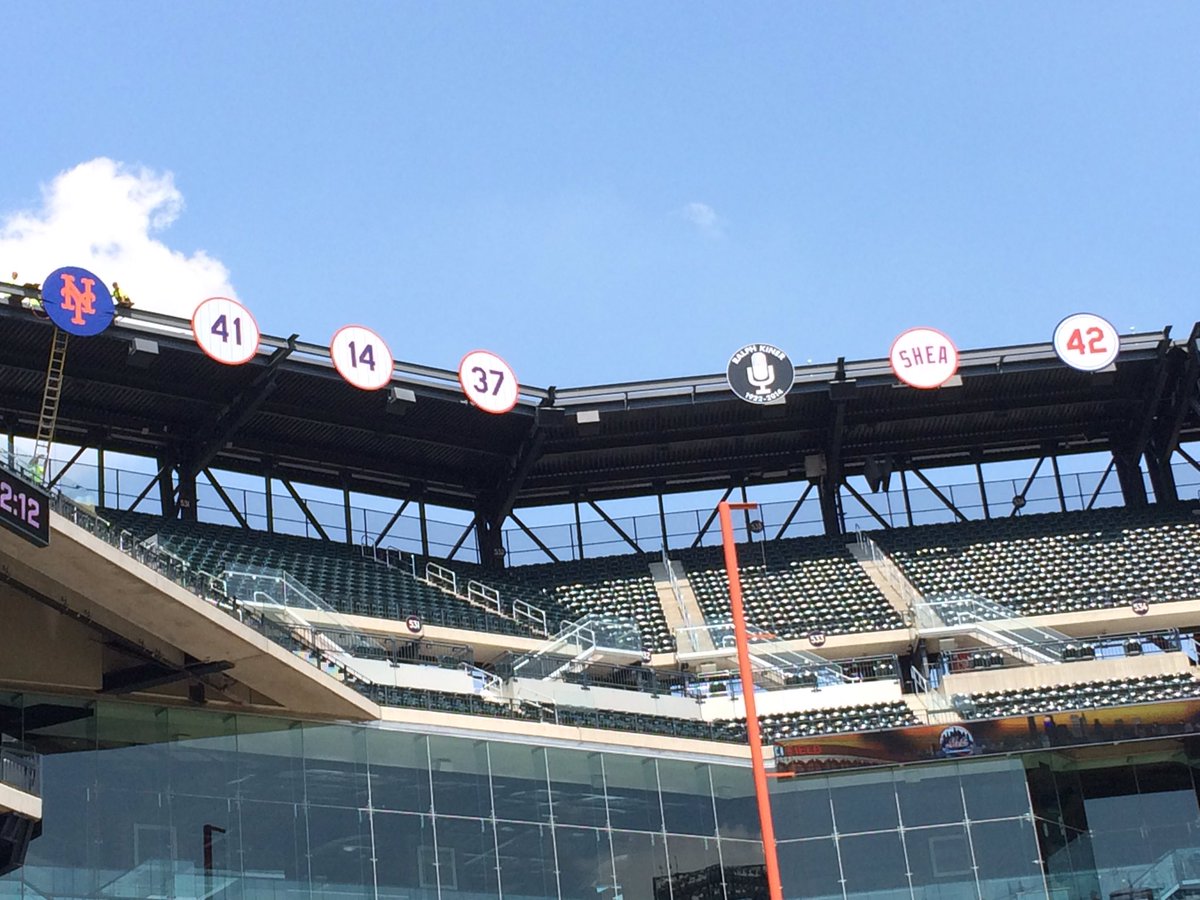
* Photo courtesy of Jeremy Posner.
At least that is what I am calling it.
Piazza is there because he was just inducted into the Baseball Hall of Fame as a Met. He was the second Met all-time and their first position player. He is there because he helped take a “nice little team” and led them to back-to-back postseason appearance for the only time in Mets history. No Met will ever wear his number again due to him being the greatest hitting catcher of all-time who has hit more homers than any catcher in baseball history. He is there for the post 9/11 homer, for all the other important homers, and what he meant to Mets fans. Today, Piazza will officially have his number retired. Personally, I cannot wait to go to Citi Field and cheer him like I did all those games I attended in the late nineties and early 2000s. It couldn’t have happened to a better man or a better Met.
Congratulations Mike Piazza.
Last year, the Mets parted with number of pitching prospects in a drive to make it to the postseason for the first time since 2006. Over the course of this past year, we have seen some of them actually pitching in the major leagues:
- In 16 starts for the Detroit Tigers, Michael Fulmer is 9-2 with a 2.50 ERA and a 1.089 WHIP. He is the leading candidate for the American League Rookie of the Year Award, and he should receive some Cy Young Award votes at the end of the season.
- The Tigers traded Luis Cessa in the offseason to the New York Yankees. Cessa has pitched briefly out of the bullpen for the Yankees this year. In his six appearances, he has pitched 13.2 innings going 1-0 with a 3.95 ERA and a 1.244 WHIP.
- The Atlanta Braves do not seem quite sure what to make of John Gant and his quirky delivery, but they seem to be convinced he’s a major league caliber pitcher. Out of the bullpen, Gant has made seven appearances with no record, a 6.17 ERA, and a 1.714 WHIP. As a starter, Gant has performed considerably better going 1-2 with a 3.38 ERA and a 1.179 WHIP.
As we know, the Mets got Yoenis Cespedes for Fulmer and Cessa. Gant was part of a trade that netted the Mets Juan Uribe and Kelly Johnson. The Mets also made trades of varying success to obtain Tyler Clippard, Addison Reed, and Eric O’Flaherty. Overall, the Mets gave up valuable pieces to obtain major league players that helped them win the National League Pennant.
As of right now, the Mets are in a similar situation to where they were last season. They need to assess what they need (starter, reliever, and right handed bat off the bench) and what they are willing to trade to obtain those pieces. Sooner or later, the right player is going to come along, and the Mets are going to have to decide whether to trade next year’s Fulmer for this year’s Cespedes. The issue becomes who do you and who do you not trade. Here is a look at the Mets top prospects teams are sure to be inquiring about.
Each and every team is going to inquire on Rosario, and the answer time and time again is going to be no. It’s for good reason as well. When the Mets signed him out of the Dominican Republic, his defense was seen as a given, but there were concerns about his bat. Rosario has put many of those concerns to bed by hitting .321/.372/.464 with 19 doubles, 12 triples, three homers and 56 RBI between St. Lucie and Binghamton. He was a Florida State Leauge All Star, on the Team World Roster for the Future’s Game, and he was named MLB.com‘s 18th best prospect. Unless you are talking a Mike Trout trade, Rosario is off the table.
This is where things start to get a little interesting as Smith has really taken off since Rosario joined him in AA hitting .336/.398/.626 with five doubles, one triples, eight homers and 27 RBI. Smith is starting to show the power that could take him from a very good prospect to an elite prospect with the ranks of Rosario. Already, Smith is a plus defender at first base, and he has the ability to drive the ball gap-to-gap. If you trade him, you could be trading away the next John Olerud or worse if his power game continues to develop. If you keep him, you risk him becoming the next James Loney. Yes, Loney has been a quality major league first baseman, but Loney should never be what stands between you and getting an All Star or difference maker at the trade deadline that could put the team over the top.
It seems that since Herrera came to the Mets in the Marlon Byrd trade, he was touted as the Mets second baseman of the future. He was someone who could handle the position well defensively while being a real force at the plate. He showed that he has unique power for the position. Due to injuries in 2014, the Mets brought him up from AA to play in the majors. Last year, he was seen as an offensive spark when a number of players went down due to injury. This year he hasn’t been a consideration at all. He has struggled in AAA hitting .277/.331/.471 in the Pacific Coast League which is a hitter’s league. Part of that might be teams figuring him out. Part of that may be him dealing with a shoulder injury sapping him of some of his offensive ability and having him fall into bad habits at the plate. He is less patient at the plate, and he is lunging for balls he wouldn’t last year. If you move him, you are moving the guy that could be a multiple time All Star. If you don’t, you just might be hanging onto a guy that may never figure it out.
Cecchini is in a tough position in the Mets organization. He isn’t seen as good a prospect at short as Rosario, and he has had some trouble handling the position at Cashman Field, who has an infield that is not kind to infielders. He’s a good hitter hitting .315/.392/.441 with 18 doubles, two triples, five homers, and 40 RBI, and he reminds you of a right-handed Daniel Murphy at the plate. However, he is not considered as good of an offensive prospect as an Herrera. Furthermore, his bat does not have the power profile that would play at third or the outfield. By many accounts, Cecchini will play in the majors one day. What you don’t know is what he will be. Will he be the next Murphy at the plate with similar defensive versatility? With that in mind, will he develop power as he gets older and fills out like Murphy did? Will he turn into the next Matt Reynolds – a major league utility player? Again, you don’t want to lose the next Murphy for a rental, but you also don’t want to miss out on someone because you wnated to keep another Reynolds or Joe McEwing type of player.
Most Mets fans would jump at the opportunity to trade him. He hasn’t hit at all in the majors despite given extended looks on two different occassions. However, Plawecki has been a good defensive catcher and pitch framer. He was also once considered a prospect who could push Travis d’Arnaud for playing time. Keep in mind that since his demotion, Plawecki is hitting .291/.347/.512 with four doubles, five homers, and 21 RBI in 27 games. These numbers aren’t exciting, especially in the Pacific Coast League, but it shows he is starting to become more patient at the plate and more selective swinging at pitches. Also keep in mind that catcher is a position that players tend to develop later in their careers than other positions. Plawecki could still very well be the Mets catcher of the future, or he could be a solid backup. He may not be the type of player who should hold up a deal, but he definitively is a player you want to protect if at all possible.
Ultimately, it seems like one of the aforementioned players are going to have to be traded if the Mets want to acquire an impact player like Jonathan Lucroy. However, they need to be very careful about which one.
In an ideal world, Rosario and Smith are non-starters. These are two players who are excelling in AA at a young age, and they appear primed to contribute to the Mets sooner than expected. You do not ever want to give up a Rosario or a Smith. These players should prove to be fixtures in the Mets lineup for ten plus years. Still, you’re going to have to give up someone if you are going to want to add that last piece who could put the Mets over the top in 2016.
That piece appears to be between Herrera and Cecchini. The Mets may very well have a preference between these two players, and coming into this season, it seemed like Herrera. However, that does not mean they still feel the same way, nor does it mean that other teams think similarly. Regardless of how the Mets feel, a team may force their hand to trade one or the other to hopefully trade for this year’s version of Yoenis Cespedes. In the end, it seems like the Mets will be giving up a Herrera or a Cecchini like they did with Fulmer last year if they want to make a move.
The hope is that the player has the impact Cespedes did last year and that the Mets take the next step and win the 2016 World Series.
Editor’s Note: this was also published on Mets Minors
According to SB Nation’s Chris Cotillo, the Mets have inquired about Jon Niese, and the team may be interested in Mark Melancon.
Niese makes a lot of sense for the Mets. With the Mets not knowing when and if Zack Wheeler can come back this year and Steven Matz dealing with bone spurs in his elbow, it would not hurt for them to have some insurance in their starting rotation even if it is Niese, who was dreadful as a starting pitcher this year. The hope is that Niese could get back to what he was with the Mets when he is once again working with Dan Warthen. It is also possible that Niese could pitch out of the bullpen for the Mets as he did so well for them last year.
Niese was demoted to the bullpen by the Pirates, and he has made four appearance so far pitching well. He is 1-0 with a 2.16 ERA and a 1.080 WHIP.
On the other hand, it is hard to believe the Mets could also acquire the pending free agent Melancon from the Pirates even if it was a package deal to take on both Niese and Melancon. Melancon is having another outstanding year as the Pirates closer going 1-1 with 30 saves, a 1.51 ERA, and a 0.960 WHIP in 45 appearance. Either this is a ploy to drive up the price of Melancon as the Nationals are interested in him, or it’s the Mets trying to get him on the cheap by having the Pirates try to package him with Niese. It is doubtful the Mets would give up the prospects necessary to land him to have him set up for Jeurys Familia.
The Mets are apparently more interested in a bat now due to Juan Lagares‘ injury. In other news, the Mets were interested in Steve Pearce, but they have found the Rays asking price to be too high. The Mets have also inquired on Jay Bruce as insurance for Yoenis Cespedes for both this year and the next. It should be noted that the Reds turned down a Bruce for Wheeler deal last year that resulted in the Mets acquiring Cespedes for Michael Fulmer last year at the trading deadline.
The Reds are also dangling Ross Ohlendorf, Blake Wood, and Tony Cingrani in the hopes of making a deal to alleviate some payroll for next year. There are no reports that the Reds have discussed any of these relievers with the Mets in a deal that could or could not involve Jay Bruce. However, we do know that the Reds have been scouting Kevin Plawecki for some reason or another.
If the Mets were able to move Plawecki for a Cingrani or a Wood, they have to consider it as they are both having good years out of the pen. Wood has made 44 appearances going 5-1 with one save, a 3.42 ERA, a 1.500 WHIP, and an 8.6 K/9. Cingrani has made 46 appearances going 4-2 with 12 saves, a 3.20 ERA, a 1.267 WHIP, and a 6.4 K/9. Both relievers are controllable past this year, and it appears as if Plawecki may never fulfill his offensive potential with the Mets. It is worth a shot.
With the trade deadline Monday, there are going to be a number of rumors involving the Mets as the Mets were very active in the trade market last year, and they are in the thick of the Wild Card race. Now, with the Marlins making the first big deadline trade acquiring Andrew Cashner and Colin Rea, Fox Sports Jon Morosi believes it will get the ball rolling with a number of teams, like the Mets, making a number of deals.
The Jonathan Lucroy Sweepstakes
According to ESPN’s Jerry Krasnick, the Tigers are out on the Jonathan Lucroy Sweepstakes. This might be one of the reasons the Brewers have re-engaged the Mets on Lucroy. As the Milwaukee Journal Sentinal’s Tom Haudricourt reported, the Brewers aren’t getting the offers they thought they would receive in exchange for Lucroy, and they also want to make sure they canvass the area to make sure they get the best possible return they can get for the catcher.
Lucroy would be a huge upgrade over what Travis d’Arnaud has provided the Mets this season. So far this year, d’Arnaud is hitting .246/.299/.333 with five doubles, two homers, and 10 RBI. Additionally, d’Arnaud has already had a stint on the disabled list. Lucroy has been the second best catcher in baseball this season hitting .300/.361/.486 with 17 doubles, three triples, 13 homers, and 50 RBI. It is not much of a surprise that the Brewers already rejected a straight up deal of Lucroy for d’Arnaud. According to Fox Sports Ken Rosenthal, the Brewers informed the Mets that they want some high end prospects in addition to d’Arnaud in exchange for Lucroy. In order to get those prospects, Haudricourt says the Brewers would consider bundling Lucroy with one or two of their coveted relievers, which include Jeremy Jeffress and Will Smith.
The Mets will have to get creative as, according to ESPN’s Adam Rubin, the Mets do not anticipate either Amed Rosario or Dominic Smith. Further complicating matters is, as MMO and Mets Minors own Michael Mayer reports, Dilson Herrera has been dealing with a sore shoulder causing him to miss the last four games.
Trade With the Tampa Bay Rays
According to Yahoo’s Jeff Passan, the Rays will trade Steve Pearce prior to the trade deadline, and it appears that Matt Moore is the pitcher they will most likely be willing to trade.
According to Crasnick, the Mets are very interested in Rays’ Steve Pearce. In his career, Pearce has predominantly played first base and outfield. However, the Rays have not played him in the outfield this year. Instead, he has played mostly first base with some time at second, third, an DH.
Pearce would certainly fulfill a need for the Mets as he is hitting .312/.384/.528 with 11 doubles, one triple, 10 homers, and 29 RBI on the year. He has hit a respectable .288/.348/.452 against righties, but he is flat out mashing lefties hitting .377/.476/.736 against lefties. The Mets could desperately use him given some of the splits we have seen with the Mets starters against lefties:
- James Loney .212/.235/.303
- Curtis Granderson .230/.300/.400
- Michael Conforto .091/.128/.091
This does not even include Neil Walker who is hitting lefties well this year, but is still a career .262/.320/.357 career hitter against lefties. Given the injuries to Jose Reyes and Yoenis Cespedes as well as Juan Lagares again being put on the disabled list with the torn ligament in his left thumb, the Mets are going to have to play two or more of the aforementioned players against lefties.
The Mets could also have some interest in Matt Moore, who is 7-7 with a 4.08 ERA and a 1.269 WHIP in 21 starts. Moore would be an upgrade over Logan Verrett, and he could be insurance against Steven Matz and the bone spurs in his left elbow.
However, the chances of the Mets acquiring either player is not particularly good at the moment as the Rays intend to drive a hard bargain. According to ESPN’s Jayson Stark, the Rays asked for Christian Yelich and J.T. Realmuto in exchange for Moore and Jake Odorizzi.
Relief Help
The Mets were earlier linked briefly to Jon Niese given Matt Harvey‘s season ending surgery. However, it does not appear as if those talks have gotten anywhere beyond the preliminary stages at this point. Now, the struggling Niese is in the bullpen alongside Pirates closer Mark Melancon. Melancon is having another strong year as the Pirates closer going 1-1 with a 1.51 ERA and a 0.960 WHIP while recording 30 saves.
According to Rosenthal, the Nationals have been in active trade discussion with the Pirates about Melancon after Jonathan Papelbon has had a rough stretch to the season. Rosenthal further reports trading the pending free agent Melancon would not signal the team is waiving the white flag. Instead, the Pirates remain active on the trade market themselves, and they intend to replace Melancon with either Tony Watson or former Texas Rangers closer Neftali Feliz.
Frankly, it wouldn’t be a trade deadline unless the Nationals were trying to displace their closer. According to Rosenthal, the Nationals are also in on Royals closer Wade Davis, who is having another great year recording 21 saves while recording a 1.60 ERA and a 1.099 WHIP.
Neither Melancon nor Davis have been linked to the Mets.
The Final Cost
As we see with the ask for Lucroy, the prices are going to be steep at the trading deadline. In reality, the only thing that helps the Mets chances there is the fact that the Mets are not on Lucroy’s no trade list. Perhaps the most discouraging sign of all is Passan’s latest report that the Phillies could obtain three to four prospects in exchange for Jeremy Hellickson.
Editor’s Note: this was first published on Mets Merized Online
According to Mike Puma of the New York Post, the Mets are confident they will add a reliever before the trading deadline, and they have are in active discussions on three relievers:
Daniel Hudson – Hudson has twice had Tommy John surgery in his career. The last one costing him cost him the 2013 season. In this his second full season after his lastest Tommy John surgery, he has made 42 appearances. He has gone 1-2 with a 6.08 ERA and a 1.459 WHIP, which is much worse than he was last year when he was 4-3 with a 3.86 ERA and a 1.315 WHIP in 64 appearances. One reason for the regression is Hudson’s changeup isn’t as good as it was last year. Last year, Hudson generated the most swings and misses and the weakest contact when he threw his changeup. This year, no one is fooled by Hudson’s changeup with batters hitting the pitch frequently and with authority. The hope in acquiring him is the team could make a mechanical adjustment to help make his changeup a more useful pitch. It also doesn’t hurt that he throws a 97 MPH fastball with an 88 MPH slider. Hudson will be a free agent after this season.
Jim Johnson – It has been three years since Johnson has been a dominant closer for the Orioles. Since leaving the Orioles, Johnson has made 163 appearances going 9-13 with a 5.30 ERA and a 1.599 WHIP. This season he is pitching better than that going 2-5 with a 4.21 ERA and a 1.349 WHIP. His main issue is his once dominant sinker is no longer dominant. Batters have a .303 batting average with a .472 slugging on the pitch. The 33 year old will be a free agent after the season.
Joe Smith – The former Mets third round pick will be a free agent after the season. This year, Smith is 1-4 with a 3.96 ERA and a 1.349 WHIP. His ERA stands to be the worst of his career, and his WHIP stands to be the worst since his rookie year with the Mets. One reason could be his having a slight downtick in his velocity. As a result, batters are hitting .265/.348/.368 against him. While it would be anticipated that lefties would be doing most of the damage against the sidewinding righty, it has not been the case. Righties and lefties are hitting him fairly equally. However, over his last seven starts, Smith seems to be pitching much better having not allowed a run and limiting opposing batters to a .227/.227/.227 batting line. In those games, it appears he has regained some of his lost velocity.
On the whole, these appear to decent choices for the back end of the Mets bullpen, and in the event they pitch well for the Mets, each should ease some of the burden off of Hansel Robles, Addison Reed, and Jeurys Familia.
Editor’s Note: this was also published on Mets Merized Online
The only thing we know right now about Mike Piazza‘s retired 31 is that it is going to be in the Left Field Legends Landing in front of Tom Seaver‘s number 41.
* Photo courtesy of Jeremy Posner
For whatever reason, the Mets are changing how the retired numbers are displayed. It used to be in the order the numbers were retired, and now with Piazza’s ceremony on the horizon, the Mets have changed it to reverse order. It’ll be interesting to see if that is how it remains. What is also interesting is that the Mets have tipped their hands, and they have shown that they are going to do a “uniform” display of the retired numbers:

What is interesting about that is Piazza never specifically wore that jersey. Sure, the Mets would occasionally wear pinstripes during Piazza’s tenure with the Mets, but when they did the number had a dropshadow.
Instead of the jersey number as the Mets will most likely display it, the Mets should have gone with the black jerseys to represent not just Piazza, but also the specific Mets era in which he played:

That’s the jersey Piazza wore in his first playoff game with the Mets (road version of the black jerseys in Game 1 of the 1999 NLDS). It was a game the Mets won highlighted by an Edgardo Alfonzo grandslam. It was the jersey he was wearing when Robin Ventura hit the Grand Slam single. It was the jersey he wore when he hit the three run homer to cap a 10 run eighth inning rally that saw the Mets overcome an 8-1 deficit against the hated Braves. It was the jersey he wore when the Mets won the 2000 Pennant. It was the jersey he wore when he broke Johnny Bench‘s record for most home runs by a catcher. And yes, it was the jersey he wore when he hit the post 9/11 home run.
Overall, if you conjure up your favorite moment of that era or of Piazza in a Mets uniform, chances are the Mets were wearing the black uniforms. It doesn’t really matter that Piazza wore the snow white jerseys more than any other jersey. The Mets need for symmetry should not outweigh properly representing history, and remember, it was their idea to have the black jerseys in the first place. Instead, the 31 that will forever hang in the Left Field Legends Landing should be the Mets black jersey as that is the jersey that most fans associate with Piazza.
Unfortunately, that is not what is going to happen, and with it the Mets will fail to properly reflect their history.
Over the past month, Alejandro De Aza has completely turned his season around. He has been unrecognizable in July hitting .333/.484/.500 with a double, a home run, and an RBI. With De Aza being and useful and productive player, it seems like anything is possible including but not limited to Antonio Bastardo becoming a competent part of the Mets bullpen. Yes, even that. And it has happened.
In Bastardo’s has 10 appearances, he has pitched 12 effective innings. Over this stretch, he has a 2.25 ERA and a 0.833 WHIP. Batters are only hitting .205/.222/.341 against him. This is a completely different pitcher than the one who pitched to a 5.46 ERA and a 1.618 WHIP over his first 29 appearances that saw batters hit a whopping .261/.372/.443 off of him. He has gone from a guy Terry Collins justifiably buried in the bullpen necessitating the Mets to seek out a reliever on the trade market to a potentially valuable piece in the bullpen. What has happened?
As strange as this may sound for a pitcher on the Mets, Bastardo has benefitted from throwing his slider more frequently. Coming into this season, Bastardo had used his slider 31% of the time, and it proved to be a plus pitch for him. Batters didn’t make much contact off the pitch swinging and missing 44.46% of the time. When a batter was able to put the bat on Bastardo’s slider, it usually resulted in weak contact with the batters having a .168 batting average and isolated power of .091. For whatever reason, Bastardo has shied away from this pitch in the beginning of 2016.
To start the season, Bastardo’s slider usage rate dropped from 31% to 24%. Instead, Bastardo began to throw more changeups, which is a very bad idea. Over his career, batters tee off on Bastardo’s changeup hitting .375 off the pitche with a .609 slugging percentage. Essentially, every batter turns into Babe Ruth when they get a chance to hit Bastardo’s changeup. In reality, there is no reason for Bastardo to ever throw his changeup especially when you consider that batters see it coming. Over his career, batters swing and miss only 26% of the time. Overall, batters aren’t fooled by the pitch, and they do some real damage when they make contact. Over Bastardo’s last 10 appearances, he is still throwing way too many changeups, and the pitch is still being hit hard and frequently. However, he is able to compensate for that by throwing more sliders.
In what has been Bastardo’s best stretch of the season his slider usage rate is back up to 33%. He is still generating similar swing and miss numbers (39.13%), and batters are still unable to do anything with the pitch hitting .125 off the pitch with an isolated power of .000.
Perhaps more important than the pitch selection is the fact that Bastardo is throwing strikes. The main issue with Bastardo has always been control, and those issues were really prominent to begin the year. In his first 29 appearances, Bastardo was averaging 5.5 walks per nine innings. He was only throwing strikes 60% of the time. Now, he’s getting the ball over the plate throwing strikes 70% of the time. He has only walked one batter over the last 12 innings. With him throwing his slider more frequently, and getting the pitch over the plate, he has become a more effective pitcher. He has become the pitcher the Mets thought they were getting when they signed him to a two year $12 million contract in the offseason. So is he back?
It might be too early to say. We have seen some flashes here and there only to be disappointed once again. The Mets have only used him ONCE over this stretch to get some batters out in a close game. That resulted in Bastardo allowing Daniel Murphy to hit a home run off of him to make it an 8-7 game. Other than that, Bastardo has been used mostly in blowouts and to preserve the bullpen arms when the Mets have been behind. While Bastardo is pitching much more effectively, it is difficult to determine if he’s ready to once again pitch in a pressure filled situation with the game on the line.
With that in mind, the Mets should keep their current 7-8-9 combination as Hansel Robles–Addison Reed–Jeurys Familia. If Bastardo keeps pitching well, he could crack that group for a night or two to give one of those guys a breather. He could also be called on to get big outs in the sixth inning. That could be his role, and he can do it extremely well so long as he keeps throwing his slider, and he keeps throwing strikes.
On August 11, 1992, the Mets had a day to honor Tom Seaver for being inducted into the Baseball Hall of Fame. Considering he was the best pitcher in Mets history, you would think the honor of starting that game would go to Dwight Gooden, who was the only Mets pitcher who would break any of Seaver’s records. David Cone was another terrific choice given how great a pitcher he was for the Mets. Bret Saberhagen would have been fitting as he was a two time Cy Young winner and a former World Series MVP. Even Sid Fernandez could have fit the bill as it was his Game Seven performance that helped prevent Seaver from winning one last ring in 1986.
Instead, it was Eric Hillman, who was making his first ever major league start on a dark and rainy night that drove away most of the fans who should have been there to celebrate with Seaver. To be fair, that game would’ve been called almost any other night had it not been Seaver’s night. Between the weather, and who was going to be honored, it was a difficult situation for a young pitcher. Hillman was up to the challenge pitching eight scoreless innings to help defeat the first place Pittsburgh Pirates.
With Monday’s rainout, the Mets will be in a similar position for Mike Piazza‘s number retirement ceremony.
It was supposed to be Noah Syndergaard. Who better to celebrate the career of the Mets rock star catcher than to have the Mets rock star starting pitcher? Who better to honor the power Piazza showed at the plate than the power pitcher who can routinely throw over 100 MPH? The long haired starting pitcher dominating the opponents should have started the game honoring the long haired dominant hitter. It was all too perfect to be true. With the rain, it’s not going to happen.
Instead, the Mets are most likely going to get a spot starter making his first ever major league start similar to what happened with Eric Hillman on Tom Seaver’s night. It just seems to go that way on a night when the Mets honor their Hall of Famers.
The start could to to Seth Lugo, who has pitched extremely well out of the bullpen in his four appearances this year. Gabriel Ynoa could be summoned from the minor leagues to make his first ever start as could his Las Vegas 51s teammate Robert Gsellman. Whoever it turns out to be, they have some large shoes to fill. No, not Syndergaard’s, the 6’10” Hillman’s. Whoever the Mets give the chance to make his first ever career start needs to go out there and put up a dominant performance like Hillman’s to allow the fans to celebrate deep into the night.