David Wright
Yesterday, the Mets featured an odd lineup against a right-handed pitcher. David Wright was getting a scheduled day off. Wright will get these days off even if it means the Mets have eight players on the field. It’s that necessary and important. Neil Walker needed the day off because of a bruised shin. As such, with the Mets looking to earn a four game split with the Padres, Eric Campbell started the game at third.
It was a decision that would have a profound impact on the game.
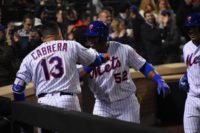
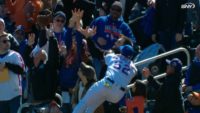
In the second was a big part of the two out rally. He knocked in Kevin Plawecki, who doubled, and he would later score on an Asdrubal Cabrera RBI single. Ironically, for a player that we talk about being a leader in hard hit ball percentage, his RBI single was a slow rolling grounder up the middle. As they saw, that ball had eyes. Overall, Campbell would go 2-3 with a run, an RBI, and a walk. He also ended the game with this web gem:
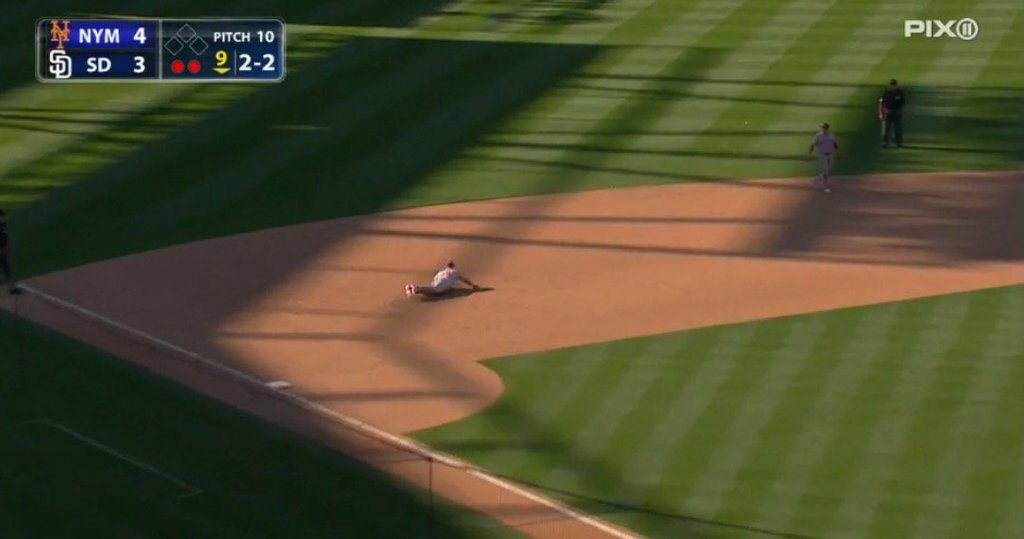
Campbell had a great game. He went from a .182/.357/.182 hitter to a .286/.444/.286 hitter. It was first RBI and only his third run scored. For that matter, it was only his second start of the year.
Given Campbell’s past it’s too soon to say the Mets should give him more playing time even with Wilmer Flores‘ struggles. Still, Campbell has earned the playing time he has received, and he has shown the Mets he has a place on the roster. If Flores continues to struggle, we may see more and more of Campbell. If he plays like he did on Sunday, that won’t be a bad thing.
This game wasn’t about the superb game David Wright had going 2-2 with three walks, two runs, a homerun and an RBI. This game isn’t about Michael Conforto snapping an 0-17 streak with a homer. It’s not about Yoenis Cespedes hitting another homer. It’s not about the 6-3 win snapping the Mets two game losing streak.
No, it’s about Bartolo Colon‘s homerun:
There’s nothing more than needs to be said about tonight’s game other than . . .
Bartolo Colon homered.
This is now Wright’s first full season since he learned about his spinal stenosis. So far, Wright has only played 52 games this far. As many people will tell you, 52 games is a short sample size. Choosing a subset of that information is a really small sample size. However, with that said, there does seem to be a pattern developing with David Wright.
He’s not handling airplane travel well.
Since Wright came off the DL, he’s had 13 trips that required airplane travel (regular season only). In those games, he’s had 63 plate appearances, and he’s hitting .185/.301/.389 with nine walks, five doubles, two homeruns, and 17 strikeouts. That’s a far cry from the .266/.382/.443 batting line he has had since his return. Extrapolating further, if you remove those travel dates, Wright is hitting .295/.410/.456.
One reason for the deviation could be the small sample size. Another could be his back.
Airplane travel has been known to exacerbate back injuries, especially lower back injuries. People can stiffen up and feel discomfort. While it is recommended that a person get up and move around on a flight to help lessen these issues, it’s difficult to do that after a nine inning game and your team is scheduled for an overnight flight. Aside from these issues, we don’t know what effects the travel has on Wright’s grueling training regiment.
It’s still a short sample size, but there is a correlation between flights and back discomfort. There’s also a correlation between the flights and Wright’s sluggish play. It’s something to keep an eye on as the season progresses.
Editor’s Note: this was also published on metsmerizedonline.com

Today is Star Wars Day (May the Fourth – get it?). In celebration of the day, here are the Mets alter egos from Episode VII: The Force Awakens:
Yoenis Cespedes – Poe Dameron
- Both Poe and Cespedes were renown for their incredible air power (Cespedes- HR, Poe – pilot). Both were thought to be gone only to return to the joy of everyone. We now know victory is certain.
Matt Harvey – Kylo Ren
- Both were once the most powerful apprentices only to have a younger one with long hair and more powers usurp them. Despite their most recent losses, they will be heard from again.
Noah Syndergaard – Rey
- Both were lost in the desert (Thor – Vegas, Rey – Jakku). Neither knew when they were going to be able to find their next lunch. Both are extremely powerful and are only now starting to realize it.
Michael Conforto – Finn
- Neither were supposed to be here. Neither were supposed to show any signs of greatness. Instead, they broke the mold and carved out a new path for themselves.
Curtis Granderson – Han Solo
- They’ve been around a long time, but they are still as cool as ever. It may be surprising, but they are in the thick of things like they always were. The only problem is there are some young upstarts (Granderson – Conforto, Han – Kylo Ren), who may push them aside. However, before that time comes, they will be heard from again.
Bartolo Colon – Chewbacca
- All these years later, they may be a step slow, but they still are large and in charge. One moment you’re questioning what something so old can do to you. The next, you’re getting your arm or bat taken from you.
Captain David Wright – General Leia Organa
- Years ago, they thought they had accomplished it all as the young, brash good looking people they were. Unfortunately, they didn’t. There’s still more work to be done. The difference is now they have to be the leaders and show a new generation how it’s done.
Logan Verrett – BB8
- Both are taking over for someone else’s role (Verrett – Sean Gilmartin, BB8 – R2D2), and they are performing admirably.
Zack Wheeler – R2D2
- Both are sitting around, shut down, but both still have a very important role to play.
Jacob deGrom – C3PO
- Both have problems with their arms (deGrom – decreased velocity, C3PO – it’s red) and no one knows how it happened. No worries. They’re back and better than ever.
Dan Warthen – Maz Kanata
- Both seem to have the secrets needed to unlock people’s secret powers and lead them on the path to greatness. Plus they kinda look alike.

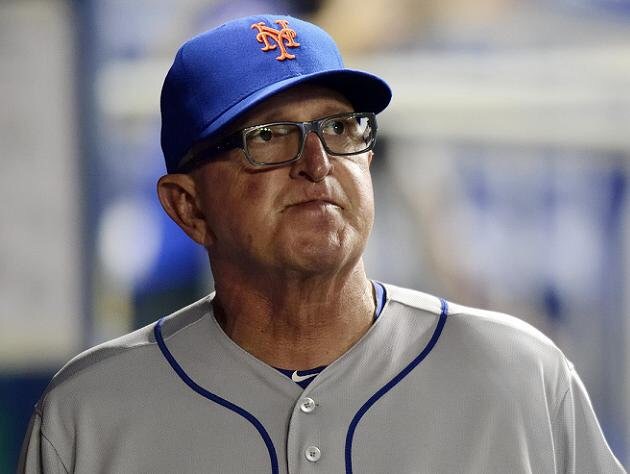
Terry Collins – Admiral Ackbar
- Both seem like this has all passed them by, but they have returned. They came back and led their people to great victories (Collins – NL, Ackbar – blowing up the Starkiller Base). Now if only Collins had screamed, “It’s a trap!” in Game 5 of the World Series . . . .
Lucas Duda – Captain Phasma
- Their roles are relatively overlooked. Both are large and intimidating presences that can destroy you in the blink of an eye.
Juan Lagares – Snap Wexley
- Both have been here since the new generation’s fight began, but they’ve been pushed aside by Poe/Cespedes who gets all the focus and glory.
Mike Piazza – Luke Skywalker
- The time has come where their greatness has now become the stuff of legends. They are now at the shrines where it all began (Piazza – Cooperstown, Luke – first Jedi temple)
Note, there are no Mets compared to Supreme Leader Snoke or General Hux as they just seem pure evil with no chance for hope. With that said, I think there’s enough room here for one more:
Chase Utley – General Hux
- Their sole intent is to destroy everything for their victory regardless of the consequences. Actually, that’s not true. The more amoral pain and violence inflicted the better. The good news is that no matter what they do, they will ultimately fail.
After an Opening Night loss, most people were writing the epilogue to David Wright‘s career. Since that point, Wright has played well. He’s getting on base, hitting homeruns, and playing good baseball. He constantly reminds us, his career isn’t over:
Twenty year old me never would’ve thought I’d say, “Thank God the Mets get to play the Braves 19 times a year,” but here we are. The Mets get to beat up on an awful Braves team 19 times a year. The Mets starting beating up on the Braves immediately:
Yoenis Cespedes‘ and David Wright‘s homers were tattooed.
Back to back! Cespedes saw Wright hit a 106mph homer, so he decided to hit a 106mph homer of his own. pic.twitter.com/bfKert3HWS
— CitiFieldHR (@CitiFieldHR) May 2, 2016
As for Cespedes, his homer was a new Mets record:
Yoenis Cespedes: fastest player to 25 HR with Mets (77 G). Previous fastest? Carlos Delgado: 88 G. via @EliasSports pic.twitter.com/njYSdGDvzg
— ESPN Stats & Info (@ESPNStatsInfo) May 2, 2016
Speaking of Carlos Delgado, this was the first time the Mets hit three homers in the first inning of a game since 2006. How you take that is up to you, but I choose to think of that as a good omen.
Speaking of slugging Mets first basemen wearing the number 21, this was the fourth time this season Lucas Duda was involved in back-to-back homeruns. The Mets have gone back-to-back five times this year.
After the first inning, the Mets bats quieted down a bit. Nothing of note really happened unless you want to count Wright singling off the face of Reid Brignac in the
As for Bartolo Colon, he did what he does best. He beat a really bad team handily. Colon pitched eight shutout innings allowing seven hits, no walks, and seven strikeouts. Colon had only thrown 99 pitches, but Terry Collins pulled him out. Jeurys Familia would pitch the ninth. He allowed a run to spoil the shutout, but would hold on to preserve the 4-1 victory.
Colon put on a show on the mound and at the plate:
BARTOLO EXIT VELOCITY!!!!!!!!!!!!!!!!! pic.twitter.com/tBtpW1Otr4
— Cut4 (@Cut4) May 3, 2016
Yes, this happened again:
#BigSexy, pure concentration. pic.twitter.com/xM2tq4tg6t
— MLB GIFS (@MLBGIFs) May 3, 2016
Congratulations are in order to Colon for his 220th career win. He broke the tie with Pedro Martinez for the second most wins by a Dominican pitcher. Juan Marichal is in first place with 243 wins. For the Mets, it was their 16th of the year and are 4-0 against the Braves.
Game Notes: Eric O’Flaherty is officially a Brave again as he pitched a scoreless seventh. Both he and Kelly Johnson received their NL Championship rings before the game. Neil Walker stole his first base as a Met in the eighth.
Around this time last year, David Wright was on the DL with a quad injury. He would soon find out that he was suffering from spinal stenosis, a condition which would forever impact his career. It would forever change not just his ability to play in games, but also how he prepares for games.
We’ve seen back issues cause players like Don Mattingly and Lenny Dykstra to retire early in their 30’s. However, as Danny Knobler reports for ESPN.com, Wright is not at that point no matter how frustrating, grueling, and tiresome his pregame routine can be:
“Every day it sucks,” Wright said late Tuesday night. “Every day it sucks getting ready for the game. But I enjoy playing the game. So it’s worth it. You know, it’s no fun doing the preparation for the preparation, but I want to play and give myself the best chance to be healthy, you’ve got to do what you’ve got to do.”
Wright’s “preparation for his preparation” begins five hours before first pitch. Wright needs at least two hours ready just to prepare himself to take batting practice. Everyone one sees what Wright goes through on a daily basis. As his manager, Terry Collins, said, “I know David. He’s fighting it really, really hard.”
Wright is working hard, and he knows he’s doing what’s necessary for him to get out on the field. As he said, “I’m satisfied I’ve put in the work to be able to play,” but “[y]ou’re never satisfied with where you are as a player.”
As a player, Wright is hitting .238/.342/.444 with seven doubles, two homeruns, four RBI, and two stolen bases. Last night, he had the game winning hit against the Reds. Moments like last night is no surprise to Collins, who said, “Great players do unbelievable things when you need them to.”
With that said, both Collins and Wright both acknowledge Wright won’t be available to do it every time he’s needed. As Collins said, “He has to come to me everyday and tell me how he feels.” Wright does as he’s acknowledged his limitations saying, “I know what’s best for me and the team is that I get those occasional days off.” As Wright said to Collins, “I’ve got to make sure I don’t overdo this.”
So far this year, there are no signs that Wright is overdoing anything. He’s taking days off, and he’s doing what is necessary to prepare for each game. It’s part of Wright’s new reality, but as he said, “you’ve got to do what you got to do.”
Editor’s Note: this article first appeared on metsmerizedonline.com.
Sometimes it’s just looks like it’s not going to be your night. Yoenis Cespedes and Travis d’Arnaud were out with injuries. Reds starter Brandon Finnegan showed why he’s a highly rated prospect. Bartolo Colon didn’t have the mojo working:
Just two elite athletes out there giving it their all. pic.twitter.com/fvlOy2Y1Cr
— Cincinnati Reds (@Reds) April 27, 2016
No, after the Ivan DeJesus two run homer in the third to make the score 3-0, it looked like it wasn’t going to be the Mets night. Even when the Mets could get rallies going, this would happen:
Billy. Goes. Ham. #LetsGoRedshttps://t.co/BJUhBREj1D
— Cincinnati Reds (@Reds) April 27, 2016
No, the Reds were in control and about to snap their nine game losing streak against the Mets. Then the Reds got greedy. They tried to push Finnegan through the seventh inning.
Juan Lagares had a one out single followed by a Kevin Plawecki walk. The Reds could’ve pulled Finnegan there. He just got out of a jam unscathed in the sixth. Instead, the Reds let him face Cespedes, who was pinch hitting for Logan Verrett. First pitch Cespedes saw:
YOOOOOO! One pitch, 3 RBI. @ynscspds ties the game. #Mets pic.twitter.com/L8DZoaOEtJ
— New York Mets (@Mets) April 27, 2016
Tie game.
Finnegan was gone after six brilliant innings (and one tough inning). We then got a glimpse of why the Reds were loathe to go to their bullpen.
Tony Cingrani entered the game. He was greeted by Curtis Granderson with a triple. Granderson would later score on a David Wright RBI single. It was a nightmare night for Wright at that point having gone 0-3 with two strikeouts at that point. It was emblematic of his recent struggles. In a brief moment, it was forgotten with that single making it 4-3. It was remembered again when he was picked off of first base (technically a caught stealing).
This gave Verrett the win. He was terrific. He came on in the sixth inning, and he threw two shutout innings. He showed both his versatility and his value. He deserved this win.
For the second straight night, Addison Reed and Jeurys Familia locked down the eighth and ninth. They preserved the Mets first come from behind win. It’ll be one of many.
Game Notes: With the Cespedes injury, Michael Conforto hit cleanup against the lefty Finnegan. He went 2-4. Before the game, d’Arnaud was placed on the 15 day DL. Lucas Duda sat against the lefty but came on in the ninth for defense.
Last year, the Mets saw lengthy absences from David Wright and Travis d’Arnaud. Daniel Murphy and Michael Cuddyer were nicked up most of the year. Other Mets players got bumps and bruises along the way. The Mets depth got tested early and often in 2015, and it was ugly.
Dilson Herrera and Kevin Plawecki showed they weren’t ready to hit major league pitching. For his part, Plawecki had to stay in the lineup because Anthony Recker and Johnny Monell weren’t either. Eric Campbell and John Mayberry, Jr. showed why they weren’t everyday players, let alone middle of the order bats. There were other forgettable debuts from players like Darrell Ceciliani and Danny Muno. In 2015, the Mets bet against their farm system, and it nearly cost them the season.
In the offseason, the Mets made sure to build a deeper roster. They moved Wilmer Flores to a utility role. Alejandro De Aza is here as a fifth outfielder. Juan Lagares is a part time player who will start against lefties and come on as a late defensive replacement. Herrera is back in AAA where he belongs for now. Campbell and Plawecki are on the 25 man roster, but they are asked to do much less. Hypothetically, it’s a much deeper team.
Well, that hypothesis is now being put to the test.
Yoenis Cespedes has been dealing with a thigh issue due to his jumping in the stands and an awkward slide. As for now, he’s not DL bound. Yesterday, d’Arnaud left the game early with pain in his throwing shoulder. While he may not have been the best at throwing out would be base stealers, his throws were uncharacteristically poor. He will be examined today before a DL decision is made. Whether it will be one day, one week, one month, or more, the Mets will miss Cespedes and d’Arnaud.
No matter how much time if will be, this Mets team is better built to sustain these losses. Having a De Aza/Lagares platoon is a much better option than Ceciliani. Plawecki has another year of development under his belt. Hopefully, this translates to him having a better year at the plate.
The Mets better hope so. The Nationals look like a different team than they were a year ago. The Mets aren’t going to be able to coast for two – three months with subpar players. This is a new year. Fortunately, this is a new Mets team that’s built for just these types of situations.