When Steven Matz first cracked into the majors with his grandfather jumping up and down, we expected him to do the Jerry Koosman each start. For the uninitiated, Koosman said his job as a pitcher was to shut them out and hit one out. Essentially, a pitcher should be a threat on the mound and at the plate. By the way, Koosman might’ve said that, but he was a terrible hitter.
Tonight, Matz had one of those Koosman dictated games. Matz pitched 6.1 innings allowing nine hits, two earned, two walks, and eight strikeouts. He got touched up was the third when noted Mets killer, Freddie Freeman, hit an RBI double. In the seventh, he ran out of gas, but Hansel Robles came in and got out of the jam. At the plate, Matz went 1-2. Terrible Braves team or not, Matz had a terrific night.
At the plate, the Mets had some firsts. In the first inning, Lucas Duda hit the Mets first sacrifice fly of the year scoring Curtis Granderson, who led off the game with a single and moved to third on a Michael Conforto single. Speaking of Conforto, he would have his first career stolen base in the third inning. After Duda hit his sacrifice fly, Neil Walker walked for the first time this year. Don’t worry, he would add a homerun in the eighth. The second run scored in the first would later score on an error. Sarcastic Mets fans would tell you this is the first time all year the Mets manufactured a run.
In any event, this game was what you would expect, or rather, what we should expect from Braves-Mets games this year. The Mets pitching and offense dominated. Every Mets starter, including Matz, reached base at least once. The Third Baseman Formerly Known as David Wright (RIP Prince) hit two doubles. He was 2-5 with one run, two RBI, and two strikeouts. Once again tales of his demise were greatly exaggerated.
Somewhat surprisingly, Juan Lagares got the start in center for an ailing Yoenis Cespedes. It was surprising because Jhoulys Chacin, who is a right handed pitcher. Before Cespedes was signed, it was presumed there was going to be a centerfield platoon with Alejandro De Aza facing the eighties.
Other than the Lagares -De Aza decision, nothing about tonight was surprising was the Mets domination. Once all was said and done, the Mets won 8-2. They need to dominate teams like this. They need to sweep teams like this. The Mets are in the process of doing that. They’re getting back on track.
This past week, I was able to interview Anthony Scaramucci regarding him and his partners purchasing the Mike Piazza post 9/11 homerun jersey. I appreciate Mr. Scaramucci purchasing the jersey and taking the time to answer my questions.
Special thanks goes to Mets Merized Online, who not only ran this interview on their site, but also many other of my Mets articles.
I also appreciate the links and recommendations for this interview including being part of Adam Rubin’s Morning Links. My wife was so thrilled she got a screen shot of it:
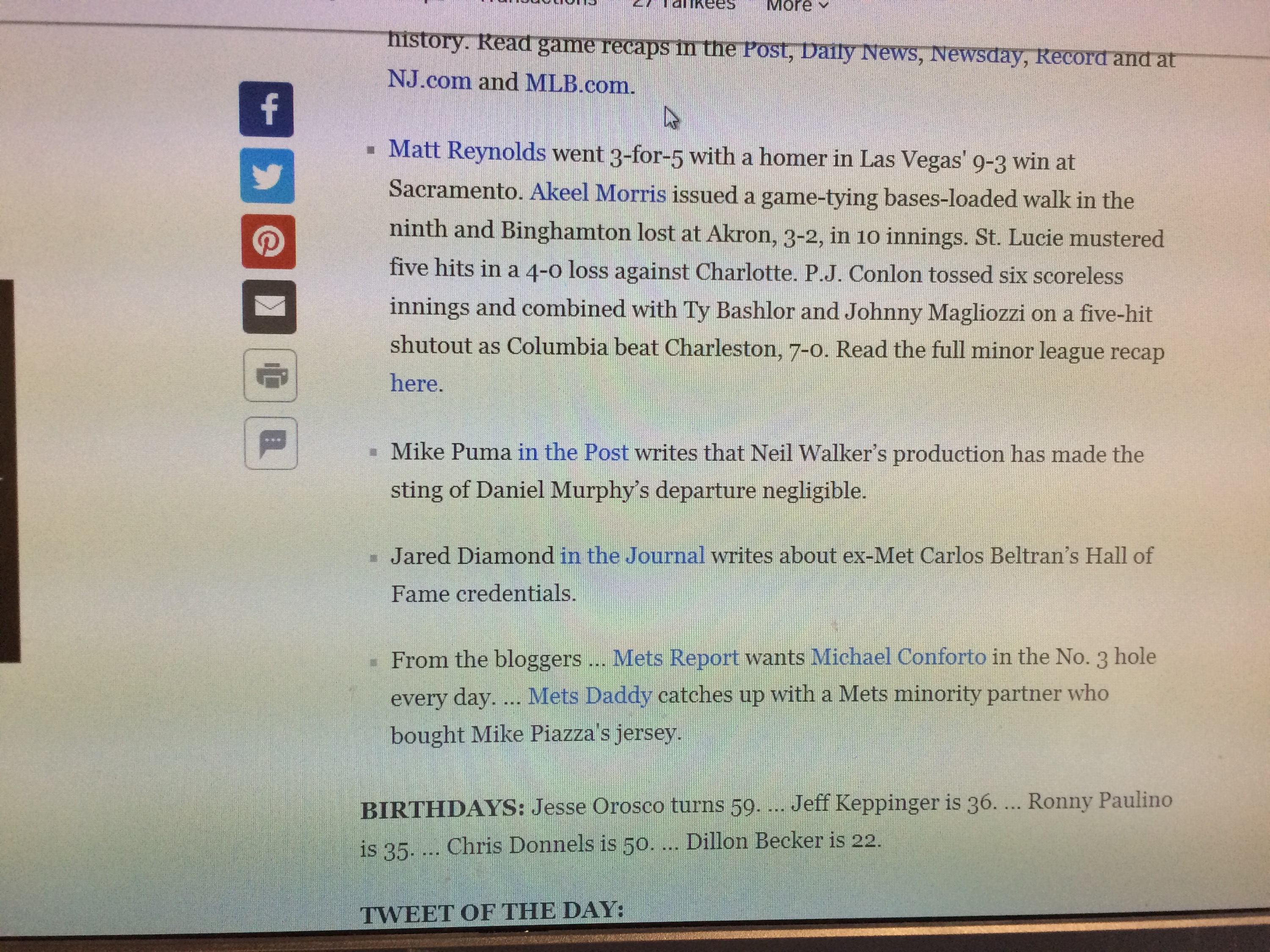
There were also links from SNY and Kevin Kernan, whose reporting brought the issue to light.
I appreciate everyone who linked the interview as well as those who took the time to read it. I especially appreciate those who read the site day in and day out.
After last season, you would want to believe that the Mets wouldn’t want to underestimate their own pitching prospects and expose them to the Rule 5 draft.
The Mets got very, very lucky with Logan Verrett. Everyone underestimated him. Perhaps it was a result of a low 90’s fastball. Perhaps it was because he relies on control, changing your eye level, and working both sides of the plate rather than blowing a 100 MPH fastball by you like Noah Syndergaard.
In any event, the Orioles decided he was worthy of a Rule 5 pick but not worthy of making their Opening Day roster. The Rangers scooped him up and decided after six games he couldn’t help them. He was returned to the Mets. He pitched well out of the bullpen and in spot starts. This year he’s made two spot starts and hasn’t allowed a run in 12 innings. The Mets needed him more than they ever knew. Fortunately for the Mets, the Orioles and Rangers never realized what they had in Verrett. The Mets got very lucky.
This year the Mets may not be so lucky with Matt Bowman.
Bowman was taken by the Cardinals in the Rule 5 draft. Partially due to Jordan Walden opening the year on the DL, Bowman made the Opening Day roster. So far this year, Bowman has appeared on five games pitching 6.2 innings. He has a 1.35 ERA and a 0.900 WHIP. He’s predominantly throwing a 93 MPH sinker. He mixes in the occasional slider (88 MPH) and splitter (82 MPH). It’s a short sample size, but Bowman looks good out of the bullpen. There’s no reason to believe the Cardinals will let him go.
The head scratching part was there was no excuse for why the Mets let Bowman become a Cardinal. The Mets had roster space. They could’ve protected Bowman. To make matters worse, they lost what appears to be a good bullpen piece. How did this happen?
In answering, this question it is important to note teams typically keep a roster spot open so they can make a pick in the Rule 5 draft in the event there’s a player out there who can help them. It’s how the Mets acquired Sean Gilmartin last year, and he became a valuable part of the bullpen. So in reality, the question was who should the Mets have left off the roster in place of Bowman.
The Mets did subsequently lose Kirk Nieuwenhuis on waivers. The Mets traded Darrell Ceciliani for cash. Carlos Torres and Ruben Tejada were initially offered contracts only to subsequently be released. The Mets also could’ve realized what they had and did the unconventional and just put Bowman on the roster barring them from making a Rule 5 draft pick. The Mets didn’t. Instead, they exposed Bowman in the draft in the oft chance they could’ve found someone of his caliber in the Rule 5 draft. How did this happen?
Simply put, like Verrett, Bowman didn’t have lights-out stuff. He is a four pitch pitcher that was projected to be, at best, a back of the rotation starter or bullpen arm. He really regressed his first full year in AAA. In 2014, he was 3-2 with a 3.47 ERA and a 1.294 WHIP in six starts and one relief appearance. In 2015, he made 26 starts and two relief appearances. Bowman would finish the year 7-16 with a 5.53 ERA and a 1.679 WHIP. Entering the 2015 season, he was seen as a back of the rotation starter or a bullpen arm. His 2015 season reasonably cast doubt on those projections. At age 25, it appeared like the former 13th round draft pick’s development had stalled.
It didn’t, and it shouldn’t be surprising as Bowman has looked for ways to improve. He has tried to emulate Tim Lincecum‘s delivery. While in college, he studied Sabermetrics, and he has sought to use it to find ways to improve. Basically, there’s no rock this former 13th round pick will leave unturned to he better. He’s built himself into a major league pitcher.
However, Bowman is pitching for the Cardinals, and the Mets have nothing to show for it. Worse yet, the Mets could’ve used him. With Jacob deGrom‘s lat injury (and problems with his son), Verrett was thrust into the starting rotation. Rafael Montero was recalled to help in the bullpen, but Collins has been loathe to use him.
Perhaps Collins would’ve trusted Bowman and allowed him to pitch. Unfortunately, we will never know. The Mets will not get lucky with a Rule 5 pick returning to the organization. Bowman is a Cardinal likely never to return.
Editor’s Note: this article was first published on metsminors.net
Before the game, Matt Harvey declared he figured out his mechanical problems, and that he was back. He took no chances as the Mets ore the traditional road grays instead of the blue alternates he prefers. The Mets need him to be back because he has not resembled the Matt Harvey we’ve seen:
Harvey in his career:
Bases empty: .199/.247/.296
Men on: .252/.302/.365 https://t.co/SqB05IV6Hd— Michael Mayer (@mikemayer22) April 22, 2016
First inning, Harvey came out guns blazing. He got three quick outs, including one strikeout. After the first, it was a struggle. It could’ve been the same problems he’s had all year. It could’ve been the delay due to the need to change home plate umpires due to the home plate umpire getting injured on a foul tip. In any event, Harvey’s pitches were up. His velocity was generally down (about 1-2 MPH), and the Braves were making solid contact.
Fortunately, the Braves were only able to score runs in the second. The first was an RBI single by old friend Kelly Johnson. Another run would score off an RBI double by Mallex Smith. Harvey would be in trouble most of the night. He would’ve allowed more runs in the fifth but for Yoenis Cespedes’ arm:
N'uh uh says the ?? of @ynscspds. #Metshttps://t.co/iwIPlyq0QU
— New York Mets (@Mets) April 23, 2016
Keith Hernandez was right. He missed the cut-off man, but it was a near perfect throw that got the runner. It reminded me of Major League when Lou Brown essentially said to Willie Mays Hayes to never do it again.
Cespedes also left his impression at the plate with his seventh game with an extra-base hit. In the seventh, he hit an RBI double to score David Wright, who hit an opposite field one out double himself. Cespedes came up gingerly after sliding awkwardly into second. It should’ve been a standup double, but he didn’t break it out of the box presumably thinking it was a homerun. A noticeably uncomfortable Cespedes stayed in the game despite the a Mets having a 6-2 lead. He would eventually have to be pulled:
Juan Lagares had already taken the field for the bottom of the eighth before the rain delay started. Yoenis Cespedes was leaving game.
— Adam Rubin (@AdamRubinMedia) April 23, 2016
Curtis Granderson was responsible for the other five. In the second, Granderson hit his first grand slam as a Met. In his very next at bat, he hit a solo shot off of Braves’ starter Bud Norris. Granderson looks to be rounding into his 2015 form after a tough start.
Blame @cgrand3 for the ☔️. He's brought a lot of it tonight. #GrandSlam #SoloHR pic.twitter.com/NOhszhy788
— New York Mets (@Mets) April 23, 2016
The Mets’ bullpen would come through to get Harvey his first win of the year. Antonio Bastardo pitched 1.2 innings before needing to be pulled with runners on first and second. Jim Henderson only faced one batter – it was the seventh after all- and he allowed an RBI single to Adonis Garcia. Jerry Blevins came on and ended the rally by striking out A.J. Pierzynski. Blevins was the only one to get Pierzynski out all night.
After about an hour rain delay, Addison Reed came on to pitch the eighth. Originally, it was supposed to be Blevins, but the rain eliminate that option. Reed pitched a scoreless eighth despite a throwing error from Asdrubal Cabrera.
Jeurys Familia had a save opportunity in the ninth because God has a good sense of humor. With Cespedes out if the game, Terry Collins allowed Michael Conforto hit against Eric O’Flaherty. Conforto hit a soft liner to the shortstop, and Juan Lagares was doubled off of second for the inning ending double play. It didn’t matter. Familia pitch a scoreless ninth to preserve the 6-3 win.
In any event, Harvey struggled. He only pitched five innings allowing seven hits, two earned, one walk and five strikeouts. He fought through it. He still had work to do, but at least he has a win under his belt.
Game Notes: Freddie Freeman got his first hit in 20 at bats against Bastardo, who Collins was trying to pitch for two innings. While Harvey was struggling, Travis d’Arnaud tried talking to Harvey in the dugout. A visibly frustrated Harvey wanted none of it.
On another note, Ricky Bones was the pitching coach. Dan Warthen missed the game because he was attending his mother’s funeral. Our thoughts and prayers are with the Warthen family at this time.
Last year, it was rough at times watching Wilmer Flores play shortstop. He didn’t look quite natural. He had trouble turning the double play. Worse yet, he seemingly took these struggles to the plate.
For a variety of reasons, Flores was thrust out of his role as the starting shortstop. The Mets handed the job back to Ruben Tejada, who at least looked the part. Tejada was steadier. He looked more fluid. And yet, Tejada was actually worse than Flores at shortstop. While Flores had a – 2.5 UZR and -10 DRS, Tejada had a -5.6 UZR and a -15 DRS. It’s surprising to see that Tejada was that much worse because he really did look better at shortstop. A big part of that was shortstop was his natural position, and he was more comfortable out there.
After the 2015 NL Pennant winning season was over, the Mets sought to upgrade their shortstop position. They wanted to put both Flores and Tejada on the bench. The ultimately released Tejada. In their stead, they added Asdrubal Cabrera.
Through the Mets first 14 games, Cabrera has looked good at shortstop. Unlike Flores, he is a natural shortstop. He’s comfortable turning the double play. He makes the routine plays with ease. When using the eye test, Cabrera has been nothing short of a revelation.
According to the stats, he hasn’t been. So far this year, Cabrera has a -1.1 UZR and a -2 DRS. To be fair, this is too short a sample size to make any judgments. However, this is indicative of Cabrera’s abilities at short. Last year, he had a -6.0 UZR and a -8 DRS. The prior year he had a -6.6 UZR and a -7 DRS. Despite how he looks, Cabrera isn’t a good shortstop.
In reality, Cabrera was brought here to hit. The Mets wanted the pop in his bat. In the second half last year, he hit .328/.372/.544 with 10 homeruns and 36 RBI. So far this year, he’s hit .314/.364/.392. Those numbers would be higher if he didn’t have a homerun taken away on replay in Philadelphia. In sum, Cabrera has been a positive addition to the Mets thus far. He’s been exactly what the Mets thought they were getting.
A steady shortstop with poor range who hits the ball well.

The Mets are on a homerun barrage lately. They’re even getting homeruns now from some in their “streakier” players. With that in mind, can you name the Top 10 in homeruns by Mets first baseman (as of today)? Good luck.
As we’ve seen with Lucas Duda, fans can use streakiness as a perjorative to hide their contempt for a particular player. However, when fans love a player, like Yoenis Cespedes, they talk about how he carries a team or wins the NL East.
Make no mistake about it, Cespedes is just as streaky as Duda.
Cespedes was a superstar when he came to the Mets, or so it seemed. In his first 10 games as a Met, he hit .262/.279/.333 with no homers, five RBI, and seven strikeouts. Then Cespedes went off on an absolute tear starting with the last game the Mets played in Colorado. Starting from that point, Cespedes had a 31 game streak like none other. He hit .323/.379/.805 with 17 homers and 37 RBI. It was incredible. After that streak? Cespedes finished the season hitting .280/.345/.320 with no homeruns and two RBI in eight games.
Cespedes cold snap would carry into the postseason. In the postseason, he hit .222/.232/.352 with two homeruns and eight RBI in 14 games. Yes, Cespedes dealt with hand and shoulder injuries, but it’s also true Duda dealt with back problems. It doesn’t make either player anymore or any less streaky.
So far this year, Cespedes has continued the streaky play. In the first eight games, he hit .233/.324/.333 with no homeruns, three RBI, and 11 strikeouts. In the six games since, starting with a trip to Cleveland, Cespedes is hitting .360/.429/1.000 with four homeruns and 10 RBI.
Fact is Yoenis Cespedes is both streaky and beloved by the fan base. He bunches his homeruns together during his hot streaks. He’s capable of carrying a team on his back for long stretches of time without a moment’s notice. Therefore, next time you knock a player for being streaky, just remember the guy you put on a pedestal as being able to carry a team is just as streaky.
Personally, I’ll take a Duda or Cespedes hot streak whenever they come.
Last year, Lucas Duda hit 27 homeruns. He had a stretch where he hit eight homeruns in seven games. He hit seven homeruns in May, eight homeruns in July, and six homeruns in September/October. The other three months of the year, he hit 10 total. Many people have attributed this streakiness to Duda’s high leg kick.
Since 2012, various Mets hitting coaches have worked with Duda to work on reducing his leg kick. It appears this Spring, Kevin Long was finally able to get him to reduce his leg kick. Long also got Duda to take less batting practice. All of this is designed to make Duda a healthier and more consistent hitter. So far this year, Duda’s leg kick is much less pronounced.
For example, this was a homerun he hit in the NL East clincher:
https://m.youtube.com/watch?v=ZK-RlkIvrmc
Here’s a homerun he hit last night in Philadelphia:
It’s clobbering time! Lucas Duda went full #DudaSmash on his first home run of the season. https://t.co/ysZr0TY7fuhttps://t.co/C1UwEe7kHY
— New York Mets (@Mets) April 19, 2016
Now, after not homering in his first 10 games, he has homered in three straight games. It’s a long season, and you shouldn’t make judgments after 14 games, but Duda is once again hitting homeruns in bunches. It could be this is a small sample size, but it could also be that this is who Duda is. He’s a streaky homerun hitter.
If it’s as simple as Duda is a streaky homerun hitter that’s fine. Since Duda has become the Mets everyday first baseman, he has a .350 OBP. That means even when he’s not hitting homeruns, he’s getting on base. Additionally, looking at this lineup, the Mets don’t need Duda to carry them for stretches at a time. However, when Duda gets in a homerun groove he can carry a team.
The aforementioned stretch of eight homeruns in seven games coincided with the Mets sweeping the Nationals en route to the Mets taking control of the NL East for good. In that three game sweep of the Nationals, Duda hit three homeruns in nine at bats with five RBI. In that three game series, he hit .626/.667/1.875. When Duda gets hot, he’s scorching red hot. He can carry the Mets, and he can make a difference in the NL East.
Whether Duda’s streakiness will continue this year even with a reduced leg kick is besides the point. The only thing that matters is that Duda continues to be the good OBP first baseman that can carry the Mets for stretches. So long as he continues this, he will have had another terrific year.

When Sandy Alderson, J.P. Riccardi, and Paul DePodesta were first hired by the Mets, everyone assumed the Mets were going to be recreated in the image of the high OBP Scott Hatteberg Oakland Athletics teams.
However, upon reflection of what the Alderson regime has done here, the team has been more focused upon power than they’ve been on OBP. That philosophy was on display last year when Yoenis Cespedes came aboard, and it’s on display again this year:
17 HR by the @Mets in their last 5 games is their most in a 5-game span
Previous: 16 (last season)@EliasSports pic.twitter.com/4NuSWA4t65
— ESPN Stats & Info (@ESPNStatsInfo) April 20, 2016
Over the offseason, the Mets brought in three players to play everyday. There was the aforementioned Cespedes with his career .320 OBP. Cespedes also hit 35 homeruns last year while slugging .612 as a Met. Neil Walker has a career .336 OBP, but he averages 16 homeruns per year. He led all Major League second basemen in homeruns last year. Asdrubal Cabrera was signed to be the new shortstop. He has a career .329 OBP, but he did hit 15 homeruns last year.
That’s not to suggest the Mets do not value OBP. This is the same team that did choose Lucas Duda over Ike Davis, in part because Duda got on base more frequently. Rather, it shows the Mets put more emphasis on homerun power than OBP. The Mets aren’t looking to clog the bases and manufacture runs. Rather, they are looking for players that can change an inning or a game with one swing of the bat.
This shouldn’t surprise anyone.
Let’s re-examine that fabled 2002 Oakland Athletics Moneyball team. As we know, they actively sought out players like Hatteberg because they were undervalued and could get on base. That year, the Athletics ranked fourth in the AL and seventh in the majors in OBP. The same year, the Athletics ranked fourth in the majors (and the AL) in homeruns. While the Athletics no longer had Jason Giambi, one through nine, their lineup still had players that could hit the longball. The OBP got the headlines because it was a shift in how people viewed baseball, but the homeruns are what powered that Athletics offense.
The Athletics being powered by the longball wasn’t anything new or groundbreaking. It was what powered the Athletics when Alderson was the GM. From 1988 – 1990, the Athletics went to three World Series winning one. In 1988, the Athletics were ranked second in the majors and the AL in homeruns. Their rankings slipped in 1989 to seventh in the AL and eleventh in the majors, in part due to injuries like Jose Canseco‘s wrist, but the Athletics rose back up the ranks in 1989. In 1989, the Athletics were ranked third in the AL and fourth in the majors in homeruns.
Overall, Sandy Alderson, J.P. Riccardi, and Paul DePodesta have built teams that hit homeruns. Even if everyone expected different, this regime is doing what they’ve always done, and that’s building an offense based on their batters hitting homeruns. By the way, when they’ve successfully accomplished this goal, they’ve won a lot of games and went to the postseason.