Since Michael Fulmer‘s call-up on April 29th, he is an astounding 6-1 with a 2.83 ERA and a 1.175 WHIP. In his last four starts, he is 4-0 with a 0.32 ERA and a 0.635 WHIP. These are great numbers from any rookie. It’s all the more incredible when you consider he’s only made three starts in AAA. The 23 year old is showing everyone why he was considered a potential ace, and why the Tigers wanted him in the first place.
It’s also a reminder that the Mets used their biggest trade chip last year.
While the Mets farm system is still stocked with pitching talent, there aren’t any pitchers with the upside of Fulmer, at least not any that are as close to the major leagues as Fulmer was last year. Now, the Mets do boast some terrific position player prospects like Dominic Smith and Amed Rosario. However, neither one of those players are close to ready to being major leaguers. While these players are highly thought of around baseball, they are certainly not going to fetch a player of Yoenis Cespedes‘ caliber at the trading deadline. That’s a huge problem for the Mets.
Right now, the Mets are without Lucas Duda, David Wright, and Travis d’Arnaud due to severe injuries. The Mets don’t know the long-term status of Juan Lagares and the torn ligament in his left thumb. Hopefully, d’Arnaud, who has started rehab games, can catch with the torn labrum. Realistically, all the Mets can do with each of these players is put a timetable on when they think they could return not fully knowing when these players can return. As the Mets are waiting to figure this out, they are playing a group of players that are having problems just to reach the Mendoza Line. The big solution they have so far was to acquire James Loney. Loney has been good so far, but he is still the player who was released by the Tampa Rays and was playing for the San Diego Padres’ AAA affiliate. In short, the Mets are going to have to go out there on the trade market and obtain some players that can help them at catcher, first, and third.
The Mets have the pieces to make those deals. However, they may not have the pieces to make that blockbuster deal that everyone wants. The Mets don’t have the one big trade piece that could solve the issue at one or more positions. The reason why is the Mets went all-in on the 2015 season. The result was the Mets making it to the World Series. At the end of the day, the 2016 Mets may be hamstrung by what happened in 2015.
With that said, Sandy Alderson is a very good GM. He has swung some good trades while he has been the manager of the Mets. The deals he made with the Braves for Kelly Johnson and Juan Uribe as well as the deal he made with the Arizona Diamondbacks for Addison Reed were absolute coups. Alderson was able to acquire quality major league pieces without giving up much of anything. The Mets are going to need the same type of performance this trading deadline, especially since he doesn’t have the same assets he had last year to get the job done. It’s not going to be easy. It’s going to require some creativity. However, if anyone can do it, it’s Sandy Alderson.
Initially during the rain out, I was watching Amazin’ Finishes featuring either the 2007 or 2008 season. In other words, two years that decidedly didn’t have amazing finishes. I decided to turn it off.
Then something struck me. It’s been 10 years since 2006. Looking back at that roster, only five of the 49 players who appeared in a game for that team are still in the majors. Seeing how most of those players have retired and the changes roles of the other five, it’s really shows you how much things have changed.
David Wright – he was the young star then, but now with the spinal stenosis and herniated disc in his neck, you wonder how much longer he has.
Jose Reyes – back then he was charmingly seen as Wright’s partner in crime. There’s no charm in that anymore with the allegations against him that never went to trial. His future is uncertain now that rookie Trevor Story has claimed the shortstop position for the Rockies.
Oliver Perez – there was a time during Game 7, that you thought you would he would’ve been forever loved. Problem is he stayed too long. He eventually became an effective relief pitcher, and now, he’s helping the Nationals try to get to the World Series.
Mike Pelfrey – Pelfrey was the rookie pressed into action due to a number of injuries. He struggled as he wasn’t ready, and he was sent back to the minors. Now, he’s a 32 year old veteran starter for the Tigers who is struggling.
Carlos Beltran – he was the best player on the planet in 2006. He is on his way to the Hall of Fame. He’s also still a very productive player:
Carlos Beltran is on pace for 40 homers and 102 RBI. Pretty solid stats for a 39-year old. His 3-run HR was decisive for Yankees tonight.
— Jack Curry (@JackCurryYES) June 7, 2016
It is amazing to look back and see how much has changed. It’s even more amazing to see that Beltran is still the best of this group. He was a special player, and Mets fans were lucky to see him play everyday for seven years.
For the past year, we have seen the magic that can happen when a player plays for the team he rooted for throughout his entire life. Steven Matz is an astounding 11-1 as a Met. Not only has he become a beloved Met, but his grandfather has become a beloved figure as well. It doesn’t get any better than that.
However, what happens after that? What happens when the team you love decides they are better off without you?
Twenty years ago, that was what happened to Bernard Gilkey. Gilkey was born and raised in St. Louis. In 1984, Gilkey was signed as amateur free agent. Six years later, Gilkey made his major league debut for his hometown team. In six years, Gilkey played very well for the Cardinals. He hit .284/.354/.431. In his four seasons as a starter, he had a 117 OPS+. Then, after the 1995 season, the Cardinals decided they could do better than him as they had Ron Gant, Ray Lankford, and Brian Jordan. This facilitated a trade to the Mets.
Gilkey responded by going 2-4 with a homerun and 2 RBI on opening day against those same St. Louis Cardinals. It was the first step in what turned out to be a career year for Gilkey. Gilkey hit .317/.393/.562 with 30 homers and 117 RBI. He set a still standing Mets record of 44 doubles. He had a 155 OPS+. It stands out as the greatest season a Mets left fielder has ever had. Gilkey responded to the heartbreak of leaving his hometown team, the team that drafted him with a career year.
This year Neil Walker finds himself in the same predicament Gilkey did twenty years ago. Walker is responding in a similar fashion.
Moreso than Gilkey was to St. Louis, Walker was Pittsburgh. His father was good friends with Roberto Clemente. Walker walks this earth because Clemente told Walker’s father not to get on that plane. Walker was born in Pittsburgh, and he grew up in their suburbs. He was the Pirates first round pick in 2004, and he made his debut with the team in 2009. Walker was an important part of the make-over of the Pirates from a team that had a losing record 20 consecutive seasons to a team that made the playoffs three consecutive years. Despite all of this, the Pirates decided Walker was too expensive, and they traded him to the Mets.
Like Gilkey, Walker is responding by having a career. year. Walker has already hit 13 homeruns this year. That’s a 38 homerun pace, which would shatter his career high of 23. He is hitting .279/.348/.505. The OBP stands to be his second highest ever, and his slugging percentage would be his best ever. His 131 OPS+ would also be a career high. Perhaps more important than any of this is the fact that Walker is now a true switch hitter.
Before coming to the Mets, Walker only hit .261/.306/.338 with only six homeruns against lefties. This year, he’s hitting .341/.396/.727 with five homeruns. He’s nearly doubled his career homerun total. He’s gone from being meek against lefties to being a force in the lineup against lefties. In some way, the coming to the Mets as turned Walker’s already solid career around. Like Gilkey, coming to the Mets seems to be the best thing that has ever happened to Walker. Sometimes, the best thing that can happen to a player is for them to leave their hometown to fully develop as a player. The Mets have been fortunate to have Gilkey and Walker blossom after they left their hometowns.
With all that said, we all hope Matz never leaves the Mets. From what we’ve seen with him, he doesn’t need to leave the Mets to be great.
Editor’s Note: this was also published on metsmerizedonline.com
The biggest trade of the offseason was the Mets trading Jon Niese for Neil Walker. Now matter your thoughts on the trade, Walker has been terrific for the Mets as he has been their second best player this season.
Just glancing at the numbers, Niese has been pretty terrible this year making the trade look even better.
However, after starting the year 3-1 with a 5.94 ERA and a 1.680 WHIP in his first six starts Niese has turned a corner. It’s not that surprising given Ray Searage is his pitching coach. In Niese’s last five starts, he is 2-1 with a 2.64 ERA and a 1.206 WHIP. Part of that is his BABIP going from .337 to .264. Part of that is his level of competition has dropped a bit. And yes, part of it is his pitching coach.
Whatever the case, Niese pitching well now is certainly the worst case scenario. No one – I repeat – NO ONE wants to see Niese beat the Mets.
Niese was a guy who had no love for Mets fans. He always had an excuse for why he was pitching poorly. He took a jab at his teammates about their defense on his way out of the door. In sum, Niese wasn’t built for New York.
He still had some good moments as a Met. He volunteered to go to the bullpen for the postseason, and he pitched well there. For a few years, he was one of a few viable starting pitchers in the rotation. It speaks volumes that he once got an Opening Day start. However you felt about him, he’s now toeing the rubber against the Mets tonight.
This is not a game any Mets fan wants to lose. I’m sure the players he slighted on the way out the door feel the same way. Hopefully, Walker goes out and does this tonight en route to a big win:
Go out and beat Niese tonight.
The other day, Travis d’Arnaud began his rehabilitation assignment playing DH for High-A St. Lucie. It’s interesting he started at a position other than catcher as many people believe d’Arnaud should be using this time to transition away from catcher.
There are sound reasons for this decision. d’Arnaud has been injury prone, and catcher is a position where a player tends to get many nicks, bumps, and bruises. With the torn labrum, d’Arnaud is going to have even more issues throwing out more base stealers than he is perceived to have. Finally, with the Lucas Duda and David Wright injuries, the Mets may need long term solutions to those positions.
Despite all of these reasons, it would be an incredibly poor decision to move d’Arnaud out from behind the plate.
First, d’Arnaud’s torn labrum shouldn’t affect his ability to catch and call a game. Throughout his career, d’Arnaud’s strength has been as a receiver and a pitch framer. Yes, his torn labrum could affect his ability to throw. However, his throwing would be a bigger issue from third base.
Additionally, moving d’Arnaud doesn’t help the Mets offensively. In d’Arnaud’s absence, Kevin Plawecki has hit .203/.302/.298, and Rene Rivera has hit .194/.310/.361. Right now, the Mets have James Loney at first, who is a career .285/.338/.411 hitter, and Wilmer Flores at third, who is a career .251/.288/.382 hitter. Simply put, the Mets are better off with d’Arnaud, Loney, and Flores in the lineup.
Overall, the Mets need d’Arnaud back with the Mets as soon as possible. They need his bat in the lineup to improve the lineup. He helps this team, and this pitching staff most, when he is behind the plate. He needs to stay there.
You’re not going 162-0. It’s simply not going to happen. Even the 108 win 86 Mets lost 54 times. Your only hope is that when the Mets lose they can provide you with something positive.
Matt Harvey did that.
Harvey did take the loss, but he lost 1-0 against Jose Fernandez, a great pitcher in his own right. Harvey was good again today. He pitched seven innings allowing only four hits, one earned, and no walks with three strikeouts. He was averaging 96 MPH with his fastball. Harvey built upon his last start. This is a other sign the Harvey of old is coming back:
Since 1913, most games allowing one run or fewer by starting pitcher in first 77 starts:
Dwight Gooden: 38
Matt Harvey: 35— New York Mets Stats (@NYMStats) June 5, 2016
Ultimately, no one wants to see the Mets lose. However, this loss is more acceptable than most as Harvey took another step forward. Getting Harvey back to form is more important than the outcome of any game.
The Mets just had to tip their caps to Fernandez, who was awesome against the overmatched Mets backups:
José Fernández led the Marlins to a win over the Mets with 14 K. Here's a look inside his dominant performance: pic.twitter.com/OslZ22sCTb
— ESPN Stats & Info (@ESPNStatsInfo) June 5, 2016
Fernandez is difficult for any lineup. It’s even worse for a lineup without David Wright (DL – neck), Travis d’Arnaud (DL – shoulder), Yoenis Cespedes (DTD – hip), and yes, even Juan Lagares (DTD – presumed sprained thumb). About the only positive from the game from an offensive standpoint was Michael Conforto and James Loney going 1-3. Both hitters got hits in what has been a good series for both.
The Mets now travel to Pittsburgh where Neil Walker gets to face his old team. Making the matchup all the more interesting is the fact that old friend Jon Niese takes the mound.
Game Notes: Harvey recorded his 500th career strikeout in this game. Harvey fell to 1-18 in his career when the Mets give him two runs or less of run support. In those games, he has a 2.53 ERA in such games.
Back in 2014, my son was a little over nine months when we went to his first Mets game. There was a condition precedent for us going to the Mets game – there had to be an area where our son could breastfeed. I had done my research, and my wife was satisfied with the results of my reasearch.
Unfortunately, the information provided on the various mommy blogs were completely wrong. There really wasn’t an area to breastfeed at Citi Field.
During that September 14th game, my wife searched high and low for a place to breastfeed. First, we went to the nurses’ station, which was the recommeded area. We were turned away. Next, we tried to go to one of the family rooms you see scattered across the Field Level. They’re all locked. We tried speaking the ushers, but they had no idea. Finally, we made our way back to Fan Assistance where they arranged for my son to be fed in a right field promenade ticket booth while an employee stood outside the door preventing anyone from entering. This is not an ideal situation, and it really prevents families from bringing their little ones to games. Fortunately, the Mets have remedied this situation.
Now, the Mets have a Mamava Station located at the Empire Level of Citi Field. Note, all moms are allowed to use this station regardless of where they are sitting. All you need to do is to contact guest services, and they will assist you. Your best bet is probably to to go Fan Assistance the minute you get to the game and figure out how the process works. In this private booth, mom is able to either breastfeed her child or pump. I’m assuming it’ll be easier to bring a handpump into Citi Field. I’d also caution that there only seems to be a USB station and not an outlet listed in the amenities located in the booth. One thing that is really nice about the booth is that it’s air conditioned so mom can be comfortable while she is breastfeeding the baby.
The Mets should really be commended for making this addition to Citi Field. Anything that encourages families to attend Mets games is a good thing. Anything to helps mothers is an even better thing. Unfortunately for me, it was about two years too late.
Lost in all the offensive struggles is the fact that this Mets team is built upon pitching. As a franchise, the Mets always have and always will be built upon pitching. It started with Tom Seaver, Jerry Koosman, and Jon Matlack in the late 60’s. It was continued in the 80’s with Dwight Gooden, Ron Darling, Sid Fernandez, and David Cone. The mantle was supposed to be picked up this year by the Mets young rotation.
However, the rotation has had some struggles. Matt Harvey struggled mightily going 2-4 in May with a 5.91 ERA. To a lesser extent, Jacob deGrom struggled in May going 0-1 with a 3.86 ERA. The concern with deGrom was not so much the results but the seemingly precipitous drop in velocity. These were to the two aces the Mets road all last year and into the postseason. These were supposed to be the two aces this year leading the team while the younger starters developed. Instead, the reverse has been true.
Noah Syndergaard has taken the next step this year. He is 5-2 with a 1.84 ERA and a 0.958 WHIP. He is throwing fastballs up and over 100 MPH, and more impressively, he is throwing sliders around 95 MPH. He is as dominant a pitcher as there is in baseball right now.
Steven Matz was named the National League Rookie of the Month for the Month of May. It was a well deserved honor after going 4-0 with a 1.83 ERA and a 0.757 WHIP. In fact, if you take away his first nightmare of a start, a start he made after a long period of inactivity, Matz is 7-0 with a 1.51 ERA and a 0.932 WHIP. Matz has been the pitcher everyone has imagined he would be and more since he burst onto the scene last year beating the Reds from the mound at the plate.
Overall, Syndergaard and Matz have taken the next step. On almost any other rotation, they would be the unquestioned ace. That was the same thing that has been said for Harvey and deGrom. On that front, there is some great news as well. In Harvey’s last start, he went seven innings allowing only two hits, no runs, and one walk with striking out six. In deGrom’s last start, he went seven innings allowing five hits, one run, and two walks while striking out 10. More importantly, deGrom’s velocity is returning with him getting his fastball up to 96 MPH.
So yes, it appears like the 2016 Mets are continuing the franchise’s legacy of having great pitching. With Syndergaard and Matz being ahead of schedule in their development coupled with Harvey and deGrom starting to return to last year’s form, the Mets rotation is stacked with four aces. If you’re a baseball player or a poker player, you know four aces is next to impossible to beat no matter whatever else you have in your hand . . . even if that hand contains the deuce that the Mets offense was over the month of May.
David Wright is gone for who knows how long. Yoenis Cespedes was scratched right before the game with a hip issue. When you don’t have the big bats in your lineup, you’re doing to need everyone to pitch in to try to help secure the victory.
As usual, Juan Lagares provided Gold Glove defense:
Sorry, the gap's closed today: https://t.co/ZAOFAXw8FG #Juanderfulhttps://t.co/hr1USxY5HI
— MLB (@MLB) June 4, 2016
It was an important catch as the game was 3-2, and that hit could’ve put the game out of reach. Instead, the Meys got new life.
That’s when James Loney made his contribution. Loney led off the inning with a double and moved to third on a passed ball. Loney then scored on an RBI single by surprise starter Michael Conforto. Conforto has been struggling badly of late, but today he was 1-3 with a run scored, a walk, and two RBI. Conforto later scored on an RBI pinch hit single from Matt Reynolds. Reynolds had to pinch hit for Lagares, who left the game with an apparent injury, which may or may not have been related to that amazing catch.
Seemingly every Met contributed to this 6-4 win. Wilmer Flores was 3-4 with a run and a walk. Neil Walker scored two runs, and Asdrubal Cabrera scored one as well. He also stayed in a game where everyone seemed to get knicked up a bit. Bartolo Colon pitched in and out of trouble allowing only one run over five. Jerry Blevins, with a little help from Lagares, bailed out Hansel Robles in the sixth. Jim Henderson pitched a scoreless 0.1 innings, and Addison Reed pitched a scoreless eighth. Alejandro De Aza had a two out, two run double in the the ninth. Jeurys Familia recorded his 18th save. As you can see, pretty much everyone contributed to this win, save Kevin Plawecki.
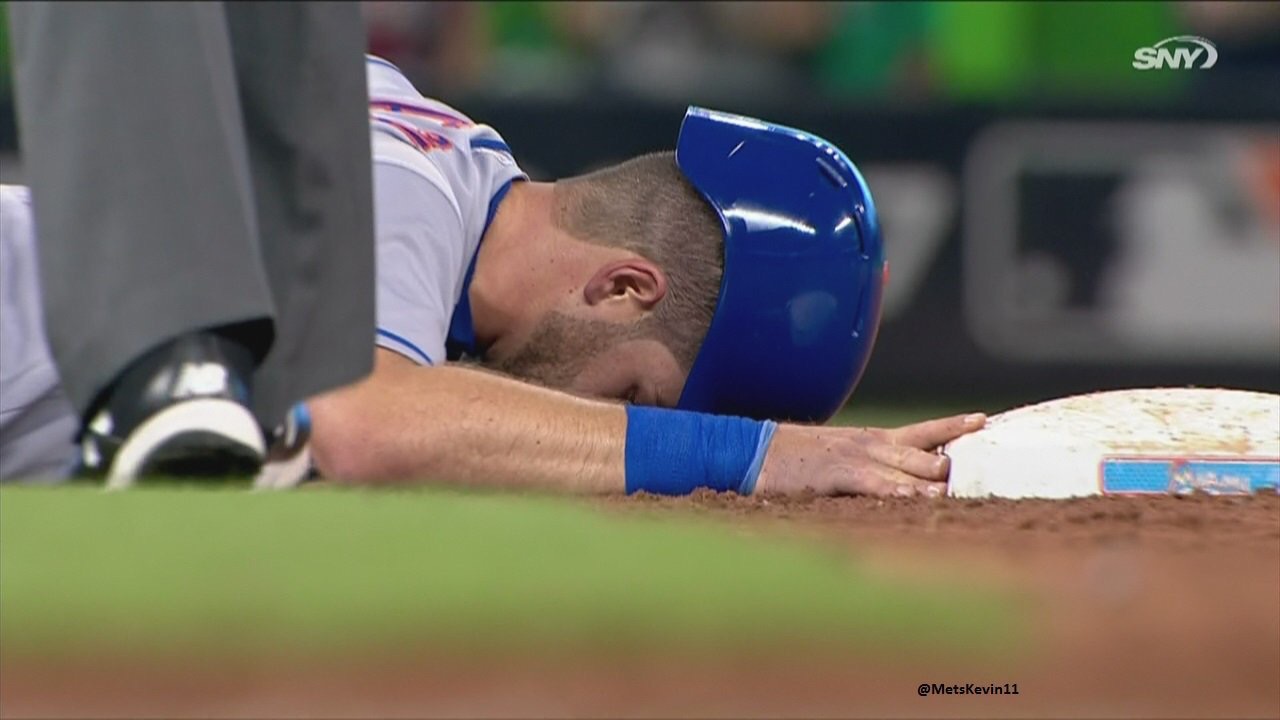
He has an error in the second when he took a throw from Flores and couldn’t find homeplate with his foot or tag the runner. In the top of the third, he hit a double and was immediately picked off second. In the eighth, he couldn’t get down a sacrifice bunt. It was a tough say for him on what was a terrific day for his teammates.
So long as the Mets role players and lesser starts keep stepping up like this, this is going to be a special season.
This year, the Mets intended to rely heavily upon Wilmer Flores. The Mets needed him to be the main backup at all four infield positions. Mainly, he was needed as insurance for David Wright‘s back.
Unfortunately, Flores wasn’t up for the task in the early part of the season. Flores started the year hitting a paltry .167/.242/.267 with a -0.4 WAR, 40 OPS+, and a 44 wRC+. He was struggling with his throws from second and third. He then went on the disabled list with a strained left hamstring. He was becoming an after-thought.
Part of the reason for Flores’ struggles could’ve been his irregular playing time. Now, with David Wright’s injury, there is a chance. With Wright being shut down for 6-8 weeks due to the herniated disc in his back, Flores is the obvious choice to get be the starter at third base. He’s going to get a shot to prove he’s up to the task. That’s all Flores wanted.
Flores knows this is his chance. Flores said, “You don’t want to have anybody get hurt. It happened. Since I got here, I’ve been waiting for an opportunity. It’s an opening. Knowing that you could be in the lineup, it changes everything.” (ESPN).
At least for one night, Flores looked like a changed player. On Friday, he went 2-3 with two runs, one walk, one RBI, and a double. He got a two out RBI hit, and he drew a walk to start the game winning rally. It’s the type of performance you wanted to see from him the first night he officially became the Mets short term answer at third base.
Better yet, there’s reason to believe games like Friday’s are not a mirage. Prior to that game, Flores had an unsustainably low .188 BABIP. That’s well below the league average of .300 and his career average of .264. Accordingly, it is reasonable to expect Flores to see an improvement in his offensive numbers.
Additionally, last year he got better as the season progressed. In the first half, he only hit .252/.286/.395 with a 91 OPS+. As he worked with Kevin Long, he improved. In the second half, he hit .280/.311/.429 with a 101 OPS+. His best month was August where he hit .306/.337/.506. As the year progressed, he steadily improved. It’s what promising young players do.
It’s easy to forget Flores is just 24 years old. He’s still developing as a player. He still hasn’t reached his full potential. He’s got a good coaching staff that will help him get there. Now, due to Wright’s unfortunate injury, Flores is going to get the playing time he needs to continue in his development.
This is his chance to show the Mets they don’t need to add a third baseman because he’s ready to take over. At least on one night, he took advantage of that opportunity.