Musings
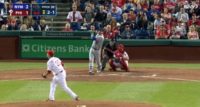
Last year, Lucas Duda hit 27 homeruns. He had a stretch where he hit eight homeruns in seven games. He hit seven homeruns in May, eight homeruns in July, and six homeruns in September/October. The other three months of the year, he hit 10 total. Many people have attributed this streakiness to Duda’s high leg kick.
Since 2012, various Mets hitting coaches have worked with Duda to work on reducing his leg kick. It appears this Spring, Kevin Long was finally able to get him to reduce his leg kick. Long also got Duda to take less batting practice. All of this is designed to make Duda a healthier and more consistent hitter. So far this year, Duda’s leg kick is much less pronounced.
For example, this was a homerun he hit in the NL East clincher:
https://m.youtube.com/watch?v=ZK-RlkIvrmc
Here’s a homerun he hit last night in Philadelphia:
It’s clobbering time! Lucas Duda went full #DudaSmash on his first home run of the season. https://t.co/ysZr0TY7fuhttps://t.co/C1UwEe7kHY
— New York Mets (@Mets) April 19, 2016
Now, after not homering in his first 10 games, he has homered in three straight games. It’s a long season, and you shouldn’t make judgments after 14 games, but Duda is once again hitting homeruns in bunches. It could be this is a small sample size, but it could also be that this is who Duda is. He’s a streaky homerun hitter.
If it’s as simple as Duda is a streaky homerun hitter that’s fine. Since Duda has become the Mets everyday first baseman, he has a .350 OBP. That means even when he’s not hitting homeruns, he’s getting on base. Additionally, looking at this lineup, the Mets don’t need Duda to carry them for stretches at a time. However, when Duda gets in a homerun groove he can carry a team.
The aforementioned stretch of eight homeruns in seven games coincided with the Mets sweeping the Nationals en route to the Mets taking control of the NL East for good. In that three game sweep of the Nationals, Duda hit three homeruns in nine at bats with five RBI. In that three game series, he hit .626/.667/1.875. When Duda gets hot, he’s scorching red hot. He can carry the Mets, and he can make a difference in the NL East.
Whether Duda’s streakiness will continue this year even with a reduced leg kick is besides the point. The only thing that matters is that Duda continues to be the good OBP first baseman that can carry the Mets for stretches. So long as he continues this, he will have had another terrific year.

When Sandy Alderson, J.P. Riccardi, and Paul DePodesta were first hired by the Mets, everyone assumed the Mets were going to be recreated in the image of the high OBP Scott Hatteberg Oakland Athletics teams.
However, upon reflection of what the Alderson regime has done here, the team has been more focused upon power than they’ve been on OBP. That philosophy was on display last year when Yoenis Cespedes came aboard, and it’s on display again this year:
17 HR by the @Mets in their last 5 games is their most in a 5-game span
Previous: 16 (last season)@EliasSports pic.twitter.com/4NuSWA4t65
— ESPN Stats & Info (@ESPNStatsInfo) April 20, 2016
Over the offseason, the Mets brought in three players to play everyday. There was the aforementioned Cespedes with his career .320 OBP. Cespedes also hit 35 homeruns last year while slugging .612 as a Met. Neil Walker has a career .336 OBP, but he averages 16 homeruns per year. He led all Major League second basemen in homeruns last year. Asdrubal Cabrera was signed to be the new shortstop. He has a career .329 OBP, but he did hit 15 homeruns last year.
That’s not to suggest the Mets do not value OBP. This is the same team that did choose Lucas Duda over Ike Davis, in part because Duda got on base more frequently. Rather, it shows the Mets put more emphasis on homerun power than OBP. The Mets aren’t looking to clog the bases and manufacture runs. Rather, they are looking for players that can change an inning or a game with one swing of the bat.
This shouldn’t surprise anyone.
Let’s re-examine that fabled 2002 Oakland Athletics Moneyball team. As we know, they actively sought out players like Hatteberg because they were undervalued and could get on base. That year, the Athletics ranked fourth in the AL and seventh in the majors in OBP. The same year, the Athletics ranked fourth in the majors (and the AL) in homeruns. While the Athletics no longer had Jason Giambi, one through nine, their lineup still had players that could hit the longball. The OBP got the headlines because it was a shift in how people viewed baseball, but the homeruns are what powered that Athletics offense.
The Athletics being powered by the longball wasn’t anything new or groundbreaking. It was what powered the Athletics when Alderson was the GM. From 1988 – 1990, the Athletics went to three World Series winning one. In 1988, the Athletics were ranked second in the majors and the AL in homeruns. Their rankings slipped in 1989 to seventh in the AL and eleventh in the majors, in part due to injuries like Jose Canseco‘s wrist, but the Athletics rose back up the ranks in 1989. In 1989, the Athletics were ranked third in the AL and fourth in the majors in homeruns.
Overall, Sandy Alderson, J.P. Riccardi, and Paul DePodesta have built teams that hit homeruns. Even if everyone expected different, this regime is doing what they’ve always done, and that’s building an offense based on their batters hitting homeruns. By the way, when they’ve successfully accomplished this goal, they’ve won a lot of games and went to the postseason.
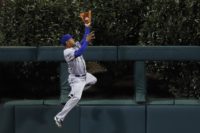
The Mets roster is full of game changers. The pitching staff can change a game with their dominating stuff. Most of the lineup can change the game with the swing of the the bat. However, there’s only one gamechanging defensive player.
Lagares won the Gold Glove in 2014 despite playing in only 116 games. He was that good. His UZR was 18.5, and his DRS was 26. These are elite numbers. His numbers were better in 2013 when his UZR was 21.5, and his DRS was 26. Overall, he’s a deserving Gold Glover. Time and again, he can change a game by getting to a ball no one else could field. He’s a game changer in the field.
Except last year. Lagares’ offense and defense slipped noticeably. Yes, he had an elbow injury that was rumored to require Tommy John surgery. However, that would explain his offense and throwing more than his range. Last night, Lagares showed everyone that he’s back:
That right there is Lagares’ true value. He saved three runs there (even if it didn’t matter in terms of the game). While Terry Collins may look to platoon Lagares with Michael Conforto to get Lagares’ bat in the lineup against lefties. Collins is mistaken. The Mets don’t need Lagares’ bat. They need his glove. They need him out there late in the game to protect leads with his play in the field.
He will make a catch like he made last night again – only next time it’s going to change the outcome of a game.
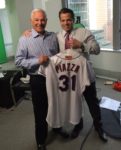
Thanks to Kevin Kernan, we all discovered that Mike Piazza‘s post-9/11 homerun jersey was up for auction with Goldin Auctions. The jersey faced an uncertain future until a group stepped forward and purchased the jersey for a record $365,000. Part of that group included Anthony Scaramucci.
For those who don’t know Mr. Scaramucci, he is the founder and co-managing partner of global investment firm SkyBridge Capital, founder of the SkyBridge Alternatives (“SALT”) Conference and host of iconic financial television show “Wall Street Week.”
Despite his busy schedule, he was able to answer some of my questions regarding his Mets fandom and the Piazza jersey:
How did you become a Mets fan?
Growing up on Long Island, I got hooked in 1969 with the Miracle Mets and the 1973 team that made it back to the World Series. They could have lost every game after that. It wouldn’t matter to a true fan.
What is your favorite Mets memory?
I’d have to say winning the World Series in ‘86. Last year’s World Series run was also a thrill, seeing our young team get back to winning ways. I can’t wait to see what the future holds for the franchise.
What were your recollections from Mike Piazza’s post 9/11 homerun?
The 9/11 attacks had an impact on all Americans, but especially those living in and around New York. It was almost guaranteed that you knew someone directly or indirectly who died that day. There was no precedent for how to respond to such a tragedy. When should life return to normal? Should sports resume, and if so when? Should we play games in New York? I felt very strongly that we needed to get things back to normal as quickly as possible to honor the fallen and send a message to the world that you cannot disrupt our way of life.
In the stadium, everyone was tense and uneasy for most of the game. Players were hesitant to make a hard slide or argue a call. Everyone was sort of going through the motions. When Piazza hit that home run, the place erupted, the old suspension system at Shea was literally bouncing, everyone was hugging each other and there wasn’t a dry eye on the place. It was an outpouring of grief and the beginning of the healing process for New Yorkers and for the country.
What did the jersey mean to you?
The jersey to me is a symbol, a symbol of American resolve and resilience in the face of unspeakable tragedy, a symbol that no matter the adversity we will always pick ourselves up, dust ourselves off and move forward. Some might say it was just a baseball game and it’s just a jersey, but anyone who was there or watching that day knows differently.
Why did you decide to purchase the jersey?
I know the jersey meant a lot symbolically to the people of New York – 9/11 first responders to families of the deceased to fans and former players – and when the opportunity came to get it back my partners and I just couldn’t let the opportunity pass. We wanted to make sure it came back home to New York to be displayed in the public domain forever.
At any point, did you ever consider wearing it around like George Costanza wearing Babe Ruth’s jersey on Seinfeld?
You didn’t think I would pay all that money without trying the jersey on did you? Unfortunately it isn’t quite my size. In true New York fashion, I’ve mostly been carrying it around in a garment bag on a cheap wire hanger.
Where is the jersey first going to be displayed?
We’re not 100% sure on that yet. All three venues where it will rotate (the 9/11 Memorial Museum, National Baseball Hall of Fame and Citi Field) have to figure out some display logistics, so in the meantime we’ll be showing it around and I’m going to bring it out to Las Vegas for the SkyBridge SALT Conference in May. Hopefully the flight stewardess has room to hang it up in the pilots’ closet.
How long will the jersey be on display?
We are writing a clause into the deal so the jersey will forever be displayed in the public domain, hopefully well after we’re dead and gone.
How do you feel when people thank you and your partners for purchasing the jersey?
I’m conflicted on that. On one hand obviously I appreciate the kind words and support, but I also don’t want to pretend like I’m some kind of hero for buying a jersey. There were thousands and thousands of heroes on 9/11 – workers in the towers herding others to safety, first responders rushing up into the burning buildings, volunteers digging through toxic rubble for days on end in hopes of finding one or two miraculous survivors. I feel fortunate that my success has put me in a position to contribute to a gesture like this, but the jersey and this moment isn’t about me, it’s about honoring the legacy of those who died that day.
What are your predictions for the 2016 season?
I’m an optimistic guy, but I think the Mets are going to win the whole thing. We have one of the greatest pitching staffs of all time and it’s going to be fun to see those young guys grow. Management did a great job keeping Cespedes and making some nice additions to the team. It’s going to be a year to remember.
Personally, I would also like to thank him for taking some time out of his busy schedule to answer my questions.
I would also like to thank Mr. Scaramucci and his partners for purchasing the jersey and sharing it with the people of New York. When I tell my son about 9/11, I will also tell him how Piazza’s homerun uplifted New York. Because of Mr. Scaramucci and his partners, I will be able to show the jersey Piazza wore that day to my son.
* picture from Anthony Scaramucci’s Twitter account (@scaramucci)
Editor’s Note: this article also ran on metsmerizedonline.com

Thank goodness for PIP (picture in picture) technology. Because of that, I was able to watch both the Mets-Phillies game and Game Three between the Rangers and Penguins. By the way, if not for my wife and the Declaration of Independence, I’d propose getting rid of Pennsylvania a together.
In any event, the Mets did all people who were both Mets and Rangers fans a huge favor tonight by blowing out the Phillies and giving Rangers fans something to cheer about.
While the Phillies have terrific young starting pitching, we were reminded of the perils of relying on young pitching. While Vincent Velasquez has pitched incredibly well this season (including a terrific game against the Mets), he struggled against the Mets. The Mets jumped on him right away when Michael Conforto hit a two run homer in the first. It was not a good start for Velasquez who only lasted 4.1 innings allowing five hits, five runs (two earned), no walks, and four strikeouts. With the Phillies bullpen, the game was over once Yoenis Cespedes did this:
Watch @ynscspds do bad things to this baseball >> https://t.co/9FZRBHOap4. 5-0 #Mets! ?https://t.co/9ONhf9egGN
— New York Mets (@Mets) April 20, 2016
This was more than enough for Logan Verrett, who once again had a terrific spot start. Verrett would go six innings allowing six hits, no runs, one walk, and four strikeouts. He seemingly had someone on every inning, but he navigated how way through all the trouble.
Overall, it was the type of night you expected from a World Series contender against a team that’s expected to contend for the first pick in the draft. The Mets offense went off hitting six homeruns. Aside from the aforementioned homeruns, the Mets got homeruns from Lucas Duda, Curtis Granderson, and two from Neil Walker. Walker gave one a ride in the ninth but fell just short of a three homerun game. All told, the Mets would score 11 runs.
Things went so well, there was even a Rafael Montero sighting. Keep in mind, that was only after Terry Collins pitched Jim Henderson of an inning to protect the then 9-0 lead. As always, the seventh inning belongs to Henderson.
Montero wasn’t good. He allowed two hits, one earned, one walk, and two strikeouts. It would’ve been much worse if not for a Gold Glove play by Juan Lagares, who came into the game after the blowout started, robbing Maikel Franco of a homerun:
Juan doing Juan things. #Juanderful @juanlagares2https://t.co/a7kqGxuajP
— New York Mets (@Mets) April 20, 2016
Naturally, Collins gave the ball to Hansel Robles in the ninth to preserve the 11-1 victory rather than letting the long man Montero, who will soon be sent back to Triple-A, finish the game.
Right now, the Mets are beginning to get in a rhythm and are beating up on bad teams. It’s what they did very successfully last year. It’s what they’ll need to do in order to return to the postseason.
Game Notes: The Mets are back over .500 at 7-6. Every Mets starter got a hit, including Verrett, who had his first career hit. Verrett has not allowed a run in 12 innings as a starter. Travis d’Arnaud returned to the lineup after getting hit on the elbow on Saturday. The referees are still calling the Rangers-Penguins one-sided even as Sidney Crosby asks for the Rangers to get a game misconduct for giving him a mean look. Rangers trail the Penguins 2-1 in the series.
* photo from the Mets Twitter account
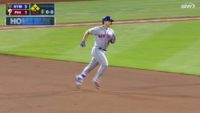
Since David Wright has put on a uniform, he has been a great player. He has become the face of the franchise, if not all of baseball. We’ve seen him overcome all obstacles. He overcame the original inane Citi Field outfield configuration. He overcame a broken back. He’s overcome bad players and managers. Through all of it Wright has become a borderline Hall of Famer.
Wright has been facing his toughest test with his battle with spinal stenosis. So far, he’s handled that the same way he’s always faced adversity.
When Wright first came off the DL, he homered in his first at bat. He would hit .277/.381/.437 with four homers and 13 RBI in 30 games. He would then hit the first ever World Series homerun in Citi Field history:
Despite all of what Wright has overcome, and despite what he has done while playing with the spinal stenosis, he still has his doubters. After an admittedly rough Opening Day, writers like Buster Olney were beginning to write the postmortem for Wright’s career. Articles like these were as premature as they were wrong.
So far this year, Wright has reached base in each and every game he has played. He’s shown a good eye at the plate drawing a walk in all but two games. By the way, in the two games he didn’t draw a walk, he had multiple hit games. So far this year, he’s hitting .289/.426/.526. His career line is .298/.377/.493. Last night, we also got to see him hitting the ball to the opposite field with authority, which has always been a David Wright staple:
Everything was all Wright in Philadelphia last night. #DavidWright #Metshttps://t.co/irfWSwJMBv
— New York Mets (@Mets) April 19, 2016
As Terry Collins would tell you, he’s not in the least surprised. Furthermore, he believes that no one should be surprised at what David Wright is doing. As Collins said in the postgame press conference, “Star players should never surprise you with what they can do.”
Yes, David Wright is still a star, and no, no one should be surprised at what we’re seeing. Wright has been doing this his entire career, and he will continue to do so.
Editor’s Note: this article first ran on metsmerizedonline.com

In a do-or-die Game Five, Terry Collins went to Noah Syndergaard in the seventh to go in there and shut down the Dodgers and preserve the Mets 3-2 lead.
Without the need to keep his stamina for eight move innings, Syndergaard let it fly. He averaged 100 MPH with his fastball and his sinker. Both pitches were 2-3 MPH faster than what he threw in the regular season. He would only throw 17 pitches with one slider and three curveballs. Syndergaard came in with heat and struck out two in a scoreless inning.
Watching that inning allowed you to continue the dream of winning the World Series. You wondered what it would be like to see Syndergaard in the bullpen fulltime. You wanted to see how much better he could be.
If you polled each and every Mets fan, they would tell you that Syndergaard would win at least Cy Young. They would tell you he would win at least one World Series with the Mets. They would tell you he had the drive to get better and better. For once, it wouldn’t be the fans’ fervor, it was a widely held belief in baseball circles.
But this? I don’t think anyone could’ve expected to see what we’ve seen out of Syndergaard so far this year.
Last year, Syndergaard threw 17 pitches over 100 MPH. He averaged 98 MPH on his fastball and sinker. He averaged 89 MPH on his change, 88 MPH on his slider, and 81 MPH on his curve. This year Syndergaard is just in another stratosphere.
He’s already thrown 12 pitches over 100 MPH including hitting 102 on the radar gun. He’s actually throwing all of his pitches harder. His fastball and sinker are up to 99 MPH. His change up is 90 MPH, which is about the same speed as Bartolo Colon‘s fastball. His improved and more often thrown slider averages 93 MPH, and his curveball is at 83 MPH. His improved pitching has definitely left an impression:
How hard does Syndergaard throw? Plawecki blocked a pitch w/ his chest. Theres now an imprint where his necklace was pic.twitter.com/Sd52ije5PZ
— Steve Gelbs (@SteveGelbs) April 19, 2016
Think about it this way. Syndergaard got one inning to throw it as hard as he possibly could for one inning when the Mets season was on the line. So far this year, Syndergaard has been throwing harder than that, and he has been doing that for approximately seven innings this year. How do you describe all of this?
David Wright calls him “a maxed out video game player.” Fans have given him the Thor moniker.
At this point, there are no words. There are no apt comparisons. Syndergaard truly is doing something we have never seen before. The scary part is he is continuing to improve. There’s no telling where Syndergaard goes from here. All we can do is sit back and enjoy the ride.
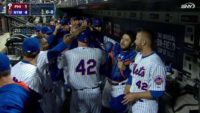
In some respects, any idea to make changes on how to properly commemorate Jackie Robinson is too late as April 15th has already passed. However, it’s also the point of MLB’s celebration of Jackie Robinson. It’s supposed to make you think and reflect on not just on his contributions, but also on how to make the world better.
Upon reflection, I think MLB has the wrong idea in having every single MLB player wear the number 42.
Yes, baseball has its heart in the right place. It is taking the opportunity to have every single one of its players honor Robinson, who in many ways, is the most important player in baseball history. However, this honor has had some unfortunate and unintended side effects.
First, there’s all the jokes. Undoubtedly, a fan or a broadcaster is going to make an oft repeated joke about everyone wearing the same number. They’ll also complain everyone is wearing the same number making it hard to identify which player is which. When your good intentions lead to jokes and complaints, it’s time to reassess the situation.
Uponreassessment, we also have to consider the honoring of Jackie Robinson has had the unfortunate and unintended consequence of overlooking other players contributions. There were players who were great like Cool Papa Bell who never got the chance to play in the majors. There were others like Satchel Paige whose chance came well past their primes. Then there were the other players like Larry Doby who faced the same obstacles Robinson did in other leagues and other cities. As Dan Szymborski noted, there needs to be room to honor other players:
I do wish if in addition to the 42, every team around during color barrier had a patch honoring their player that broke the color barrier.
— Dan Szymborski (@DSzymborski) April 15, 2016
That’s the unfortunate consequence of every player wearing 42. There were other individuals and players who had fought the same fight. That’s what Jackie Robinson and his legacy was. He was the one that got to pave the way. He made it possible for others. It wasn’t just that Jackie Robinson broke the color barrier, it was that one day players of all races and creeds could play together. Jackie Robinson was a key figure in a movement, but he wasn’t the only one. With that said, Jackie Robinson Day should be a moment not only to honor Jackie Robinson, but also every player that was part of this movement.
To that end, each and every single player should be able to take the field wearing the number of a player that was important to them. More importantly, they should select players that helped advance equality.
There should always be a player that wears 42. In fact, if the entire team wants to wear 42 as a team decision, it has that much more power. It would also be great to have some players wear 5, 8, or 23, which were some of the numbers Robinson wore while he was a player with the Kansas City Monarchs. Someone can wear his number 10, which he wore when he first broke the color barrier when he played for the Montreal Royals, who was the Dodgers AAA affiliate at the time.
Aside from Robinson, there are other numbers that could be worn. As a nod to Szymborski’s recommendation, players could wear the uniform number of the player who broke the color barrier for the franchise for which they play. A player could wear the number 1 in honor of Pee Wee Reese, who put his arm around Robinson during a game (even if Ken Burns’ documentary Jackie Robinson debunked). There’s the number 14 Larry Doby wore when he broke the color barrier in the American League in 1947, the same year as Jackie Robinson. Someone could wear the number 20, not only in honor of Josh Gibson, but also in honor of those talented enough to play but barred from playing. Speaking of the number 20, a player could wear it to honor Frank Robinson, the first black manager in baseball history. As we know seeing a black MLB manager was a cause Robinson championed as well.
Babe Ruth and his number 3 would be appropriate as The Babe was an early advocate of integration and would play Negro League teams on his barnstorming tours. A player could wear Ted William‘s number 9 to honor a man who called for more Negro League players to be elected to the Hall of Fame and twice put his career on hold to serve his country.
The choices could extend outside the Negro Leagues as well. There’s Roberto Clemente‘s and his number 21. Clemente is revered in Puerto Rico, and in the United States, not only for his Hall of Fame talent, but also his charitable work. There’s Tony Perez‘s 24, which could be worn to honor not only the first Cuban elected to the Hall of Fame, the hardships the players endure coming to the United States to play baseball, and the fight for civil rights the Cuban people have back at home. There’s also Hideo Nomo‘s 16 to show that despite prejudice, Japanese players could not only play in the major leagues, but they could be an All Star. A player could wear Jim Abbott‘s 25 to show there is no obstacle you can’t overcome. There may be some player who wears no number on his back to honor the countless players who never had an opportunity to wear a number on the back of a major league jersey.
There really no wrong option unless you are choosing to honor Cap Anson.
After players have made their selections, they can say a few words about what both Jackie Robinson and the player they selected means to them. These clips can run on the scoreboards, on local broadcasts, and on team and MLB social media accounts. The jerseys can then be sold after the game to help support the RBI Program and/or other charities.
By doing this, we keep not only honor Jackie Robinson, but also all the players who fought injustice. That is the best possible way to honor Jackie Robinson.
The Mets hired Kevin Long as their hitting coach to help a team that wasn’t hitting. Subsequently, they hired Pat Roessler as the assistant hitting coach. Roessler was hired because of his previous relationship with Long. So far, they’ve worked extremely well together.
Long and Roessler work hand-in-hand to help the Mets batters. For example, they worked in tandem to help Lucas Duda hit lefties last year. It’s helpful to have another voice to bounce ideas of of when trying to help a hitter. When your message isn’t getting through, it’s helpful to have another voice to help deliver the same message. Having both coaches this allows Long to watch video between innings to see both his pitcher’s mechanics and how the Mets’ batters are getting pitched. It also allows Long to delegate Roessler to work with the pitchers on their hitting.
Perhaps it’s time the Mets add an assistant pitching coach to the staff.
This is no slight against Dan Warthen. He is in charge of what is the best pitching staff in baseball. He has not shown anything to lead you to believe his message isn’t getting through or that he should be replaced. With that said, wouldn’t it be beneficial for Warthen to have an assistant coach he trusts and feels comfortable working with help with the pitching staff?
Let’s take Matt Harvey‘s start on Saturday. For the first 4.1 innings, he dominated. Then the wheels came off. For his part, Harvey believes he’s struggled with his command since the season began. As reported by Anthony DiComo of MLB.com, Warthen believes it was as simple as Harvey falling into bad habits in a pressure filled inning:
“You get into a pressure situation, you do fall back into bad habits,” Warthen said. “Essentially, that’s what happened today. This has been Matt’s biggest bugaboo since I’ve had him.”
There are two important things to note here. First, Warthen knows the problem and the solution. Second, Warthen doesn’t know quite how to get Harvey to stop falling into the trap. Quite possibly, this is where a second voice could come into play.
One thing that can’t be discounted is perhaps Harvey was just lucky for the first 4.1 innings. For a player who averages 96+ MPH with his fastball, he was sitting at 94 MPH against the Indians. This is a player who averaged 9.5 strikeouts per nine coming into the season. This year he’s at 4.7, and his season high was the four he had against the Indians. It’s possible the mechanical quirk might’ve been perceptible to an assistant coach watching video in the clubhouse as opposed to a pitching coach watching from the dugout.
Now, the Mets do have a bullpen coach in Ricky Bones. However, he can only help so much. The bullpen coach primarily works with relievers and spends the game in the bullpen. Before and after games, he can be a sounding board for Warthen and/or another voice to help a struggling pitcher if needed. With that said, Bones job as the bullpen coach prevents him from running into the clubhouse to watch video of a pitcher’s last half inning to see the pitcher’s mechanics and his batters are approaching their at bats.
That job would best be done by an assistant pitching coach.
There’s another factor to keep in mind. Warthen is a 63 year old pitching coach with bad hips. He missed some time last year after being brought to the hospital with an accelerated heartbeat. No one knows how much longer he will want to or be able to stay on as the Mets pitching coach. As the organization clearly thinks very highly of Warthen, wouldn’t it make sense for him to groom his successor?
It’s time for the Mets to add an assistant pitching coach.

Last week, I was approached by Brew and Orange to answer some questions about the Mets upcoming series against the Phillies. Here is the link. I hope you enjoy the interview and the site.
Thank you for Brew and Orange for the invitation.