Musings
On October 31, 2015, Jose Reyes was arrested for allegedly choking his wife and pushing her through a sliding glass door while on vacation in Hawaii. The term allegedly is used here because Reyes never stood trial and the charges were dropped due to his wife’s lack of cooperation.
Reyes’ trial was cancelled on March 30, 2015. Before the trial was cancelled, Reyes received a paid suspension pending the resolution of the trial and/or the completion of MLB’s investigation into the allegations.
It’s been a month since Reyes’ trial was cancelled. It’s been six months since Reyes was arrested. But for his wife’s lack of cooperation, the State of Hawaii had sufficient time to conduct a full investigation and go to trial. However, for some reason, six months wasn’t enough for baseball to make a determination in this case.
Now, no one wants baseball to rush their investigation and make errors along the way. However, it should be noted Chapman committed his acts a day before Reyes. There were disputed facts, and there were people who failed to cooperate with the police. There were no hospital records or criminal charges filed. Somehow, with less information at their disposal, baseball was able to conduct a timely investigation. In just nine days, Chapman’s suspension will be over, and he will be able to play in games. It’s possible, perhaps likely, that Reyes will still be serving his paid suspension.
It’s important to note, the Yankees traded for Chapman. He’s an important part of their bullpen. Reyes, on the other hand, is a headache waiting for the Rockies. He’s a headache due to his off the field actions. He’s a headache because they have to figure out what to do with him in light of the incredible start to Trevor Story‘s career. The Yankees desperately wanted and needed Chapman. The Rockies don’t need or want Reyes right now. Might be a coincidence. It might not.
However, one thing is true. The Reyes investigation has taken much longer than the Chapman case. It should be coming to an end sooner rather than later. Maybe this time baseball can show they take the issue of domestic violence seriously.
If you were asked to rattle off the names of some great pitching coaches, you would probably name people like Dave Duncan and Leo Mazzone. If you were asked to name a great hitting coach, you’re doing would most likely draw a blank.
Part of the reason is there’s an assumption that hitting coaches don’t do a whole lot. In essence, they show video or making suggestions, but their impact is generally regarded to be minimal. For some reason, there’s a belief that hitting and a batting stance is an innate ability. As the Mets have seen with Kevin Long, it’s time for that narrative to change.
Since coming to the Mets in 2015, he has helped players hit for more power.
As has been noted, Kevin Long was hired by the Mets, in part, to help resurrect Curtis Granderson. In 2014, Granderson hit a disappointing .227/.326/.388 with 27 doubles, two triples, and 20 homeruns. Long worked with Granderson on getting his hands in the right position and having a more compact swing. In 2015, Granderson hit a much better .259/.364/.457 with 33 doubles, two triples, and 26 homeruns.
Long hasn’t only had success with Granderson.
When Yoenis Cespedes came to the Mets, he was hitting .293/.323/.506 with 18 homers in 102 games. He was in the midst of what was a career year for him. Aside from working with Cespedes in the cage, he encouraged Cespedes to play golf. This helped Cespedes both clear his mind and focus on keeping his hands in. In 57 games with the Mets, Cespedes hit .287/.337/.604 with 17 homeruns.
This year Kevin Long has been working with and getting more power out of Neil Walker. Coming into this season, Walker was a .272/.338/.431 hitter who averaged 16 homers a year. Against lefties, he was a career .265/.321/.335 hitter with just 3 homeruns in six full seasons (seven total). Walker and Long worked on his leg kick and how he uses the lower half of his body. So far, Walker is hitting .500/.500/1.643 against lefties with three homers, and overall, he’s hitting .300/.325/.638 with a major league leading nine homeruns.
Now, it’s unrealistic to expect Cespedes to maintain his 2015 pace, and it’s unrealistic to expect Walker to keep up his current pace. With that said, it’s clear Long has an ability to work with hitters to get them to hit for more power than they have in the past. It’s become his trademark.
It’s time he starts to receive some of the accolades he’s deserved.
If you were asked to rattle off the names of some great pitching coaches, you would probably name people like Dave Duncan and Leo Mazzone. If you were asked to name a great hitting coach, you’re doing would most likely draw a blank.
Part of the reason is there’s an assumption that hitting coaches don’t do a whole lot. In essence, they show video or making suggestions, but their impact is generally regarded to be minimal. For some reason, there’s a belief that hitting and a batting stance is an innate ability. As the Mets have seen with Kevin Long, it’s time for that narrative to change.
Since coming to the Mets in 2015, he has helped players hit for more power.
As has been noted, Kevin Long was hired by the Mets, in part, to help resurrect Curtis Granderson. In 2014, Granderson hit a disappointing .227/.326/.388 with 27 doubles, two triples, and 20 homeruns. Long worked with Granderson on getting his hands in the right position and having a more compact swing. In 2015, Granderson hit a much better .259/.364/.457 with 33 doubles, two triples, and 26 homeruns.
Long hasn’t only had success with Granderson.
When Yoenis Cespedes came to the Mets, he was hitting .293/.323/.506 with 18 homers in 102 games. He was in the midst of what was a career year for him. Aside from working with Cespedes in the cage, he encouraged Cespedes to play golf. This helped Cespedes both clear his mind and focus on keeping his hands in. In 57 games with the Mets, Cespedes hit .287/.337/.604 with 17 homeruns.
This year Kevin Long has been working with and getting more power out of Neil Walker. Coming into this season, Walker was a .272/.338/.431 hitter who averaged 16 homers a year. Against lefties, he was a career .265/.321/.335 hitter with just 3 homeruns in six full seasons (seven total). Walker and Long worked on his leg kick and how he uses the lower half of his body. So far, Walker is hitting .500/.500/1.643 against lefties with three homers, and overall, he’s hitting .300/.325/.638 with a major league leading nine homeruns.
Now, it’s unrealistic to expect Cespedes to maintain his 2015 pace, and it’s unrealistic to expect Walker to keep up his current pace. With that said, it’s clear Long has an ability to work with hitters to get them to hit for more power than they have in the past. It’s become his trademark.
It’s time he starts to receive some of the accolades he’s deserved.
There are two times when any particular trade is judged. The first is when the trade is initially made. People look at the value derived from both teams and make a determination. The second is when the players involved play for their respective teams. These impressions are much longer lasting, and at times, these trades become quite infamous.
On December 10, 1971, a pitching rich Mets organization traded their fifth or sixth starter Nolan Ryan along with three other players for Jim Fregosi. It could be argued it was a shrewd move as Ryan was 29-38 with the Mets, and the Mets were acquiring six time All Star Fregosi to fill a position of need. It was done to help improve a team thought to be a possible World Series contender.
Ryan played more years than any other player. He won 324 games. He set all time records for strikeouts (5,714) and no-hitters (7). Fregosi played two years for the Mets hitting .233/.319/.328 in two season. The Mets are now universally panned for this trade.
On August 12, 1987, the Detroit Tigers traded prospect John Smoltz for Doyle Alexander. The Tigers were 1.5 behind the Blue Jays in the AL East race. Alexander would go 9-0 with a 1.53 ERA in 11 starts for a Tiger team that would win the division by two games. He would go 0-2 with a 10.00 ERA in an ALCS the Tigers lost in five games. Alexander made the All Star team for the Tigers in 1988, and he would follow that with a league leading 18 loss season in 1989.
Smoltz pitched 20 years for the Braves. In his career, he was 213-155 with 154 saves and a 3.33 ERA. He took his game to another level in the postseason. In 41 postseason games (27 starts), he was 15-4 with four saves and a 2.67 ERA. He was the 1992 NLCS MVP, and he was a member of the 1995 Braves World Series Championship team. He was inducted in the Hall of Fame in 2015. The Tigers are now universally panned for this trade.
On August 30, 1990, the Boston Red Sox traded prospect Jeff Bagwell for Larry Anderson. The Red Sox had a 6.5 game lead and were trying to sure up the bullpen for the postseason. In the regular season, Anderson pitched in 15 games. He had a 1.23 ERA and one save. In the ALCS, he was 0-1 with a 6.00 ERA in three appearances. The Red Sox were swept by the Athletics, and Anderson would go to the Phillies in the offseason.
Bagwell made his debut a year after the trade, and he would win the Rookie of the Year Award. He would win an MVP, be named to four All Star teams, three Silver Sluggers, and a Gold Glove. Last year, he received 71.6% of the Hall of Fame votes. He appears to be on track to be elected next year. The Red Sox are now universally panned for this trade.
On July 7, 2008, the Cleveland Indians traded CC Sabathia to the Milwaukee Brewers for four prospects headlined by Matt LaPorta and Michael Brantley (PTBNL). The Brewers were four games out and in third place in the NL Central. They were a half a game out of the Wild Card. Sabathia would make 17 starts, many on short rest, for the Brewers going 11-2 with a 1.65 ERA. The Brewers won the Wild Card on the last game of the season. Sabathia started that last game allowing only one run in a complete game win.
In his lone NLDS start, a fatigued Sabathia would only last 3.2 innings while allowing five runs in a Game Two loss. The Brewers would lose the series, and Sabathia would sign with the Yankees in the offseason.
LaPorta lasted only four years for the Indians hitting .238/.301/.393. He hasn’t played a major league game since 2012. Brantley is in his eighth season for the Indians. He has hit .293/.349/.422 in his career. In 2014, he was an All Star, won the Silver Slugger, and he finished third in the MVP voting. The Brewers now receive universal praise for the trade.
On July 31, 2015, a pitching rich Mets organization traded Michael Fulmer and Luis Cessa for Yoenis Cespedes. At the time of the trade, the Mets trailed the Nationals by three games in the NL East. Cespedes would hit .287/.337/.604 with 17 homeruns and 44 RBI. The Mets would win the NL East by seven games. Cespedes hit .222/.232/.352 with two homers and eight RBI. He signed a three year deal with the Mets with an opt out after one year. To date, a vast amount of Mets fans approve of the trade.
Cessa was traded by the Tigers to the Yankees. He made his major league debut this year pitching two innings and allowing one earned in his only appearance. He was sent down to Triple-A. It is too early to tell what will become of his career.
Fulmer was the Tigers main target in the Cespedes trade. Fulmer was a first round pick by the Mets in the 2011 draft. In a deep system stocked with pitching talent, he was a well regarded prospect. Once he became a Tiger, he quickly became their top prospect.
Tonight is his first career start. It will be not only the first chapter in his career, but it will also be the first chapter on how we judge what the Tigers received in exchange for Cespedes.
Almost immediately, the Mets wish they could’ve undone the Fregosi trade. Anderson and Alexander undoubtedly helped their teams, but in retrospect, the Red Sox and Tigers wish they could’ve undone those trades. On the other hand, the Brewers are pleased with their trade.
We’re about to start finding out where the Cespedes trade falls in Nolan Ryan to CC Sabathia spectrum.

During MLB Tonight, former players were asked to compare themselves to current major league players. During John Smoltz‘s segment, he compared himself with a Mets pitcher who had Hall of Fame talent . . . Zack Wheeler.
During his breakdown, Smoltz noted he and Wheeler have both had Tommy John surgery. He also broke down how both he and Wheeler had the inverted W (which is really an M) and had the same landing point. There’s another comparison Smoltz failed to mention. They were both overshadowed by other Cy Young/Hall of Fame caliber pitchers in the same rotation.
Just like Smoltz was overshadowed by Greg Maddux and Tom Glavine, Wheeler has become overshadowed by Matt Harvey, Jacob deGrom, and Noah Syndergaard. Some would even argue he’s been surpassed by Steven Matz.
For Smoltz, it didn’t matter he was overshadowed. He built himself a Hall of Fame career. He was 213-155 with 154 saves, a 3.33 ERA, and a 1.174 WHIP. He won a Cy Young Award and was an eight All Star. He was an incredible postseason pitcher taking his game to the next level. He was 15-4 with a 2.67 ERA and a 1.144 WHIP.
Now, Wheeler is not on this level. So far in his career, he’s 18-16 with a 3.50 ERA and a 1.339 WHIP. That doesn’t mean he can’t improve. He’s a four pitch pitcher with a 96 MPH fastball and a 89 MPH slider. He’s got the stuff to dominate. He just needs better control and pitch location. Once he does that, the results will come.
All Wheeler had to do is make adjustments. As Smoltz noted in the segment, he consistently made adjustments in his career to get better. With each adjustment, Smoltz would improve.
Making the right adjustments is the final piece to the puzzle. If he can do it, he can have a long dominating career like Smoltz. The awards and accolades will come no matter how much another ace overshadows him.

It’s only been 20 games, but there’s a lot to talk about with the Mets. There’s Neil Walker turning into Postseason Daniel Murphy. There’s Noah Syndergaard becoming the ace of the staff. Michael Conforto is already batting third, and he’s already become the Mets best hitter.
Also, the bullpen has been dominant. Really dominant.
The Mets bullpen has recorded with nine saves with a 2.54 ERA and a 1.23 WHIP in 69 appearances. They’ve recorded 78 strikeouts in 63.2 innings pitched. That’s good for a 11.03 K/9. All these numbers are all the more impressive when you consider it includes Rafael Montero‘s 11.57 ERA and 2.571 WHIP. When you back out Montero’s stats, the Mets bullpen would have a 2.20 ERA and an 1.17 WHIP.
Of particular note, Jim Henderson, Hansel Robles, and Addison Reed have been outstanding. They have combined to pitch 29.2 innings with a 1.82 ERA, 1.08 WHIP, and a 12.74 K/9. The group of them have created the perfect bridge to Familia.
All the more impressive is that the Mets bullpen has performed this well without Jeurys Familia getting going. He has a 2.45 ERA and a 1.545 WHIP. However, even with his relative struggles, the he’s still a perfect 7/7 in save opportunities. Even better, he seems to have settled down, and he’s starting to pitch better. Over his last two appearances, he hasn’t allowed a baserunner. Once Familia returns to form, and there is no doubt he will, the Mets bullpen will become even more dominant.
That’s bad news for teams that are trying to get into the Mets bullpen after 6-7 innings against one of the Mets aces. Overall, the Mets not only have the best starting pitching staff in the majors, they really have the best pitching in the majors period.
Editor’s Note: this article was also published on metsmerizedonline.com
Around this time last year, David Wright was on the DL with a quad injury. He would soon find out that he was suffering from spinal stenosis, a condition which would forever impact his career. It would forever change not just his ability to play in games, but also how he prepares for games.
We’ve seen back issues cause players like Don Mattingly and Lenny Dykstra to retire early in their 30’s. However, as Danny Knobler reports for ESPN.com, Wright is not at that point no matter how frustrating, grueling, and tiresome his pregame routine can be:
“Every day it sucks,” Wright said late Tuesday night. “Every day it sucks getting ready for the game. But I enjoy playing the game. So it’s worth it. You know, it’s no fun doing the preparation for the preparation, but I want to play and give myself the best chance to be healthy, you’ve got to do what you’ve got to do.”
Wright’s “preparation for his preparation” begins five hours before first pitch. Wright needs at least two hours ready just to prepare himself to take batting practice. Everyone one sees what Wright goes through on a daily basis. As his manager, Terry Collins, said, “I know David. He’s fighting it really, really hard.”
Wright is working hard, and he knows he’s doing what’s necessary for him to get out on the field. As he said, “I’m satisfied I’ve put in the work to be able to play,” but “[y]ou’re never satisfied with where you are as a player.”
As a player, Wright is hitting .238/.342/.444 with seven doubles, two homeruns, four RBI, and two stolen bases. Last night, he had the game winning hit against the Reds. Moments like last night is no surprise to Collins, who said, “Great players do unbelievable things when you need them to.”
With that said, both Collins and Wright both acknowledge Wright won’t be available to do it every time he’s needed. As Collins said, “He has to come to me everyday and tell me how he feels.” Wright does as he’s acknowledged his limitations saying, “I know what’s best for me and the team is that I get those occasional days off.” As Wright said to Collins, “I’ve got to make sure I don’t overdo this.”
So far this year, there are no signs that Wright is overdoing anything. He’s taking days off, and he’s doing what is necessary to prepare for each game. It’s part of Wright’s new reality, but as he said, “you’ve got to do what you got to do.”
Editor’s Note: this article first appeared on metsmerizedonline.com.
The Mets saving grace last year was having a healthy and productive Curtis Granderson. While Mets players seemingly ranged from injured to incompetent in the first half of 2015, he kept hitting. He was seemingly the only player who could hit and keep the Mets afloat offensively. On top of that, he was a finalist for the Gold a Glove Award for rightfielders. As he went, the team went.
Even with the arrival of Yoenis Cespedes and his incredible hot streak, it was Granderson who drove the Mets offense. From August 1st until the end of the season, he hit .267/.390/.495 with 45 runs, 14 doubles, one triple, 10 homeruns, and 34 RBI. In the stretch run to claim the NL East, Granderson played even better than he had all season. Like with most team MVP’s, as Granderson went, so did the Mets.
In 2016, the Mets are seemingly falling into the same pattern they did last year.
Through the first six games of the season, Granderson was 1-24 with a single and six strikeouts. He was hitting an abysmal .042/.179/.042. The Mets were 2-4 and were averaging 2.8 runs per game. After those six games, Granderson has taken off and so have the Mets.
Over the past 13 games, Granderson had hit .333/.387/.678 with 13 runs, four doubles, two triples, four homeruns, and eight RBI. In that stretch, the Mets have gone 10-3 and are averaging 5.2 runs per game.
Overall, we can point to many factors for the Mets turnaround. Stellar starting pitching. Terry Collins batting Michael Conforto third in the lineup. Cespedes and Neil Walker hitting homeruns. All of these are very important factors as to why the Mets are now winning. Once again, the success of his teammates is overshadowing Granderson’s contributions.
That’s fine. Granderson is once again on his way to having another big season with the Mets. At the end of the day, he could very well be the team’s MVP for the second straight year. If the Mets perform the way they’re expected, Granderson may very well be in line to recreate his World Series homerun barrage.
If the Mets do return to the World Series, it’ll be because one again Granderson has led them there.
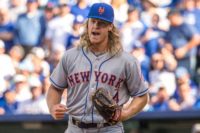
Looking at the Mets this year, it’s amazing to see Michael Conforto emerging as the Mets best everyday player if he isn’t already. The same goes for Noah Syndergaard who is emerging not just as the Mets ace, but also as one of the best pitchers in all of baseball. Each of these players are playing their first full seasons in the majors at 23 years old.
Mets fans are left to think about how much better these two 23 year olds can get. They’re already dominating the majors at an age when most players are in AA or AAA. It’s not too long before they cement their status as two of the best players in the game.
You know what’s funny?
The current debate in baseball is over who the best player in the game is – Bryce Harper or Mike Trout. Harper is 23 years old, and he’s playing in his fifth season. Trout is slightly older at 24, and he is playing in his sixth season.
Between the two of them, they have made seven All Star teams. Each year, they were the youngest All Star on their respective teams. Both of them have won the Rookie of the Year Award and an MVP. They’ve accomplished all of this before Syndergaard and Conforto have played one full season in the majors.
With that said, neither Harper nor Trout have played in an LCS, let alone a World Series. Syndergaard won a game in the World Series. Conforto hit two homeruns in a World Series game. Syndergaard and Conforto are primed to lead the Mets back to the World Series this year and perform even better.
Overall, these are four young players dominating the baseball landscape. They’ve already accomplished much, and they’re going to accomplish much, much more. It’s a good time to not only be a Mets fan, but also a baseball fan.
Last year, the Mets saw lengthy absences from David Wright and Travis d’Arnaud. Daniel Murphy and Michael Cuddyer were nicked up most of the year. Other Mets players got bumps and bruises along the way. The Mets depth got tested early and often in 2015, and it was ugly.
Dilson Herrera and Kevin Plawecki showed they weren’t ready to hit major league pitching. For his part, Plawecki had to stay in the lineup because Anthony Recker and Johnny Monell weren’t either. Eric Campbell and John Mayberry, Jr. showed why they weren’t everyday players, let alone middle of the order bats. There were other forgettable debuts from players like Darrell Ceciliani and Danny Muno. In 2015, the Mets bet against their farm system, and it nearly cost them the season.
In the offseason, the Mets made sure to build a deeper roster. They moved Wilmer Flores to a utility role. Alejandro De Aza is here as a fifth outfielder. Juan Lagares is a part time player who will start against lefties and come on as a late defensive replacement. Herrera is back in AAA where he belongs for now. Campbell and Plawecki are on the 25 man roster, but they are asked to do much less. Hypothetically, it’s a much deeper team.
Well, that hypothesis is now being put to the test.
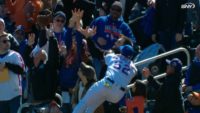
Yoenis Cespedes has been dealing with a thigh issue due to his jumping in the stands and an awkward slide. As for now, he’s not DL bound. Yesterday, d’Arnaud left the game early with pain in his throwing shoulder. While he may not have been the best at throwing out would be base stealers, his throws were uncharacteristically poor. He will be examined today before a DL decision is made. Whether it will be one day, one week, one month, or more, the Mets will miss Cespedes and d’Arnaud.
No matter how much time if will be, this Mets team is better built to sustain these losses. Having a De Aza/Lagares platoon is a much better option than Ceciliani. Plawecki has another year of development under his belt. Hopefully, this translates to him having a better year at the plate.
The Mets better hope so. The Nationals look like a different team than they were a year ago. The Mets aren’t going to be able to coast for two – three months with subpar players. This is a new year. Fortunately, this is a new Mets team that’s built for just these types of situations.