Musings
Yesterday, the Mets announced David Wright had a successful cervical discectomy and fusion surgery. The Mets have no idea about whether Wright can return this September or if his season is over. With that in mind, three Mets are going to have to address their third base position.
The initial solution has been Wilmer Flores. He has been terrific thus far hitting .320/.375/.460. The one caution with these stats is Flores has a .366 BABIP during this 16 game stretch, and he has a career .271 BABIP. He’s due for a regression. The bigger issue is he was hit with a pitch on his left hand forcing him from Thursday’s game. Fortunately, the x-rays were negative. Unfortunately, Flores was unable to swing a bat, and he’s gone for the next few games. Maybe more.
If he is gone, the Mets have three options: (1) play musical chairs across the infield with Neil Walker and Dilson Herrera; (2) swing a trade; or (3) sign Cuban free agent third baseman Yulieski Gourriel.
Back in Cuba, the 32 year old Gourriel is a former teammate of Yoenis Cespedes, and the two were close friends. It should come as no surprise that Cespedes has nothing but glowing things to say about Gourriel. As reported by Kevin Kernan of the New York Post, Cespedes said, “At the time I left Cuba [in 2011] that was the best ballplayer player in Cuba. He’s a five tool player.”
Scouts agree. Baseball America ranked Gourriel as the top Cuban prospect. He’s seen as a plus defender at third with a good arm. He has enough range to handle second, but he is really better suited to third. At the plate, he has a patient approach at the plate. He’s capable of hitting for both power and average. In sum, he’s a major league talent who calls have a big impact in the majors.
Over Gourriel’s nine year career in the Cuban and Japenese Leagues, he has hit .335/.417/.580. To put it in perspective, Cespedes hit .319/.404/.585 in eight years in the Cuban Leagues. If the numbers translate for Gourriel as they did for Cespedes, whoever signs him is getting a terrific player.
That team should be the Mets as they need a third baseman for the rest of the year. They need insurance for Wright’s back going forward. With the prospect of Cespedes opting out, they may need an extra carrot to entice Cespedes to once again re-sign with the Mets so he can play with his friend.
The Mets need to sign Gourriel.
Editor’s Note: this article first appeared on metsmerizedonline.com
The minute there was the hint of trouble with David Wright, the popular opinion was to move Neil Walker over to third base. The concept behind the move was two-fold: (1) Walker should be able to move over to a position he played 15 games in his career; and (2) it would permit the Mets to call-up Dilson Herrera to play second base. Herrera is the Mets second baseman of the future, and it appears that the future is now. Lost in this is an analysis of how Walker’s bat would actually play at third base.
It’s easy to overlook that fact when the Mets have been trotting out Eric Campbell, Matt Reynolds, and Ty Kelly at third base. Yes, anything would be an improvement over them. However, the idea is not to simply get better; the idea is to put a team on the field that is capable of winning the World Series.
This year Walker has been terrific at the plate hitting .275/.346/.498 with 14 home runs and 28 RBI. He is definitively one of the best second baseman in the league and should garner serious consideration for the All Star Game. He is nearly in the top 10 in each and every statistical category, and he has the most home runs among second basemen. Here is how Walker would rank among National League third basemen this year:
- Hits – 7th
- Homers – 3rd
- RBI – 7th
- Average – 5th
- OBP – 8th
- Slugging – 5th
These are not awe-inspiring rankings. However, these stats show that Walker’s bat could very well play at third base this year.
Overall, you would prefer to have Walker play second base this year because he is more comfortable at the position, and he has a plus bat for the position. However, beggers can’t be choosers, and the Mets are in a position where they are begging for some offense from first and third base. If Dilson Herrera can handle being an everyday player in the majors now, it would make sense to move Walker to third as he can handle it offensively.
The real question is going to be whether he can handle it defensively. With Wilmer Flores getting hit on the hand yesterday, we may find out soon.
On Saturday, September 27, 2003, my father, brother, and I sat down to watch what was seemingly a meaningless baseball game. The Minnesota Twins had already locked up the AL Central, and the Detroit Tigers had already locked up the worst record in baseball. At that time, the only matter at issue was whether the Tigers would finish with a worse record than the 1962 Mets.
As each and every Mets fan knows, the worst team in baseball history was the 1962 Mets. They were bad from the beginning. The 1962 Mets lost their first nine games. That wouldn’t even be the lowpoint of the season. From May 21st until June 6th, the Mets would lost 17 straight games. That wasn’t even their only 10 plus game losing streak. There was an eleven game losing streak in late July, and there was a 13 game losing streak that spanned most of August. The 1962 Mets didn’t really do anything well except maybe lose. They inspired manager Casey Stengel to utter the phrase, “Can’t Anybody Here Play This Game?” It was a phrase so utterly perfect that Jimmy Breslin used it as the title for his book about the 1962 Mets.
The funny part about that team is that they are somewhat beloved. There were colorful characters Mets fans know to this day regardless of whether or not they were around to see it. There were old heroes like former Brooklyn Dodgers like Gil Hodges and Don Zimmer. There was future Hall of Famer Richie Ashburn. There were colorful characters as well. There was Marvelous Marv Throneberry who missed not just first but second base when running out a triple. There was speedy catcher Choo-Choo Coleman who best utilized his speed chasing down balls that went to the backstop. About the only players who didn’t belong was Frank Thomas with his 34 homers and 17 year old Ed Kranepool who actually had a bright future ahead of him in the majors.
That 1962 season was the first season in Mets history, and it was an important one at that. This record is quintessentially the Mets. It is a terrific reference point for each and every time the Mets have success. Whenever a 1969 or 1986 happens, it’s a reminder of how the Mets really did come from nothing to achieve great heights. Having this record was important, and it should be important to Mets fans.
It is why my family was rooting for the Tigers that day. At that point it wasn’t looking good. The Tigers had to take three of four from the Twins to avoid loss 120. They lost the prior game, and they were down 7-1 going into the bottom of the seventh. Somehow, someway, the Tigers pulled it off. They scored three in the seventh and then four in the eighth to somehow time the game. Then in the ninth, old friend Jesse Orosco threw a wild pitch allowing Alex Sanchez to score the winning run. At that point, Orosco was probably throwing things in disgust. However, to Mets fans, it looked like Orosco was throwing his glove into the heavens like he had done in 1986. The Tigers snatched a win from the jaws of defeat number 120. The 1962 Mets would be safe.
Now, this year, the 1962 Mets are being challenged once again. The Atlanta Braves come to Flushing sporting a 19-46 record. With their .292 win percentage, the Braves are on pace for a 47-115 season. If the Mets sweep the Braves like they should, the Braves will be all the closer to loss number 120. If the Braves are able to move the few major league quality bats from their line-up like Freddie Freeman, who knows how much worse things will get in Atlanta. Towards the end of the season, there will most likely be a race to see if the Braves could actually surpass the 1962 Mets loss total.
While it has been ingrained in me from the days of Mike Piazza and Edgardo Alfonzo to never root for the Braves, I will root for the Braves to win some games to avoid losing 120 or more games. Preferably, those wins will come at the expense of the Washington Nationals. Hopefully, at the end of the season, the 1962 Mets place in history will be secure.
The Braves come into Citi Field tonight with a 19-46 record and a .292 win percentage. If the Braves continue on this pace, they are going to finish the year with a 47-115 record. If the Braves sell off more than just Kelly Johnson, they could lose even more games in the second half. They are challenging the 1962 Mets record for the worst season in major league history. Those Mets only won 40 games. Can you name the players who were in the starting lineup the day that team won its first game? Good luck!
As a Knicks fan, I remember in 1999 when Patrick Ewing went down with a partially torn Achillies tendon against the hated Indiana Pacers in the Eastern Conference Finals. The team’s leader was sidelined. He was robbed of what proved to be his last chance to win a championship. He gathered his teammates together, and he delivered a message:
I told them before practice started that I believe in them, and for them to go out there and get me my ring. They’re ready. They’re ready to get it for me.
As it turns out, the Knicks would rally to beat the Pacers, but they would falter against the much deeper and talented San Antonio Spurs.
Ewing never did get his ring. When the Knicks had won the Draft Lottery in 1985, the question was never whether Ewing would win a ring, it was how many rings he would win. Ewing always did his part. He won the Rookie of the Year Award. He was an 11 time All Star. He was the Knicks all-time leading scorer. He was named to the 1992 Dream Team that won gold in Barcelona. He was named one of the 50 greatest players in NBA history. To many, he is the greatest Knick to ever wear the uniform. Ewing did everything but win a ring. In many ways, he has become a tragic figure amongst Knicks fans.
That’s the fate befalling David Wright. When he was called-up in 2004, Mets fans were able to imagine him winning multiple World Series. That notion was fortified by the 2006 season. Then disaster struck in 2007 and 2008. The Mets were then terrible for nearly a decade. Through all of it Wright stayed with the Mets, and he played extremely well. He has had a borderline Hall of Fame career. With his spinal stenosis, the only left for Wright to reasonably accomplish is to win a World Series ring. He came painstakingly close last year. He’s on a team that is built to do it this year.
However, Wright is no longer going to be a part of that team. Wright now needs surgery to repair a herniated disc in his neck. While Wright and the Mets are not discounting his return to the team this year, there are others who suggest Wright will not be able to play again until the 2017 season. At that point, Wright will be a 34 year old who has spinal stenosis and a cervical fusion. While we have learned never to count Wright out, we cannot assuredly believe that he will be able to every play again. Furthermore, even if he will be able to play again, we don’t know what the Mets future holds.
Neil Walker will be a free agent. Yoenis Cespedes can opt out of his deal, and given his production, he will most likely opt out of his deal. Lucas Duda is dealing with a back issue for the second year in a row. Curtis Granderson will be another year older. The 2016 free agent class will be less than lackluster. There is no telling what this Mets team will look like next year regardless of whether or not Wright is on the team. With that said, this year could be Wright’s best year to win a ring. It could also be his last.
Wright has been important to this franchise and this current Mets team. Injuries have robbed Wright of so much during his career. He’s done everything he can do to help the Mets franchise add a third World Series title. It’s time for his teammates to pick up where he’s left off and go win it. It’s time for them to go out there and get him the ring the Knicks never could get Patrick Ewing.
After the game, Terry Collins revealed Juan Lagares was scratched from the lineup because he couldn’t close his left hand. At a minimum, it seems like a DL stint is inevitable.
The natural inclination would be for the Mets to call-up Brandon Nimmo. He’s certainly earned the promotion hitting .330/.411/.529 with five homers and 32 RBI. The 23 year old 2011 first round pick appears to be ready for a promotion to the majors. He could take the place of Michael Conforto in the lineup while Conforto waits for his wrist to react to the cortisone shot.
With that said, Conforto is expected back this weekend. Once he returns, it is likely Terry Collins will play him everyday. That will leave Nimmo on the bench which would be detrimental to his development. Nimmo needs to get regular at bats, and that does not appear likely at the major league level.
However, Lagares and Conforto aren’t the only Mets that are ailing. Neil Walker had to pull himself from a game on Saturday. He hasn’t been able to play since. Tomorrow, he is going to see a back specialist to be evaluated. Given the Mets luck lately with Lucas Duda and David Wright, no one should be holding their breath.
With that in mind, the Mets should call-up Dilson Herrera.
Herrera is the second baseman of the future, and depending on Walker’s back, the future may be now. Herrera is hitting .298/.344/.517 with ten homers and 36 RBI. Like Nimmo, Herrera has earned the call-up. Unlike Nimmo, Herrera has some major league experience. Moreover, Herrera doesn’t have an obvious impediment to his playing time.
In Walker’s absence, Collins has had to pick between Matt Reynolds and Kelly Johnson. Both have played well recently, but there shouldn’t be expectations for that to continue. Reynolds is the same player who has hit .282/.335/.420 in the Pacific Coast League, which is about as favorable a hitter’s league there is. Even with his hot streak, Johnson is hitting .226/.288/.308 this year. Herrera should be an upgrade over these players.
Accordingly, Herrera should be called-up to play second until such time as Walker is ready to return. In the interim, Collins can go with either Johnson in left, like he did Wednesday, or Alejandro De Aza, who Collins wants to get more at bats. Herrera can and should effectively man second base until Walker is ready. When that happens, the Mets will do what they always do in these situations:
They will call up Eric Campbell.
However, before that happens the Mets need to call-up Herrera. He’s the best option at second base behind Walker. Additionally, in Wright’s absence, the Mets can judge whether it is time to let Herrera play second while moving Walker to third. This is an option the Mets have internally discussed. They now have a window to see if it is feasible.
It’s time to call-up Dilson Herrera.
Editor’s Note: this was first published on metsminors.net
Mets fans always have been and always will be captivated by Jose Reyes. During his time in Flushing, he meant so much to Mets fans. He was an exciting leadoff hitter whose speed on the bases was matched only by the speed of his throws to firstbase. The joy and excitement he showed on the field was only surpassed by they joy and enthusiasm exhibited by the fans who watched him on the field. When he finally became a free agent, he wanted to stay, and Mets fans wanted him to stay. Now, with his future uncertain with his suspension and the rise of Trevor Story, there are those who may want him to return.
Admittedly, there was a time I would have gladly joined that chorus. Not now.
Let’s start with the practicalities. The Mets have a shortstop, and his name is Asdrubal Cabrera. Cabrera is a career .267/.329/.411 hitter with a 104 OPS+. With his recent slump, Cabrera is hitting .267/.332/.400 with a 100 OPS+. Over the last two years, he averaged a -6,3 UZR and a -7.5 DRS. The Mets owe him $8.25 million this year and the next. After next year, the Mets can decide to keep Cabrera for the 2018 season at $8.5 million, transition to Gavin Cecchini or Amed Rosario, or move in a completely different direction.
For his part, Reyes has put up similar production to Cabrera. Reyes is a career .290/.339/.431 hitter with a 105 OPS+. Because he accepted a suspension for an alleged act of domestic violence, Reyes has not played this year. When he played last year, Reyes hit .274/.310/.378 with an 82 OPS+. He did that while playing in two hitters ballparks in the Rogers Centre and Coors Field. Over the past two years, he has averaged a -6.6 UZR and a -12 DRS in the field. For that, the Rockies are paying Reyes the prorated portion of $22 million this year and the next. Like Cabrera, Reyes has an option for 2018. Unlike Cabrera, if that option is not exercised, Reyes is a $4 million buyout.
In terms of his production on the field, Reyes is not an upgrade over Cabrera. Worse yet, he’s a much more expensive option. Even if you were to presume the Rockies would eat a portion of Reyes’ salary, there is almost no amount that would make a deal between the two clubs make sense.
For the time being, the Mets needs are at first and third base. Reyes does not address either of those needs unless you want to shuffle a bunch of players out of position. The first option would be to move Reyes to second base like he once did in the first year of the Kaz Matsui experiment. That would force Neil Walker to third base. In that situation, you are asking Reyes to return to a position he last played in 2004 for 43 games, and you are asking Walker to play a position he last played in 2010 and has played 15 total games in his career. It’s asking for trouble. The other option is to put Reyes at shortstop and move Cabrera to third base. Cabrera has only played 1.1 innings at third base in 2004. It’s not much better. Overall, there is no fit for Reyes on the team.
Assuming there was room for Reyes, and assuming the Rockies were to release him, it is still a bad idea.
The addition of Reyes would be a distraction. It’s a distraction because of who he is and what he once meant to Mets fans. If Cabrera, Walker, or another infield falters, there will be a clamoring for him to replace that regular in the lineup. There’s also the matter of his domestic violence action. There have been studies that show 62% of previously arrested domestic violence perpetrators are re-arrested withing two years of the initial domestic violence act. Now, Reyes is purportedly taking the issue seriously. As part of his suspension, he is seeking counseling. We all hope for both him and his wife that the counseling will help and that there will be no more violence in that household.
With that said, this is baseball. We use statistics to make judgments on players. We can use Reyes’ statistics to show he is no longer the player he was with the Mets. We can use the statistics to show he would not be an upgrade on the Mets roster. Unfortunately, we can also use the statistics to show that the drama that surrounds Reyes may not be over. What is and should be over is Reyes’ great Mets career.
We should all wish Reyes and his family the best no matter where he winds up. Let’s just hope that place isn’t Flushing.
Editor’s Note: this was first published on metsmerizedonline.com
Let’s start with the obvious. In each and every at bat, the optimal result is the home run. One through nine, you want each and every one of your batters to hit a home run each and every time at the plate. That’s not always going to happen. As a result, you are going to have to build runs through basehits, walks, and effective at bats with runners in scoring position. The best offensive teams are able to score runs and win games even when they are not hitting home runs. Accordingly, the Mets are not a good offensive team as they are overly reliant upon hitting home runs.
No matter how you slice or dice it, the Mets offense is entirely dependent on hitting a home run. Here is the breakdown:
| HR/Game | Games | Record | Runs/Game |
| 0 | 20 | 5-15 | 2.1 |
| 1 | 19 | 11-8 | 3.3 |
| 2 | 12 | 8-4 | 4.7 |
| 3+ | 11 | 10-1 | 6.3 |
In essence, if the Mets don’t hit any home runs, they are not scoring runs, and they are not winning games. Why?
First and foremost, the Mets just don’t get on base that frequently enough to score runs without hitting homeruns. The Mets team batting average is .233 which ranks 27th in the majors. The team OBP is .309 which ranks 23rd in the majors. In order to score runs by something other than the homerun, you need to get people on base. In that respect, the Mets are one of the worst in the game right now.
The Mets next problem is that even when there are runners on base, they do nothing with the baserunners. The Mets are the worst team in baseball with a .226 batting average with runners on base. Their .303 OBP with runners on base is 28th. When you look at stats like this, the answer most people advocate is the Mets should start playing some good old fashioned small ball. The problem with that is the Mets are really bad at playing small ball.
The Mets rank 24th in the majors in productive outs. A productive out is an out that moves over a baserunner with no outs, when a pitcher lays down a successful sacrifice bunt with one out, or when an out scores a runner. The Mets have had 613 such opportunities this season, and they have been successful only 29.4% of the time. A large part of that is, as a team, the Mets have struck out 563 times this year which is the fifth most in the majors. With the Mets being ineffective in getting people on base, they cannot afford to be this ineffective in moving runners over when they make those outs.
When baserunners take matters into their own hands, the results are just as poor. This Mets team has not been blessed with much team speed, and as a result, the Mets do not try to steal many bases. In fact, the Mets rank second to last in stolen base attempts (22) and stolen bases (13). When the Mets do attempt stolen bases, they are successful only 59.09% of the time. Now, it has been espoused in order for stealing bases to be an effective tactic, the baserunner needs to be safe 75% of the time. Therefore, in the rare occasions the baserunners try to take matters into their own hands, they are hurting the team with a poor percentage play.
The Mets not only have trouble getting runner on base and into scoring position, but they also have problems getting those runners home. The Mets rank DEAD LAST in the majors with a .214 batting average with runners in scoring position. The Mets 129 RBI with runners in scoring position ranks is tied for last place with the Philadelphia Phillies. It’s even worse with two outs. With runners in scoring position with two outs, the Mets are again DEAD LAST in team batting average (.163) and RBI (43). The Mets are last in the majors with nine sacrifice flys. In fact, when the Mets have a runner on third with less than two outs, the baserunner only scores 42% of the time. Again, that’s last in the majors. Overall, when the Mets can a baserunner, that baserunner only scores a league worst 23% of the time. The end result is the Mets having one of the worst offenses in all of baseball.
Simply put, the Mets are not scoring runs unless they hit a homerun. When they don’t hit homeruns, they don’t win many games. There have been many discussions about whether the Mets hit too many homeruns. As it turns out, the answer is they don’t hit enough of them. With that said, it’s time for Yoenis Cespedes, Michael Conforto, Curtis Granderson, and Neil Walker to get to work hitting homeruns because if they don’t, the Mets aren’t going to score any runs.
Editor’s Note: this was first published on metsmerizedonline.com
On June 14, 1777, the Second Continental Congress adopted the Stars and Stripes as the official flag of the United States of America. It’s up to you to decide whether or not it was created by Betsy Ross at George Washington‘s behest. There’s no harm in perpetuating the fantasy. As baseball fans at least pretend that baseball was invented by Union General Abner Doubleday in the quaint little village of Cooperstown, New York. It’s why the Baseball Hall of Fame is located there.
As Americans and Mets fans, we all carry the fantasy that this October we will once again see the American Flag stretched across the outfield in Citi Field. We will all be getting residential flagpole installation services to fit our front yards with as many flagpoles as we can physically fit on the grass, and raising the star-spangled banner high into the sky for all to look upon in pride. Flag Day is a proud moment in our history, and I for one can’t wait for it.
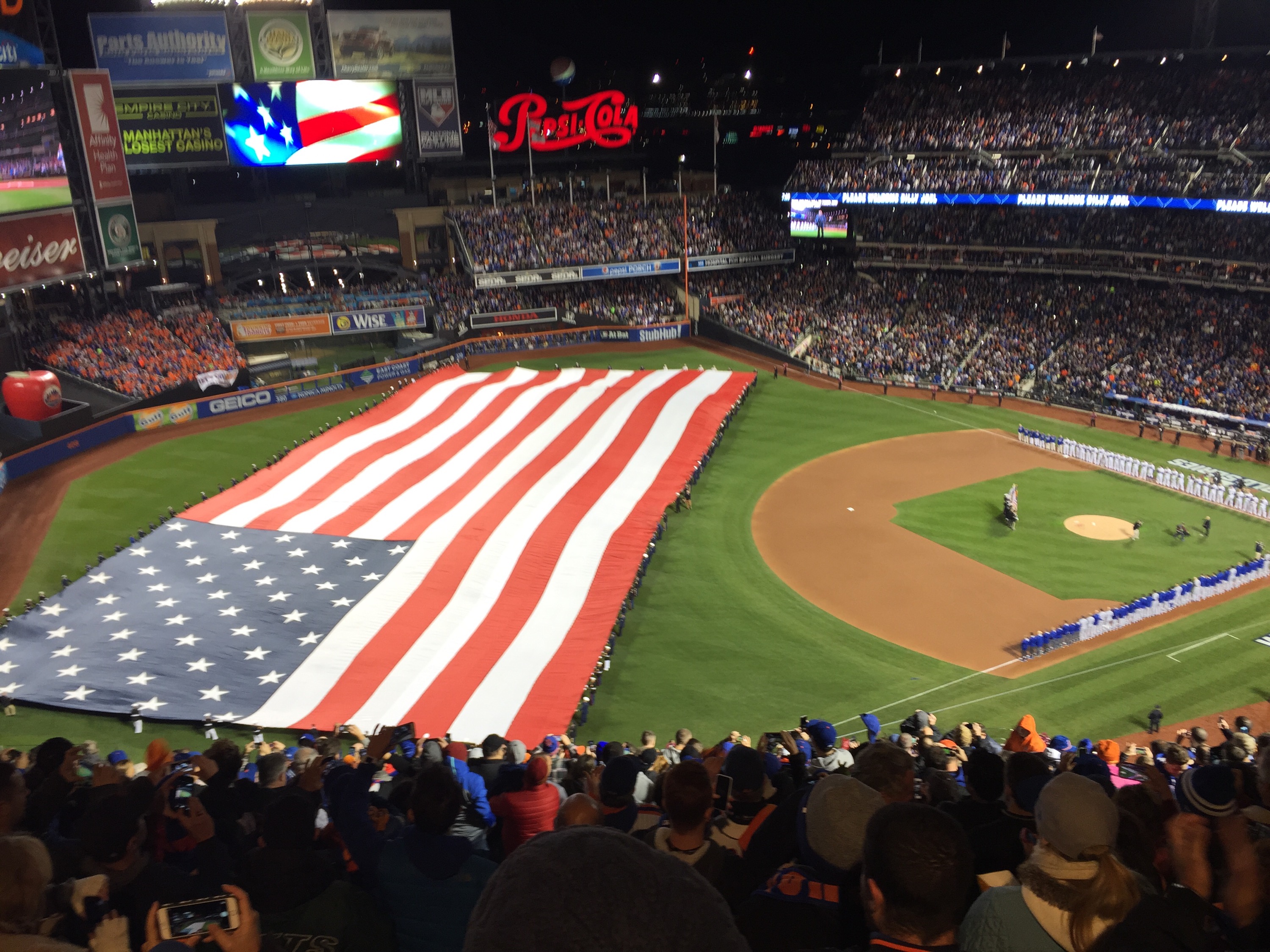
In actuality, it’s not really a fantasy. The Mets faced the same issues last year with the injuries and the poor offense. On this date last year, the Mets were 34-30. This year, they are 34-28. Lost in the David Wright and Lucas Duda injuries as well as the struggles from Curtis Granderson and Michael Conforto is the fact that this Mets team is simply better than the one the Mets fielded last year. Even in the worst of times, the Mets now have Yoenis Cespedes in the middloe of the lineup instead of John Mayberry and Eric Campbell.
So yes, on this Flag Day, we can still dream of the days in which the American flag once again adorns the Citi Field outfield. We can hope for Wright and Granderson to hit homeruns while Noah Syndergaard intimidates batters from 60′ 6″ away. We can also await the Mets raising a World Series flag in centerfield.