Musings
Seriously, Alejandro De Aza is not as bad a player as he has seemed in his limited time with the Mets. Up until this season, De Aza was a .267/.337/.405 hitter with a 101 career OPS+. Essentially, he was an average major league baseball player. You don’t necessarily want that in your starting lineup day in and day out the way it once appeared he was going to be. However, a player like that could be a vital and important piece for your bench.
Unfortunately, it has not turned out that way.
It is quite possible this all started when the Mets signed Yoenis Cespedes in the offseason. At the time the Mets signed De Aza two things were fairly evident: (1) the Mets didn’t have the stomach or money to give Cespedes a contract like the one he was expected to receive in free agency; and (2) he was going to be part of a center field platoon with Juan Lagares. As it turns out, the Mets got very lucky. No one really offered Cespedes a fair market value free agent contract allowing him to return to the Mets for what was effectively a one-year deal. By extension the Mets seemed to be extremely deep in the outfield as their fourth and fifth outfielders, De Aza and Lagares, were major league quality everyday players in some capacity. It was great on paper. However, De Aza has clearly suffered from the lack of playing time – playing time he reasonably expected when he signed with the Mets as a free agent.
So far this year, De Aza is only hitting .165/.224/.241 with a 27 OPS+. He has gone hitless in his last 20 at bats. In his limited starts (13 games), he is hitting .128/.180/.213. Keep in mind those stats are inflated due to a 3-4 game he had in a start against the Indians in May. Other than that De Aza has been flat out terrible. Things have gotten so bad for him that Terry Collins is starting Matt Reynolds over him in games, and Reynolds had never played a game in the outfield as a professional. His stats are in Ty Kelly and Eric Campbell territory, and as we’ve seen with him, he’s a much better player than either of these players. Overall, it is fair to say that De Aza has been affected by the lack of playing time.
As it turns out, De Aza might get a chance to leave an impression on the Mets and turn his season around. Yesterday, Cespedes had to leave the game with what turned out to be a sprained wrist. Right now, Cespedes is day-to-day, and in reality, De Aza is the only person on the roster right now who can play center field on a regular basis. As a result, Collins has no choice but to put De Aza in the lineup until Cespedes is ready to return to the lineup. As fortune would have it, the Mets are about to begin a four game series against the Atlanta Braves, who despite sweeping the Mets last weekend, are the absolute worst team in baseball. There really is no excuse for De Aza not to seize this opportunity and start playing better.
Right now, there are some offensive issues overall with the Mets. One of them is bench production, and De Aza is a large part of that. Hopefully, De Aza is able to use these starts to turn his season around and help improve the Mets bench. Both the Mets and De Aza need him to have a big weekend.
The main entrance to Citi Field is the well-designed and well-conceived Jackie Robinson Rotunda. It is an area that not only pays homage to one of the most important and transformative figures in baseball history, it lets you catch a glimpse of what he was as a man and a ballplayer. There is even a giant 42 that stands in the back of the rotunda that can be used as a backdrop for fan photos:
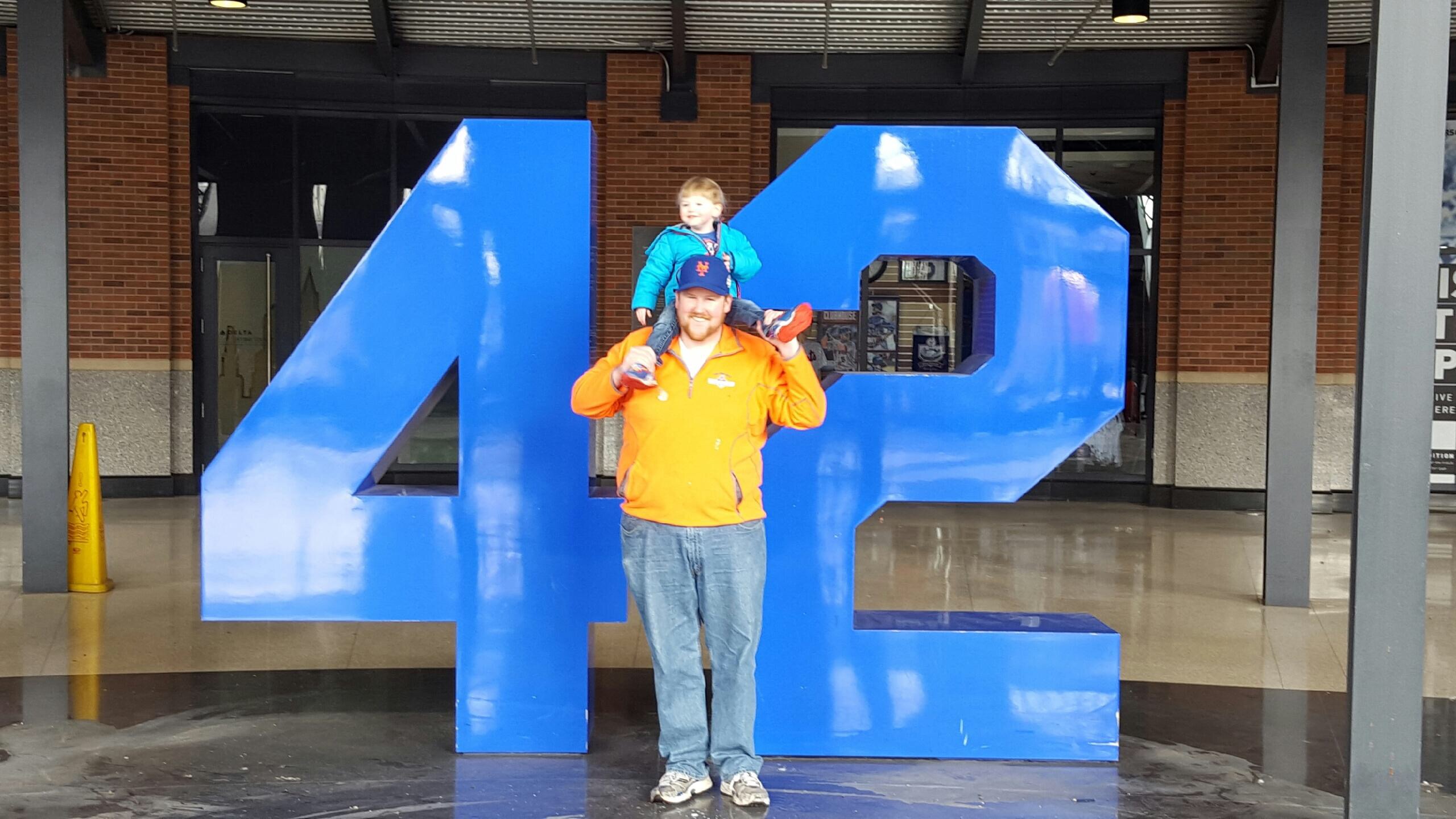
There are many things right about the Jackie Robinson Rotunda. However, the rotunda highlights one major flaw about Citi Field – Robinson is the only player that is celebrated there.
Sure, there are the retired numbers in left field. Also, there is the Mets Hall of Fame (which has also become an extension of the team store). However, is it really enough? If you are like many Mets fans and Nancy Seaver, the answer is a resounding no. As Nancy Seaver told the New York Daily News, “They should have a statue for all those numbers they have retired on their wall — Seaver, Gil Hodges, Mike Piazza.” She finds the fact that here isn’t one for her husband to be “ridiculous.” She sums up her feelings by saying, “I’m embarrassed for (the Mets). I really am.”
The fact of the matter is she’s right. At a minimum, there needs to be a statue for Tom Seaver. He is the Mets version of Babe Ruth.
Seaver has been the greatest player to ever don a Mets uniform. Considering the mind boggling stats he put up, it is next to impossible to imagine a scenario where there will come another player who will legitimately challenge Seaver’s place in Mets history. He helped turn the Mets around from a losing franchise to a team that miraculously won the 1969 World Series. He was the ace of a staff that almost won a second unlikely World Series in 1973. He’s the Mets all-time leader in wins, ERA, innings pitched, strikeouts, complete games, and shutouts. It’s one of the many reasons Seaver has been dubbed The Franchise. The Mets reputation as being a traditionally pitching rich organization began with him. It’s why he was the first player to have this number retired by the Mets. It’s why the Mets chose him to throw out the last pitch at Shea Stadium and the first pitch at Citi Field. It’s why he was elected to the Hall of Fame with the highest voting percentage ever given to a pitcher. It’s why he needs to have a statue featuring him with that classic leg drive:
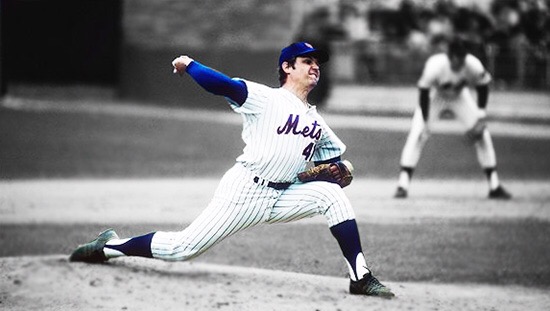
Any argument against the Seaver statue is ill conceived:
- It’s too costly – You’re a major league franchise in New York. You can afford a statue.
- Seaver can’t travel for the unveiling – Hodges’ number was retired posthumously. It’s about honoring a player properly, not about attendance.
- There’s nowhere to put it – First, you found a spot for the old Home Run Apple. Second, there are empty places in and around the ballpark. If it’s important to you, you find a spot.
- It would diminsh the importance of the Jackie Robinson Rotunda – It won’t.
- Building one for Seaver means the Mets will have to build ones for other Mets Hall of Famers – So what? There are only two of them so far. I think the team can manage that.
Other than that, what possible reason is there for not having a statue? There is no legitimate reason.
The time has long since passed to build a statue in Seaver’s honor. As many have done before, Nancy Seaver shone a light on the issue. She’s right that it is embarrassing that the Mets won’t honor the greatest player in their history. It’s time for the Mets to right that wrong and build the statue.
It seemed like disaster struck for the Mets. Both Noah Syndergaard and Yoenis Cespedes were forced to leave Wednesday’s game due to injuries. For Cespedes, it was his left wrist. For Syndergaard, it was the dreaded elbow complaints. Speaking of elbow complaints, it appeared that Zack Wheeler had a Jeremy Hefner-like setback during his Tommy John rehab.
It was seriousness enough that the Mets weren’t screwing around this time. They immediately sent Cespedes and Syndergaard to see Dr. Altchek.
While these two Mets were getting themselves examined for potential season-ending injuries, Mets fans were left to drive themselves crazy. I spent most of the time trying to talk myself into Sean Gilmartin or Rafael Montero as a viable fifth starter. I looked to see how Brandon Nimmo‘s numbers would translate to the majors. I thought about moves like signing Yusileski Gourriel.
I kept reminding myself that Steven Matz was 7-3. I harkened back to last year when there was a big three of Syndergaard, Matt Harvey, and Jacob deGrom. We haven’t seen the best of Harvey or deGrom yet, and Matz had shown the ability to potentially replicate what Syndergaard last year. I kept telling myself the Mets were going to be fine. All they have to do is make the playoffs with that pitching staff and bullpen. It was possible.
Fortunately, Syndergaard put our minds at ease:
After that tidbit of good news, we learned neither he nor Cespedes are headed to the DL. Furthermore, tests revealed Wheeler has no structural damages.
We don’t know when Cespedes can return to the lineup, nor do we know if Syndergaard will make his next start. However, we do know they will play again in the near future. We also learned there is still hope for Wheeler returning to the Mets to pitch this year. It’s a huge relief.
Now, instead of staying up all night trying to dream up scenarios where the Mets can compete without their best hitter or pitcher, I can put my head down and go to sleep in peace. I imagine that I’ll dream of the Mets winning the World Series behind Cespedes, Syndergaard, and maybe even Wheeler.
All throughout the 2015 postseason, Alcides Escober swung at the first pitch of the game. In Game 1 of the World Series it led to an inside-the-park home run due largely in part to a Yoenis Cespedes misplay in center. In Game 2 of the World Series, he flew out to right field. In Game 3 of the World Series, Escobar didn’t swing at the first pitch:
Instead, Escobar took at step back at a pitch that was up and in from Noah Syndergaard.
After the game, when asked about the pitch, Syndergaard informed the Royals, and frankly all of baseball, that if anyone has a problem with the way he pitches, teams can meet him on the mound.
The next time Syndergaard pitched was in the second game of the regular season in Kansas City. There was no controversy at the time as he never moved any of the Royals off the plate. Also, since he never came up to bat, there was no fear of retribution from the Royals whatsoever. Today is a different story. Today, Syndergaard takes the mound against the Royals at Citi Field. At some point during the first three innings, he is going to dig in at the batter’s box, and the Royals are going to have an opportunity to exact revenge against Syndergaard the way he tried to exact revenge against Chase Utley this season.
Keep in mind, the Royals don’t shy away from throwing at batters. It was just this month that Yordano Ventura sparked a brawl by continuously throwing inside to Manny Machado until he finally hit him. Even with the Royals starting Danny Duffy, the chance for retribution remains. This is the same Royals team that was involved in five benches clearing incidents last year. They’re not afraid of another. They won’t be afraid of plunking Syndergaard.
If it does, it will be very interesting to see how Syndergaard, the umpires, and the Mets respond.
For the second straight season, we have been reminded how important Travis d’Arnaud is to the Mets. We are again reminded how much the Mets need him to stay on the field.
Last year, d’Arnaud was only able to play in 67 games with the Mets due to a a broken pinkie and a hyper-extended elbow. When d’Arnaud was able to play, he hit .268/.340/.485 with 12 homers and 41 RBI. Behind the plate, d’Arnaud continued to be a good pitch framer, and he threw runners out at a league average rate. In the games, the Mets were 41-26, which is a 99-63 pace.
When d’Arnaud was injured or sat, his replacements struggled mightily. The Mets had entered with Anthony Recker with as the primary backup. However, with his being a career .185/.260/.334 hitter, the Mets knew they would have to go to somewhere else for offense. At first, the Mets turned to their former first round pick Kevin Plawecki who hit .219/.280/.296. As Plawecki did not hit, the Mets turned to Johnny Monell, who hit .167/.231/.208. As he didn’t hit, the Mets went back to Plawecki. During this time the Mets had a 49-46 record, which is an 84-78 pace. In some ways, if d’Arnaud never returned to the Mets, the team never would have made the playoffs.
With the Mets 36-32 record, that’s where the Mets are. They are on the outside looking in.
They Mets are in this position in large part because of how poorly Plawecki and Rene Rivera have hit. Plawecki is even worse than he was last year hitting .194/.301/.258. Rivera has hit .190/.273/.310. No matter who the Mets pick to play, they can be rest assured that they are not going to get any offensive production from the catcher position. That should change tonight when d’Arnaud returns to the Mets.
It has to change. The Mets need d’Arnaud to have the same impact and offensive production he had last year. If he does, it’ll go a long way towards fixing the problems the Mets are currently experiencing. It could take this team from a team on the outside looking in to a team that is once again in position to win the National League East. With the Mets pitching and bats like d’Arnaud, this team can win the World Series.
On July 31, 2015, the Mets were three games behind the Washington Nationals. The Mets had the pitching to win, but they still needed the offense. Most of the Mets best hitters were either on the disabled list or had just returned from their own stint on the disabled list. Under these circumstances, the Mets made a trade for Yoenis Cespedes. Cespedes played his first game with the Mets on August 1st. From that point until the end of the season, Cespedes would hit .287/.337/.604 with 17 homers and 44 RBI. The Mets would go from three games back in the division to winning the National League East by seven games. The Mets then set out on a magical postseason run that found them falling just short of winning a World Series.
Many have posited that but for the Cespedes’ acquisition, the Mets would not have even made the playoffs. Cespedes was credited only with raising his game, but also raising the play of his teammates. Cespedes’ production and the ensuing run the Mets went on were seen as proof positive of that fact. Unfortunately, that narrative hasn’t been proven true this year.
Last year, the Mets were 37-22 in the 59 games Cespedes was with the Mets. This year the Mets have played 68 games, and they are 36-32. Despite having played in nine additional games, the Mets still have less wins with Cespedes on the roster. The Mets are faltering despite the fact that Cespedes is producing near the same levels he produced last year. In fact, Cespedes is hitting .287/.352/.564 with 17 homers and 43 RBI this year. Last year, this production was seen as transformative. This year many are left to inquire what moves the Mets need to make to return to the postseason.
The reason for this is simple. The current Mets team is worse than the 2015 version. For example, here is the lineup from Cespedes’ first game with the Mets:
- Curtis Granderson CF
- Daniel Murphy 3B
- Yoenis Cespedes LF
- Lucas Duda 1B
- Wilmer Flores 2B
- Kelly Johnson RF
- Travis d’Arnaud C
- Ruben Tejada SS
Here is the Mets lineup from Sunday:
- Curtis Granderson RF
- Asdrubal Cabrera SS
- Yoenis Cespedes CF
- Neil Walker 2B
- James Loney 1B
- Wilmer Flores 3B
- Michael Conforto LF
- Kevin Plawecki C
No, the lineup Cespedes first appeared would undergo some tweaks as the season progressed. First, Granderson would move back to RF, and Cespedes would play CF most of the time. Additionally, Murphy played some third base, but his primary position with the team was second base. Furthermore, until David Wright returned, Juan Uribe received the bulk of the playing time at third base. Finally, in both 2015 and 2016, Conforto was the primary left fielder that played alongside Cespedes in center. With that in mind, your only conclusion can be that the 2016 Mets as currently constituted are worse than the 2015 Mets. Here are the stats:
| 2016 | 2015 | |||
| C | Plawecki | .194/.301/.258 | d’Arnaud | .268/.340/.485 |
| 1B | Loney | .279/.329/.412 | Duda | .244/.352/.486 |
| 2B | Walker | .266/.335/.477 | Murphy | .281/.322/.449 |
| 3B | Flores | .241/.308/.380 | Uribe | .219/.301/.430 |
| SS | Cabrera | .265/.325/.394 | Tejada | .261/.338/.350 |
| LF | Conforto | .270/.335/.506 | Conforto | .231/.297/.447 |
| RF | Granderson | .223/.310/.449 | Granderson | .259/.364/.457 |
Overall, other than Walker, the 2016 Mets have no real advantage over the 2015 Mets from an offensive standpoint.
Granderson and Conforto are worse versions of themselves. Cabrera has hit for more power than Tejada did last year, but Cabrera’s stats are buttressed by a strong April. Since May 1st, Cabrera has hit .249/.306/.391. As for the catching and first base situations, the Mets have been trying to keep afloat since the Duda and d’Arnaud injuries. There is no timetable on Duda’s return. The expectation is d’Arnaud returns today.
This all tells us two things. First, Cespedes really didn’t make the players around him better last year. Yes, his presence in the lineup made the Mets a better team. However, him being a Met didn’t make the other Mets better players.
That leads to the second point, which is Sandy Alderson didn’t do the job he was tasked to do. He built a Mets team that lacked sufficient depth to carry the Mets through the anticipated Wright injury (even if the injury was of a different nature), and the likely Duda injury (again the injury was of a different nature).
So yes, Cespedes was great last year, and the Mets won. Cespedes has been similarly great this year, but the results are different. The results are different because it takes a lot more than Cespedes being great to make the Mets great. We know that now. Hopefully, so do the Mets.
From time to time, if you listen to the Mets telecasts close enough, you will hear Keith Hernandez tell the story of his 1975 season. After getting called-up and playing well in 1974, he thought he was in the majors for good. That wasn’t the case. In 1975, he was hitting .250/.309/.362 in 64 games. He left the Cardinals with little other choice but to send him down to the minors, and they did.
Initially, Hernandez was humiliated by the moment. However, he took advantage of the opportunity. Down in the minors, he got his swing right. He came back to the majors in 1976, and he he hit .289/.376/.428. He was back in the majors, and he was back for good. Hernandez would go on to win the 1979 batting title and MVP Award (shared with Willie Stargell). He had a bat to match his unparalleled defense. From that adversity, Hernandez would become a champion as a member of the 1982 and 1986 World Series teams. In total, Hernandez put together a borderline Hall of Fame career. It is something he might not have done had he not ever gone to the minors. As he has said, it was the best thing that ever happened to his career.
If you listen to Mets telecasts closely enough, you will also notice that Hernandez is a huge fan of Michael Conforto. You will also notice Conforto is struggling mightily like Hernandez did in 1975.
It was not too long ago that Conforto seemed to be a budding superstar. Having never played above AA, Conforto was called-up to the majors last year to hit .270/.335/.506 in 56 games. He hit two home runs in Game 4 of the World Series. He started this season off hitting .365/.442/.676 with four homers in April. The question then wasn’t whether he was major league ready, the question was how high his ceiling could possibly be. It seemed that Conforto was a likely All Star, possibly more. Then the calendar turned to May.
Since May 1st, Conforto has hit .157/.212/.321. There could be a multitude of reasons why this has happened from major league pitchers figuring him out and Conforto failing to make the needed adjustments to the cortisone shot Conforto needed in his wrist. Bottom line is Conforto has gone from playing at an All Star level to being a player who belongs in the minor leagues. Considering the fact that Terry Collins wants to “shake things up” it may be a signal that the Mets are willing to demote Conforto. It may not be the worst thing for Conforto or the Mets.
Conforto can go to Las Vegas and get himself right. He can spend time down there not only working on his swing but also his approach at the plate. Furthermore, hitting in a hitter’s haven like the Pacific Coast League could do wonders for a player that has been struggling for well over a month in the majors. We all saw how well this worked for Travis d’Arnaud back in 2014. He came back a much better player after his time in the minors. We also saw the positive effects of such a demotion with Keith Hernandez.
In the interim, the Mets could choose to give Alejandro De Aza some additional playing time to see if he can start playing like the player they thought he was when the Mets signed him in the offseason. The Mets could decided to turn to Brandon Nimmo who has been raking in AAA. Maybe, just maybe, the Mets could allow Conforto to start taking grounders at first considering James Loney is not the long term answer and no one knows when Lucas Duda can return from the disabled list.
Ultimately, this could be the best thing that has happened to both Conforto and the Mets. If the Mets have designs on returning to the World Series, they are going to need Conforto, who, when right, is the most complete hitter on the team. While he’s finding his stroke in the minors, Nimmo could get his chance to see if he is indeed ready to play in the majors. If Conforto is able to pick up first base, then the Mets could keep Nimmo in left when Conforto is ready to return to the majors. It might be time to send Conforto to AAA for not only his own good, but also for the good of the Mets.
After all, it worked for Keith Hernandez.
It’s the bottom of the ninth, and James Loney takes his lead from second. He represents the tying run. With his speed, or lack thereof, the ball is most likely going to need to be hit deep in the outfield to score him. With that in mind, Terry Collins knows he can’t let Rene Rivera bat in this situation, and he turns to his bench. He then summons Ty Kelly because he seriously had no better choice to make.
With that said, Kelly was the wrong choice. It should’ve been Travis Taijeron there.
On a bench with a dearth of power, Taijeron would be a welcome addition. This year Taijeron is hitting .314/.394/.587 in AAA. As we saw in Spring Training, his slugging isn’t a Vegas desert mirage. It’s legitimate power. He’s hit for power at each and every level he’s played. On top of that, Taijeron is a good corner outfielder. With that’s said, with the amount of strikeouts heaccumulates, there is a legitimate issue as to how his skills will translate to the majors.
What we do know is that Kelly’s skills don’t translate well. Despite his one home run, he hasn’t hit the ball with much authority from either side of the plate. It’s why he’s hitting .160/.222/.280 in his 27 plate appearances. He’s shown why four organizations passed on him, and why he didn’t get a call to the majors until he was 27. And yet, the Mets won’t move on from him allowing Taijeron to get his chance.
We don’t know if Taijeron would’ve come through in the ninth inning last night. What we do know is that Kelly didn’t, and no one reasonably expected him to get that big hit. Last night was yet another reason why the Mets should send down Kelly and give Taijeron his shot.
Editor’s Note: this was first published on metsminors.net
Lucas Duda went on the disabled list almost a month ago due to a stress fracture in his back. So far, the stress fracture in his back is not allowing him to do anything other than ride a stationary bike. As each day passes, the question needs to be asked about whether Duda can play again in 2016. The question needs to be asked about whether the Mets can sit and wait for Duda to return.
For the time being, the Mets solution has been James Loney. In his 13 games as a Met, Loney has hit .260/.302/.340 with 77 OPS+. This is as short sample size, but based upon his .280/.322/.357 batting line and 91 OPS+ last year, it may be fair to say that this is now who Loney is as a player. The positive aspects of having Loney is that he’s a better option than Eric Campbell and Ty Kelly. The negative is that his bat is just not going to cut it over the course of a season. If Duda is not going to be able to return, Loney’s bat is going to force the Mets to make another move for a long term solution at first base.
Obviously, if the Mets are going to make a move, they are going to have to obtain a player who is going to put up better numbers than Loney. At this point in the season, there are going to be very few sellers, and there are going to be very limited options at first base. At this point, the line of demarcation are teams that are under .500 teams who are at least ten games out of the division. That means if the Mets are going to upgrade at first base, they would be looking to swing a trade with the Minnesota Twins, Los Angeles Angels, Oakland Athletics, Philadelphia Phillies, Atlanta Braves, Milwaukee Brewers, Cincinnati Reds, Arizona Diamondbacks, and San Diego Padres. With those parameters in place, here is the list of potential trade targets
Joe Mauer – he’s returned to form hitting .286/.388/.420. However, given his contract and the fact that he’s the Twin’s David Wright, it’s hard to imagine the Mets would add his salary, and that the Twins would trade him.
C.J. Cron – Cron is the Mets version of Wilmer Flores. He’s a low OBP hitter with some pop in his bat. This year he is hitting .249/.305/.389, and he is a career .257/.389/.431 hitter. While Cron is still only 26, and he has some upside, he is not a clear upgrade over Loney.
Kole Calhoun – Presuming Calhoun can play first base everyday is a stretch considering he’s only played nine games there in his five year career. At the plate, he’s amidst a career year hitting .295/.369/.461 with eight homers. However, if the Mets do think he can play first base, it is going to take a lot to get from from the suddenly stingy Angels as Calhoun is still under team control until 2020.
Albert Pujols – there are $140 million reasons over the next five years why this will never happen.
Yonder Alonso – As a prospect in the Reds system, Alonso was supposed to be a slugging on base machine. This year he is nothing more than a .245/.306/.324 hitter. While his career .270/.336/.385 line is an upgrade over Loney, it is not clear that this version of Alonso will be.
Danny Valencia – it can’t be a Mets trade rumor analysis without mentioning Valencia who has played 25 career games at first base. He’s been great this year hitting .335/.379/.567 with 10 homers. He’s under team control until 2018. If Duda does return, he can shift to third. If Duda and Wright return, it’s a nice problem to have. The main sticking point with Valencia is going to be the cost.
Billy Butler – While Butler is best suited for DH, he has played first base almost every year of his career. Unfortunately, the question with respect to Butler isn’t his glove, it’s his bat. Butler is hitting .257/.296/.396 this year, and he has not had an OPS+ over 100 since 2013.
Ryan Howard – stick a fork in him, he’s done.
Freddie Freeman – the Braves have removed everything of value from this roster including the copper wiring. The only thing that remains is Freeman who is having a poor year hitting .248/.343/.432, which is to say, he’s a big upgrade over what the Mets have. Before this year, the 26 year old Freeman hit .286/.368/.467 in each of his five seasons as a starter. The main sticking points to a Mets/Braves trade will be the $106.5 million Freeman is owed through 2021. It’s a reasonable contract given his skill set and the fact that he will be 31 when the contract ends. However, it does not appear the Mets would be willing to take on that type of contract even if they were willing to part with the necessary prospects.
Chris Carter – This year Carter has been what he has always been – a pure slugger. Carter doesn’t walk, he strikes out a lot, and he hits a lot of homeruns. He’s hitting .223/.295/.507 this year with 17 homeruns. He would be the Mets homerun leader, but he is not getting on base. Carter is the all or nothing player that has been the entire Mets offense this year.
Joey Votto – he was a superstar, and he’s one of the few trade pieces the Reds actually have. He can be a real difference maker. However, he’s due $172 million until 2023, which is his age 39 season. After that he has a $7 million buyout.
Jay Bruce – he has three career games at first base, and he has a very reasonable $13 million trade option for next year. He has returned to form this year hitting .271/.329/.584 with 15 homers. The issue is the Reds turned down a straight up trade for Zack Wheeler last year. With that said, it does not appear there is room for a trade for Bruce even if you’re willing to ignore his limited first base exposure.
Paul Goldschmidt – there is absolutely no way the Diamondbacks are trading him.
Jake Lamb – he’s a young player having a breakout year, who is also under team control through 2o21. He’ll be easier to acquire than Goldschmidt, but this trade isn’t happening either.
Yasmany Tomas – Tomas is interesting because since he’s came to the majors from Cuba, the Diamondbacks aren’t quite sure where to play him. With him owed $55.5 million through 2020, the Diamondbacks may be willing to move their .260/.313/.425 hitter to retool so they can make another run for it next year (or the second half). However, his salary may be just want keeps the Mets at bay.
Wil Myers – The 25 year old Myers is finally living up to some of the potential everyone envisioned when he was traded to the Royals for James Shields. He’s in the All Star conversation as he is hitting .283/.324/.506 with 14 homers. He’s also versatile, which could be of great benefit to the Mets. All of this is also why the small market Padres would not want to trade him unless they are getting a massive haul in return.
Yangervis Solarte – like Myers, he’s having a terrific year, he’s versatile, and he’s under team controll. The Mets are going to part with a lot to get him.
Brett Wallace – Like Loney, Wallace is not hitting for power. Unlike Loney, he gets on base with a .208/.352/.369 batting line which is good for a 101 OPS+.
Overall, the first base upgrades that would be available for the Mets have bigger contracts. Seeing how the Mets have operated the past few seasons, it is difficult to imagine them being willing to pay someone like Freeman. It is also difficult to imagine the Mets would be willing to part with the prospects necessary to acquire a Solarte. In the end, this means the Mets are most likely sticking with Loney until Duda is able to return to the Mets.