Musings
Back in 2007, the Mets collapsed in part due to a rash of pitcher injuries. Pedro Martinez missed most of the year following offseason surgery to repair a torn labrum. An injured Orlando Hernandez (El Duque) had to be moved out of the rotation and into the bullpen. With they myriad of injuries, Mike Pelfrey was put in the rotation before he was truly ready. Brian Lawrence made a few poor starts. With the walls crashing in on the Mets and the Phillies gaining on them, the Mets had to turn to Philip Humber.
Humber was the third overall pick in the 2004 draft. In his career, he never lived up to that billing. It could have been that he was damaged goods coming from Rice University, who is well known for abusing pitcher arms. He did have ulnar collateral ligament reconstruction surgery before his major league debut. It could be that he was rushed through the system never being given proper time to develop. It could any single factor or any combination thereof. It could just be that he just wasn’t good enough to be a top line starting pitcher.
He certainly wasn’t on September 27, 2007. His final line was four innings, six hits, five runs, five earned, two walks, no strikeouts, and one home run allowed. Humber did his best to battle that night, but he either wasn’t ready or wasn’t capable of winning a big game like that. The only reason he didn’t take the loss was the Mets staked him to a 4-0 and a 6-2 lead. It would be his last game as a Met as he would be part of the Johan Santana trade. It was also the last day the Mets would have sole possession of first place as the loss would drop them to only one up in the division.
Like in 2007, the starting pitching is dropping like flies. Matt Harvey, Steven Matz, and even Jon Niese have found themselves on the disabled list. Logan Verrett has served as this year’s Lawrence. Robert Gsellman serves as this year’s Pelfrey. However, Lugo isn’t quite this year’s Humber. They really have nothing in common.
Whereas Humber was a high draft pick, Lugo was a 34th round draft pick. While Humber was pushed through the minors without mastering a level, Lugo has performed at each and every level having to prove himself over and over again. During his career, Humber had trouble developing a real outpitch. Conversely, Lugo has a terrific curveball that has already fooled Anthony Rizzo, who is a terrific major league hitter. More importantly, the main difference between Humber and Lugo is Lugo has already had success as a pitcher for the Mets.
In nine appearances as a reliever, Lugo pitched 17.0 innings and had a 2.65 ERA. When injuries forced him to make an unexpected start, Lugo was better than anyone could have imagined. He was not only good, but he was efficient. When Lugo walked off the mound, he had pitched 6.2 innings allowing seven hits, one run, one earned, and one walk with three strikeouts. At a minimum, Lugo has shown everyone he has the capability of being a good and reliable major league pitcher.
During this season, this Mets team has been compared to past Mets teams that have failed. Namely, they have been compared to the 1987, 2001, and 2007 teams. You can go up and down the line and compare different aspects of those teams to this current team. However, those comparisons need to stop with Lugo as everyone should have faith when Lugo steps on the mound.
There is no sugar coating it. Travis d’Arnaud has had a bad year. Blame his shoulder. Blame the hex the Mets have seemingly been under this year. Blame whatever you want. The simple fact remains d’Arnaud has had a horrible year. You can even say he has regressed offensively.
However, behind the plate, he is the same guy he has always been. He is still a terrific pitch framer that helps his staff by helping ensure that strikes are called strikes and by occasionally getting a ball called a strike. He allows very few passed balls. When there is a play at the plate, d’Arnaud is not only adept at fielding a throw, but he does a great job blocking the plate within the terms of the new rules. As seen last night, he goes a great job in making sure he gets the tag on the runner before they have a chance to touch the plate.
He is slightly below average in throwing out base stealers when there is a pitcher on the mound that bothers holding on runners. When the pitcher doesn’t hold runners on, like most catcher’s he virtually has no chance to throw out the base runner. Generally speaking, he seems to call a good game, and there have never been any public complaints from any of his pitchers about his abilities behind the plate.
The reason is on the average d’Arnaud is a good defensive catcher. While it was anticipated that d’Arnaud’s value would be in his bat, the truth is, as a major leaguer so far, his real value is as a receiver.
With all that said, it seems d’Arnaud has been the scapegoat for this entire 2016 season. With the Mets struggling offensively, the team sought to upgrade the position by aggressively pursuing Jonathan Lucroy. Apparently, James Loney and his 86 OPS+ wasn’t hurting the team. When someone steals a base, it is on him. Nevermind the fact that Rene Rivera also has a supbar caught stealing percentage (28.6%) or that Noah Syndergaard and Steven Matz don’t bother holding on base runners. On a team where no one is hitting well, he is the guy slated to hit eighth. Seemingly, d’Arnaud has been blamed for everything. It is a shock no one has pinned Yoenis Cespedes injuring his quad on d’Arnaud.
Even with that in mind Nelon Figueroa took blaming d’Arnaud to a new level. After the game, Figureoa pinned part of the blame for Jacob deGrom’s poor outing on d’Arnaud. Figueroa took issue with d’Arnaud not going out to the mound to calm down deGrom (frankly, a lost art in the game that few catchers do), and with his pitch selection saying d’Arnaud failed to call inside pitchers. Only that’s not what happened.
According to deGrom, it was on him saying, “It’s hard to get results when you throw everything right down the middle. That’s what it is. I’m missing down the middle and these are big-league hitters and that’s what they do.” (New York Post).
There is no amount of pitch calling, pitch framing, or pep talks that can cure a starting pitcher who has just been completely missing his spots for two days now. There are very fair and valid criticisms of d’Arnaud. As noted, he doesn’t throw base runners out. Furthermore, he is having a terrible offensive season. That’s all on him. However, things are going overboard with people now blaming him for other player’s poor performance.
In the Bergen County Record, Bob Klapisch had this gem regarding whether or not Yoenis Cespedes will exercise his opt out clause after the season:
When asked by The Record’s Matt Ehalt if he intended to honor all three years of his current $75 million contract, without opting out, Cespedes flatly said, “Yes.”
In what has been a trying year for the Mets and Mets fans, this is a brief respite that should give each and every Mets fan reason for joy. However, it is hard to believe Cespedes.
As it stands now, Cespedes stands to be the top free agent on the market this offseason. If he opts-in, he could potentially be losing $100 million, possibly more. There should be several big market teams who want more offense that could offer Cespedes more money than the Mets are able or are willing to offer him.
Remember, Cespedes is a man who missed out on a chance of a lifetime. When Cespedes left Cuba, he left behind his mother, his son, and many more friends and relatives. Instead of going back to Cuba to see his loved ones, he stayed in the United States because he was “a free agent seeking a huge multiyear deal and essentially [had] to attend to business.” (New York Times). Quite possibly, Cespedes missed his last chance to ever see his mother and son again because getting a big multiyear deal was that important to him. This is not to be critical to Cespedes. Rather, it is to show how important the financial security, and yes, being in the right place is to him.
Remember, it’s easy to say you’re staying when it is August and your team is in the thick of the Wild Card chase. It is another thing all together when it’s just you and your agent, and you have a life altering decision to be made. An off-hand comment is not the same thing as purposefully walking away from at least $100 million. Even if he were so inclined. His agent wouldn’t let him. It’s probably why within 24 hours the story changed.
Now, when asked if he made up his mind about staying with the Mets past this season, Cespedes said, “Nope. My focus is just to play baseball and help the team win, hopefully make it to the playoffs. I let my agents worry about all that.” (New York Post).
Cespedes would also say he wants to remain a Met for the reason of his career. I believe Cespedes when he says that. He has seemingly found a home with the Mets. He seems to enjoy it here. He has become a much better player with the team. These are all terrific and very valid reasons why he wants to stay.
However, there are going to be over $100 million reasons that will help him make his decision where he winds up next year and the next few years past that.
He was really focused on that deal last offseason. It meant enough for him to miss seeing his loved ones. It will be just as, if not more important, this offseason.
He’s going to opt out.
This will be the third time after the All Star Break that Jacob deGrom is pitching in an important game against a team in the thick of the playoff race. The first two times did not go well.
On July 23rd, the Mets were coming off a 5-3 victory against the Marlins. If the Mets were able to win consecutive games for the first time in almost a month, the Mets would’ve jumped a half game over the Marlins and claimed the second Wild Card spot. However, deGrom faltered in his first start after his career complete game shutout. He allowed five earned on 10 hits in only 3.2 innings in a game the Mets lost 7-2. Instead of being a half-game behind the Marlins, the Mets were 1.5 games back, and they have not yet caught up to the Marlins in the standings.
On August 18th, the Mets were at .500 after a terrible nine game stretch against two of the worst teams in baseball. The Mets sent deGrom to the mound in what was supposed to be a classic pitcher’s duel against Madison Bumgarner. Neither pitcher lived up to the billing. For his part, deGrom would only last five innings surrendering a career high 13 hits while allowing eight earned in the Mets 10-7 loss to the Giants. With the loss, the Mets would fall back under .500, and they would fall 4.5 games behind the Cardinals for the second Wild Card spot.
The Mets have been playing much better of late having won three in a row. With last night’s win over the Cardinals, the Mets are a game over .500 and are 3.5 games behind the Cardinals for the second Wild Card spot. With a win, the Mets will have won four in a row, pulled a game closer to the Cardinals, and they will have real momentum.
Tonight’s game won’t be easy. The Mets are going against Carlos Martinez, who has been the Cardinals’ best pitcher all season. That means deGrom is going to have to be at his best. He hasn’t been in these situations since the All Star Break.
However, to say he isn’t capable of going out there tonight and pitching a gem tonight is absurd. It was deGrom who started off the NLDS last year out-dueling Clayton Kershaw to give the Mets a 1-0 lead in the series. In that game, deGrom struck out 13 Dodgers over seven shutout innings. In Game Five of that series, deGrom had nothing, but he outlasted Zack Greinke and kept the Mets in the game over six of the gutsiest innings you will ever see a Mets pitcher throw. In the NLCS, deGrom effectively ended the series with a dominant Game Three performance.
No matter how you slice or dice it, deGrom is a big game pitcher. Just because he has faltered in his two chances after the All Star Break doesn’t mean he won’t go out there tonight and shut down the Cardinals. While Noah Syndergaard could have the best stuff in all of baseball, deGrom is the Mets pitcher you trust most out there. He is the ace of the staff. He’s going to have a big game tonight.
With Jacob deGrom, Noah Syndergaard, and now Robert Gsellman, the Mets feature a team with a number a players with long flowing locks:
Whose flow is best? Reply with who you think rules the #Mets hair game. #LGM pic.twitter.com/aC2Dgbz86S
— New York Mets (@Mets) August 23, 2016
None of that could prepare you for the Gary Cohen photo from college during the game last night:
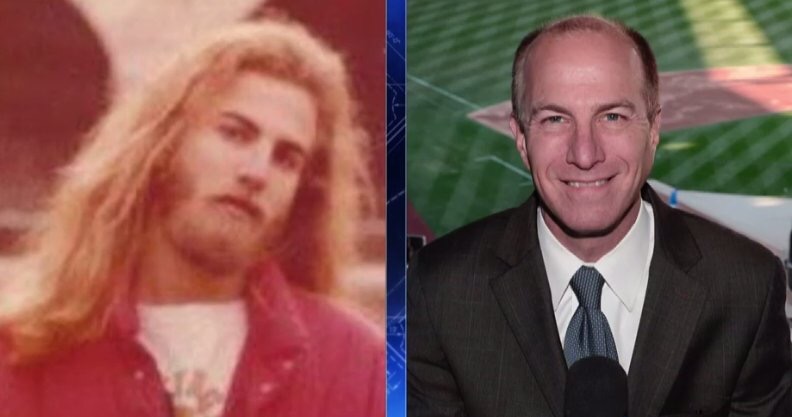
Who knew Gary Cohen was a hippy? Heck, who knew he had hair?
At this point, seeing Gary Cohen, it’s fair to say none of the Mets will beat either this photo or this hair style.
Hopefully, the Mets will be in peak defensive form as the team is going to send Jon Niese to the mound in a critical three game set in St. Louis. How did we get to this point?
Plain and simple, a mixture of bad luck and bad planning. Niese was never supposed to be a Met in 2016. The Mets traded him for Neil Walker, and with his reasonably affordable option years, it was presumed that he would be a Pirate through the 2018 season. However, Niese was horrendous this season leaving the Pirates to demote him to the bullpen. They were clearly going to let him walk after the season was over. Fortunately for the Pirates, they were able to get rid of him even sooner.
The Mets had to contend with Matt Harvey‘s season ending surgery which left a hole in the rotation Logan Verrett couldn’t quite fill. Despite know this, the Mets kept turning to Verrett as they did not trust Gabriel Ynoa, Robert Gsellman, or Seth Lugo. Sean Gilmartin went down with a shoulder injury. Additionally, the Mets had the under-performing Antonio Bastardo in the bullpen. The Mets were probably the one team who could use Niese as a bullpen arm and/or a possible fifth starter. They were probably also the one team that believed they could salvage Niese.
As it turns out, the Mets desperately needed Niese. Verrett couldn’t handle being the fifth starter. Ynoa appeared as if the wasn’t ready in his short stint in the Mets bullpen. Gsellman isn’t putting up great numbers in AAA. Worst of all, Steven Matz was just diagnosed with a mild rotator cuff strain. It is quite possible the Mets will need to not only replace Harvey, but also Matz for the rest of the season. That will put Seth Lugo in the rotation. It also means the Mets will have to keep Niese in the rotation for the remainder of the season.
It’s strange to think about it. Niese was the first pitcher removed from the rotation last season. The Mets seemingly wanted to get rid of him. Now? Now, he is a key part of a rotation that is taking the ball to start what is the Mets most critical series to date.
Niese has his fair share of detractors due to his struggles and his inability to accept any blame for his poor pitching. Detractors could also be synonymous with Mets fans in this case. With a big finish to the season, Niese can win over a large group of Mets fans. That all begins tonight.
Somehow, some way, the Niese are relying on Jon Niese yet again. It’s strange how it came to this point, but here we all are. Let’s hope Niese makes the best of it because if the does, the Mets will return to the postseason.
Currently, the Mets outfielders are Jay Bruce, Yoenis Cespedes, Alejandro De Aza, Curtis Granderson, and Justin Ruggiano. Not on this list is Michael Conforto as the Mets have no intention of calling him up until September 1st.
Conforto is absolutely raking in AAA. In the 10 games since his demotion, Conforto is 22-40 with four doubles, four homers, eight RBI, and two walks. That is a .550/.581/.950 batting line. Offensive statistics in the Pacific Coast League are typically inflated, but they aren’t that inflated.
Better yet, over his two stints in the minors this year, Conforto is hitting .500/.559/.633 with a double, a homer, and seven RBI in 30 at bats.
No, the Mets have no interest in that production right now even with them playing in a crucial three game set against the Cardinals that will have a dramatic impact upon their chances of winning the Wild Card. Instead, the Mets want to go with the following:
- Bruce who is hitting .169/.263/.282 in 19 games as a Met
- De Aza who is hitting .192/.287/.308 on the season and .133/.264/.311 in August
- Granderson who is hitting .224/.312/.428 on the year and .186/.240/.347 since the All Star Break
- Ruggiano who was released from the Rangers while he was in AAA and is a career .258/.322/.438 hitter
Overall, the only player who deserves to be in the lineup day-in and day-out is Cespedes. After that, the Mets have to pick two other outfielders who are playing best to man center and right. Looking at the Mets 40 man roster, it is hard to believe that Conforto isn’t one of those players right now.
Hopefully, the Mets will sweep the Cardinals and get terrific production from their center and right fielders. If not, we will all be left asking why were the Mets willing to field their best possible team and best possible lineup in the most important series of the year.
Yesterday, both Stephen Strasburg and Steven Matz were placed on the disabled list for very different reasons.
The Nationals put Strasburg on the disabled list as a precaution as the pitcher complained of elbow stiffness. General Manager Mike Rizzo felt it was the right move saying, “We felt like the prudent thing to do – like we always have with our pitchers – was to give him this reset. We’re going to put him on the DL rather than pitch through some routine inflammation and soreness.” (Washington Post).
These are the things you do when you sign a pitcher to a seven year $175 million contract extension. Teams are afforded this luxury when you enter the day 8.5 game up in the division with a 99.99% chance of making the playoffs.
The Mets, who are in a different position than the Nationals, took a completely different course with Matz.
Matz wasn’t dealing with “routine inflammation or soreness,” rather he was dealing with bone spurs that were affecting his ability to finish his pitches. When asked about how to proceed, Mets General Manager Sandy Alderson said, “At this point it’s a function of whether he can tolerate the discomfort while continuing to pitch. What we will do is monitor this discomfort, monitor his mechanics to make sure whatever discomfort he has doesn’t cause him to do something that might lead to something else, and we’ll monitor it on a start-by-start basis.” (ESPN).
Before each and every start, Matz needed to take painkillers before every start to manage the pain in his elbow, and now, Matz’s elbow discomfort has led to a shoulder injury. Matz has gone from pitching through bone spurs to landing on the disabled list with what the Mets are calling a mild strain and inflammation of his rotator cuff.
It should be noted this wasn’t the prudent course with Matz. Quite to the contrary. In fact, according to Jon Heyman, the Mets reportedly talked Matz out of getting surgery to remove the bone spurs despite him pitching with the bone spurs for at least a month with declining production.
At the time the Mets reported Matz’s bone spurs, the Mets were 40-35. They were 4.0 games out in the National League East, and they were a half a game behind the Marlins for the second Wild Card.
Beginning with the start prior to the June 27th announcement, Matz has gone 2-5 with a 4.20 ERA and a 1.300 WHIP. Before that date, Matz was 7-3 with a 2.74 ERA and a 1.134 WHIP.
During this post-June 27th stretch, the Mets have fine 22-27 slipping to 11.0 games behind in the National League East and 4.5 games behind for the second Wild Card.
The Mets pushed Matz, and they got declining production from him as they fell lower in the standings. Now, the Mets have lost Matz for at least three starts while the team is fighting for their playoff lives.
It makes you question whether things would have gone differently if the Mets took the prudent course in erring on the side of caution to protect their young pitchers arm instead of pushing him into another injury.
Ahead of a huge three game set against the St. Louis Cardinals, the 61-61 New York Mets are at .500 and are 4.5 games back of the Cardinals for the second Wild Card spot. Even with a good series here, nothing is guaranteed as the Mets are one of four teams currently withing five games of the last Wild Card spot. Here is where they all stand:
St. Louis Cardinals
The Cardinals are currently the second Wild Card with a 66-57 record. The team is hot having gone 7-3 in their last 10 games. The Cardinals hot streak is surprising given the fact that they are without Matt Adams, Aledmys Diaz, Matt Holliday, Michael Wacha, Seth Maness, and Trevor Rosenthal. The current Cardinals streak is a testament to their depth, resiliency, and the managing ability of Mike Matheny. Either that or it is a random hot streak, and the Mets are in prime position to take them down.
Miami Marlins
The Marlins are at 65-59 and are 1.5 games back of the Cardinals. Over their last 10 games, the Marlins are playing .500 ball. Worse yet for the team, they are starting to deal with some major injury problems. The team is most likely without Giancarlo Stanton and Wei-Yin Chen for the rest of the season. The team is currently without Adam Conley, and they have the prospect of having to shut down Jose Fernandez at some point in the season. Andrew Cashner was supposed to help alleviate some of these issues, but he has remained the same pitcher he was with the Padres. Offensively, first baseman Justin Bour has been on the disabled list for quite a while, but no one quite knows when he will return.
Over the course of the season, the Marlins have been a pleasant surprise (if you’re not a Mets fan). Ichiro Suzuki seems rejuvenated and got his 3,000 hit. Don Mattingly and Barry Bonds have changed the culture while helping young players like Christian Yelich reach their potential. However, now that they are no longer healthy, there is real doubt that they can stay in the race.
Pittsburgh Pirates
As we have seen with the Pirates the past few seasons, the Pirates a second half team. They are currently 62-59, three games back, and have a favorable schedule from here on out.
The Pirates are turning things around by turning over their rotation. They have traded away struggling and underperforming pieces in Francisco Liriano and Jon Niese and have replaced them with top prospect Jameson Taillon and former Yankee Ivan Nova. Nova seems to be the type of pitcher pitching coach Ray Searage thrives with, and it certainly hasn’t hurt him being reunited with his old catcher Francisco Cervelli.
Part of the reason the Pirates are in this position is not just their rotation, but it was also due to the struggles of Andrew McCutchen. McCutchen is having a big second half. Coupled with Starling Marte‘s terrific season, and the Pirates suddenly have a potent lineup.
In the end, the big question is if the young Pirates rotation and a bullpen without Mark Melancon can continue a second half charge to claim the second Wild Card spot.
New York Mets
The Mets have been a mess since April. Most of their players were hurt, stopped hitting, or both. However, now, the team is healthy, or as healthy as they can possibly be. Seeing Yoenis Cespedes in the lineup reminds you of the difference maker he is in the Mets lineup, and it is a reminder of the type of run the Mets are capable of making. For that to happen, the Mets are going to need more of the same from Jacob deGrom, and they are going to need Noah Syndergaard to keep pitching the way he did yesterday. The Mets will also need their other pitchers to step up especially if Steven Matz is going to be out for the season like Matt Harvey and Zack Wheeler are.
In the end, if the Mets are goign to run, they have to start with them taking the Cardinals down a few pegs in this three game set starting tomorrow. If the Mets are not able to at least win two out of three, it is going to be an even steeper hill to climb to make it back to the postseason.
Editor’s Note: this was also published on Mets Merized Online.