MIke Piazza
Recent reports indicate that President Elect Donald Trump is considering Bobby Valentine as the United States Ambassador to Japan. If Valentine is indeed selected as the Ambassador to Japan, it would be his second biggest accomplishment. Naturally, his biggest accomplishment was leading the 2000 Mets not only to the postseason, but to the National League Pennant.
As luck would have it, the New York Mets would begin the season in Japan. Valentine’s Opening Day outfield was Rickey Henderson–Darryl Hamilton–Derek Bell. Of that group, only Bell would play in a postseason game for the Mets, and he would be injured in Game One of the NLDS. Henderson would prove to be a malcontent that wanted a new contract, and ultimately, he would be released in May. Hamilton would lose his job in April after suffering a toe injury. This led to the Mets outfield being Benny Agbayani–Jay Payton-Bell for most of the season.
The one thing Agbayani could do was hit. In 2000, he hit .289/.391/.477 with 15 homers and 60 RBI in 119 games. However, he was a terrible fielder who did this in the field during a game that season:
For his part, Payton was one of the heralded players out of Georgia Tech that included Jason Varitek and Nomar Garciaparra. While Payton was once considered on par with them, if not better. As a prospect, Payton’s star would diminish a bit, but he would still become a major league player. In his 2000 rookie season, Payton relatively struggled at the plate hitting .291/.331/.447 with 17 homers and 62 RBI in 149 games.
There was more than that. Valentine also had to help make Todd Zeile an effective first baseman after he spent most of his career as a third baseman. Zeile was of course signed to replace John Olerud, who departed in free agency. While Zeile had a nice season hitting .268/.356/.467 with 22 homers and 79 RBI, his production fell far short of Olerud’s .298/.427/.463, 19 homer run, 96 RBI season. When you consider the drop off defensively from the Gold Glover Olerud to the quickly adapting Zeile, the team was noticeably worse at first base.
The team was also worse at shortstop. While Rey Ordonez never hit for much, he was a Gold Glover at shortstop. The Mets would miss that defense after he broke his left arm trying to get a tag down in May. This led to the Mets trying to get by with Melvin Mora at shortstop, who struggled at the plate and in the field. This led to the ill advised trade for Mike Bordick who would hit .260/.321/.365 in his 56 games as a Met.
In reality, this was all part of a Mets team that was considerably weaker than the 1999 version. Pat Mahomes was nowhere near as good as he was in 1999. In place of well established veterans like Orel Hershiser and Kenny Rogers in the rotation, the Mets had Glendon Rusch and the return of Bobby Jones. However, it should be noted the rotation was one area the Mets were better.
Whereas the 1999 Mets were an offensive juggernaut with a strong bullpen, the 2000 Mets were built on starting pitching. Al Leiter had an improved season making him 1A behind the ace the Mets acquired in the offseason, Mike Hampton. With Rusch and Jones outperforming their expectations, and quite possibly what their rotation counterparts did in 1999, the rotation was one area the Mets were improved.
The rotation along with two terrific players in Mike Piazza and Edgardo Alfonzo, Valentine was able to lead the Mets to the World Series. Valentine was able to do that despite a diminished offense, vastly diminished defense, an overall less talented roster, and some drama (which usually follows Valentine wherever he goes). It was a team that outperformed their Pythagorean win-loss record by six games. It was a team that outperformed expectations.
Making it to the 2000 World Series should be considered Valentine’s biggest accomplishment. That Mets team really had no business making it to the postseason let alone the World Series. It is why that should stand as Valentine’s biggest accomplishment even if he were to be named as President Trump’s choice to be the Ambassador to Japan.
One of the biggest issues with the 2017 Mets was the production they received from first base. The precipitous drop in production was a major factor in why the 2016 Mets scored fewer runs than the 2015 Mets. Remember, the 2015 Mets once infamously had John Mayberry, Jr. and Eric Campbell hitting in the middle of the lineup. With that in mind, getting improved production out of first base needs to be a priority for the Mets this offseason. Here is what should be available for the Mets this offseason:
INTERNAL FIRST BASEMAN
Duda is exactly the player the Mets need to revive their offense in 2017. From 2014-2015, Duda hit .249/.350/.483 while averaging 28 homers and 82 RBI. He is a home run threat in the middle of your order, and he is the classic slugging first baseman.
The issue with Duda is no one knows if he is healthy. In 2015, he went on the disabled list with a herniated disc in his lower back. In 2016, he suffered a stress fracture in his lower back, and he took longer than expected to return from the injury. While he tried admirably to try to play in the Wild Card Game, he just wasn’t ready. For the season, he only played in 47 games hitting .229/.302/.412 with seven homers and 23 RBI.
While all indications are Duda is completely healthy, it is unknown whether he can withstand the rigors of a 162 game schedule. It is also unknown whether he can return to form after suffering back injuries in consecutive seasons. At the moment, it is anticipated he will earn approximately $7 million in arbitration. For the production we know he is capable of producing, that is a steep bargain. Not knowing if he can produce, $7 million could be an expensive gamble, especially in light of Wright’s situation.
Smith is coming off a terrific year in AA where he finally began to fulfill some of the offensive potential he has by hitting for more power in the second half of the season. He is a a highly regarded prospect who is already a slick defender at first base. Still, he is just 21 years old, and he has yet to have an at-bat above AAA. He is not ready to be the Opening Day first baseman, and it is quite possible he may not be ready to play in the majors next year.
PLAYERS CHANGING POSITIONS
Time and again, people state Wright should just move across the diamond and play first base. Saying that presents a clear misunderstanding of the first base position and how taxing it would be on Wright.
Other than catcher, first base is the most demanding physical position for a player. At first base, a player is constantly stretching, turning, and twisting in the hopes of getting a throw from one of his infielders that much quicker to turn a close play into an out. With a runner on first, the first baseman has to spring off the bag and into his defensive position as the pitcher delivers the ball. Like a third baseman, he charges the bunts and dives for balls down the line. According to Dr. Walter P. Jacobsen, DO, a neurosurgeon, these activities that are high impact and require twisting are activities that should be avoided. These activities are more prevalent at first than third base.
Even assuming this was incorrect, that Wright was better suited to first base, when is he going to get the opportunity to transition there? Wright had season ending cervical fusion surgery, and presumably, he is going to need to spend most of his time in the offseason rehabbing and figuring out yet another pregame routine that will permit him to play in as many games as possible. As such, there is no time for him to learn first base.
Without or without Cespedes’ return, the Mets are going to have a glut of everyday caliber outfielders, and one of them may need to find a new home. That new home could be on another team or at another position. With UZR and DRS rating Bruce was the Mets worst outfielder, he would be the likely candidate to move to first base.
The one caution is Bruce has only played three games there in his major league career, and all three of those games were two years ago. Even accounting for that, Bruce may have the athleticism to adapt to first base and succeed there on the major league level. It is also a way to keep him and his 30 home run caliber bat in the lineup every day while also allowing Curtis Granderson, another Mets right fielder who can hit 30 home runs, in the lineup everyday.
Still, before moving someone over to first base, Mike Piazza should always be a caution to Mets fans that not just anyone can move over there. It is a difficult position that requires hard work in the offseason. If this is the plan, the Mets need to implement it sooner rather than later.
None other than Keith Hernandez believes Conforto should be playing first base with him saying, “He more than likely is going to end up at first base, though it’s unlikely he’ll be anything more than average there.” (nj.com). While it is far from a ringing endorsement, it is notable when Hernandez, the best defensive first baseman in major league history, states you should play his position.
For his part, Conforto is open to the possibility saying, “I took some reps in college over at first base just for emergency-type situations. I think that’s something that’s very, very interesting, something I’d be open to, obviously. I just want to help the team.” (New York Post).
Moving Conforto there means you won’t have to displace a veteran like Bruce. However, it does create a few problems. First, choosing to move Conforto over Bruce also means choosing to move the better defensive outfielder out of the outfield. Second, moving Conforto there could become a potential barrier to Smith or Peter Alonso at first base in the upcoming seasons. Third, having Conforto change positions to the infield could be yet another obstacle in the young player’s development.
For a myriad of reasons ranging from a wrist injury to uneven playing time to him just falling into slumps like any other player, the 2016 season was a lost one for Conforto. He went from the Mets top hitting prospect to a young player Terry Collins entrusted to little more than pinch hitting duty down the stretch. It is quite possible the best thing for him is for the Mets to pick a position in the outfield and let him stay there and allow him to work with Kevin Long to get back to what worked well for him.
EXPENSIVE OPTIONS
Tigers GM Al Avila has already announced the Tigers are looking to get younger and shed some payroll this offseason. With that in mind, the Tigers have a number of interesting trade candidates making big money like Cabrera.
At 33, Cabrera had another terrific season hitting .316/.393/.563 with 38 homers and 108 RBI. Should Cespedes depart this offseason, Cabrera would more than replace Cespedes in the lineup. However, the Mets chances of obtaining Cabrera are unlikely due to the cost. First, it is going to take a huge haul of players to obtain them, and in the past, the Mets have shown unwillingness to move one of their big pitchers like Matt Harvey, Jacob deGrom, Noah Syndergaard, or Steven Matz. Given Cabrera’s production, it is likely the Tigers ask for one of these players and/or a big prospect like Smith, Amed Rosario, or both.
Even if there was a middle ground on players the Mets deemed acceptable, it is hard to imagine them adding Cabrera’s contract. Cabrera still has seven years $132 million left on his deal. The contract carries through to his age 40 season, and there are two vesting options at the back end of the deal for $30 million a piece. If Cabrera does not age well, this contract would become the type of albatross Sandy Alderson typically avoids.
Bringing back Turner would be a page out of the Todd Zeile handbook. While Turner has not played regularly at first base, he has shown the ability to play over there, and his bat may help the Mets improve in 2016.
Moreover, Turner may need to move to first base to lengthen his career. Over the past few seasons, he has had knee issues, and he may not be well suited for the third base position in the time of the modern shift era that requires a third baseman to cover more ground than they did a decade or so ago.
There does remain some issues for Turner. First and foremost is the aforementioned knee issues. Second, Turner took off when he played in his hometown. There is no telling if he would struggle playing on the east coast again. Third, he regressed from an on base perspective this year. In 2014 and 2015, Turner was a player who had a .384 on base percentage with a .492 slugging. This year, Turner’s OBP dropped to .339 even while his slugging percentage stayed in the same vicinity (.493). This might have been a product of his knee issues or it could have been a product of him swinging for the fences more as evidenced by his career high 27 homers.
In either event, Turner is not the safest choice, especially when you are asking him to play out of position. These fears become magnified when you consider Turner will likely received a qualifying offer, and he will likely get a big contract offer from someone, including but not limited to the Dodgers, to play third base.
THE DESIGNATED HITTERS
Encarnacion may prove to be the biggest power bat on the free agent market. He is coming off a year that saw him hit .263/.357/.529 with 42 homers and a league leading 127 RBI. Over the past three seasons, Encarnacion is hitting .269/.361/.544 while averaging 38 homers and 112 RBI.
There are two issues with Encarnacion. First, much of his stats have been generated as a result of him hitting in the Rogers Centre, which is a hitter’s park. In his career, Encarnacion has hit .272/.360/.535 there. Last year, on the road, Encarnaction was a .246/.342/.492 hitter on the road. While it is a drop-off, the Mets would gladly take Encarnacion’s road production from their first base position next year.
Therein lies the real problem with Encarnacion. He’s a DH. Encarnacion has not played more than half a season at first base in his entire career. In his last five years with the Blue Jays, he has split his time between first and DH. While advanced metrics like UZR and DRS rate him to be an average first baseman, it is unknown whether he could withstand the rigors of playing in the field everyday. Those concerns are amplified for a player that will turn 34 next year, will command a large contract, and will most likely recent a qualifying offer.
Seemingly, from the moment Santana came up to the Cleveland Indians as a catcher, the team has sought a position for him. He has proven his best position is DH.
Santana is coming off a terrific year that saw him hit ..259/.366/.498 with 34 homers and 87 RBI. Those were the highest home run and RBI totals of his career. In his six full seasons with the Indians, Santana has averaged 24 homers and 81 RBI. With his on base skills and his switch hitting ability, Santana would be a welcome addition to the Mets lineup. However, like Encarnacion, the real question is whether he can be an everyday first baseman.
Like Encarnaction, he rates as average when he does play there. Unlike Encarnacion, he played almost a full season there in 2015. Moreover, he is four years younger than Encarnacion. So while both may receive qualifying offers and large contract offers on the free agent market, Santana may prove to be the better bet for the Mets should they look to upgrade the first base position in free agency.
QUESTIONABLE OFFENSIVE PRODUCTION
The best thing you can say about Loney in 2016 was he was a definitive upgrade over the Mets internal options like Campbell. Unfortunately, Loney showed little that would entice the Mets to bring him back next season. Loney finished the year hitting .257/.287/.369 with five homers and 18 RBI in 63 games after the All Star Break. He also showed he had limited range and an inability to stretch far for throws made to first. While he was an improvement over what the Mets had in 2016, the Mets are simply going to have to do better than him in 2017.
The Cleveland Indians took a one year flier on Napoli this offseason, and it has been a boon for them as Napoli has been a major contributor for a team now playing in the World Series. Still, there is caution for Napoli, who has a history of hip problems, and whose numbers were not great this season.
In 150 games, Napoli hit .239/.335/.465 with 34 homers and 101 RBI. In 2015, Napoli bounced around, and he hit .224/.324/.410 with 18 homers and 50 RBI in 133 games. With Napoli turning 35 next year, it is hard to believe he will have another strong campaign. Furthermore, the last thing this Mets offense needs is another low OBP guy who is seemingly all or nothing at the plate.
For a few seasons, Lind had proven himself to be a good on base player who may not have the traditional power you typically want from the first base position. In 2016, Lind played for the Mariners, and his production fell off a cliff. In 126 games, Lind hit .239/.286/.431 with 20 homers and 58 RBI. Historically, Lind has also struggled to hit left-handed pitching. Lind is more of a buy-low candidate in the event there are no better options than he is an upgrade you would seek on the free agent market.
BEST CHOICE
Ultimately, it may behoove the Mets to bring back Duda for one more season. If he produces at his normal levels, he will be exactly what this offense needs. Better yet, if he produces at that level, the Mets could give him a qualifying offer next offseason thereby helping them gain a first round draft pick in the process (assuming no changes to the Collective Bargaining Agreement). Furthermore, with Duda, the Mets have a nice bridge to Smith should he take another leap this year and prove himself ready to contribute at the major league level ahead of schedule.
There are many factors to consider when voting for a candidate today. At this point, they have all be regurgitated and discussed at length, and hopefully, you have made your decision based upon sound criteria. However, if you are looking for a reason to change your mind or reason to have your mind made up for you, or you really want to base this important decision on how the Mets have fared with a Republican or a Democrat in office, you are in luck. Here is how the Mets have performed under each President in their 54 year history:
| President | Seasons | Record | Win % |
| John F. Kennedy | 1962 – 1963 | 91 – 231 | 0.283 |
| Lyndon B. Johnson | 1964 – 1968 | 303 – 506 | 0.375 |
| Richard M Nixon | 1969 – 1974* | 478 – 433 | 0.525 |
| Gerald R. Ford | 1974* – 1976 | 263 – 277 | 0.487 |
| Jimmy Carter | 1977 – 1980 | 260 – 388 | 0.401 |
| Ronald Reagan | 1981 – 1988 | 662 – 573 | 0.536 |
| George H.W. Bush | 1989 – 1992 | 386 – 423 | 0.477 |
| William Jefferson Clinton | 1993 – 2000 | 562 – 506 | 0.526 |
| George W. Bush | 2001 – 2008 | 651 – 643 | 0.503 |
| Barack Obama | 2009 – 2016 | 630-666 | 0.486 |
* Nixon resigned from office August 9, 1974
Here are the cumulative results:
| Party | Record | Win% |
| Democrat | 1,846 – 2,297 | 0.446 |
| Republican | 2,440 – 2,349 | 0.510 |
Here are some interesting Mets postseason facts when there was a Democrat or Republican in the White House.
Democrat Postseason Facts
- The two times the Mets have been to back-to-back postseasons was when there was a Democrat in the White House (1999 & 2000 – Clinton; 2015 & 2016 – Obama)
- The Mets have only had an NLCS MVP when there was a Democrat in the White House (Mike Hampton – 2000; Daniel Murphy – 2015)
- The Mets have only won the division once (2015) with a Democrat in office. The other three postseason appearances were as the Wild Card.
- The Mets have appeared in four total postseasons and two World Series. The Mets are 21-17 in postseason games with the following records per round:
Wild Card Game 0 – 1 NLDS 9 – 4 NLCS 10 – 4 World Series 2 – 8
Republican Postseason Facts
- The Mets have won their only two World Series with a Republican in office (1969 – Nixon; 1986 – Reagan)
- In all five of their appearances in the postseason with a Republican in office, the Mets were the National Leauge East champions.
- In three of the five appearances, the Mets won 100+ games with the high water mark coming in 1986 with 108 wins
- In four of the five seasons the Mets appeared in the postseason with a Republican in office, the Mets had the best record in the National League (1973 is the exception). In two of those seasons (1986 & 2006), the Mets had the best record in baseball.
- In total, the Mets have appeared in five postseason and three World Series. The Mets are 30-20 in those postseason games with the following records per round:
NLDS 3 – 0 NLCS 16 – 12 World Series 11 – 8
If you wish to mainly focus on player performance over how the team has fared during each administration, Mets players have received more awards during Republican leadership:
Cy Young Award
- Republican 4 (Tom Seaver 1969, 1973, & 1975; Dwight Gooden 1985);
- Democrat 1 (R.A. Dickey 2012)
Rookie of the Year
- Republican 3 (Seaver 1967; Jon Matlack 1972; Darryl Strawberry 1983; Gooden 1984)
- Democrat 1 (Jacob deGrom 2014)
Rolaids Relief Man
- Republican 2 (John Franco 1990; Armando Benitez 2001)
- Democrat 0
Sports Illustrated Man of the Year
- Republican 1 (Seaver 1969)
- Democrat 0
Gold Gloves
- Republican 14 (Tommie Agee 1970; Bud Harrelson 1971; Keith Hernandez 1983 – 1988; Ron Darling 1989; Carlos Beltran 2006 – 2008; David Wright 2007 – 2008)
- Democrat 6 (Doug Flynn 1980; Rey Ordonez 1997 – 1999; Robin Ventura 1999; Juan Lagares 2014)
Silver Sluggers
- Republican 14 (Hernandez 1984; Gary Carter 1985 – 1986; Strawberry 1988; Howard Johnson1989 & 1991; Mike Piazza 2001 – 2002; Jose Reyes 2006; Beltran 2006 – 2007; Wright 2007 – 2008)
- Democrat 5 (Piazza 1998 – 2000; Edgardo Alfonzo 1999; Hampton 2000)
Roberto Clemente Award
- Republican 2 (Carter 1989; Carlos Delgado 2006)
- Democrat 2 (Al Leiter 2000; Curtis Granderson 2016)
From the Front Office side, Republicans have a 2-1 edge in executive of the year with Johnny Murphy winning in 1969, Frank Cashen winning in 1986, and Sandy Alderson winning in 2015. Baseball America named the Mets the top organization in baseball once in a Republican (1984) and once in a Democratic (1995) term.
As a general rule of thumb, the Mets and their players have performed better with a Republican in office. As you enter the voting booths today, take that as you will. Hopefully, you have more sound criteria for choosing your candidate.
Back in the 1998 offseason, neither the Mets nor Mike Piazza were messing around. Before the end of the World Series, which is the time players could file for free agency, the Mets made the 30 year old Piazza the highest paid player in the sport by giving him a seven year $91 million contract. With that Piazza got to stay in the place he wanted to play, and the Mets got their superstar who would lead them to consecutive postseason appearances and would become the team’s second Hall of Famer.
This is the stage the Mets and Yoenis Cespedes are at right now.
Cespedes has until three days after the end of the World Series to opt out of the remaining two years of his contract. Given the terrific, yet injured plagued, season he just had, he is widely expected to opt out to seek a more lucrative contract in the free agent market. Unlike last season where players like Justin Upton and Jason Heyward were free agents, Cespedes stands alone as the top free agent target for any team that needs to add an outfielder, a bat, and a superstar.
There have been conflicting reports about Cespedes’ desire to remain with the Mets. However, if the last year and a half have been any measure, Cespedes has enjoyed being a Met, and he has blossomed as a player playing in New York. He has worked well with Kevin Long to improve his approach at the plate getting on base more often and hitting for more power. He has an organization that allows him to be the person he is by letting him play golf and show off his car collection. He also has a fan base that adores him and pleads for him to stay with the team day and night.
The Mets have also greatly benefited from Cespedes’ duration in New York. Cespedes and Piazza are the only two superstars who have led the Mets to consecutive postseason appearances. The fans love of Cespedes helps increase the gate and merchandise sales. More importantly, Cespedes presence in the lineup and the Mets outfield give the Mets the best possible chance to win a World Series.
Given that, the time between the end of the Wild Card Game and the end of the World Series should be spent with the Mets and Cespedes’ agents, Roc Nation, trying to reach an agreement to keep Cespedes on a contract that pays him commensurate value. Most likely, Cespedes has a a price he would agree to right now in order to stay. Similarly, there is most likely a price the Mets would be willing to offer Cespedes to entice him to stay. If there is a will, there can be a meeting of the minds before any other team is able to make an offer to Cespedes.
If a deal is not reached it means one of three things: (1) Cespedes wanted to hit the free agent market; (2) the Mets are not willing to pay what it takes to keep Cespedes; or (3) both sides failed to put forth their best efforts to get this done. If any of these are the case, it is a shame, and it may be a decision both sides will rue for years to come.
For what it’s worth, the Mets appear willing to take that risk.
Editor’s Note: this article first appeared on Mets Merized Online
The other day I was in Toys R Us getting a birthday present for one of my son’s friends. On our way to find a toy, we walked through the Halloween aisle.
If you wanted a costume, it was available. Woody and Buzz from Toy Story. All of the Ninja Turtles were available. Star Wars characters old and new:

Then there were the superheroes. All of the Justice League and the Avengers were available. Most notably, there is a Thor costume. No, not the real one:
Dear Empire State Building: Wasn't me (For liability purposes only) pic.twitter.com/OJvxm5s32B
— Noah Syndergaard (@Noahsyndergaard) July 26, 2016
That’s right. No Noah Syndergaard costume. Also, no MLB costumes of any kind whatsoever. This seems like a missed opportunity.
Now, I realize MLB can’t necessarily do player costumes. If this was the 50’s you could, but not in today’s game. With the frequency in which players are traded, you would have to continuously change costumes year to year. At some point, it becomes cost ineffective.
That leaves you with a few options. First is the generic player jersey. Yes, I’m aware there are kid’s uniform sets, but have you seen them?
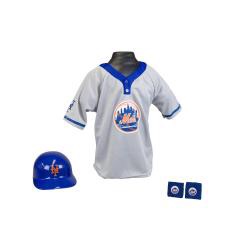
They’re terrible. They look nothing like the player jerseys. The other issue is they’re hard to find. Another problem is these are only made for five year olds. That eliminates a wide range of children. MLB has to do better than this.
Since MLB can’t do player jerseys and can’t do whatever the above is supposed to be, there are a few options.
The first would be to do an all time player for each franchise. Since these are young kids, you want it to be a player of as recent vintage as possible or a player everyone knows no matter how old they are. Here are some suggestions:
- Mets – Mike Piazza
- Yankees – Babe Ruth or Derek Jeter
- Red Sox – Ted Williams or David Ortiz
- Dodgers – Jackie Robinson
- Mariners – Ken Griffey, Jr.
The benefit of these is you can use them in perpetuity. The downside is these players are more iconic for the parents. That may entice the parent of a toddler to buy it, but an older child has no real attachment to these players. That coupled with the inherent issues with the current players means you need to go with something more basic.
There are two solutions to this, and they both should work well.
The first is to create mascot costumes. If you think about it, the mascot was created to entertain young fans. Generally speaking, it works as kids love team mascots:
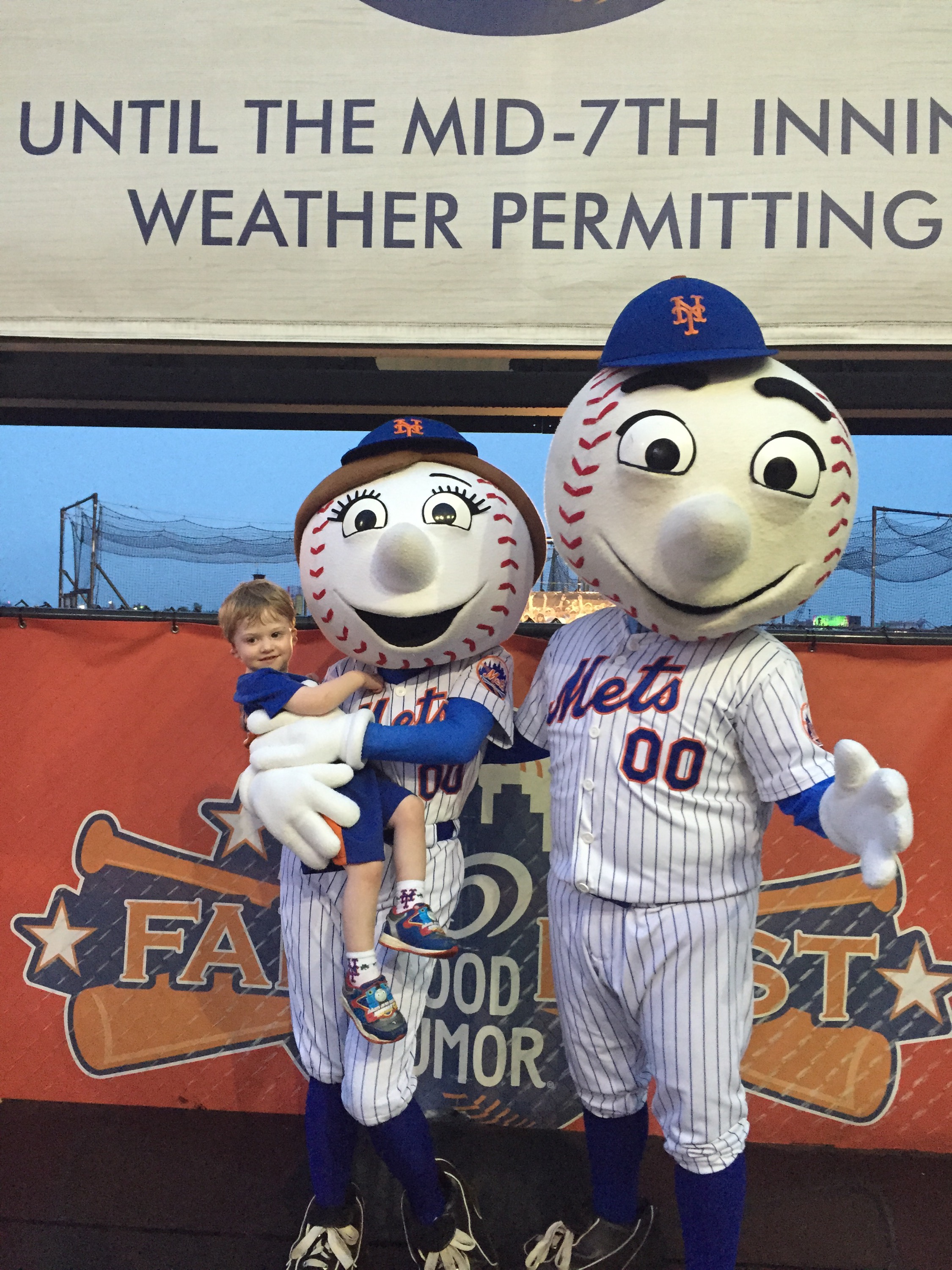
There will be many little Mets fans who would love to be Mr. Met for Halloween. Same goes for the other popular mascots across baseball.
For teams without a mascot, baseball could go with standard face like the one on the bobbleheads. In fact, if baseball wanted, they could make them all “Bobblehead Costumes.”
For those that say, they may not sell, give it time. The same exact costume my son wore last year was still for sale a year later. And guess what? It wasn’t the only one.
With that, you help foster a child’s interest in baseball. For the child a little less interested in baseball, perhaps they get more interested due to the Halloween costumes. Kids get interested in things for far less.
Not having MLB Halloween costumes overall seems like a lost opportunity. It doesn’t give the fan a chance to be a player, a mascot, or a bobblehead for Halloween if they so choose. It also allows the kid to move on from baseball a little more after the baseball season is over.
That’s not a good thing. Accordingly, MLB needs to create Halloween costumes.
Across the National League, there have been a number of standout performances. Consider for a moment that this ballot omits pitchers like Kenta Maeda, Steven Matz, and Junior Guerra. It also doesn’t include the terrific shortstops Trevor Story and Aledmys Diaz. In any other season, each of these players could not only be on the ballot, but they also could win the award. In what was a loaded field, here is my NL Rookie of the Year ballot:
1st – Corey Seager
Short of Jackie Robinson and Mike Piazza, Seager has put together the best rookie season by a Dodgers player. That’s high praise especially when you consider the Dodgers organization has accumulated more Rookie of the Year Awards than any other team in baseball.
Seager was incredible this year leading all rookies in WAR, doubles, and RBI. He was also second in home runs. He was the only rookie in the National League who played enough games to qualify for the batting title. He’s also played a great shortstop with a 10.9 UZR. Overall, there is no knocking his overall game, nor is there any reason to not give him the Rookie of the Year Award
2nd – Trea Turner
It’s one thing to be a well regarded prospect. It’s another thing to come up and show the world why you were a well regarded prospect. It’s a whole other thing to do that while playing out of position.
Given Ben Revere‘s failures in center field, the Nationals had two options to fill-in the position. One was Michael Taylor, who is a well regarded prospect in his own right despite his weak bat, or move your best prospect to center field. The Nationals chose the later, and they really benefited from it.
In 73 games, Turner hit .342/.370/.567 with 14 doubles, eight triples, 13 homers, and 37 RBI. With that, he had a 3.6 WAR, which was the second highest position player WAR accumulated in the non-Seager division. In center field, Turner had a -2 DRS, which means he was slightly below average, which is really remarkable when you consider he had never played an inning in center field before the 2016 season. All of this is even more impressive when you consider Turner did this to help a team win their division.
Given the totality of the circumstances, Turner’s 2016 season might have been the most impressive by any rookie. If not for Seager, it was the best season any rookie had this year.
3rd – Seung-Hwan Oh
Where would the St. Louis Cardinals be this season had they not signed The Final Boss out of the Korean Leagues? For most of the year, the Cardinals team and bullpen has dealt with injuries. Most notably, Trevor Rosenthal went from ineffective to injured in the span of the year. With those issues, the Cardinals needed someone to step up. That person was Oh.
In 74 appearances, Oh showed all of baseball how he earned the nickname The Final Boss. He made 76 appearances going 6-3 with 19 saves, a 1.92 ERA, 0.916 WHIP, 11.6 K/9, 214 ERA+, and a 2.13 FIP. He took over the closer’s job in the beginning of July, and he was converted 19 out of 22 save chances with a 2.27 ERA, 0.958 WHIP, and an 11.3 K/9. Not only was Oh one of the top rookies in baseball this year, he was also one of the best relievers in the game. With that in mind, The Final Boss deserves to be on the Rookie of the Year ballot.
Apparently, the Mets and Nationals being rivals for a whole two seasons has lead a bunch of Mets fans to root for Chase Utley in the NLCS. Yes, rooting for the Dodgers, or against the Nationals, is rooting for Utley. As a Mets fan, I don’t get it. To me the Nationals are the lessor of two evils. Without even getting into the early years of the Mets history where the Dodgers, notably Sandy Koufax, routinely embarassed the Mets, here’s why:
Mike Scioscia grand slam off Dwight Gooden:
Jay Howell is a dirty cheat:
Orel Hershiser effectively ends the best run in Mets history:
Dodgers sign Darryl Strawberry in free agency making him an ex-Met:
And, oh yeah, Bobby Ojeda.
Guillermo Mota hitting Mike Piazza on multiple occasions and always running away when confronted.
Utley breaking Ruben Tejada‘s leg turning a potential sweep into a series:
Also, Utley’s subsequent cowardice ducking in and out of Citi Field and not taking one at-bat at Citi Field.
Speaking of which, everything Utley ever did to the Mets:
Seriously, did you know that other fans refer to the right field corner in Citi Field as the Utley Corner? It is one of the biggest humiliations the Mets have suffered at the hands of Utley and his Phillies teams including the 2007 and 2008 collapses. By the way, also part of those teams was current Dodgers catcher Carlos Ruiz.
So no, there is no circumstance, unless they are playing the Cardinals, that I could ever root for the Dodgers or an Utley led team. It’s why, despite this new massive rivalry the Mets have apparently had stretching all the way back to last year, I’m rooting for the Nationals. Personally, I’d rather have a little bit more perspective on Mets history past and present. Speaking of which, just remember that while Utley was always a thorn in the Mets side, Daniel Murphy was doing this for the Mets last year:
So overall, I’m siding with the team that has been a Mets rival for exactly two years and hasn’t done much harm to the Mets as a franchise over a team that put an end to the best run in Mets history, had players who consistently threw at Piazza, and have one of the dirtiest players in baseball.
With the addition of John Olerud and the emergence of Rick Reed, the 1997 Mets made a tremendous leap forward going 88-74 to be a factor in the Wild Card race. However, they would eventually lose out to a Florida Marlins team that was literally built to win the World Series that one season.
After that season, the Marlins disbanded because, as we were first learning out, that’s what the Marlins do when they win. The Mets were one of the main beneficiaries of the the offseason sell-off with them obtaining Al Leiter and Dennis Cook. Then the real boon came when the Marlins had swung a deal with the Dodgers to obtain Mike Piazza to unload a bunch of big contracts. With the Mets struggling, due in large part to Todd Hundley‘s elbow injury, the Mets moved quickly and added Piazza. With a week left in the season, the Mets won to go to 88-68. All the Mets needed to do in the final week of the season was to win one more game to at least force a playoff with the San Francisco Giants and Chicago Cubs for the Wild Card. They didn’t. Once again, finishing the year 88-74 was not good enough for the Wild Card.
Entering the final game of the 2016 season, with the Mets having already clinched the Wild Card, the Mets needed just one more win to finish the year at 88-74.
There was a version of me 20 years younger that wanted to see the Mets get that win to erase some of the bad feelings that an 88-74 record created. It was going to be a difficult task because the Mets objective wasn’t to win this game. The sole objective was to just get through it with everybody healthy so as not to compromise the team for the winner-take-all Wild Card Game this Wednesday at Citi Field.
For starters, it was Gabriel Ynoa who took the mound instead of Noah Syndergaard. Terry Collins would also give an at-bat a piece to Curtis Granderson, Asdrubal Cabrera, and Yoenis Cespedes. Jay Bruce would get two. T.J. Rivera, Jose Reyes, Rene Rivera, and Travis d’Arnaud would not play. This was a full-on keep people fresh and don’t get anyone injured operation.
Ynoa would acquit himself well even if he couldn’t go five. He would only throw 52 pitches in 4.2 innings allowing five hits, one run, one earned, and one walk with two strikeouts. Collins would lift him for Jerry Blevins, who is probably the one Mets reliever who could’ve used some work, to get out of the fifth. At that point, the Phillies were only up 1-0 on a third inning Maikel Franco RBI single.
The Mets would eventually go ahead in this game making the 88-74 season a reality. In the sixth, Matt Reynolds doubled, and he would score on an Alejandro De Aza RBI singles. In the seventh, Kelly Johnson hit a leadoff single, and he would score on a Kevin Plawecki two out RBI double.
The lead would not last long as the Phillies went to work against Erik Goeddel in the bottom of the seventh. After an Andres Blanco single, an Aaron Altherr walk, and a Lucas Duda throwing error, the Phillies loaded the bases with no outs. Cesar Hernandez brought home the first two runs on an RBI single, and then Jimmy Paredes knocked in the third run of the inning with a sacrifice fly. That Paerdes sacrifice fly was an extra base hit if anyone other than Juan Lagares was manning center field. Lagares once again reminded everyone that he is the best fielding center fielder in baseball, and that if he can at least manage one at-bat per game, he needs to be on the postseason roster.
The Phillies then added a run in the eighth off Jim Henderson to make the game 5-2. That would be the final score of a game where both teams reached their primary objective. The Phillies were able to provide a fitting send-off for Ryan Howard removing him from the game in the eighth so he could leave to a standing ovation. The Mets just got through the game without suffering any injuries, and also got much needed reps for Duda and Lagares.
The Mets weren’t able to get that final win to erase the angst of the past when 88 wins just wasn’t good enough for the postseason. Ironically, 87 was good enough this year. With those 87 wins, the Mets put the capper on a mostly frustrating season. However, in the end, they were able to go to make consecutive postseason appearances for only the second time in their history. When viewed through that prism, this was a successful and enjoyable season.
Back on September 25, 2004, everyone was reminded how the bottom division clubs love to play spoiler, and how the teams that seemingly have nothing to play for are the most dangerous of all.
Entering the final week of the regular season, the reigning National League Central Division Champs, the Dusty Baker led Chicago Cubs, had a two game lead in the Wild Card standings and a fairly easy schedule in front of them to close it out. First, it was the 90 loss Mets followed by the 90 loss Reds, and then finally a Braves team that would have clinched and have nothing to play for in the final week of the season.
That 2004 Mets team simply wasn’t good. It was a mixture of players like Mike Piazza, who was past his prime, and players like David Wright, who were not quite ready to become the stars they would eventually become. They were lead by a manager in Art Howe, who had become a lame duck manager that was going to be fired at the end of the season. However, that didn’t mean that 2004 Mets team didn’t have anything to play for in the final days of the regular season.
Naturally, you would have expected the Cubs to roll over this Mets team because the Cubs had everything to play for, and this Mets team was playing out the string. That certainly seemed true as the Cubs carried a 3-0 lead into the bottom of the ninth against the Mets. At that point, the Mets who had something to play for began to go to work. Eric Valent and Jason Phillips, both of whom were trying to show they could be everyday major league players drew walks against Ryan Dempster necessitating Dusty Baker to bring on his closer LaTroy Hawkins. Hawkins was rudely greeted by Chicago native, Victor Diaz, who was a Cubs fan growing up.
The Mets had acquired Diaz in 2003 in the Jeromy Burnitz trade. The Mets organization was understandably excited about player that was nicknamed “Baby Manny” after Manny Ramirez. On this day, Diaz would show everyone how he got that nickname as he launced a game tying three run opposite field homer off Hawkins. In the bottom of the 11th, the Mets would again shock the Cubs when Craig Brazell, an interesting power hitting first base prospect, hit a walk off home run against Kent Merker.
That Mets win would begin a Cubs downward spiral that saw them finish the year 2-7 and two games behind the Giants for the Wild Card. The Cubs were beat by a group of Mets players that still had something to play for in what was a lost Mets season. This is a good reminder for a Mets team heading into Philadelphia to face what could be a dangerous Phillies team.
The Phillies are already talking tough with catcher Cameron Rupp saying, “his is the last time all these guys in this clubhouse will be together. Just go out and finish hard. A lot can happen in four days. We can ruin somebody else’s season.” (Philly.com).
The Phillies have the right mindset showing they can be a dangerous team this weekend. They’re going to start young pitchers with something to prove in Alec Asher and Jerod Eickoff. They have Ryan Howard who continuously hits long home runs against the Mets. They even have Tyler Goeddel, who would probably love to stick it to his older brother Erik Goeddel. Lastly, the Phillies have a manger in Peter Mackanin, who is trying to make a case that he should continue to be the Phillies manager.
Believe it or not, the Phillies have lot to play for this weekend. The Mets cannot take them lightly. Starting with Bartolo Colon, the Mets have to go out there and just crush what Rupp has indicated could be a feisty Phillies team. The Mets are better, and they just need to take care of business. If they don’t, they may fall victim to their own Diaz and Brazell homers, and they still could find themselves on the outside looking in come this postseason.
When I first heard about the show Pitch, I have to admit I was rooting for the show to succeed. I’m a baseball junkie, and I like everything about baseball. While I don’t have an overt interest in the sport’s popularity, anything that helps increase the profile of the sport and draws more fans to it is a good thing. When I found out Zack Morris was going to star in the show, I really wanted the show to succeed. After hearing some negative reviews, I watched the first episode with some trepidation.
For starters, let’s note that this show has a greater chance to succeed because it is on Fox. Due to Fox’s relationship with MLB, you get to have more bells and whistles than other shows. Additionally, with their Fox Sports Network personalities, you get to have real sports talkers offer sports opinions like they would on their own shows. It’s also called cross-promotion. Right off the bat, we get snippets from Colin Cowherd and Katie Nolan giving their monologues about Ginny Baker (Kylie Bunbury). Reactions to her first start would be woven through the show.
With it being on Fox, you also get John Buck and John Smoltz announcing her first ever game. One thing I noted, aside from Buck’s and Smoltz’s reactions being really forced, wasthis seemed like an unusually subdued Fox coverage of the game. As someone who watches baseball incessantly, I was expecting to see Kevin Burkhardt leading MLB Whiparound with Frank Thomas and Dontrelle Willis. I expected to see Ken Rosenthal with a pink bowtie (fundraising for breast cancer) interviewing the manager Al Luongo (Dan Lauria) or the All Star catcher, face of the franchise Mike Lawson (Mark-Paul Gosselaar). I understand this is a TV show, but if you want the hardcore fan like me to buy it as a baseball show, these are the bells and whistles that are expected. In reality, this show isn’t for the diehard baseball fan. This show really uses baseball and having the first female in a men’s professional sport as a vehicle to draw people to watch a drama.
That really became clear when you saw Baker throw her first pitch. Her pitching ability was vastly similar to Tony Danza in Angels in the Outfield or Gary Busey in Rookie of the Year; that is, it wasn’t good. The difference between those movies and this series was the baseball is supposed to be believable. With her rotation, it just wasn’t.
You can normally brush that aside, but they really went out of their way to make it believable. There was Fox rolling out Buck and Smoltz to do the broadcast. There was a scene with her father telling her she needed to learn the screwball because no woman could compete with men without learning a trick pitch. Most baseball fans would have assumed a woman would need to throw a knuckleball, but having watched John Franco‘s career, I could buy a woman succeeding in the majors with a screwball. What I couldn’t buy was someone with her pitching motion succeeding in the major leagues.
That means that ultimately this show is going to rise or fall as a drama. That was a mixed bag.
Instead of an agent, we see Baker going with a publicist (played by Ali Larter) over a superagent like a Scott Boras. First off, this was another hit to the credibility of the show. Secondly, the interactions Larter had with team brass and the like seemed slightly over the top. As did the flirting between her and the general manager (Mark Consuelos).
Where the show settled in was the baseball interactions. There was a funny exchange with Lawson regarding whether or not a teammate can slap her on the butt like they would any other teammate. There was the team owner giving Baker the number 43 because it was one higher than Jackie Robinson‘s 42. There was the discussion among the manager and the front office about this being a sideshow. There was also the discussion in the clubhouse about not letting Baker’s call-up be a distraction and letting the team go out there and win some games. Finally, there was the Bull Durham type moment between Baker and Lawson on the mound in her second start. Overall, while the baseball part of the show failed, the talk surrounding the baseball played worked well.
Where the show truly worked was the interactions between Baker and her father (Michael Beach). Like most Dads, he wants to see his son become a professional athlete. With him having failed in the minors as a pitcher, he wants his son to be a big leaguer. When he quickly realizes his son doesn’t have it, he pours all of his attention into making his daughter a major league pitcher. You see flashbacks with him fighting to get her a shot and with him driving her to become a better athlete. Watching the show reminded me of the interactions Mike Piazza described having with his dad growing up in his autobiography Long Shot.
In sum, Pitch worked as a drama using baseball as a vehicle so long as you did not have to watch any of the baseball being played. Ultimately, while I was disappointed with different aspects of the show, there was enough there to justify tuning in for the second episode. Hopefully, it will go as well as Baker’s second effort did against the Giants.
With the Mets off tonight, it might be a good opportunity to catch Pitch as its second episode airs tonight at 9:00 on Fox.