Davey Johnson
It has been almost 15 years since Bobby Valentine has managed the Mets, and because of how history works, the enduring image we have of Bobby V is the time he came back into the dugout with sunglasses and a fake mustache made with eye back after he had been thrown out of a game. Bobby V was much more than that.
After a disappointing player career that included two forgettable seasons with the Mets, Valentine became a coach. In 1983, he was named the third base coach for the George Bamberger led Mets. Despite Bamberger not lasting the season, and General Manager Frank Cashen cleaning house, the Mets decided to keep Valentine when Davey Johnson was hired. From 1983 – 1985, Valentine was generally regarded as a very good third base coach, who helped in the development of a young Mets team from cellar dwellers to contenders. He would be hired as the Texas Rangers manager, and he would miss all of the 1986 season.
After his stint in Texas, a brief stop in Norfolk, and one in Japan, the Mets brought Bobby V back to the organization for the 1996 season. Initially, he was named as the manager of the Tides. However, after Dallas Green had finally run through all of the young arms on the team, Valentine was named the interim manager for the final 31 games of the season. In the offseason, the interim tag would be removed, and he would start the 1997 season as the Mets manager.
The 1997 Mets were THE surprise team in all of baseball. Despite a starting rotation that was comprised of Rick Reed, Dave Mlicki, Bobby Jones, Mark Clark, Brian Bohanon, and Armando Reynoso, the Mets would go from a 71 win team to an 88 win team. Now, there were good seasons for the turnaround. There was the acquisition of John Olerud. There was also another strong season from Lance Johnson, and Todd Hundley proved his record setting 41 home run 1996 season was no fluke. However, there were other factors at play, and they were directly related to the manger.
First, Edgardo Alfonzo was made the everyday third baseman instead of the utility player he was under Green. Also, while Reed had started the season coming out of the bullpen, Bobby V moved him into the rotation. Additionally, whereas Green’s calling card was to abuse his starters’ arms, Valentine protected his starters’ arms (his starters averaged six innings per start and less), and he used the bullpen to his advantage. On a more subjective note, this was a team that played harder and was more sound fundamentally. It was a team that probably played over their heads for much of the season.
One important note from this season, Mlicki threw a complete game shut-out against the Yankees in the first ever Subway Series game. While the Mets were overmatched in terms of talent in that three game series, Bobby V had that group ready to play, and they very nearly took the three game set from the Yankees.
With the Mets having overachieved, the front office led by General Manager Steve Phillips gave his manager some reinforcements. The team would acquire Al Leiter and Dennis Cook from the Marlins. The Mets would also add Japanese pitcher Masato Yoshii from Japan. However, this team was struggling due to Hundley’s elbow injury and Bernard Gilkey and Carlos Baerga having yet another disappointing season. Bobby V and the Mets kept the team above .500 and competitive long enough to allow the front office to make the bold move to add Mike Piazza.
From there, the Mets took off, and they would actually be in the thick of the Wild Card race. They were in it despite the Hundley LF experiment not working. They were in it despite getting nothing offensively from left field and their middle infield. They were in it despite the fact the Mets effectively had a three man bullpen. The latter (I’m looking at you Mel Rojas) coupled with the Braves dominance of the Mets led to a late season collapse and the team barely missing out on the Wild Card.
The Mets re-loaded in 1999 with Rickey Henderson, Robin Ventura, Roger Cedeno, Armando Benitez, and Orel Hershiser (no, Bobby Bonilla is not getting lumped in here). Things do not initially go as planned. After blowing a late lead, the Yankees beat the Mets, and the Mets found themselves a game under .500. Phillips responded by firing almost all of Bobby V’s coaching staff.
The Mets and Bobby V responded by becoming the hottest team in baseball. From that point forward, the Mets were 70-37. At points during the season, they even held onto first place for a few days. The Mets were helped by Bobby V being judicious with Henderson’s playing time to help keep him fresh. Like in year’s past, Bobby V moved on from a veteran not performing to give Cedeno a chance to play everyday, and he was rewarded. Again, like in previous seasons, Bobby V had to handle a less than stellar starting rotation.
In what was a fun and tumultuous season, the Mets won 97 games. The team nearly avoided disaster again by forcing a one game playoff against the Reds for the Wild Card. Not only did the Mets take that game, but they upset the Diamondbacks in the NLDS. The NLDS performance is all the more impressive when you consider Piazza was forced to miss the last two games due to injury. In the NLCS, they just met a Braves team that had their number for the past three seasons. Still, even with the Braves jumping all over the Mets and getting a 3-0 series lead, we saw the Mets fight back.
In Game 4, it was an eighth inning two run go-ahead Olerud RBI single off John Rocker. In Game 5, it was a 15 inning game that was waiting for the other team to blink first. While, the Mets blinked in the top of the 15th with a Keith Lockhart RBI triple, the Mets responded in the bottom of the 15th with Ventura’s Grand Slam single to send the series back to Atlanta. The Mets would be ever so close in Game 6. They fought back from a 5-0 and 7-3 deficit. Unforutnately, neither John Franco nor Benitez could hold a lead to force a Game 7. Then Kenny Rogers couldn’t navigate his way around a lead-off double and bases loaded one out situation in the 11th.
In 2000, Bobby V finally got the rotation he needed with the trade acquiring Mike Hampton and the emergence of Glendon Rusch. However, even with the much improved rotation, it still was not an easy year for the Mets. It rarely ever was during Bobby V’s tenure.
First, the Mets had to deal with the Henderson and Darryl Hamilton situations. Henderson became a malcontent that wanted a new contract. Hamilton lost his starting job due to a toe injury and had become a part time player. The result was the complete transformation of the outfield with Benny Agbayani and Jay Payton becoming everyday players. In the infield, the Mets lost Olerud to free agency and had to convert free agent third baseman Todd Zeile into a first baseman. Additionally, the Mets lost Gold Glove shortstop Rey Ordonez to injury leading the team to have to rely on Melvin Mora as their shortstop for much of the season. In what was perhaps Bobby V’s finest managing job with the Mets, the team made the postseason for the second straight year. It was the first time in Mets history they had gone to consecutive playoff games.
In the postseason, the team showed the same toughness and grit as they had in prior years. In the first game of the NLDS, they overcame an injury to Derek Bell and saw Timo Perez become a folk hero. The Mets outlasted the Giants in Game 2 despite a Benitez blown save. In Game 3, Agbayani hit a walk-off homer in the 13th, and Game 4 saw the Jones one-hitter. With the Mets not having to face the Braves in the NLCS, they steamrolled through the Cardinals en route to their first World Series since 1986. While the team never gave in, the balls did not bounce in their favor. That was no more apparent than when Zeile’s fly ball hit the top of the left field wall and bounced back into play.
From there, Phillips lost his magic touch. The team started to get old in 2001, and by 2002, everything fell apart. After what was his first season under .500 with the Mets, Bobby V was fired after the 2002 season. With one exception, it was the end of a forgettable and disappointing two seasons for the Mets.
One thing that cannot be lost with the 2001 season was how the Mets dealt with the aftermath of 9/11. Every player did their part. So did their manager. After 9/11 happened, Bobby V was a visible face of the Mets franchise visiting firehouses and helping relief aid at Shea Stadium. When it was time to return to playing games, he was able to get his players in a mindset to play baseball games. That is no small feat when your captain was a local guy who lost a friend on 9/11. Also, while it was the players who spearheaded wearing the First Responders’ caps, it was their manager who stood by their side and encouraged them to wear them despite requests to take them off from the Commissioner’s Office.
Through the roller coaster ride that was the 1,003 games of the Bobby V Era, the Mets were 536-437. During that span, Bobby V managed the second most games in Mets history while earning the second most wins in Mets history. His .534 winning percentage is the third best in Mets history just behind Johnson and Willie Randolph. In all but his final season as Mets manager, the Mets either met or exceed their expected (Pythagorean) record.
Bobby V stands as just one of two managers to go to consecutive postseasons. His 13 postseason wins are the most by any manager in Mets history. He’s the only Mets manager to win a postseason series in consecutive postseasons. He’s managed in more postseason series than any other Mets manager.
Overall, Bobby V is an important part of Mets history. Out of all the managers in Mets history, it is fair to say the Bobby V consistently did more with the talent given to him by his front office. For some, he is the best manager in Mets history. Most will certainly agree he is at least the third best manager in Mets history. For all of this, and how he represented the Mets organization during 9/11 and the aftermath, Bobby V should be inducted into the Mets Hall of Fame.
This was a strange year in the National League Manager of the Year race. All the teams that were supposed to be contenders were actually contenders despite most of those teams suffering brutal injuries.
That Nationals lost Stephen Strasburg for a good part of the year and will likely not have him in the postseason. The Mets lost Matt Harvey, Jacob deGrom, Steven Matz, David Wright, and Lucas Duda for a good portion of the season. At one point, the Dodgers entire starting projected rotation was on the disabled list with the most crushing blow being a Clayton Kershaw trip to the disabled list. The Cardinals have had their shortstops, Jhonny Peralta and Aledmys Diaz, on the disabled list with injuries, and they lost their closer Trevor Rosenthal. Even the Cubs suffered a huge injury with Kyle Schwarber going down with a torn ACL. With these teams overcoming those injuries, it could be quite difficult to determine who was actually the best manager in the National League this season. Taking all that into consideration, here is my ballot:
1st Place – Dave Roberts
A large part of his award goes to Roberts because of what he did despite his team being the most injured team in all of baseball. By the first week of the season, he lost two members of his starting rotation with Brett Anderson and Hyun-Jin Ryu. He would also lose important bullpen arms in Carlos Frias, Yimi Garcia, and Chris Hatcher for the year. He’d also deal with the most dramatic injury of all when Kershaw went down with a back injury.
When Kershaw made his last start before heading to the disabled list, the Dodgers were 41-36, eight games behind the Giants in the West and a game behind the Marlins for the second Wild Card. From that point forward, the Dodgers have the second best record in baseball. They have won the NL West for the second year in a row, and they seem poised to make a deep run in the postseason.
That’s not the only reason why Roberts is the Manager of the Year. He’s also capably handled a number of tricky situations that would have the potential to flummox other managers and potentially poison some clubhouses. He had to get Howie Kendrick to accept being a utility player and eventually an outfielder. He had to get one last great season out of Chase Utley. He would pull rookie Ross Stripling while he had a no-hitter going because it was the best thing for the young player’s career and the Dodgers’ future.
Clearly, Roberts has been unafraid to make the tough decisions. He had control of the clubhouse. He avoided near disaster, and he led his team from eight games back to win the NL West. That’s Manager of the Year material.
2nd – Joe Maddon
In reality, any other year this award would go to Maddon. Maddon has established himself as the best manager in the game.
Maddon was handed a roster that was easily a World Series favorite, and he delivered during the regular season. Not only did he get another great season from Jake Arrieta, but he also got better years from Jon Lester and John Lackey. By the way, somehow he got a Cy Young caliber season out of Kyle Hendricks.
We also saw Maddon play mad scientist like he loves to do. When Schwarber went down, Maddon took his budding superstar Kris Bryant and turned him into a Ben Zobrist type of player. It probably helped Bryant that he had the actual Zobrist on the team to give him some pointers. Additionally, never one to stay at the status quo, Maddon experimented using multiple relievers on the field.
On June 28th, Maddon would actually play Spencer Patton and Travis Wood in the outfield in a 15 inning game against the Reds. It actually worked out well for the Cubs. Patton started the 14th inning on the mound and Wood in left field. When Jay Bruce came up to bat, Maddon would switch them around to get Bruce out. After the Bruce at bat, Maddon switched them back so Patton could get Adam Duvall out. This was reminiscent of the 1986 game where Davey Johnson was forced to shift Jesse Orosco and Roger McDowell between left field and the pitcher’s mound due to a Ray Knight ejection leaving the Mets without another position player. However, Maddon wasn’t forced into the decision. There wasn’t an injury or an ejection. Rather, Maddon did it because he simply believed it gave the Cubs the best chance to win the game.
That is the type of progressive thinking that has made Maddon the best manager in the game, and it has helped the Cubs to a 100 win season with the best record in baseball. If not for the terrific season Roberts had, Maddon would have won this quite easily.
3rd – Dusty Baker
Last year, the Nationals were done in by a toxic clubhouse and a terrible manager in Matt Williams. In the offseason, the Nationals did what they had to do in firing Williams, and then they had to settle on Baker as their manager.
Baker has always been a curious case. He has never been a favorite of the Sabermetrically inclined. He makes curious in-game decisions (hello Russ Ortiz), and he has a tendency to over rely on veterans over young players that are probably better and can do more to help the team win. Despite all of that, Baker has won wherever he has gone. He has brought the Giants, Cubs, Reds, and now the Nationals to the postseason. The reason is Baker is a manager that gets the most out of his players.
It wasn’t easy for him this year. Bryce Harper had a down year, Jonathan Papelbon wouldn’t last the season as either the closer or as a National, and Ben Revere would show he was not capable of being the center fielder for a good team. Worse yet, Strasburg went down with injury despite Baker actually being someone careful with his young pitcher. So how’d he do it. Well, he got career years from Daniel Murphy and Wilson Ramos. In a sign of growth, Baker trusted a young player in Trea Turner to not only play everyday, but also to play out of position. Mostly, Baker was Baker.
Overall, it is clear that Baker has some innate ability to get his teams to play well. He did that again this year in turning around a Nationals team that fell apart last year to a team that comfortably won the NL East.
Honorable Mention – Terry Collins
By no means did Collins have a strong year this year. You can point to the injuries, but he did do a lot to exacerbate them by playing players who he knew was injured. He had a year where he messed around with Michael Conforto‘s development and threatened the career of Jim Henderson by abusing his surgically repaired shoulder for a “must-win” game in April. Furthermore, he flat out abused the arms of Hansel Robles, Addison Reed, and Jeurys Familia. So no, Collins is not deserving of the award.
However, he is deserving of an honorable mention with the class and dignity he comported himself in the aftermath of Jose Fernandez‘s death. He made sure his team was there to console the Marlins, and he prepared his team to win games when some of his own players were devastated by Fernandez’s death. This was one of the many acts of kindness Collins has shown as the Mets manager, and it should be highlighted.
It’s that time of the year when we get that warm and fuzzy feeling. It’s a time when you feel even closer to what you love. I am of course referring to Pitchers and Catchers reporting to Spring Training this week.
As the Mets report, they are trying to do something that only Bobby Valentine’s Mets have ever done. They are trying to go to the postseason for consecutive years. It’s still amazing to think that in the 54 year history of the Mets, they have only e been in consecutive postseasons only once. Gil Hodges couldn’t do it. Davey Johnson couldn’t. Willie Randolph came agonizingly close.
No, the only one to do it was Bobby V. He did it with a core of Mike Piazza, Edgardo Alfonzo, Robin Ventura, and Al Leiter. He had a terrific bullpen of Armando Benitez, John Franco, Turk Wendell, and Dennis Cook. Each year, he had drastically different outfields and rotations. Yet, he was still able to make it work. He got the most out of these teams. The Mets made consecutive NLCS appearances, and they were close to winning a World Series.
This now is the task set forth for Terry Collins. For the first time in 16 years and the second time in Mets history, he is tasked with leading a Mets team to consecutive postseason berths. Like Bobby V, he has a strong core of players. Unlike Bobby V, he has not had much turnover in the roster.
Overall, the one thing uniting Bobby V’s Mets and Terry Collins’ Mets is hope. Mets fans hope and believe in this team. We all believe this is our year even after a heartbreaking loss. And yes, as this is Valentine’s Day, Mets fans love their team.
So remember on this the coldest of Bobby Valentine’s Day, Spring is in the air, and we will soon be reunited with the team we love.
You never know what is going to happen before or during a postseason series. How a team responds to it may determine if a team wins or loses a series.
I was reminded of that with another playoff series against the Dodgers. Both times the Mets played the Dodgers, one of their starting pitchers was injured.
In 1988, Bobby Ojeda suffered a potentially career ending injury on the same day the Mets clinched at least a tie atop the NL East. It threw the Mets postseason rotation off kilter. Dwight Gooden started Games 1 and 4 (on three day’s rest). He wouldn’t make another start in the series.
I still don’t know what Davey Johnson was thinking. The Mets had a 2-1 series lead. They already won a game in which Orel Hershiser started. Johnson unnecessarily went to Gooden on three days rest, and then he left him in too long. Even more baffling is the fact that Johnson went to Sid Fernandez in Game 5 with the series tied 2-2.
Honestly, I don’t think Johnson doesn’t make a ponderous decision like this if Ojeda was able to pitch. Ojeda was 2-0 in the 1986 postseason. He stabilized things in Game 3, and he gave the Mets a chance in Game 6. Johnson doesn’t skip his start in 1988, and the Mets probably don’t blow that series.
Eighteen years later, the Mets again found themselves facing the Dodgers in the playoffs. Again, a key starting pitcher went down. Two days before the NLDS, El Duque, the scheduled Game 1 starter, went down with a torn calf muscle. Keep in mind, he was the second choice after Pedro Martinez suffered a rotator cuff injury.
Willie Randolph gave the ball to John Maine. Maine lasted 4.1 innings before hitting trouble. Randolph quickly turned to his incredible bullpen who brought it home. The Mets responded better to the problem in 2006, and they won the series.
It’s possible the Mets have already been presented with their Ojeda-El Duque dilemma with Steven Matz. Matz slept on a sofa, and he injured his back. The Mets now have a critical decision to make, especially with Matz having a successful simulated game. If he responds well, he may be on the roster. If not, it will be Sean Gilmartin.
Whomever the Mets choose, history shows it’s not who you pick that’s important. It’s how you respond to the crisis that’s important. Fortunately, this is one of Terry Collins’ strengths. Hopefully, there won’t be any more surprises.
Lets Go Mets!

In 1991, the Mets streak of finishing second or better in the NL East came to an end. The Mets had a 77-84 record, good for second to last in the division.
Part of the problem was the Mets had a hard time retooling. Davey Johnson gave way to Bud Harrelson. Frank Cashen gave way to Jerry Hunsicker. Darryl Strawberry gave way to Vince Coleman. Gary Carter initially gave way to Mackey Sasser, who was terrific until he came down with Steve Blass Disease. The Mets knew they needed another catcher, so they traded for Magic Man Number 5 Charlie O’Brien:
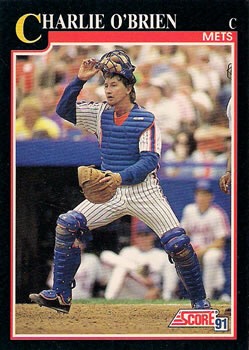
O’Brien was meant to be that classic backup catcher who was terrific defensively. That was his reputation. However, he couldn’t play everyday because he was terrible offensively. In 1991, his first full year with the Mets (only year he wore 5 with the team), he hit .185/.272/.256. For his Mets career, he would hit .212/.289/.309. While with the Mets, he would only play in losing teams.
Really, his only claim to fame was his hockey style catcher’s mask, which he wouldn’t wear in a game until he was long gone from the Mets. Ultimately, he would serve as a mentor to the young Todd Hundley, but that would not be for a few more years.
Charlie O’Brien reminds me of earlier this year when the Mets couldn’t generate any offense. He reminds me of a time when the Mets were trending downward as opposed to being on the verge of something potentially great. He reminds me that older players can effectively mentor younger players to help them be the best players they can be.
Charlie O’Brien may have been on a Mets team that was heading in a different direction, but he exhibited some of the virtues that have helped make this Mets team great. So with that, let’s tip our caps to Magic Man Number 5 Charlie O’Brien.
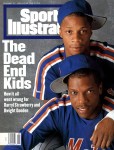
The 1980’s tremendous run was partly fueled by Darryl Strawberry and Dwight Gooden. They had their share of drug problems. They were self destructive. They were labeled the “Dead End Kids.”
It seems after years, most likely decades, of problems, they’re finally clean. They have seemingly turned their lives around. They now have important things to say and have important things to do. It’s a remarkable turn-around. I want to hear them talk as much as possible about the dangers of drug use. It’s an important message. Hopefully, they’ll prevent someone from repeating their mistakes. Maybe they’ll help a troubled person through a tough time.
What I don’t want to hear is them lecture other players on how they should be more like they were. Sure enough, Gooden weighed in on the whole Matt Harvey controversy:
can't believe what I'm hearing i couldn't imagine me or ron darling agent would even think about taking the ball from us come crunch time i
— Dwight Gooden (@DocGooden16) September 6, 2015
Would expect Matt being the ace to come out & say he's pitching if they make the playoffs & moving forward he wants the ball every 5th day
— Dwight Gooden (@DocGooden16) September 6, 2015
day here on out as Iong as he's feeling good ….lets remember stressful innings r more important than innings counts not even going to
— Dwight Gooden (@DocGooden16) September 6, 2015
mention my innings as a 18yr 19yr 20yr
— Dwight Gooden (@DocGooden16) September 6, 2015
This hypocrisy demands a look into Doc’s career, a look I would rather not make. However, when he tells everyone to look at what he did when he was playing, we should.
Let’s start with the innings. Doc was abused by Davey Johnson and Mel Stottlemeyer. Doc was amazing. He was doing things not even Tom Seaver did. In his age 19, 20, and 21 seasons, he threw 218.0, 276.2, and 250.0 innings. His last All Star Game was in 1988, when he was 23 years old. On September 8, 1991, when he was 26 years old, he received season ending rotator cuff surgery. For a man who set strikeout records, he would never again reach 150 strikeouts. In the last eight years of his career, his average season was 7-7 with a 4.45 ERA and 94 strikeouts.
Effectively speaking, he was done when he was 26 years old. If anyone should be preaching caution against overuse, it’s Gooden. His Hall of Fame talent and possible career went the wayside due to abuse and overuse, at least partial so.
That wasn’t the only abuse that ruined Gooden’s career. Gooden was a drug addict. Gooden became hooked on cocaine during the 1986 season. He missed the championship parade because he was high in the projects. In 1987, he was suspended for one month due to failed drug tests. He was forced into rehab by then Commissioner Peter Ueberroth. Gooden missed the Opening Day after a World Series title. He would return on June 5, 1987. It was 31 games into the season, the equivalent of six starts. The Mets missed the playoffs by three games that year. Gooden would be suspended for the 1995 season for failing a “bunch of [drug] tests.”
So no, I don’t want Gooden to point to his career as an example of what to do. When he talks about Harvey being shut down for health reasons, he neglects how injuries damaged his career. When he talks about how Harvey should demand that he go out there for his teammates, he neglects to mention all the times he wasn’t.
I don’t like bashing Gooden. However, I also don’t like the Harvey bashing. Harvey has a hard decision and a career to contemplate. It’s easy for everyone to tell Harvey what to do. It’s not their career or future. It was easy for Gooden to do the same. He just forgot how injuries ruined his career as well as the times he wasn’t there for his teammates.
Harvey has a big start tomorrow, and he will pitch in the playoffs. I wish the best for him. More importantly, I wish the best for Gooden. They both need our support this year and beyond.