Musings
Everything was going perfect for the New York Mets. After a big four run fifth inning, Max Scherzer was at 72 pitches. That meant he had at least a few more innings before passing it off to the bullpen to close out the win. That moment came far sooner than any of us realized.
After a 1-1 pitch to Dylan Carlson, Scherzer motioned to the dugout. He was hurt, and he knew he was done for the evening. Perhaps longer.
Max Scherzer has removed himself from his start due to apparent injury. Could be an absolutely brutal loss for the Mets.
🎥 @SNYtv pic.twitter.com/SJpwRHHDyS
— Stadium (@Stadium) May 19, 2022
During the game, Gary Cohen announced Scherzer was going to have an MRI. After the game, Scherzer answered reporters questions. While he seemed alright, he told them he was in considerable pain, and he was experiencing spasms in his left side. It would seem reasonable to assume he’s going to be on the IL for an indeterminate amount of time.
You could really argue this was the arm the Mets could ill afford to lose. He was the Jacob deGrom insurance. While true to an extent, the Mets really can’t afford to lose anyone from their rotation from the moment. In addition to deGrom still recovering, Tylor Megill is dealing with biceps tendonitis. That means any pitcher injury was one too many.
Jose Butto and Thomas Szapucki are the only remaining starters on the 40 man roster. Butto has pitched fairly well in Double-A, but he hasn’t surpassed 64 pitches in an outing, and he is averaging four innings per start. All told, Butto is a non-starter (pun intended) for the Mets.
Szapucki has been impressing lately posting big strikeout numbers. However, Szapucki is returning from surgery, and he has also not gone above 64 pitches in a start, and he has reached five full innings in a start once. Szapucki is working his way back to being in consideration, but he’s still building strength, and in reality, it’s best for him and the Mets that he remain in Triple-A
That leaves the Mets in a bad spot. Looking at the Syracuse roster, Mike Montgomery is probably the best non-40 option, but he has a 5.52 ERA on the season including a 9.00 ERA over his last three starts. There also aren’t any surprise options down in Double-A. Really, the Mets answer isn’t in their minor league system.
The answer is Trevor Williams.
With respect to Williams, he was a Major League starter in his five plus seasons before coming to the New York Mets in the Javier Baez trade. The best way to put Williams career as a starting pitcher was he was a borderline fifth starter. That is a large reason why the Mets wanted him at the trade deadline as part of that trade. Williams was depth who could be moved to the bullpen.
In reality, Williams has pitched his best with the Mets with a 118 ERA+. Part of that was moving to the bullpen and not having to go through a lineup the second time. Going over his career, batters are hitting .283/.351/.468 when facing him a second time in a game. Again, he’s a borderline fifth starter.
Trevor Williams in his last five appearances (1 with CHC, 4 with #Mets): 2 earned runs in just 19.1 IP while allowing 13 hits and 4 walks with 15 strikeouts. That'll do. #LGM (via @SNYtv) pic.twitter.com/IzXjod8uEI
— Matt Musico (@mmusico8) September 1, 2021
The other benefit is working with Jeremy Hefner. He’s helped Williams get more movement on the sinker. Mostly, it’s just better location. Before joining the Mets, Williams had a 3.0 BB/9 and a 7.8 BB%. Since joining the Mets, he’s now at a 2.1 BB/9 and a 5.3 BB%. He’s also striking out more batters.
It’s more than that. Hefner was Williams working more down in the zone while using his four seamer up in the zone. The result has been a 45.2 GB%. Before joining the Mets, Williams had a 42.7 GB%. This has allowed Williams to take advantage of the Mets superior up the middle defense.
If these seem like incremental gains, well, they are. However, that’s still improvement which could help Williams become a more solid fifth starter. Honestly, that’s all the Mets need him to be right now.
Fortunately, he’s been at his best with the Mets, and due to a blowout loss and now a spot start, Williams has been stretched out a bit. In fact, he’s throwing as many pitches per outing as Butto and Szapucki. However, Williams has Major League success and has proven he can start at this level.
Overall, the Mets are a the end of their starting pitching depth. Williams is the next and last guy up. Fortunately, Williams is in a position where he can step up, and he’s been the best he’s ever been with the Mets. Hopefully, he can be that stopgap until somebody, anybody is able to return to the rotation.
Watching New York Mets fans react to Francisco Lindor‘s start, you would think this is the first time they got to see him play. Moreover, you would think people had no idea about his historical trends. Sadly, that is not the case.
In 2021, it was a very poor start for Lindor even by his standards. Through the first half of the season, he was only hitting .225/.325/.373 with 11 doubles, a triple, 11 homers, and 36 RBI. Most of that was from his picking it up very late in May and into June as well as a huge July.
Really, much of the reason why is Lindor typically fights it through the first half of the season. On that point, here are his monthly wRC+ splits for his career:
- March/April 110
- May 121
- June 100
- July 128
- August 117
- September 120
Now, this year was a bit odd for Lindor in that he jumped out of the gate in April. He hit .282/.367/.482 with five doubles, four homers, and 14 RBI. That was good for a 148 wRC+. He hasn’t had a wRC+ that high in any month in the first half of the season since May 2018. Now, Lindor didn’t springboard off a poor April into May like he normally does, but then again, he’s only once had an April like that.
That was in 2017. In that year, Lindor had a 135 wRC+ in April only to fall off in May, and he would be even worse in June. Lindor rebounded with a great second half amassing a 140 wRC+ finishing that season fifth in AL MVP voting. That’s the highest he’s ever finished in the voting.
Again, when we see Lindor, he historically struggles over one of the first two months of the season. Historically, it has been April. That said, when he has had big Aprils, he has followed that with a down May. That’s the player he has always been. This is the player the Mets fans celebrated when they obtained him.
This is another way of saying Lindor is just fine, and he will have a great season. One down May is not going to change that. Keep in mind, he still has a 0.8 bWAR and 1.0 fWAR with over four months remaining in the season. Even with his May struggles, he is still one of the top shortstops in the game this season.
That’s true now, and it will be the case throughout the 2022 season. Just wait. He’s going to have a huge July like he always does, and he’s going to be one of, if not the, best player on a Mets team heading to the postseason. When all that happens, just remember all the unnecessary hand-wringing we have seen over his slumping over a couple of weeks of May.
In the bottom of the ninth in the second game of the doubleheader, Dominic Smith came up as a pinch hitter with one out. St. Louis Cardinals closer Giovanny Gallegos had Smith right where he wanted him with a 2-2 count. If you’ve been watching the New York Mets and Smith all season, you expected a strike out.
As noted in the first half of the doubleheader by Keith Hernandez, Smith has been expanding his zone all season. Chiefly, it has been at pitches up in the zone. However, we have also seen it on pitches down-and-in. For some reason, Smith just can’t seem to lay off those breaking pitches breaking in off the plate.
Gallegos reared back and busted Smith in, and Smith laid off of it. Full count. Then, Gallegos made a very smart pitch. He threw that slider low-and-in. Smith has struck out on that pitch all year. Except, this time, Smith didn’t. He spit on the pitch, and he took his walk.
Right there, more than anything, was the biggest sign Smith might just be breaking out of his season long slump.
We had thought that what was going to happen with Smith after his four hit game against the Philadelphia Phillies. However, Smith went right back into his funk. After that game, he was 1-for-22 with six strikeouts. It was at the point where Buck Showalter was suggesting Mark Canha needed to get work at first base.
In the first half of the doubleheader, Smith looked much like the Smith of old. In his first at-bat, he got a rally started with a lead-off single. In the third, he hit an RBI double. Smith would finish the game 2-for-4 with a run, double, and RBI. Importantly, it was his first start since the beginning of the month where he did not strike out.
With Smith, we know what he can do. We’ve seen when he’s healthy, he hits. He needs to just get on track, and he hasn’t so far this season. As noted, part of the reason is the Mets initial need to see what they have in Robinson Cano leading to a season’s worth of disjointed playing time.
Case-in-point, after Smith had his four hit game, he did not start the ensuing game. Hopefully, the Mets are able to recognize how Smith has finally made the adjustments he needed, appears locked in, and is ready to contribute like we all know he can.
On April 29, 2022, Tylor Megill, Drew Smith, Joely Rodriguez, Seth Lugo, and Edwin Diaz each took the mound, and none of them allowed a hit. By its very definition this is a no-hitter. In fact, it was one of 17 in Major League history featuring multiple pitchers in a game.
It was an amazing night at Citi Field, and it was a moment New York Mets fans will forever cherish. After all, this was just the second time in team history this pitching fabled franchise had a no-hitter. It was a historic moment in Mets and MLB history.
Really, no one can take that moment away from those five pitchers, this Mets team, the franchise, or the fan base. This will be forever played on SNY, and this is a moment which will be noted somewhere in Citi Field for eternity. It needs to be repeated – nothing can take this away from us.
That includes when Los Angeles Angels pitcher Reid Detmers threw a no-hitter against the Tampa Bay Rays. It was what we have long referred to as a no-hitter, or as Noah Syndergaard put it in his Instagram story, a “real” no-hitter.
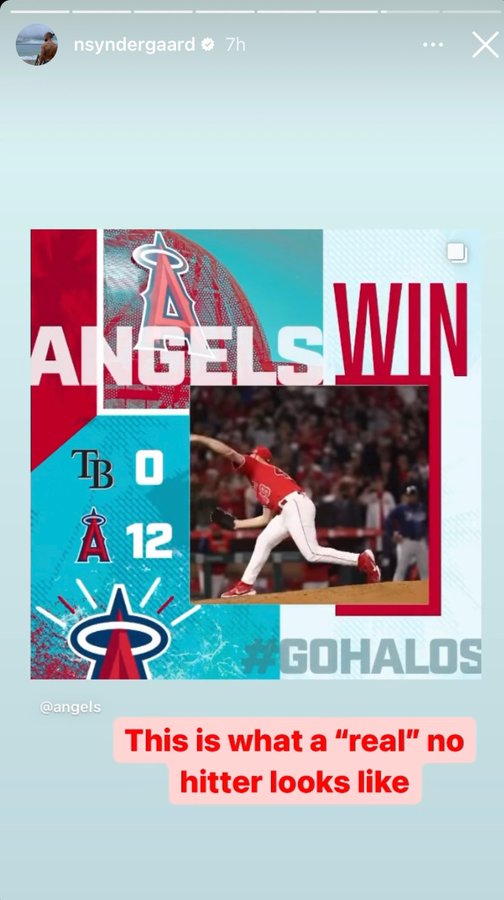
Honestly, this is not something which should have been met with any reaction whatsoever. Syndergaard took to celebrating a moment. Instead of analyzing whether he was chiding the Mets or trying to examine why he put quotes around real, we should move on. When Syndergaard was doing this stuff with the Mets, we all loved it.
It’s who he is. He’s a quirky personality. In some ways, it’s why he’s built for the big markets, but more to the point, the second team in the big market. He’s built for the Mets, Angels, or Chicago White Sox. He knows how to garner attention and keep his team in front of the local rival. He’s really good at this.
Whether or not this was a shot at the Mets really doesn’t matter. More to the point, anything anyone says about the co-no, good or bad, really doesn’t matter. That goes for players and analysts alike.
And look, I like that the Mets are having a nice time lately as much as the next person, but this was the first no-hitter of the year. Combined no-hitters are like half birthdays (technically true but otherwise insignificant)
— Hannah Keyser (@HannahRKeyser) May 11, 2022
As an aside here, if you are in the Apple+ TV booth, making comments like this is rather humorous. This is the only “network” who has zero exclusivity to their time slot for a “nationally televised game.” That is even before you consider how maligned that booth has been this season.
Overall, Syndergaard and Keyser can say what they want. Really, everyone is entitled to their opinion. Guess what? The Mets still threw a no-hitter, and this is a first place team who is built to win a World Series. Mets fans have enjoyed every moment of this season, and there are going to be a lot more special moments in store as this team goes deep into October.
When the Mets make the postseason and win the World Series, let’s see what everyone has to say then.
In the third game of the season, Buck Showalter shoehorned Trevor Williams into a game under the auspices he needed to get the reliever work. In that game, Williams was credited with a blown save and a loss after allowing two unearned runs. After Williams blew that game, it seems like Showalter feels no need to get him into a game again.
In fact, since that game, Williams has only gotten into four more games. Aside from the “start,” each of those times the score differential was more than four runs. That included when the Atlanta Braves put a beating on the Mets. All told, whatever you want to call a low leverage reliever, that’s what Williams is.
It’s really bizarre when you look at is. For example, Sean Reid-Foley, a pitcher who was widely anticipated was going to be designated for assignment, was used on seven different occasions. He’s been on the IL for about two weeks now, and he still has three more appearances.
We have also seen some diminishing returns from Adam Ottavino. Ottavino has been mostly good with nine scoreless relief appearances out of his 12 appearances for the season. That said, Showalter also felt compelled to use him for three consecutive days in a series against the Braves. That helped lead to the aforementioned blowout and Williams’ fourth appearance of the season.
The problem there is the Mets need that one extra right-handed arm in the pen. Edwin Diaz, Seth Lugo, and Drew Smith are the late inning relievers. Joely Rodriguez and Chasen Shreve are there for the left-handed relievers. Ottavino was fine for the middle innings, and Trevor May was there for that bridge, but now he’s injured and gone for months.
This could have been a chance to see what Williams has in the tank. However, the Mets haven’t seemed inclined to use him at all. That was even the case in doubleheaders where a spot start opportunity was there. The Mets understandably and correctly went with David Peterson.
Williams was actually useful in the Mets bullpen last season, and he did show some promise. In eight appearances, he pitched 22.1 innings with a 9.3 K/9 and a 3.83 K/BB. Digging deeper, there is something there with Williams.
Generally speaking, he induces weaker contact than most pitchers, and batters have a hard time squaring the ball up against him. Typically speaking, he induces pull side ground balls. With the Mets ability to shift plus having Francisco Lindor and Jeff McNeil up the middle, this should play right into the Mets hands.
He has an effective sinker, and his change is a weapon. We’ve seen his sinker be one as well. There is something there with Williams even if that is being a long or low leverage reliever. Perhaps he could be more, especially refining things and working on pitch mixes with Jeremy Hefner, but he would have to get the reps to do that.
On the long reliever front, he’s been dormant for even that role. For example, Sean Gilmartin made 50 appearances in 2015, and we saw Darren Oliver make 45 appearances in 2006. So far, Williams is on a pace to make 21 appearances. That’s not going to help him, and it’s not going to help the rest of the bullpen.
Sooner or later, the Mets are going to have to give Williams more chances. They’re going to have to get him in a rhythm and try to establish himself as a real part of this bullpen. If he does, this bullpen is even better. If not, you can move on and find someone else. However, if you’re not pitching him, you can’t make any of these needed assessments. That needs to change soon.
Entering this season, there was serious concern over James McCann and Tomás Nido. Between the two of them, neither one could really hit, and in terms of McCann, his defense regressed significantly. Between the two of them, Mets catchers were fifth worst in the majors by fWAR.
To some degree, a little over one month into the season, it would appear our concerns were justified. After all, McCann and Nido have combined for a 57 wRC+. While it’s shocking that’s only seventh worst in the majors, it is still horrific.
Now, a large part of that is Nido. His 38 wRC+ is eighth worst among catchers who have at least 40 plate appearances. With respect to McCann, for all the consternation, his 70 wRC+ is at least playable for the position as it is the 26th best among catchers. No, it’s not great, but with 30 teams, that’s a starting bat.
Here’s the thing, despite the struggles at the plate, the Mets catchers have been excelling this season, and as a result, the Mets are in first place as a result with the second best run differential in the National League.
In terms of framing, Mets catchers rank best in the National League. They’re also tops in terms of defensive fWAR.
James McCann has seen big improvements in his framing at the bottom of the zone compared to '21.
In '21, McCann converted 40.7% of non-swing pitches into called strikes in Attack Zones 17, 18 & 19.
In '22, McCann's converted 51.4% of non-swing pitches into called strikes. #Mets pic.twitter.com/fmXas9jCiP
— Mathew Brownstein (@MBrownstein89) May 9, 2022
As noted by Baseball Savant, McCann is the 12th best framer in all of baseball, and Nido is 33rd. Make no mistake here, this is a driving force behind the Mets success this season.
From a pitching perspective, the Mets have the fourth best FIP and fifth best ERA. From a starting pitching perspective, they have the third best FIP and foruth best ERA. All told, Mets starters have the second best fWAR in the majors.
It does help having pitchers like Max Scherzer. However, the Mets have gotten top performances across their starting staff, and that is without Jacob deGrom. That includes Tylor Megill surprising, and Chris Bassitt being even better than he was with Oakland.
Really, it was no accident the Mets had a combined no-hitter. McCann was brilliant behind the plate with his framing and pitching calling with Megill, Drew Smith, Joely Rodriguez, Seth Lugo, and Edwin Diaz combining for the no-hitter. Seeing these pitchers with Mets catchers, we are bound to see more memorable performances this season.
Overall, this Mets team has been led by their pitching, and that is in large part because of what is happening behind the plate. No, McCann isn’t hitting, and Nido really isn’t hitting. Despite that, they’ve been driving forces for this Mets team because their work behind the plate has been stellar, and as a a result, so have been the Mets so far this season.