Musings
When you’re hitting .207/.296/.422 with a -0.4 WAR a month and a half into the season, you begin to wonder if a player is in for a rough year. When that player is 35, you start to wonder if this is the beginning of the end.
Those are the whispers that now surround Curtis Granderson. Are those whispers premature?
After a horrible 2014, Granderson was reunited with Kevin Long. The result was pure magic in 2015. Granderson hit .259/.364/.457 with 26 homers and 70 RBI from the leadoff spot. He had a 128 OPS+, a 132 wRC+, and a 5.1 WAR. As noted above, Granderson’s 2016 numbers are a far cry from that.
What’s happening?
First, Granderson’s BABIP in May was .152. Granderson’s career BABIP is .299 (right around league average). That would suggest Granderson is due for a little luck. With that luck, he could return to his 2015 form. However, there are some warning signs.
According to Fangraphs, Granderson’s hitting a lot of ground balls. His GB/FB ratio is now 0.98 (highest in his career). He’s hitting groundballs 41.2% of the time (highest in his career). Conversely, he’s hitting fewer line drives. He’s only hitting line drives 16.7% of the time (lowest in his career). He’s pulling the ball 45.6% of the time while hitting it up the middle 39.8% of the time.
Long story short, Granderson is getting affected by the shift. That’s going to happen when you hit more groundballs. That’s going to happen when you hit the ball up the middle and to the right side 85.4% of the time. The result is Granderson’s .152 BABIP in May and .227 for the season.
By now means should we look at these numbers and say Granderson is in for a rough 2016. He hit .241/.347/.471 with four homers in April. He was able to hit that well in April despite starting the year on a 1-24 stretch. Also keep in mind, Granderson’s worst month last year was May.
Overall, there is still plenty of time left in the year. Like last year, Granderson can rebound from a rough May to put up terrific numbers. There are warning signs, but sooner or later, we should see the 2015 version of Granderson return . . . or at least the 2016 April version.
Editor’s Note: this article first appeared on metsmerizedonline.com
My first experiences watching baseball was the late 80’s. Back then, baseball had a code. If you show up a player, expect to he plunked. If you’re plunked, the middle infielders better be ready to be on the receiving end of a takeout slide.
The idea of this behavior was to let the players police themselves on the field. If all else failed, the players would just have to resolve everything with a good old fashioned benches clearing brawl. This way of handling things has largely been legislated out of the game, but Sunday, we saw a return of it in the Blue Jays-Rangers game.
As a matter of background, these two teams played a hard fought, five game ALDS. The Blue Jays win was highlighted by this:
Now, there’s some disagreement whether this bat flip had any impact on Sunday’s game. In any event, Sunday was the last regular season meeting between these two teams. Jose Bautista led off the eighth with the Rangers leading 7-6. He was hit with the first pitch of the inning. Here’s what ensued next:
Wow.
Certainly, Bautista felt the Rangers threw at him. He had a very late, but still low, slide into Rougned Odor. There are three possible reasons for this:
- Odor’s throw was in line with Bautista’s head forcing him to get down;
- Bautista was trying to break up a double play; or
- Bautista felt the Rangers threw at him, and he was getting his pound of flesh.
Whatever the case, Odor was offended, and he landed a right hook. Keep in mind, this was no sucker punch. Bautista’s hands were up. It sparked an old fashioned benches clearing brawl.
Of course, that didn’t end anything. Prince Fielder would be hit with the first pitch in the bottom of the eighth. It was an 83 MPH change-up. The benches emptied, but tensions didn’t escalate as Fielder took his place at first base. It was all over.
Baseball has made many rules to try to prevent this all from happening. It’s why there are warnings. It’s part of the reason why the new slide rules are in place. The main reason for the new slide rules is Chase Utley is a dirty player and the Gane Two umpires in the NLDS had no idea what interference was.
Upon review of Sunday’s game, you could say the rules worked. Bautista was called for interference. There were six ejections stemming from the incident. However, the rules didn’t work as intended. The players attempted to police themselves and all hell broke loose. In many ways it was a throw back to 30 years ago when incidents like this would happen. No, they were not common place or even likely. It was just possible. In today’s game, it didn’t seem like this was possible anymore.
Overall, I don’t think anything that happened on the field has a place in baseball. There’s no reason to bean someone in the fashion the Rangers beaned Bautista if it was intentional. Late slides or throwing it at someone’s head is unnecessary. Furthermore, Odor’s punch shouldn’t happen on a baseball field. With that long caveat, I enjoyed it.
It reminded me of the baseball I grew up watching. It reminded me of a time when teams would use this as a rallying cry for the rest of the season. It reminded me of a time when teams generally disliked each other and wanted to beat each other’s brains in. It reminded me of a time where the Mets were on top of the baseball world. So yes, I enjoyed it.
However, one day of nostalgia is nice. What happened Sunday has no place on a baseball field, and I hope to never see it again.
On October 31, 2015, Jose Reyes allegedly grabbed his wife by the throat and shoved her into the sliding glass doors leading out to a lanai at their Hawaiian resort hotel room. His wife was taken to the hospital for treatment of her injuries while Reyes was arrested for these alleged acts.
If convicted, Reyes would’ve faced anywhere from two days to five years in prison. If convicted, Reyes could’ve been deported. If deported, Reyes would’ve had to forfeit the remaining $44 million left on his contract. Fortunately for Reyes, he didn’t have to face these consequences for his alleged actions because his wife didn’t cooperate with the prosecutors. Reyes walked off scot-free.
This left the ball in Major League Baseball’s court to punish Reyes. They dropped the ball.
Reyes was only suspended 51 games. Major League Baseball believed the hospitalization of a person violently grabbed around the throat and shoved was only worth 51 games. They believed whatever role Reyes played, if any, in preventing his case from coming to trial was worth 51 games.
The combined Chapman and Reyes suspensions equate to half a season. Half a season for two women allegedly being choked.
Major League Baseball had been opportunistic in announcing their Domestic Violence policy. There were good provisions like getting perpetrating players help. There were other interesting provisions like leaving the matter of suspensions open-ended. It was an interesting provision as it arguably allowed each case to be judged on its own merits.
The results have been vastly underwhelming. Reyes went from potentially facing deportation, thereby effectively ending his big league career, to a 51 game suspension. That’s only 31% of the season. He gets to keep roughly $36 million of his money. Additionally, he gets a $100,000 tax write-off for his donation to the cause of stopping domestic violence. With this suspension, Major League Baseball set forth a powerful message for all to hear:
Grabbing a woman by the throat and shoving her into a sliding glass door wasn’t as bad of an offense as using PEDs.
At what point does T.J. Rivera finally get his shot?
In his minor league career, Rivera has hit everywhere he’s gone. In his minor league career, he’s hit .320/.367/.423. For the past three years, he’s played Winter Ball hitting .307/.361/.445. Bottom line is Rivera has hit everywhere he has played in his entire minor league career. He had gotten better each and every year. For example, he’s hitting .330/.360/.524 in Triple-A right now.
Even with Rivera hitting so well and improving, it seems like the undrafted 27 year old may never get his shot.
He didn’t last year. The Mets were more comfortable with a struggling Dilson Herrera. They were more comfortable with Danny Muno. They didn’t protect him in the Rule 5 draft despite his offensive production. The Mets were able to keep him because no one thought he was worthy of a Rule 5 pick. Seeing what the Braves put on the field, it makes you question what are we missing with Rivera?
There is a tendency to scout a player’s minor league statistics. The belief is that if a player can hit in the minors, they can hit in the majors. The inverse of that is deemed to be true as well. However, there are many more factors at play like level of competition, approach at the plate, level of experience and age compared to the competition, etc. When taking a totality of the circumstances, a player who hits well in the minors but isn’t deemed good enough to hit in the majors is tagged as a AAAA player.
Is that the case with Rivera? Is he really just a AAAA player? That would be the most logical explanation as to why he still hasn’t gotten his shot.
To answer that, we need to look at what he is. Rivera is a utility player that can play second, third and short. In reality, given his range and arm strength, he’s best suited to second base. Overall, no matter where you play him, he’s not that great defensively. Despite his relative versatility, it’s Rivera’s bat that would carry him to the majors.
As discussed above, Rivera has hit everywhere. There’s good reason for that. He’s a disciplined hitter. He has a good compact swing, and he’s a gap to gap line drive hitter. He doesn’t generate much power, but he’s capable of the occasional double. In short, Rivera shows the skills to be able to get on base no matter what the level.
What we don’t know if that ability will ever translate. At the major league level, the Mets have Wilmer Flores and Eric Campbell. Campbell, in particular, is what Rivera aspires to be. Campbell can play a multitude of positions. He doesn’t generate much power, but he has shown the ability to get on base. So long as Campbell gets on base, the Mets aren’t sending him down.
In the event Campbell ever gets sent down, it’s highly unlikely Rivera ever gets the call. He’s buried at the upper levels of the Mets minor league system behind guys like Herrera, Matt Reynolds, and Gavin Cecchini. Worse yet, Rivera isn’t on the 40 man roster thereby further decreasing his chances of ever getting a shot.
Unfortunately, it appears Rivera may never get his shot with the Mets. He may never get an opportunity to show he has the tools to hit and get on base in the major leagues. It’s a testament to a deep Mets farm system. It’s an indictment of the rest of baseball, who apply AAAA tags to players without ever giving them a chance that they’ve earned.
T.J. Rivera has earned a shot to play in the major leagues. Hopefully, he will get that shot someday.
Editor’s Note: this was first published on metsminors.net
After a stretch where Kevin Plawecki hit .167/.348/.167, Terry Collins couldn’t bite his tongue anymore. Collins took the rare step of calling out one of his players publicly when he said, “I don’t mean to put a lot of pressure on him, but he’s got to start getting some hits. We all thought he was going to be a good offensive player. We need [him] to start getting hits.” (NY Post).
It was a bold move from Collins. He was challenging a player who had yet to rise to the challenges given to him.
Plawecki has risen to the challenge. In the first five games since Collins’ statement, Plawecki is hitting .333/.368/.667 with three doubles and a homer. He’s not just making contact. He’s hitting the ball with more authority. He’s finally showing why the Mets drafted him in the first round in 2012. He’s finally showing glimpses of the .290/.364/.432 hitter he was in the minor leagues.
Now, to say it’s Collins’ words is a bit cliched. Plawecki has been working with Kevin Long, who is a terrific hitting coach. He’s been in the majors for nearly a year now. He’s had the sinus surgery. He’s in a much better lineup than he was last year. He’s getting regular playing time. Ultimately, it’s probably not just one thing, but a multitude of things. In any event, something seems to have clicked with Plawecki once Collins made his statement.
It’s important because the Mets don’t know when Travis d’Arnaud will come back, or how he will play upon his return. The Mets need Plawecki to step up in d’Arnaud’s absence. It looks like Plawecki is finally doing it.
Editor’s Note: this was first published on metsmerizedonline.com

In 1950, Vin Scully joined the Brooklyn Dodgers broadcast booth. As a child, my father was blessed to have heard a booth with both Scully and Red Barber call Dodger games. It was the broadcast he was listening to when his beloved Dodgers won the 1955 World Series. Then the Dodgers moved to Los Angeles in 1958, and Scully went with them.
It would be another 30 years until my father heard Scully call a game in which his favorite team won the World Series. What Mets fan doesn’t remember this call:
The answer is several. Amazingly, this call was 30 years ago. Chances are if you were born after 1976, you don’t have a vivid memory of this call.
I know I don’t, but that’s not because of my memory. I remember that moment like it was yesterday. The reason why I don’t remember the call was I never heard it. My parents had thrown an engagement party for my aunt, which was really an excuse to get a ton of Mets fans together to watch Game 6. When that ball went through Buckner’s legs, everyone erupted and drowned out the call. So like many Mets fans today, I have no specific recollection of hearing Vin Scully calling a Mets game.
That’s a shame. He’s retiring this year, and tonight may be the last time he will ever call a Mets game as he doesn’t make road trips anymore. We’ve seen the tributes from Gary Cohen and Howie Rose. They were well done, but there’s a much more fitting tribute. The Mets should air an inning (or half inning) of Vin Scully calling the game. Let Mets fans, young and old, get the opportunity to marvel at what makes Scully among the greatest, if not the greatest, broadcaster that ever lived.
Mets fans should once again hear Scully calling a Mets game. As we saw in 1986, it is pure magic.
If you were up late last night, you discovered Noah Syndergaard had his elbow examined two weeks ago. Earlier in the day, it was discovered Steven Matz is going to miss his next start with his own elbow problems.
There’s only one way to react to this news:
Thor had his elbow examined?!?!?!?https://t.co/i7LkLBHiWO via @giphy
— Mets Daddy (@MetsDaddy2013) May 12, 2016
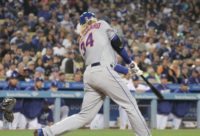
Move over Walt Terrell. Noah Syndergaard “hammered” two homeruns:
#HRDerby with @Mets pitchers … who you got?https://t.co/Kmv2E5YmvR #PitchersWhoRakehttps://t.co/WKEQErjbOu
— MLB (@MLB) May 12, 2016
The two homers were more impressive than originally thought:
Noah Syndergaard's homers registered 407 & 400 feet. He's the only pitcher in the majors with three 400+ homers since his debut 365 days ago
— Adam Rubin (@AdamRubinMedia) May 12, 2016
https://twitter.com/bbtn/status/730608220738322432
The second homerun was after Syndergaard failed to bunt the runners over. With two strikes, he then swung away hitting his second homerun of the game. At the plate, Syndergaard went 2-3 with the aforementioned two homers and four RBI (which also tied a Mets record for most RBI in a game by a Mets pitcher). Syndergaard might’ve struck out in the sixth with the bases loaded, but he certainly got his hacks in. He was trying to hit that’s third homer, but it was for naught. He also struck out on the eighth while swinging for the fences.
Interstingly enough, Syndergaard was responsible for four homeruns. While he hit two, he also allowed two. The first was hit by Corey Seager in the third and Yasmani Grandal in the fourth. Other than those two homers, Syndergaard shut down the Dodgers. He pitched eight innings allowing six hits, two earned, and one walk with six strikeouts. Jeurys Familia pitched the ninth to preserve the 4-3 win he’s now a perfect 12/12 in save chances.
Overall, you know it’s a good game when your dominance on the mound is little more than a footnote. For Syndergaard’s next game, he had some big shoes to fill. Tom Seaver and Ron Darling are the only two Mets’ pitchers to homer in consecutive starts. Interestingly enough, the Mets received Terrell and Darling in exchange for Lee Mazzilli. As we know, Syndergaard was involved in a pretty big trade himself.
Game Notes: It appears Rene Rivera is becoming Syndergaard’s personal catcher. It’s a good solution to Syndergaard’s problem with base stealers. David Wright sat with what was either normal rest or a sore shoulder. Eric Campbell got the start over a slumping Wilmer Flores. Both Campbell and Yoenis Cespedes would steal a base. Coming into the game, the Mets had only stolen eight stolen bases. Neil Walker returned to the lineup for the first time since bruising his shin.
As reported in several media outlets yesterday, Stephen Strasburg received a seven year $175 million contract extension. The deal has an average annual value of $25 million. The contract features rolling opt out clauses after the third or fourth year. Additionally, Strasburg will receive a million dollar bonus each year he pitches over 180 innings.
Strasburg is a former number one overall pick. He’s 27 years old. He has had Tommy John surgery. He is in his fifth full big league season. He throws hard with a 96 MPH fastball, 89 MPH change and slider, and an 81 MPH curve. In his career, he is 59-37 with a 3.07 ERA, 127 ERA+, 2.80 FIP, 1.089 WHIP, and a 10.5 K/9. He’s struck out 200 batters in a season once, made one All Star team, and finished in the Top 10 in Cy Young voting once.
Before the contact extension, he was slated to be the top free agent on the market. Also, his agent is Scott Boras.
This contract confirms what all Mets fans know. Keeping the current starting staff together when they start becoming free agents is next to impossible. Not even the late George Steinbrenner would be willing to spend the money necessary to keep this staff together.
Back in 2013 when Matt Harvey was becoming one of the best pitchers in baseball, Mets fans would cheer “Harvey’s Better!” when Harvey faced Strasburg. They were right, and despite Harvey’s early season struggles, they are still right. Harvey has a better career ERA+ and FIP than Strasburg. Accordingly, when’s he’s approaching free agency in 2019, wouldn’t he be worth more money than Strasburg? Boras, who is also Harvey’s agent, will certainly make that case.
If Harvey gets that money, what does that mean for the other Mets starters? Right now, Noah Syndergaard is amongst the best pitchers in baseball at 23 years of age, and he’s only getting better. Steven Matz is a 24 year old lefty, who is 9-1 with a 2.56 ERA in his career. Also, don’t forget Jacob deGrom, who many consider to be the staff’s ace.
If all four of these players get a Strasburg deal, that’s $100 million just to the starting pitching. Keep in mind that doesn’t take into consideration the fact that each one of these pitchers could reasonably seek more when they come up to free agency.
As per Spotrac, the Mets payroll is at $131 million. That would mean the Mets would have $31 million to spend on the other 21 players. With that $31 million, the Mets will also have to find money to sign Jeurys Familia and Michael Conforto to their own lucrative contract extensions. By the way, Conforto is also represented by Boras.
Unfortunately, re-signing all of these players simply isn’t feasible. Deep down, we all knew it. The Stephen Strasburg signing only confirmed it.