Musings
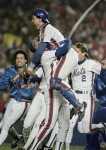
Between 1984 – 1990, the Mets finished in second place or better. Over the course of these seven seasons, the Mets averaged 95 wins. Without question, this was the best stretch in Mets history. It’s strange to think that any point in time your team averages 95 wins over the course of five seasons, you are disappointed. However, as Ron Darling expained to Mike Francesa, he feels “very disappointed” that the Mets didn’t accomplish more.
While Dariling’s feelings are understandable, and many Mets fans would agree with him, there are a number of reasons that we can point to as the reason why the Mets didn’t win more. Rick Sutcliffe went an amazing 16-1 after the Cubs acquired him helping them win the division in 1984. The Mets had to contend with a really good Cardinals team year in and year out. The Mets were snakebit with injuries during the 1987 season. The Mets ran into Orel Hershiser, who had one of the greatest seasons for a pitcher ever in 1988, in the NLCS. However, truth be told Davey Johnson managed a horrific series. In 1989, the team was in transition, and in 1990, the Pittsburgh Pirates were just better and were embarking on their own run. All of these reasons are valid, but the main reason everyone points to would be the drug problems, namely with Dwight Gooden and Darryl Strawberry.
There’s another reason why those Mets teams only got one shot at a World Series – the postseason format. Back in that time frame, the only teams that went to the postseason were the division winners. In today’s game, it would be unheard of a team winning 98 games not only missing the postseason, but also missing the postseason by three games. If you apply, the current postseason rules and divisional formats to the 1980’s, the Mets would have had won the NL East for all seven of those seasons. Its possible that instead of talking about the 1986 World Series, we’re talking about the Mets’ dynasty. It’s possible the Mets would’ve won multiple World Series during that stretch. It’s also possible that like the Braves in the 90’s, the Mets would only win one World Series, and we would be left questioning what happened.
Whatever may be the case, it’s apparent that those Mets teams did not get as many chances to reach the postseason as this current Mets team will. Last year, the Mets won the NL East with 90 wins. From 1984 – 1990, the Mets only won the NL East in the two seasons they won 100 games.
There is no reason for this Mets team to only go to the postseason twice with their current core group of players. Matt Harvey, Jacob deGrom, and Noah Syndergaard are under team control until 2019. Young players like Michael Conforto already contributing, There are big prospects like Dilson Herrera and Amed Rosario who we should see within the next few seasons at Citi Field contributing to what is already a World Series contending team. Without being too unreasonable, I believe this Mets team is set to contend for a longer period of time than Ron Darling’s Mets’ teams. To expect that seems unreasonable, but when you consider the young talent already on the team and in the pipeline, it’s certainly possible.
So before the Mets play their home opener today, they’re going to raise 2015 National League Champions flag. As we saw again that postseason, there is a lot that can happen along the way that can help you advance in each series. If not for Daniel Murphy having a game for the ages, and the Dodgers being unable to hit deGrom despite him having nothing, the Mets lose in the NLDS. The Mets are instead raising at 2015 National League East flag. So no, the 2016 season is not World Series or bust, nor in retrospect is the Mets only winning one World Series from 1984 – 1990 really disappointing.
With that said, I don’t blame Ron Darling for feeling the way he does. I won’t blame the current Mets players from feeling the same way about 2015. There is a World Series championship in the Mets clubhouse. Whether that is in 2016 or later, we do not know yet. Right now, I will say that as long as this Mets group wins one World Series, I won’t be disappointed because I will have been able to see something that has only happened twice in the Mets 54 year history. No matter what happens in 2016, it promises to be a special season, and I can’t wait to watch each and every minute of it.
Lets Go Mets.
The Wilponzi Era was about as difficult a time as I’ve experienced as a Mets fan. You can argue that after bad trades and bad free agent signings. We can have a real debate about whether or not it was time to break it down and rebuild. However, what the Mets and their fans went through was so much more than that.
The news of the scandal broke in December 2008 as the Mets closed Shea Stadium and were on their way to open Citi Field. Despite the distraction, the Mets opened the season with a the second highest payroll in baseball at a little over $149 million. The team would suffer injury after injury before falling way out of contention. In 2010, despite payroll dropping about $20 million, they did try to improve the club by signing Jason Bay. As we know neither Bay nor the 2010 season worked out well.
In subsequent seasons, the Mets made no major free agent acquisitions. How could they? The Wilpons lost at least $178 million. They were named defendants in the Madoff case and were sued for $1 billion. The Wilpons were forced to do whatever they could do to keep control of the Mets. They initially took out $65 million in loans from Major League Baseball and Bank of America. In total, the Mets borrowed over $980 million. Of that amount, $430 million was borrowed using the Mets as collateral.
The once $149 million payroll dropped down to $85 million (ranked 21st in the league). The Wilpons were facing a financial crisis, and they were doing everything they could go to go from being bankrupt. They began selling minority stakes in the team. They were trying to keep their main assets, which included the Mets.
As fans, we believed the most damaging effects of this was in the Win-Loss column. We believed it was the Mets being unable to put a winning, if not at times competitive, team on the field. We were very wrong.
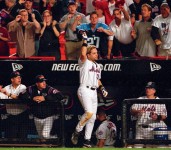
Thanks to Kevin Kernan we now know what the most damaging effects of the Wilponzi Era was the sale of the jersey Mike Piazza wore when he hit this homerun:
This moment means different things to different people. I know I shed a tear when it happened. In my opinion, it is amongst the top three moments in Mets history along with ’69 and ’86. It may mean something different to you. You may fell differently. That’s fine. We all acknowledge it was a powerful moment in history.
Here’s the thing. As much as the moment means to everyone, and as much as the jersey means, I don’t blame the Wilpons for selling it. In fact, I think they deserve some credit.
Being objective, if you’re the Wilpons owning the Mets is much more important than that jersey. If you lose the team, you lose the jersey. Looking at Kernan’s article, they did a private sale, and they arranged to have the jersey displayed in the Mets Hall of Fame.
The Mets settled the Madoff case for $162 million seemingly around the same time as the Piazza jersey was sold. They got the infusion of cash they needed while still having the ability to share the jersey with the fans. Remember, the Wilpon’s settlement in the Madoff case called for turn
However, as we now know, the Mets selling the jersey also meant the Mets lost control over the jersey. It could be sold without their permission, and it can be taken out of the Mets Hall of Fame to someone who wants to do whatever it is they want to do with it.
If you want to be angry with someone, be angry with Major League Baseball. They are the ones that allowed this to happen. This is the same organization that forced Frank McCourt out. McCourt committed two crimes. The first was he sought a $200 million loan to the Dodgers and a $30 million loan to him personally from Fox. The second was he wasn’t in good with Bud Selig. The Wilpons were.
The Wilpons had similar crippling debt and a desperation for money. In fact, they borrowed more than McCourt ever sought to borrow – over three times the amount. However, the Wilpons went about it the way Major League Baseball wanted. They made sure to keep in Selig’s good graces.
The Wilpons were empowered by Major a League baseball to cut the payroll nearly in half. Major League Baseball empowered the Wilpons to refuse to sign a free agent of real consequence. Major League Baseball empowered the Wilpons to start selling off memorabilia to stay afloat. The Wilpons were probably doing all they needed to do to keep the Mets. They were just the people ripping the copper wiring out of the walls.
With that said, their free pass on this issue ends right now.
According to Kernan’s article, it is anticipated that Piazza’s jersey will sell for north of $300,000. The good news for the Mets is they released Ruben Tejada. In doing so, the Mets saved approximately $2.5 million. There is plenty of money to allocate from those savings to permit the Mets from re-acquiring a jersey they should never have been in a position to sell in the first place. There’s no excuse this time.
Despite all of this, the Wilpons are not moving heaven and Earth to get that jersey back. According to Kevin Kernan’s latest article, the seller, Goldin Auctions, will make the jersey available for sale before the auction due to the significance of the jersey. It is something the seller has never done before, but it acknowledges the importance of not only the jersey, but also where the jersey belongs. The seller believes the jersey belongs at the 9/11 Memorial. Mets fans believe it belongs in the Mets Hall of Fame, but certainly wouldn’t object to it being placed at the 9/11 Memorial.
Despite this, the Wilpins have yet to make an offer for the jersey despite having an extra $2.5 million in their coffers from Tejada’s release. They are merely monitoring the situation gauging fan reaction. This sounds just like the Wilpons’ behavior when Piazza was a Marlin on the trading block. Don’t spend the money until the fan backlash is too fervent for you not to make the move. Well, the stakes are higher this time. It’s time for the Wilpons to stop waiting around. It’s time for action.
The Wilpons need to make sure they do everything they can to bring that jersey back to the Mets Hall of Fame where it belongs.

During his Mets career, Jon Niese was seemingly an excuse a minute. If anything went wrong, he fell to pieces. If he had a poor start, there had to be another reason why other than the fact that he pitched poorly.
There was one-time in his career that he had a valid excuse. On July 24, 2015, Niese took the mound against the Dodgers. In three innings of work, he allowed six runs on eight hits. It was a horrendous start. A huge reason why was his head was somewhere else. While he was toeing the rubber at Citi Field, his wife was in labor in Ohio. He had to rush to the dugout to get on FaceTime to see his son being born. Niese claimed this day messed up his entire season.
Up until that point, Niese had a 3.36 ERA. He would finish the year with a 4.13 ERA. Being a parent is hard. Being a pitcher is hard. Maybe, just maybe, there was something to this Niese excuse.
With that in mind, the Mets should just skip Jacob deGrom‘s start and fly him down to his home in Florida. His wife’s due date has come and gone. If his wife goes into labor, he has a two hour flight. This doesn’t include getting to the airport, landing, and going to the hospital. Long story short – if his wife goes into labor, and he’s in New York, he’s missing the birth.
It’s not worth it. There’s nothing I would’ve traded to be there when my son was born. Every parent feels the same. He should be there now. His wife needs him, and his team doesn’t need him yet.
Due to baseball’s inane scheduling, the Mets have plenty of options to pitch on Opening Day. Matt Harvey can pitch on full rest as can Bartolo Colon. Steven Matz hasn’t pitched in over a week now and could move his start up one day. Also, the Mets could turn to the long man in the bullpen, Logan Verrett, and let him make a spot start like he did so well last year. That’s four pitchers the Mets can reasonably use to pitch on Opening Day.
If the Mets slide Verrett into the rotation temporarily, the Mets will not need deGrom until his wife has given birth. The Mets can even call-up another pitcher like Erik Goeddel or Sean Gilmartin, who can also make a spot start, due to Major League Baseball’s paternity leave.
It’s important for deGrom to be in the right mindset whenever he takes the mound. No one wants him up there pitching while his mind is somewhere else. Also, what do you do if he gets the call while he’s on the mound in the second or third inning? No one is warming up. You can’t just pull him off the mound. You also can’t keep the news from him while someone warms up in the bullpen. It’s a dilemma.
It can be best resolved by not pitching him. Let him go home and see his son get born. Let him take the mound when he can focus on baseball instead of peeking in the dugout to see if his wife has called.
Starting a game when his wife was in labor led to an awful start from Niese. As he will tell you, that start caused him to pitch poorly the rest of the year. There’s no reason to risk deGrom to the same fate. The Mets should skip deGrom on Opening Day. Jacob deGrom should be home with his wife right now.

As a 26th round draft pick by the Montreal Expos in the 2003 draft, Jim Henderson faced a steep uphill climb to make it to the majors.
He stuck around long enough to be eligible for the Rule 5 draft in 2006. He was selected by the Cubs, but he didn’t make the major league roster. The Washington Nationals didn’t want him back, so he pitched two years in the Cubs minor league system before getting released. He then hooked on with the Milwaukee Brewers organization. He then had to pitch another two and a half years in the minors.
He was 29 when he finally made it to the majors. It’s a plot for a family movie about preserving and accomplishing your dreams. It’s not an indication that you’re going to have any kind of success in the majors.
Yet, Henderson quickly became the Brewers’ closer. In 2013, he recorded 28 saves with a 2.70 ERA. Finally, at 30 years of age, Henderson’s career seemed to be taking off. Unfortunately, disaster struck. Henderson needed shoulder surgery. His 2014 season was over. He only got to pitch 35 innings in the minors in 2015. He was now heading into free agency after not pitching in close to two and a half years.
At that point, he was hoping just to pitch anywhere. Even at 33 years of age, he was willing to pitch anywhere just to get another shot in the majors. He decided to sign a minor league contract with the Mets, who thought fairly highly of him.
He seized the opportunity. During Spring Training, Henderson had a 1.69 ERA with 13 strikeouts in 10.2 innings. Despite yet another steep uphill climb, Henderson proved himself. He made the Mets Opening Day roster. Better yet, he would become a prime set-up man with the Mets.
Terry Collins tabbed Henderson to pitch in the seventh inning to preserve a 2-0 lead against a Royals team that beat up on the Mets team in the World Series. Henderson’s first pitch in the majors after a two and a half year absence was a 97 MPH fastball for a called strike. He would strike out his first batter, Alex Gordon. Henderson pitched a 1-2-3 inning, recording a hold, with two strikeouts.
After all he’s been through, Jim Henderson is not just back in the majors, he’s back to dominate at the back end of the Mets bullpen.
Editor’s Note: this article also appeared on metsmerizedonline.com

Slowly but surely, Daniel Murphy became my favorite player on the Mets. He was a clutch player at the start. He played the game hard. Yes, he had some gaffes here and there, but they were the result of someone who was going all out all the time. He was never going to admit he couldn’t make a play. As a result, we sometimes got to see him do something spectacular. Other times, you just shook your head.
His being my favorite player was cemented when I met him. When I met him, he came and talked to me about my wife expecting. He signed a few things for my son, and he gave my son a baseball to learn how to play baseball with. Him becoming my son’s favorite player further cemented it.
After the postseason, there should not be one Mets fan who doesn’t love and respect this guy. Without him, the Mets lose in the NLDS.
Despite all that, the Mets didn’t want Murphy back. Instead, they made a bad trade to replace him with Neil Walker. Murphy then went to the Nationals to help them win the NL East. Admittedly, it was difficult watching Walker go 0-4 with a strikeout and an RBI ground out that helped kill a Mets eighth inning rally in an Opening Day loss. It was more difficult seeing that Murphy went 2-3 with two walks, a homerun, and a 10th inning go-ahead RBI double to help the Nationals secure an Opening Day win.
However, that does not mean I’m not rooting for Neil Walker. If you remember, I actually suggested the Mets trade for Walker if they were going to just jettison Murphy. I like Walker as a player. I just think the Mets made a bad decision letting Murphy go, and they made matters worse by making a bad trade. I hope Walker has s huge year. Trust me when I tell you I enjoyed this moment just as much as every other Mets fan, perhaps more:
? ICYMI | Newcomer @NeilWalker18 launched the first #Mets home run of 2016. #LGMhttps://t.co/d8lvAbpVrd
— New York Mets (@Mets) April 5, 2016
I’m undoubtedly rooting for Neil Walker. He’s a good baseball player. He looks to be a great guy too. Just because I love Murphy and hated a trade, it doesn’t mean I’m not rooting for the guy. I am rooting for him. I want to write glowing things about him. I want to implore the Mets to keep him for more than just this year (they won’t). I want to see more big homeruns. I want to see more of the guy that Pirates fans were depressed to see go.
I’ll always be a Mets fan first. I’m going to root for Neil Walker to succeed. I’ll root for whoever’s next, whether that is Dilson Herrera or whoever else or might be. Keep in mind, I rooted for Luis Castillo for FOUR YEARS. I think I can handle rooting for a good player and a good guy like Neil Walker.

Last season, Noah Syndergaard basically dominated with a fastball/sinker, curveball, and a changeup. He tinkered with a slider, but he only threw it 3.15% of the time. After a full offseason to work on the pitch, Syndergaard announced in a big way that the pitch will be a big part of his repertoire this season.
GIF: Did we just witness @Noahsyndergaard throw a 95 MPH SLIDER?! pic.twitter.com/v5BGdNGKLp
— Nick Pollack (@PitcherList) April 5, 2016
A 95 MPH SLIDER! ARE YOU KIDDING ME!?!?!?!?
You don’t throw 95 MPH sliders with all the cheat codes on when you’re playing a video game. It’s not seemingly impossible. It is impossible. Somehow, someway Syndergaard was able to do it. Syndergaard took that pitch and took it to another level. Everyone noticed it, including Syndergaard himself as Adam Rubin reported:
“I realized in the beginning of the game I had a pretty good feel for it,” Syndergaard said. “I really took it to the next level, because I’ve never thrown a 95 MPH slider before . . . . I kind of shocked myself with how good my slider was. It felt good in spring training, but I amped it up to another level today.”
That’s an understatement. Seven of Syndergaard’s nine strikeouts came with the slider. He only had 11 strikeouts from his slider all last season. None of the Royals could hit the pitch, not even Hall of Famer George Brett – he of 3,154 hits and a career .307 batting average. As reported by Joel Sherman of the New York Post:
“There is no man alive who could’ve hit those three sliders [Syndergaard] threw to Morales,” Yost said. “I don’t think I’ve ever seen a 95-mph slider. George Brett was in here [his office] and I asked him if he could hit that, and he said no way.
After watching Syndergaard last year, we should no longer be surprised that Syndergaard has unmatched and unhittable stuff. And yet, he continues to amaze because he has a strong work ethic and a willingness to be coached. He gets better and better. He even amazed his teammates; the same people who watch him day in and day out. As David Wright said in Adam Rubin’s article:
“He had electric stuff,” captain David Wright said. “I looked up at the scoreboard and saw 94, 95. I go ask [catcher] Travis [d’Arnaud] what those pitches were, and he’s talking about sliders. That’s unheard of. That’s about as good as I’ve seen. Stuff-wise, composure-wise, for a young guy to come into this environment and throw that type of game, he’s got the ability to be a special one.
By the way, for all the talk about his new unhittable slider, Syndergaard still had his original unhittable pitches working:
Syndergaard is averaging 99.7 mph on his sinker. Not approaching. Not maxing out at. Averaging.
— Mike Petriello (@mike_petriello) April 5, 2016
As Joel Sherman reported, Alex Gordon said, “He was throwing me fastballs right down the middle, and I couldn’t catch up.” No one was catching up to the fastball. No one was making contact with the slider. Travis d’Arnaud, an exceptional receiver, even had trouble catching the pitch at times. Syndergaard now has two unhittable pitches.
We all joke that Syndergaard is really Thor, the Norse god of thunder. It’s a moniker Syndergaard fully embraces. With his other worldly stuff, at what point does this seek being a joke and start being accepted as reality?
Editor’s Note: this article was first published on metsmerizedonline.com
There’s an inherent danger when a national baseball writer or broadcaster talks about a team. These people don’t have the intimate knowledge the local media or the fans. What’s frustrating when it comes to the Mets is the national media usually treats the Yankees as the Mets biggest rival or acts like those games are bigger than any others.
Yes, there is more juice to Mets-Yankees games than a Mets-Padres game. However, the national media makes these games to be much bigger than what they are. Case in point – of all the years you were a Mets fan, what was the single worst regular season loss you experienced?
For me, it was the last game of the 2007 season. The Mets had unfinished business from the 2006 season. They were amongst the World Series favorites. They pretty much had the division locked up being seven up with 17 to play. No one had ever blew that kind of lead. Well, the Mets did, but they still had a chance to either win the division or force a one game playoff against the Phillies to win the NL East.
It didn’t happen. The Mets lost to the Marlins. It was over in the first inning when Tom Glavine allowed seven runs in 0.1 innings. One of the runs scored when Glavine just threw the ball into left field while trying to throw out a runner at third base. Not only did the Mets lose, but the Phillies won. No postseason for the Mets. To make matters worse, Glavine spoke after the game and said that he wasn’t devastated by the loss or his performance.
You may have your own moments. There is certainly the Final Game at Shea. There was the Mel Rojas game in 1998. There was Armando Benitez blowing the save against the Braves in late September 2001 thereby taking away any hope that the Mets could win the division. I’m assuming there were games before my time, or games I’m just not remembering right now. For example, I know many people talk about how close the Mets came to winning the division in 1985 with a brutal September loss to the Cardinals. Point is, there are many valid answers. Apparently, we’re wrong.
The Sporting News picked the game where Luis Castillo dropped an Alex Rodriguez pop up with two outs in the bottom of the ninth. Derek Jeter and a hustling Mark Teixeira would score giving the Yankees a 9-8 win. Brutal loss. Absolutely brutal. However, there is no way it’s the worst regular season loss in Mets history. This is the type of mistake a national writer makes when they over-emphasize the Mets-Yankee rivalry, and they don’t pay attention to the losses that actually matter.
In any event, my guess was closer than yours. The Sporting News listed the 2007 loss as an honorable mention. In retrospect, that’s worse because they were aware it happened.

Last night I came away with the same impression of David Wright as everyone else did. He looked done. He couldn’t catch up to the fastball. He couldn’t get anything on his throws. It’s just really hard to play baseball when you have a fork sticking out of your back – it’s worse when you have spinal stenosis.
With all that said, there are some reasons to have some patience here. Other than Curtis Granderson‘s fly ball out to start the game, no Met was able to hit the ball into the outfield against Edison Volquez. In fact, Volquez only allowed two hits over six innings. He was making all the Mets hitters not named Michael Conforto look bad. Keep in mind, Wright did show a good eye, and he was able to work out a walk. As for not hitting Wade Davis, who does? As a reliever, the man has a career 1.32 ERA in 287.0 innings. No, we should not have expected Wright to get hits off of these two pitchers last night.
As for Wright in the field, it was a mixed bag. What everyone is pointing to is his poor throws. His inability to get anything on those throws led to two base hits. However, what we are ignoring was Wright’s range. He got to Eric Hosmer‘s bunt when the shift was on. He got to ball Omar Infante hit down the third base line. Yes, a good throw (or even a slightly below average throw) would’ve gotten those runners. However, Wright got to two balls that required some range. That is a good sign.
Even with these facts brought to light, yes, Wright’s arm looked weak, and his bat looked slow. Fact is he may still need some more time to get ready.
Remember, Wright started preparing for the season later than he usually does. He didn’t play in a Spring Training game until March 18th, which is less than a month ago. He didn’t play in a full game until last Tuesday. He didn’t play multiple games in a row until last week. Couple that with his taking less batting practice and infield practice, and you have a player that may still need more time to get ready for the 2016 season.
And if you look back at the 2015 season, there is room for hope. Before Wright went on the disabled list, he was hitting .333/.371/.424. This was before he was diagnosed with spinal stenosis and learned how to address it. Keep in mind, he didn’t suddenly acquire spinal stenosis with one awkward slide. When Wright was diagnosed, and he returned from the disabled list, he hit .277/.381/.437. So no, Wright didn’t forget how to play baseball.
Furthermore, Wright has learned he has to listen to his body. He’s not going to push it. He’s going to play when he’s healthy enough to play. This should result in him being a better player on the days he does play.
Overall, he just needs to play more than one game before we begin to judge him. He may need a week or a month before he returns to the David Wright of old, or at least the David Wright of last year, who was a good ball player.
Wright’s earned the right for the fans to have a little patience with him before we say that he’s done, especially since no one can honestly say that after one game.

Watching the Mets lose the 2015 World Series was tough. There were a lot of what-if moments. The Mets lost three ninth inning leads. There was a lot to get you down.
However, there was one at bat from that entire series that made me smile. The funny thing was the at bat had no bearing on the outcome of any of the World Series games. It was the penultimate at bat of the World Series.
Michael Conforto stepped up to the plate against Wade Davis. The Mets were down 3-1 in the series. Davis has a career 0.84 career postseason ERA, and he had not allowed a run in the 2015 postseason. The Royals were leading 7-2 in the 12th inning. There were two outs, and Davis had two strikes against Conforto. There wasn’t going to be any rallies reminiscent of the 1986 World Series. It was over, and the only issue in doubt was who was going to become the answer to a trivia question for making the last out of the World Series.
It wasn’t going to be Comforto. He would hit an opposite field single. In a World Series where he hit two home runs in a game, I was most impressed with this at bat. It spoke to what he was as a player. He was never going to quit despite mounting odds. It showed how special he was going to be.
Unsurprisingly, Conforto picked up where he left off. On Opening Day, he went 2-2 with a double and two walks. On a day where the Mets hitters struggled, Conforto couldn’t make an out. It was yet another sign that he is a special player. There may be no limit to what he can accomplish. From an offensive standpoint, it’s hard not to compare him to another player who skipped AAA to star in the majors.
In 2003, Miguel Cabrera skipped AAA, and he was called up to the majors to play left field for the Florida Marlins. He was the missing piece for the eventual World Series champions. That year, he hit .268/.325/.468 with 12 homers and 62 RBI in 87 games. He had a 106 OPS+, 106 wRC+, and a 0.6 WAR. He notably hit a homerun off of Roger Clemens in the World Series.
Cabrera would go on to win a Triple Crown, two MVP Awards, and six Silver Slugger Awards. He’s a 10 time All Star. He’s a future Hall of Famer.
Last year, Conforto played in 56 games hitting .270/.335/.506 with 9 homers and 26 RBI. He had a 132 OPS+, 134 wRC+, and a 2.1 WAR. As discussed before, he hit two homeruns in a World Series game. When he hit the first homerun, he became the youngest player to homer in the World Series since Cabrera. Furthermore, he has shown himself to be a good left fielder with a strong, accurate arm. Overall, to this point in his brief career, he’s been better than Cabrera.
Also of note, Conforto is a winner wherever he goes. He’s the third player to appear in the Little League World Series, College World Series, and the World Series. He’s the only person to record an RBI in all three World Series. There is no stopping Michael Conforto.
Cabrera went on to become one of if not the best hitter in the sport. The scary part is Conforto was better than Cabrera was at this point in his career. Judging by the first game of the season, Conforto is not taking anything for granted. He’s going to do everything he can do to unlock his full potential. That could mean All Star games, Silver Sluggers, and possibly MVP awards. Hopefully, there will be at least one World Series title.
Right now, the sky is the limit for Conforto. We shouldn’t be surprised at what he accomplishes.
Editor’s Note: this was also published on metsmerizedonline.com
* picture from the Mets Twitter account
I haven’t been this excited for a Mets season since 2008. The Mets might’ve collapsed in 2007, but that was due to injuries and poor starting pitching. The Mets cured that by trading for Johan Santana.
It was also the last season at Shea Stadium. It was a year to re-live all the memories from my 25 years of going to Mets games there. As Sunday Plan ticket holders, my brother, father, and I were guaranteed the opportunity to be there for the last regular season game played at Shea. Not until Jerry Manuel summoned Scott Schoeneweis from the bullpen did I think it would be the last ever game played at Shea. It was a second collapse, and a brutal way to end the season.
Looking back on the 2008 season, I never really enjoyed it. Part of it was the hangover from 2007. Part of it was the slow start to the season. Part of it was the embarrassing way the Mets fired Willie Randolph. It was just a frustrating year.
Here’s the thing. The Mets won 89 games that year making them 16 games over .500. That means the Mets season was full of more good days than bad. When that happens, it’s a pretty good year. It’s a good year even if your team falls short of its World Series aspirations. It’s a shame in a year that the Mets won a lot of games, including Santana’s gem on the penultimate game of the season, is mostly known for misery.
Entering the 2016 season, the Mets are once again seen as World Series favorites. Unlike 2008, I’m going to try to enjoy each and ever minute of it.
No, it won’t be as fun as the second half of last year. That came out of nowhere. It’s always more fun the first time a group of players win. It’s more fun when you don’t see it coming. However, it doesn’t mean that a season in which your team is amongst the World Series favorites can’t be fun.
Overall, the Mets should win more games than they lose. That means there will be more good days than bad days. I hope to not take the losses as hard while taking more enjoyment in the wins.
So starting with Curtis Granderson digging into the batter’s box, I’m going to enjoy each and every moment. This season should be a special one. The Mets should be in the postseason, and as we saw last year, their pitching can carry them to the World Series.
Lets Go Mets!