Travis d’Arnaud
Yesterday was about as frustrating as it gets. The Mets only scored one run in 13 innings despite drawing 13 walks. The natural reaction is to try to figure out where things went wrong, to try to figure out why this happened. There are many plausible and reasonable explanations. However, when seeking out an answer to what is currently ailing the Mets, Terry Collins is not one of them.
Yes, Terry Collins has his faults as a manager. He sticks with veterans too long. He has a tendency to mismanage the bullpen. He mismanaged the World Series so poorly he might’ve cost the team an opportunity to win the World Series. There are many things wrong with him as a manager. However, you cannot blame him for the current state of the Mets’ offense.
Terry Collins is not to blame for Travis d’Arnaud going down with a rotator cuff injury leaving him with the choice of the light hitting Kevin Plawecki or Rene Rivera each and every night. Terry Collins is not to blame for Lucas Duda‘s pre-existing back issue or his subsequent (if unrelated) stress fracture. He’s also not to blame for David Wright‘s spinal stenosis or the herniated disc in his neck. You can’t blame Terry Collins that his had to start someone from the triumvirate of Eric Campbell, Ty Kelly, or Matt Reynolds at third base. You can’t blame Terry Collins that the Mets had to go out and get James Loney, a player released by the Tampa Rays before the season began, to fill-in at first base.
Overall, the manager’s job is to get the best out of his players. It is not to suddenly turn Kevin Plawecki and Ty Kelly into capable major league hitters. That’s unfair and unreasonable.
While there is plenty of blame to go around for the offense, it’s not on Collins. In fact, you could argue that given the current state of the offense, Collins is exactly the manager you want in charge of the Mets. The Mets faced similar issues last year while Collins was at the helm. He had a young starting rotation going out there putting terrific start after terrific start just hoping the offense could score a run or two to get them the win. This is the type of environment that coiuld’ve fractured a team. It’s the type of environment when players could start getting frustrated and take those frustrations out on the field. Instead, Terry Collins held that team together until the team got healthy and Sandy Alderson could get reinforcements in place. A year later, the Mets are in the same exact position.
So, overall, Terry Collins is not to blame. In fact, he has shown that he is the exact manager you want in place right now. The World Series? Well, that’s a whole other matter. Let’s get through this rough patch first before discussing that point.
Yesterday, Matt Harvey may have turned his whole season around. His velocity, command, and swagger were back. Much of it had to do with the Mets finally spotting his mechanical flaw and fixing it. Another factor that wasn’t mentioned yesterday was it was the first time Rene Rivera caught Matt Harvey.
Rivera is a veteran journeyman catcher. He’s a great receiver that calls a good game. He is adept at both pitch framing and throwing out base stealers. He has a cannon throwing 34.4% of would be basestealers, which is second only to Yadier Molina among active catcher with 250+ stolen base attempts. From behind the plate, Rivera controls the game. He is a calm and steady presence back there.
This is what a young pitching staff needs more than anything. It’s what Gary Carter did for the 86 Mets. It’s what Rivera did for the Rays.
With the Rays, Rivera had been part of the development of their young pitchers, specifically Chris Archer. With Rivera behind the plate, Archer limited batters to a 93 OPS+. With all the other catchers, who have caught him, batters have a 100 OPS+ against Archer. The young Archer was just a better pitcher with the veteran behind the plate.
We’re seeing it again with Rivera and Noah Syndergaard. In the limited time, they’ve worked together, Syndergaard has limited batters to an 87 OPS+. In the four games, they have been combined, Syndergaard has a 1.54 ERA and a 0.99 WHIP. Part of that is Rivera controlling the game behind the plate. Part of that is Rivera controlling the running game allowing Syndergaard to just focus on the batter.
The results with Archer and Syndergaard show Rivera’s value. We may have seen it again with Harvey yesterday. Seeing how Rivera handles a young staff, it’s hard to justify not playing him everyday.
In fact, the only excuse is his offense. He’s a career .209/.258/.329 hitter with a 64 OPS+. This year, he’s hitting an even worse .148/.281/.259 with a 50 OPS+. Given the Mets offensive problems, it’s hard to justify putting this bat in the lineup everyday. Unfortunately, Plawecki isn’t a stumbling block.
For the second straight year, Kevin Plawecki has struggled in Travis d’Arnaud’s absence. He’s hitting .196/.292/.272 with a 57 OPS+. He’s actually worse than he was last year when he had the excuse of getting called to the majors too soon and experiencing dizzy spells during games. Right now, Plawecki is showing the Mets that he either belongs in the minor leagues, or he is nothing more than a backup catcher.
Given the comparable OPS+ figures, Rivera and Plawecki are effectively the same person at the plate. With that said, the Mets should play the catcher who is better and handling a pitching staff and controlling the running game. There is no doubt that is Rene Rivera. It’s time for the Mets to make Rivera the everyday catcher until Travis d’Arnaud returns.
Editor’s Note: this was also published on metsmerizedonline.com
Its astounding how much 2016 is paralleling 2015. This year, like last year, 46 games into the season, they trail the Nationals in the division. Interestingly enough, this is not where the parallels end.
Catcher
Last year and this year, Travis d’Arnaud had a significant injury forcing him to miss a significant period of time. This pressed Kevin Plawecki into assuming the starting catcher’s job, and he struggled. However, Plawecki kept on catching because his backup was a good defensive poor hitting catcher. Last year was Anthony Recker. This year it’s Rene Rivera.
Back Issues
Last year, the Mets faced the prospect of not knowing when or if David Wright could return due to his back problems. As a result, Eric Campbell played many more games than the Mets ever anticipated he would. The same thing is happening now as a result of Lucas Duda‘s stress fracture in his lower back.
Minor Leaguers Not Ready for the Majors
With the rash injuries last year, the Mets trotted out the likes of Daniel Muno and Darrell Ceciliani to try to fill in the gaps. It didn’t work. This year the Mets have pressed Matt Reynolds and Ty Kelly into action. Reynolds and Kelly are having similar difficulties.
Rotation Issues
Last year, Jon Niese and Dillon Gee were having the worst years of their careers thereby putting the pressure on the other starters. The Mets were stuck in a holding pattern about making a change as the obvious replacement, Noah Syndergaard, still needed a little more time. This year it is Matt Harvey struggling while the obvious replacement in the rotation, Zack Wheeler, still needs more time to get ready to pitch in the majors.
Colon Dependability
At this point last year, Bartolo Colon was 7-3 with a 4.82 ERA and a 1.20 This year Colon is 4-3 with a 3.44 ERA and a 1.22 WHIP. This year and last year the Mets have been able to count on Colon to take the ball every fifth day and give them a chance to win.
Mid 30’s Corner Outfielder
Through May 25th last year, Michael Cuddyer was hitting .250/.328/.372. This year Curtis Granderson is hitting .204/.304/.413. Like Cuddyer last year, the Mets are relying heavily on Granderson, and unfortunately, they are not getting the production they need from them.
Second Year Starter Stepping Up
Last year, Jacob deGrom went from Rookie of the Year to All Star. He emerged as the ace of the staff. This year that honor belongs to Syndergaard. Syndergaard has been dominating on the mound like deGrom did last year. He’s a likely All Star, and he’s quickly become the staff’s ace. Honorable mention should go to Steven Matz here as well.
Call for the AA Prospect to Get Called Up
Last year with a rash of injuries and offensive ineptitude, Mets fans shouted from the rooftops that Michael Conforto should be called up to the majors from AA. This year the fans have begun the same with Dominic Smith due to Duda’s injury and Campbell playing there everyday.
Jeurys Familia
Last year, Famila was as dominant as anyone at the end of the game. He started the year a perfect 13/13 in save chances. This year Familia is back to his dominant form. He’s a perfect 16/16 in save chances. As in 2015, Familia is going to slam the door shut.
The Two Team Race
Last year the Braves were the upstarts that faltered. This year will be the Phillies. However, when the dust clears, this is really a two team race between the Mets and the Nationals for the NL East.
Just remember that no matter how bad things got last year, the Mets still won the division by seven games. This year the Mets have a much better team across the board. We may sometimes forget this when the Mets slump or have a couple of injuries. However, this is a much better Mets team that can win the division. This is still a World Series contender. That’s the overriding lesson from 2015.
Since Mike Piazza left the Mets in free agency, no Met had worn 31. The number was taken out of circulation until he made the Hall of Fame. Once that happened, the Mets announced his #31 was going to be retired this summer. The Mets were following their long unwritten policy of only retiring the numbers of Mets Hall of Famers.
It makes you question why the Mets have continuously issued Carlos Beltran‘s number 15 since he was traded away from the Mets.
They reissued the number to Val Pascucci the same year Beltran was traded away. The number was then worn the following year by Fred Lewis. Travis d’Arnaud tried it out for the following two years before switching to the number seven. At that point, former bench coach, Bob Geren wore 15 for the 2015 season. Now, Matt Reynolds has become the latest Met to wear Beltran’s number.
Make no mistake. It is Beltran’s number.
With Beltran hitting his 400th homerun this year, he had further cemented his Hall of Fame case. He’s only the fourth switch hitter with 400 homeruns. He’s only one of three players with 500 doubles, 400 homeruns, and 300 stolen bases. He’s been a true five tool player that has the WAR, WAR7, and JAWS score to deserve induction. All of this is before taking into account his postseason heroics. Make no mistake, he is a Hall of Famer.
For his part, Beltran has said he could see himself going into the Hall of Fame as a Met.
However, at this point, it doesn’t seem the Mets are interested in encouraging Beltran to enter the Hall of Fame as a Met. They say it loud and clear every time they reissue his number to other players. It was clear going into this year that Beltran was going to be a Hall of Famer. The number was vacated with Bob Geren’s departure. The Mets should’ve set the number aside until that day the Mets retired his number.
They’re not. Instead, the Mets are going to let their differences and acrimony get in the way of honoring a great Met.
Beltran gave his all with the Mets. He was the best baseball player on the planet in 2006 leading the team to the NLCS. He’s in the Top Six in WAR as a Met (seven spots ahead of Piazza). He’s in the Top Ten in runs (eighth), doubles (seventh), homeruns (sixth), RBI (sixth), OBP (sixth), and SLG (fifth). He made six All Star teams and won three Gold Gloves. He hit the final Mets homerun in Shea Stadium.
Beltran was a great Met. He will be a Hall of Famer. He should be in the Hall of Fame as a Met, and his number 15 should forever be on the LF wall. It’s why his number shouldn’t have been issued to Matt Reynolds.
After a stretch where Kevin Plawecki hit .167/.348/.167, Terry Collins couldn’t bite his tongue anymore. Collins took the rare step of calling out one of his players publicly when he said, “I don’t mean to put a lot of pressure on him, but he’s got to start getting some hits. We all thought he was going to be a good offensive player. We need [him] to start getting hits.” (NY Post).
It was a bold move from Collins. He was challenging a player who had yet to rise to the challenges given to him.
Plawecki has risen to the challenge. In the first five games since Collins’ statement, Plawecki is hitting .333/.368/.667 with three doubles and a homer. He’s not just making contact. He’s hitting the ball with more authority. He’s finally showing why the Mets drafted him in the first round in 2012. He’s finally showing glimpses of the .290/.364/.432 hitter he was in the minor leagues.
Now, to say it’s Collins’ words is a bit cliched. Plawecki has been working with Kevin Long, who is a terrific hitting coach. He’s been in the majors for nearly a year now. He’s had the sinus surgery. He’s in a much better lineup than he was last year. He’s getting regular playing time. Ultimately, it’s probably not just one thing, but a multitude of things. In any event, something seems to have clicked with Plawecki once Collins made his statement.
It’s important because the Mets don’t know when Travis d’Arnaud will come back, or how he will play upon his return. The Mets need Plawecki to step up in d’Arnaud’s absence. It looks like Plawecki is finally doing it.
Editor’s Note: this was first published on metsmerizedonline.com
Is this situation from 2015 or 2016? Travis d’Arnaud suffers an injury that is going to keep him on the DL for an extended period of time. The Mets then turn to Kevin Plawecki, who just doesn’t hit.
It’s like Groundhog Day except no one is laughing.
When d’Arnaud is on the field, he’s a terrific catcher. He’s good defensively, and he’s a good hitter. However, he has trouble staying on the field. Call it bad luck or him being injury prone, but the fact remains, he had trouble staying on the field. Now, he has a shoulder injury, and there’s no telling when he can return to the Mets.
In his place is Plawecki, who is squandering his chance to become the Mets starting catcher again. Last year, he hit a woeful .219/.280/.296 in 73 games. There were reasons from that stemming from his being rushed to the majors and his dizziness. However, last year, he got major league experience and time to work with a terrific hitting coach in Kevin Long. He had offseason sinus surgery to alleviate his dizziness issues. Despite all of that, we’re seeing more of the same from Plawecki.
Plawecki has hit .167/.348/.167 since d’Arnaud’s injury. Yes, it’s a very small 18 at bat sample size, but he hasn’t shown any improvement since last year. He still can’t hit the breaking ball. He’s still a pull hitter who doesn’t hit the ball hard. In short, Plawecki is still overmatched by major league pitching.
If this continues, the Mets are going to have a hole at catcher they are going to have to address.
Until such time, the Mets are going to have to continue to try to develop Plawecki at the major league level. Ironically, Terry Collins previously said the Mets can’t develop players at the major league level because the Mets are a win-now team. It was his justification for not wanting to play Michael Conforto against lefties. Now, the Mets have no choice.
They have no choice because Rene Rivera can’t hit (despite his HR yesterday), and Johnny Monell is Johnny Monell. Furthermore, the trade market is yet to develop. The likely target would be Jonathan Lucroy, who is a good offensive and defensive catcher on the last year of his deal. However, with the Carlos Gomez debacle of yesteryear, it’s hard to imagine the Mets and Brewers pulling the trigger on a trade again this year.
Whatever the answer may be the Mets are going to have to find it fast. Sooner or later, d’Arnaud is going to have to stay in the field, and Plawecki is going to have to hit major league pitching. They are the weak link in what is a win-now team. This team can win the World Series. Hopefully, the catchers won’t stand in the way of that.
Editor’s Note: this article was also published on metsmerizedonline.com
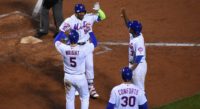
All you need to know about tonight’s game is the Mets scored a franchise record 12 runs in the third inning. Here’s how it happened:
A 12-run inning? That’s the highest-scoring frame in @Mets history. https://t.co/mLUBSOeNVe pic.twitter.com/4eUVXnWN2U
— MLB Stats (@MLBStats) April 30, 2016
Watch @ynscspds cap off our 12-run inning with a grand slam! #Metshttps://t.co/0Z4NwYW4Gb
— New York Mets (@Mets) April 30, 2016
As Ron Darling would later say, “You got the feeling that the inning might not ever end.” This inning was a far cry from the 2015 Mets June/July offense. The Mets sent 15 batters to the plate. The only Mets batter that didn’t reach base or score at least once was pitcher Steven Matz. With his grand slam and six RBI, Yoenis Cespedes broke Butch Huskey‘s team record of five RBI in one inning. Who knew?
The inning was so impressive Jake Peavy‘s ERA went from 6.86 to 8.61. The Mets scored half their runs off Peavy and the other half off of sacrificial lamb Mike Broadway. His ERA went from 3.86 to 11.81.
Matz lasted six innings allowing seven hits, zero earned, three walks, and four strikeouts. It wasn’t a dominating performance. He only had one 1-2-3 inning. With that said, he more than got the job done. The only run scored by the Giants was a leadoff homerun on the seventh inning by Angel Pagan off of Jerry Blevins. It was a good decision by Terry Collins to give Blevins a full inning of work in a blowout. Blevins has been the least used member of the bullpen.
As if they were irritated by Pagan’s homer, the Mets rallied again in the seventh to score a run. The 13th run of the game was scored on a Juan Lagares RBI single. Logan Verrett pitched a scoreless eighth, and Antonio Bastardo pitched a scoreless ninth to close out the 13-1 victory. I’m assuming Verrett, the long man in the pen, didn’t pitch two innings because Terry Collins’ Magic 8 Ball told him to do it.
This was the Mets first game this season against a National League team that was expected to be a contender for not only the postseason, but also the World Series.
Game Notes: Kevin Plawecki threw out Brandon Belt in the second. He’s now 5-9 in throwing out would be basestealers. Since taking over for the injured Travis d’Arnaud, he’s gone 2-13. David Wright, who for some reason wasn’t pulled, continued his throwing issues with a throwing error in the eighth. Eric Campbell entered the game to play LF in the eighth. Michael Fulmer made his debut for the Tigers against the Twins. He went five innings allowing two earned, one walk, and four strikeouts.
Sometimes it’s just looks like it’s not going to be your night. Yoenis Cespedes and Travis d’Arnaud were out with injuries. Reds starter Brandon Finnegan showed why he’s a highly rated prospect. Bartolo Colon didn’t have the mojo working:
Just two elite athletes out there giving it their all. pic.twitter.com/fvlOy2Y1Cr
— Cincinnati Reds (@Reds) April 27, 2016
No, after the Ivan DeJesus two run homer in the third to make the score 3-0, it looked like it wasn’t going to be the Mets night. Even when the Mets could get rallies going, this would happen:
Billy. Goes. Ham. #LetsGoRedshttps://t.co/BJUhBREj1D
— Cincinnati Reds (@Reds) April 27, 2016
No, the Reds were in control and about to snap their nine game losing streak against the Mets. Then the Reds got greedy. They tried to push Finnegan through the seventh inning.
Juan Lagares had a one out single followed by a Kevin Plawecki walk. The Reds could’ve pulled Finnegan there. He just got out of a jam unscathed in the sixth. Instead, the Reds let him face Cespedes, who was pinch hitting for Logan Verrett. First pitch Cespedes saw:
YOOOOOO! One pitch, 3 RBI. @ynscspds ties the game. #Mets pic.twitter.com/L8DZoaOEtJ
— New York Mets (@Mets) April 27, 2016
Tie game.
Finnegan was gone after six brilliant innings (and one tough inning). We then got a glimpse of why the Reds were loathe to go to their bullpen.
Tony Cingrani entered the game. He was greeted by Curtis Granderson with a triple. Granderson would later score on a David Wright RBI single. It was a nightmare night for Wright at that point having gone 0-3 with two strikeouts at that point. It was emblematic of his recent struggles. In a brief moment, it was forgotten with that single making it 4-3. It was remembered again when he was picked off of first base (technically a caught stealing).
This gave Verrett the win. He was terrific. He came on in the sixth inning, and he threw two shutout innings. He showed both his versatility and his value. He deserved this win.
For the second straight night, Addison Reed and Jeurys Familia locked down the eighth and ninth. They preserved the Mets first come from behind win. It’ll be one of many.
Game Notes: With the Cespedes injury, Michael Conforto hit cleanup against the lefty Finnegan. He went 2-4. Before the game, d’Arnaud was placed on the 15 day DL. Lucas Duda sat against the lefty but came on in the ninth for defense.