Jose Reyes
The first round in the Citi Bracket and the first round of the tournament are complete. There was no surprise with David Wright and Jacob deGrom advancing, but there were still some significant upsets at least as far as seeding is concerned.
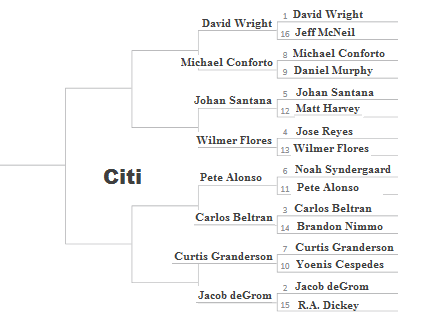
The biggest upset of the tournament so far was Wilmer Flores over Jose Reyes. That made Flores the lowest seed to advance. That is likely due to a combination of Flores love of the Mets as well as Reyes’ domestic violence. The other upset was Pete Alonso over Noah Syndergaard, but that was likely driven by Alonso’s all-time great rookie season coupled with his off the field actions.
The second round of the Citi Bracket will feature 2015 postseason heroes deGrom and Curtis Granderson. We will also see Alonso and Carlos Beltran face off. They are 1-2 in the Mets single season home run totals.
Starting tomorrow, there will be the second round of the tournament which brings us back to the Miracle Bracket with Tom Seaver facing off against Rusty Staub.
(3) Carlos Beltran – Mentored David Wright and Jose Reyes from day one. By WAR, had the second best ever season a Mets player ever had in 2006. Tied then season season record for homers and extra base hits. Set team record for runs scored in a season. Hit three homers in NLCS against Cardinals helping Mets get to Game 7 before that final at-bat. Hit last ever homer for Mets player at Shea Stadium. Had great catch on Tal’s Hill. Was a five time All-Star and three time Gold Glove winner with Mets. Stood up to Wilpons and got surgery he needed to save career. Willingly moved to right field to help team. Played at Hall of Fame level and could one day be next player inducted into Hall of Fame and possibly have number retired by team.
(14) Brandon Nimmo – Instant fan favorite for always smiling and constant hustling. Will do anything he needs to do to get on base. Mets single season leader in HBP and is 10th all-time. If he qualified, would have third best OBP in team history. Was second best hitter in NL in 2018. Returned from neck injury to have strong finish to 2019 season to show he can once again play at that level.
To put in perspective how well thought of Gary Gentry was, when the ill-fated trade for Jim Fregosi went down, the Angels initially asked for Gentry, and they were rebuffed. That led to them “settling” for Nolan Ryan. Back in 1971, this made a lot of sense.
In 1969, Gentry was a rookie for that Miracle Mets team which shocked the world and won the World Series. Gentry would have his moments during that rookie season, but it was a mostly pedestrian season where he served as an effective third starter behind Tom Seaver and Jerry Koosman. However, Gentry would do something that year neither Seaver nor Koosman would do.
The first postseason ever thrown at Shea Stadium was by Gentry. It wasn’t a great start with him leaving after two innings, but he was the pitcher who started the game where the Mets clinched their first ever pennant. Gentry would repeat that history in the World Series, and things would go much better for him.
Gentry would start Game 3 of the World Series, and as such, he became the first ever pitcher to throw a pitch in the World Series in Shea Stadium. After Koosman shut down the Orioles in Game 2, the Mets were in this series, and they had a chance no one never thought they would. They took full advantage.
What made this game interesting for the Mets was this was the first time in the series there was purportedly a clear pitching advantage for the Orioles with them starting future Hall of Famer Jim Palmer. However, on this day, the Mets would be the better team and Gentry the better pitcher.
That Game 3 will forever be known for Tommie Agee. He had a lead-off homer and made two great defensive plays. What has been overlooked was how good Gentry was. Over 6.2 innings, he shut out the Orioles while allowing just three hits albeit while walking five. As a result, Gentry would become the first ever pitcher to win a World Series game at Shea Stadium.
This was one of the most important starts in Mets history. With this great start, the Mets took a 2-1 lead, and they were about to hand the ball to Seaver and Koosman. The rest, as we know, is history.
That game would be the apex of Gentry’s career, but to be fair, it would be the apex of just about anyone’s career. There were some issues for Gentry including his temper. At times, he would show his frustration and show up fielders. His biggest issue would be his arm problems, which the Mets never could quite diagnose and fix.
As a result, at the time, he was seen more as a disappoint and a what could’ve been. After all, this was a pitcher the Mets thought was better than Ryan. It wasn’t just the Mets who felt that way. That was a common perception. Regardless of all of that, Gentry was still a good pitcher for the Mets with a 103 ERA+ posting the 10th most shutouts in team history. Overall, Gentry was the best Mets player to ever don the number 39.
Previous
1.Mookie Wilson
2.Mackey Sasser
3. Curtis Granderson
4. Lenny Dykstra
5. David Wright
6. Wally Backman
7. Jose Reyes
8. Gary Carter
9. Todd Hundley
10. Rey Ordonez
11. Wayne Garrett
12. John Stearns
13. Edgardo Alfonzo
14. Gil Hodges
15. Carlos Beltran
16. Dwight Gooden
17. Keith Hernandez
18. Darryl Strawberry
19. Bob Ojeda
20. Howard Johnson
21. Cleon Jones
22. Al Leiter
23. Bernard Gilkey
24. Art Shamsky
25. Pedro Feliciano
26. Terry Leach
27. Jeurys Familia
28. Daniel Murphy
29. Frank Viola
30. Michael Conforto
31. Mike Piazza
32. Jon Matlack
33. Matt Harvey
34. Noah Syndergaard
35. Rick Reed
36. Jerry Koosman
37. Casey Stengel
38. Skip Lockwood
When talking about the great relievers and closers in Mets history, the one name which gets constantly overlooked is Skip Lockwood. The main reason for that is he is the only one who never got to actually pitch in the postseason with the Mets.
Lockwood had a long and winding path to the Mets. Early on his career, he was thought of as a third baseman, and he would flame out at the position. He would go to the Oakland Athletics who threw him on the mound mostly just to take a look and to try to slip him through the Rule 5 Draft. Little did they know, Lockwood was a pitcher.
However, it appeared he wasn’t a starting pitcher. Over six seasons as a starter, he was 30-60 with a 3.81 ERA. On the eve of the 1975 season, he was released by the New York Yankees, and he was brought back to the Athletics organization to pitch in the minors. Finally, at that point, he not only accepted, but he pushed for a role in the bullpen. During that 1975 season, he was sold to the New York Mets, and his career would take off.
Lockwood was called up in August, and he would pitch in both ends of a doubleheader against the Expos. Over five innings, he allowed just one earned run. After allowing an earned run in his first appearance, he would not allow another one in his next six appearance which spanned 12.2 innings. This was part of a sensational debut where Lockwood was 1-3 with a 1.49 ERA, 1.097 WHIP, and an 11.4 K/9.
Lockwood would be handed the closer’s reigns the following season, and by and large Lockwood repeated his success. In that 1976 season, he was 10-7 with a 2.67 ERA, 1.018 WHIP, and a 10.3 K/9.That was the best year of Lockwood’s career. He had the third most saves in the league, and he led all National League relievers in strikeouts. By FIP, he was the best reliever in the National League.
This started one of the better stretches in team history for a closer. From 1976 – 1978, Lockwood was a full time closer and one of the best in the game. His 54 saves were eighth best in the Majors, and his 265 strikeouts were seventh best among relievers. His 2.83 FIP was ninth best. Overall, at a time when the Mets were starved for talent, they had one of the best closers in the game.
Overall, in his Mets career, Lockwood was 24-36 with 65 saves, a 2.80 ERA, 1.114 WHIP, and an 8.7 K/9. His 65 saves are the 10th most in team history. He also ranks ninth in games finished. Overall, he is one of the best closers in team history, and he is the best Mets player to ever wear the number 38.
Previous
1.Mookie Wilson
2.Mackey Sasser
3. Curtis Granderson
4. Lenny Dykstra
5. David Wright
6. Wally Backman
7. Jose Reyes
8. Gary Carter
9. Todd Hundley
10. Rey Ordonez
11. Wayne Garrett
12. John Stearns
13. Edgardo Alfonzo
14. Gil Hodges
15. Carlos Beltran
16. Dwight Gooden
17. Keith Hernandez
18. Darryl Strawberry
19. Bob Ojeda
20. Howard Johnson
21. Cleon Jones
22. Al Leiter
23. Bernard Gilkey
24. Art Shamsky
25. Pedro Feliciano
26. Terry Leach
27. Jeurys Familia
28. Daniel Murphy
29. Frank Viola
30. Michael Conforto
31. Mike Piazza
32. Jon Matlack
33. Matt Harvey
34. Noah Syndergaard
35. Rick Reed
36. Jerry Koosman
37. Casey Stengel
(4) Jose Reyes – One of the most exciting and dynamic players in Mets history. Set team records for single season and career stolen bases. Mets all-time leader in triples. By WAR, best Mets SS and fifth best position player. Only Mets player to win a batting title. Four time All-Star. Returned to Mets after domestic violence suspension to take over third base. Hit bit homer against Phillies to help Mets claim Wild Card.
(13) Wilmer Flores – Player who loved being a Mets player so much, he cried on the field when he thought he was being traded. Came back to hit a walk-off homer to beat the Nationals. That was one of many walk-off hits, and he would become the Mets all-time leader in that category. Handled shortstop well defensively after Chase Utley tackled and broke Ruben Tejada‘s leg. Joined Edgardo Alfonzo as the only Mets players to go 6-for-6 in a game. Played all four infield positions in effort to do whatever team asked of him to help them win.
When compiling a list of the best Mets by choosing the Met who wore a particular number, you finally reach a number where there is only one person who wore the number. That is the case with the number 37 with Hall of Fame manager Casey Stengel being the first and only Met to ever wear the number.
Stengel had been unceremoniously fired by the Yankees after Bill Mazeroski hit the only Game 7 walk-off homer in baseball history. After that, the Yankees decided to go in a new direction. In response, Stengel famously quipped, “I’ll never make the mistake of being 70 again.”
That was the thing with Stengel. He was always good for a line, quip, or malpropos. At his age, it seemed like it was going to be his last in baseball. Even though he was 70, Stengel had turned down other managerial jobs. That initially included the Mets.
Early on in their history, the Mets were hell-bent on bringing in some famous faces, especially those with New York roots. That included former Dodgers like Gil Hodges and Don Zimmer. After persistence, it would finally included Stengel. If nothing else, in those early days, Stengel would be a character who would give the team an early identity.
While Darryl Strawberry might’ve been the first person to play for all the teams which started in New York, Stengel would be the first and only person to actually wear all four New York uniforms. In his playing career, he played for the Brooklyn Dodgers and New York Giants. As a manger, he would manage the Dodgers, Yankees, and finally, the Mets.
Stengel was never able to bring the Mets to anywhere near the level of the Yankees. He was oft criticized, but that is what typically happens to managers with bad teams. He would be the only Mets manager in the team’s Polo Grounds days, and he would be the first manager in Shea Stadium. He would manage all the way up until he broke his hip. At the end of that season, he would be the first Met to have his number retired by the team.
While he was no longer the manager, the team would keep him as part of the organization until his dying day. When the Mets won the World Series in 1969, both he and his wife were presented with championship rings. Stengel would wear his proudly until his dying day.
So, in the end, while Stengel was not the Hall of Famer he was with the Yankees, he was quintessentially the Mets in their early years, and ultimately, he too would be a champion. Overall, he is the only and best Met to ever wear the number 37.
Previous
1.Mookie Wilson
2.Mackey Sasser
3. Curtis Granderson
4. Lenny Dykstra
5. David Wright
6. Wally Backman
7. Jose Reyes
8. Gary Carter
9. Todd Hundley
10. Rey Ordonez
11. Wayne Garrett
12. John Stearns
13. Edgardo Alfonzo
14. Gil Hodges
15. Carlos Beltran
16. Dwight Gooden
17. Keith Hernandez
18. Darryl Strawberry
19. Bob Ojeda
20. Howard Johnson
21. Cleon Jones
22. Al Leiter
23. Bernard Gilkey
24. Art Shamsky
25. Pedro Feliciano
26. Terry Leach
27. Jeurys Familia
28. Daniel Murphy
29. Frank Viola
30. Michael Conforto
31. Mike Piazza
32. Jon Matlack
33. Matt Harvey
34. Noah Syndergaard
35. Rick Reed
36. Jerry Koosman