Musings
The concept of the untouchable player is a fallacy. That goes for any player including Mike Trout. For the right price, even he could be traded.
That said, when we talk untouchable we mean a player who can’t be replaced on the roster. In terms of the Mets, there’s only three such players on the roster.
First and foremost, Jacob deGrom is untouchable. Not only has he established himself as the best pitcher in baseball, but he’s also on a very reasonable contract. There’s nothing on the free agent or trade market available where you can replace him.
The next untouchable player is Seth Lugo, and last season is exactly the reason why. In Lugo, the Mets have one of the best and most versatile relievers in baseball. He can pitch multiple innings, get a key out, and get the save.
If you’re in a jam, Lugo can also start. No, he is not nearly as dominant as a starter. However, he can be stretched to be either a dominant opener or a competent fifth starter. Looking across baseball, there really isn’t another pitcher who offers that, not even Josh Hader.
Finally, the Mets last untouchable is Jeff McNeil. He’s that mostly because his versatility allows the Mets to build the best possible roster.
McNeil is a good defender at second and left. He can hold his own at third and right. He’s a unique batter in this era in that he’s up to hit, and he puts the ball in play. In McNeil, you’re getting a modern day Ben Zobrist in the field and a slower version of Ichiro Suzuki at the plate.
In these three players, the Mets have truly unique players whose skill sets cannot easily be replicated. In fact, you can argue, their skill sets cannot be replicated. At their relative prices, it’s nearly impossible.
As for the rest of the roster, while there are extremely good players across, they just don’t rise to this level.
While you may want to argue Pete Alonso or Dominic Smith, they are both first baseman. In fact, they’re both All-Star caliber first basemen. Unfortunately, there’s just one first base, and there’s no DH.
Andres Gimenez is very promising, but this is an organization with a lot of shortstop talent. That includes Amed Rosario, who is a capable MLB starter, and Luis Guillorme, who deserves a fair shot to play everyday.
Michael Conforto and Brandon Nimmo are approaching free agency soon, and the corner outfield position is one which can typically be filled easily. On that note, McNeil can fill one of their spots if necessary.
Like Conforto, Marcus Stroman and Noah Syndergaard are pending free agents making them more movable than they otherwise would be. Also on the pitching front is Edwin Diaz. You’ve seen reason to believe in him and believe he can’t handle New York. At the end of the day, he’s a good closer, but the Mets can always obtain one of them in free agency.
So, overall, the Mets have a deep and interesting roster. However, there are many holes across the roster. Looking at this roster, short of deGrom, Lugo, or McNeil, any of these players should be on the table to address any of the deficiencies this team has.
When Carlos Delgado was five percented off the Hall of Fame ballot, there was shock from fans. Almost yearly, people look to point out the absurdity.
While understood, Delgado did not have a career as good as John Olerud‘s, and yet, we rarely hear about how Olerud should not have been five percented off the ballot.
Olerud played 17 years in the majors hitting .295/.398/.465 with 500 doubles, 13 triples, 255 homers, and 1,230 RBI. He won one batting title, was a two time All-Star, and won three Gold Gloves.
In terms of the advanced numbers, he has a 58.1 WAR, 39.0 WAR7, and a 48.6 JAWS.
Looking at the average Hall of Fame first baseman, he’s fairly well behind the 66.9 WAR and 54.8 JAWS. However, he’s closer to the 42.7 WAR7. Examining his career past these numbers you see a more compelling case.
Notably, by WAR, Olerud is the 20th best first baseman of all-time. When looking at the top 20, the only three eligible players not tainted by steroids not in the Hall of Fame are Todd Helton, Keith Hernandez, and Olerud.
Behind these players are nine Hall of Famers. Those players include Hank Greenberg and Orlando Cepeda. Other players behind him are Fred McGriff, Delgado, and Don Mattingly, three players who have very vocal advocates.
First and foremost, the 500 doubles is significant. Olerud is one of 64 players to accomplish that feat. Of those 64, there are few eligible players not in the Hall of Fame.
When you eliminate steroids tainted players like Rafael Palmeiro and players currently on the ballot like Helton, there are only members of the 500 doubles club not in the Hall of Fame.
Digging deeper into that, putting aside Barry Bonds and Palmeiro, Scott Rolen and Helton are the only players with 500 doubles and three Gold Gloves who aren’t in the Hall of Fame. Notably, Rolen and Helton are still on the ballot.
Beyond that, Olerud deserves a bump for his postseason play. In his postseason career, he was a .278/.365/.435 hitter. When you look at his performance prior to the final two seasons of his career, he had a .816 OPS. He won two World Series and was part of several memorable games.
There are also some very unique and noteworthy aspects of his career. Olerud became the only first baseman and just the second overall to hit a cycle in both leagues.
Like Hall of Famer Dave Winfield, he went straight from the draft to the Majors. In fact, Olerud would be the only second round pick to accomplish the feat.
While Hernandez is seen as the best defensive first baseman ever, Olerud is the all-time leader in defensive WAR at first base. He’s fifth in total zone rating.
Even with his being part of the best defensive infield in history, Olerud is overlooked for being one of the greatest defenders at the position. In fact, he was so good Bobby Valentine was able to utilize him holding on runners without Olerud having to stand directly on the bag.
Nearly everything about Olerud’s career was unique right down to his wearing a batting helmet in the field. Looking at his entire career, Olerud left an indelible mark on the history of baseball.
He was a great defensive first baseman, one of the best ever, and he was a very good hitter who would hit .350+ three times and have eight seasons above a 124 OPS+. In fact, in 16 of his 17 seasons, Olerud was an above league average hitter.
Overall, Olerud was an outstanding player who was one of the more complete first baseman of not just his era but MLB history. While you may still fairly look upon as his career as just short, he certainly deserved a deeper look into what might’ve been a Hall of Fame career.
Jeff Wilpon running the Mets was an absolute nightmare. He was an embarrassment to the franchise and the entire sport. Despite that, many remained silent.
There was silence when injured players were forced to play. The same when pregnant women and veterans were fired. Good people had their names tarnished, and cancer patients stood there accepting blame for actions not of their own as they were pretending the forced stepping aside wasn’t a firing.
That says nothing of the inept way the franchise was run, hiring former agent golfing buddies over well qualified front office executives, purging top prospects for insanely poor returns, and inserting themselves into every decision. Again, this was met with silence.
However, now, Steve Cohen is in charge. Already, the Mets are being run much more competently, and the Mets are being viewed in a way they haven’t since the mid-80s. With that, people have now finally found their spines and are now attacking the Mets.
Some scouts and execs reportedly believe the Mets blew it by not signing J.T. Realmuto https://t.co/5bqnuLFBw5 pic.twitter.com/vuyDVonq9H
— SNY (@SNYtv) December 18, 2020
What's most embarrassing: getting caught in an insider trading scheme and spending $1.2 billion to buy your way out of a lifetime SEC ban, being credibly accused of racketeering by your ex-wife, or not knowing how to thread tweets/do a twitter poll/punctuate a sentence? pic.twitter.com/mO8xpWD3g0
— Ken Tremendous (@KenTremendous) December 20, 2020
If you sat out the Wilpon years, don’t start now. You don’t get to overlook the horrible things they did only to now attack the new Mets ownership. In doing that, you further lack credibility and really are just embarrassing yourselves.
If you opted to stay silent when you should’ve spoken up, stay silent.
Before the change in ownership, there was a belief the Mets might non-tender Steven Matz thereby making him a free agent. Certainly, given Matz’s nightmare of a 2020 season, it would’ve been a defensible position.
However, instead of going that route, the Mets not only tendered him a contract, but they also make steps to aver their belief in him and his ability.
That started almost immediately after the 2020 season. As reported by MMO‘s Michael Mayer, Matz began working with Phil Regan. When Matz last worked with Regan in the second half of the 2019 season, Matz had seemed turn his career around.
In fact, in the second half of that season, Matz was 6-4 with a 3.52 ERA, 1.197 WHIP, and a 3.26 K/BB. For several reasons, Matz wasn’t able to build on that. However, with his working with Regan again, he very well might.
It’ll also help working with James McCann with whom he already has a rapport. As reported by Ken Davidoff of the New York Post, Matz threw 6-7 bullpens to McCann during the shutdown.
No, Matz wasn’t the reason the Mets signed McCann. However, that is a perk of the signing as Matz will be throwing to a better framer as well as to someone who he already has a comfortable level.
This will put Matz in the best possible position to succeed. Hopefully, this will translate to success. From what we saw from the Mets offseason thus far, they seem to believe it.
They further proved that when they didn’t trade him. As reported by Ken Rosenthal of The Athletic, the Toronto Blue Jays we’re interested in Matz and reached out to the Mets to engage in trade talks.
If you’re a team not interested in keeping a player, another team reaching out to have trade talks for someone you’re intending to non-tender is a godsend. It’s an opportunity to get something, anything for a player you don’t want.
That’s not Matz. The Mets wanted to keep him and weren’t trading him for it’s own sake. They had him working with a pitching coach who got the most out of him. They then signed a catcher with whom he already has a rapport.
Ultimately, in what is his final year before free agency, the Mets are doing all they can to help Matz reach that ceiling they know he’s capable of reaching. They’re letting him know they’re still very invested in his success, and maybe, just maybe, he’s a part of their future.
All told, this is going to be a very interesting year for Matz and the Mets. Maybe this could be the year he puts it all together. Certainly, the Mets are doing all they can to make sure it happens because they clearly still believe in him.
When analyzing the New York Mets roster, there are a few things they need to transform a strong core to a true World Series contender. Some of those things are a third baseman, improved defense, and more right/left balance in the lineup.
That perfectly describes Nolan Arenado.
In his latest presser, without mentioning him by name, Sandy Alderson intimated Arenado would be the type of player the Mets could look to trade for this offseason. It should come as no surprise the Mets would.
Since the Mets last made the postseason in 2016, their defense has been an embarrassment. In fact, their -242 DRS over that timeframe is by far the worst in the majors.
One of the problem areas has been third where the team has accumulated a -26 DRS. That includes the -17 DRS the incumbent third baseman, J.D. Davis, has posted over the past two seasons.
Conversely, Arenado is an eight time Gold Glove winner. In fact, he’s a perfect 8/8 in his Major League career. Since 2017, he’s easily been the best third baseman in the NL with a 55 DRS. Replacing Davis with him would just be a staggeringly defensive upgrade.
Arenado isn’t remotely slipping defensively. In 2020, he had a 15 DRS and a 7 OAA. The previous season, he had an 18 DRS and a 16 OAA. By OAA, he’s been the best defensive third baseman in each of the past two seasons.
In addition to the phenomenal defense, Arenado is a good hitter.
No, he was not remotely good in a bizarre 2020 season. All of his offensive numbers cratered. However, this past season is a complete anomaly from what we’ve seen from him in his career.
Over the three previous seasons, Arenado had a 130 wRC+. That’s 29th best in the majors over that stretch. In terms of the Mets, only Brandon Nimmo has a better wRC+ over that stretch.
This means that quite arguably if the Mets were to obtain Arenado, he’d become their best player not named Jacob deGrom. Certainly, none of the current Mets can match Arenado’s ability to field and hit.
For those who are concerned his offense won’t translate, they’re worrying too much. Yes, like every other Rockies player, he’s always had pronounced home/road splits. However, as noted by Mike Petrillo of MLB.com, “there’s no evidence that a Rockies hitter who goes elsewhere and gets regular playing time is going to fall apart.”
So, essentially, if Arenado were to leave Colorado, we should anticipate him performing the same way he always has. There’s the obvious and fair caveat here that he really struggled in 2020. Although on that point, he has a shoulder injury to his non-throwing shoulder which could’ve impacted his performance.
When you boil it all down, Arenado is a great fit for the Mets. He vastly improves the defense, and he promises to be another right-handed threat in the lineup. In terms of fit, the Mets could not do any better.
Really, the question is what will it take to get him. He’s got a no trade clause and an opt out looming. Like last year, the Los Angeles Dodgers are interested. While the Rockies may be reticent to trade Arenado intradivision, the Dodgers present real leverage to extract the most value.
We can debate just how much the Mets should give up to obtain arguably the best third baseman in baseball. What isn’t up for debate is just how much of an improvement Arenado would be over what the Mets have had at third since David Wright.
During his press conference yesterday, Mets manager Luis Rojas indicated Amed Rosario will work at third base, but he will not be working in the outfield. This plan is not something which helps Rosario or the Mets.
One of the reasons is Rosario’s bat. It doesn’t play at the position.
Mostly buttressed by a 100 wRC+ in 2019, Rosario has a career 89 wRC+. From 2016 – 2019, MLB third baseman had between a 102 – 105 wRC+. That puts a typical Rosario season well below the threshold.
To even justify Rosario at third, he’s have to play elite defense. His ability to do that is certainly up for debate.
Rosario’s defense has been gradually improving, but it appears like he’ll never reach the Gold Glove aspirations many had for him, nor will be surpass Andres Gimenez.
By OAA, he made huge strides in this shortened season going from a -8 OAA to a 2. DRS paints the same picture with his going from a -10 to a -3.
This past season, what stood out was he’s better able to go to his right. However, in a normal season, he was far better going to his left. Certainly, if he has the range for short, he should for third.
Looking at these numbers, Rosario can certainly play third. However, that’s not the issue. As noted, he needs to play at an elite level due to his bat.
Now, you could argue he’s a better option than J.D. Davis, which he certainly is. Davis is incapable of playing the position, and without the juiced ball, his offense came hurtling back to earth.
However, this shouldn’t be the test. Just being better than Davis isn’t sufficient. Again, the Mets need a real third baseman. Rosario has not shown yet he can be that with his offense being the biggest issue.
His offense won’t be as much of an issue in center. In three of the past four seasons, center fielders we’re below league average offensively. As noted, Rosario does have the tools to succeed in center.
If nothing else, Rosario should be working towards being a good center fielder. If he’s lost the shortstop job, he needs to become as versatile as possible. Learning center does that.
Overall, Rosario’s chances of success at third are not as good as his chances of success in center. Regardless, he needs to work on both as he’s now a bench player. That’s why focusing just on third is a very bad plan.
With the Cleveland Indians announcing they’re getting rid of the Indians team name and with it the final vestiges of the insanely racist Chief Wahoo, there is now a debate as to what the new name should be. There have been many fine suggestions.
One of the early front runners was the Cleveland Spiders. It makes sense because that’s a former team name and because there has already been some terrific mock-ups of what the new logo could be.
I really hope they go back to being the Cleveland Spiders, so much amazing logo potential pic.twitter.com/0EXGjMePNx
— Sam Hudson (@heroinstitute) December 14, 2020
There have been other suggestions tying the new team name to baseball history or the rock-and-roll roots of the area. Of all the ideas proposed, Mike Piazza perhaps had the best idea:
My two cents on the @Indians name change, a Negro league name? Monarchs, Buckeyes, just thinking, thoughts?#Indians #Cleveland
— Mike Piazza (@mikepiazza31) December 15, 2020
That’s a great way to turn the page forward on the teams racist past and move forward to a new, better future. It’s also a great way to honor Larry Doby who broke the AL color barrier in the same year Jackie Robinson did.
Going through Negro League history, there were a number of different teams who played in Cleveland. The team names were the Bears, Browns, Buckeyes, Cubs, Elites, Giants, Hornets, Red Sox, Tigers, Tate Stars, and Stars.
Off the bat, you know the team couldn’t be the Cubs, Giants, Red Sox, or Tigers. There are also probably issues with the Browns and Buckeyes. There are already pro sports teams named the Bears, Hornets, and Stars.
Basically, that leaves the Elites and the Tate Stars, neither of which would really work. While Tate Stars may not work, some version of the Stars might.
That’s where you could marry the idea of honoring the Negro Leagues and celebrating the city, specifically their part in the history of Rock & Roll. It’s something the team already embraces.
We saw that with the 2019 All Star Game. Cleveland was the host city, and they incorporated that history in the logo and practice jerseys.
Our city. Our game. Our logo.
Cleveland is ready to ROCK the 2019 All-Star Game. ? https://t.co/H6zy5o9s75
— Cleveland Guardians (@CleGuardians) August 7, 2018
Swagger.#AllStarGame pic.twitter.com/vMGRHMpvu2
— All-Star Game (@AllStarGame) July 9, 2019
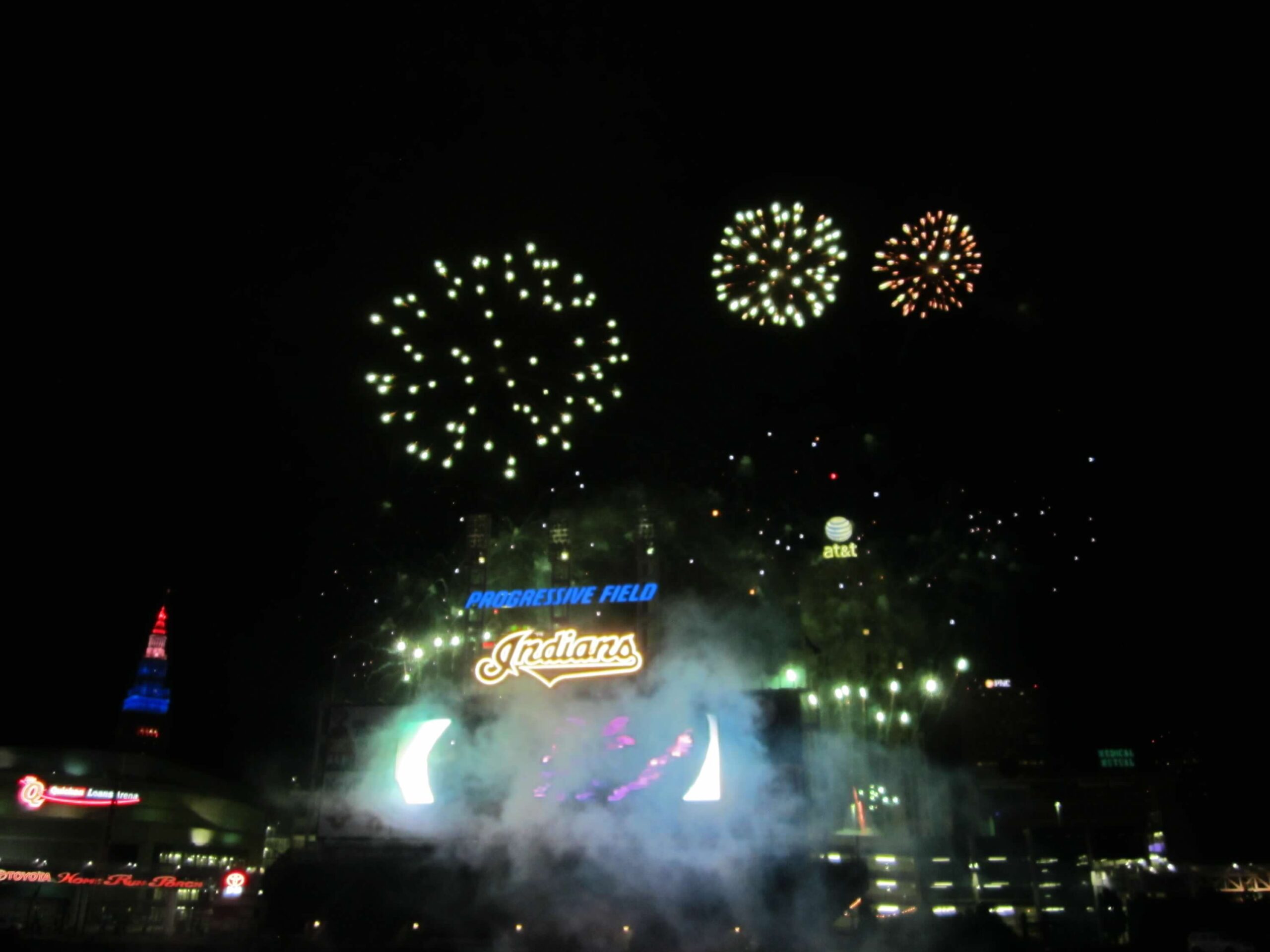
It’s not just for special events. The McCoys hit “Hang On Sloopy” is played in the middle of the eighth. There’s also the Rock and Roll fireworks during the summers.
This is one of many directions the organization could go. Perhaps, this is the best one.
The name Cleveland Rock Stars embraces the city’s history, and it honors the Negro Leagues. To wit, it also honors Doby, who is arguably the most important figure in team history.
There are other interesting options. Whatever the organization picks, we can only hope it honors the past and the city in the way the Cleveland Rock Stars would.
In his introductory press conference, new New York Mets GM Jared Porter spoke about building depth across the 40 man roster. One area which desperately needs attention is the outfield.
Really, the Mets only have three outfielders on the roster with Michael Conforto, Brandon Nimmo, and Jeff McNeil. With respect to McNeil, he’s likely going to be the Opening Day second baseman.
Assuming the Mets sign a center fielder like George Springer, the team will still need a viable fourth outfielder who can step up and start on an extended basis if needed.
And no, Dominic Smith (-2 OAA) and J.D. Davis (-2 OAA) are not outfielders. Smith is a good defensive first baseman, and Davis is a DH. Instead of a first baseman in left, the Mets need an actual outfielder.
Looking at the free agents, there is one name which stands out – Yasiel Puig.
Puig is looking to return to baseball after missing the 2020 season. He had missed out for a variety of mostly inexplicable reasons.
First, he wasn’t signed during the original Spring Training. Then, he would sign a deal with the Atlanta Braves in July. However, that deal fell through when Puig tested positive for COVID19.
Likely, that leaves Puig looking for a one year deal to rebuild value. In the event there are no starting jobs available, the Mets would be a good fit.
When Puig last played, he still had very good speed. He also had improved defensive numbers in right after an unexpected one year drop off in 2018.
In 2019, he struggled offensively by his standards. His 101 wRC+ was tied for a career worst. That was surprising partially because he posted a career best exit velocity. Whatever the case, at worst, Puig can be anticipated provide league average offense. He has a much higher ceiling than that too.
Puig also has some defensive versatility. While he’s spent most of his career in right, he has played center and left. On that point, Puig has been playing center in the Winter Leagues.
Yasiel Puig, playing for the first time since last September, made this athletic play to rob #Angels Luis Rengifo of a hit in LIDOM tonight.
Puig’s initial read wasn’t great but the correction worked out
pic.twitter.com/3sfeeSCgC3— Maria Torres (@maria_torres3) December 11, 2020
That work helps him be more versatile. Having a bench player who can play all three outfield positions would be of an enormous benefit to the Mets.
Puig does seem well suited to play in New York as he thrives in the spotlight. He possesses all the tools to be successful with good speed as well as a history of playing good defense and posting strong offensive numbers.
All told, this would make him a great bench option and insurance policy against a Nimmo or Conforto injury. If MLB refuses to acknowledge reason and instead implemented the universal DH, Puig can help be part of that rotation.
There’s a lot of ways Puig can help the Mets, and he’s the best option available for this role. The only issue is whether he’s willing to accept this role. Given his year away from baseball, he might. If so, the Mets should push to sign him.
When it comes to Brandon Nimmo, there’s a lot to like. He hustles all the time, he’s fast, and he’s an on base machine. He’s also a pretty good defensive outfielder.
Well, that’s the case if you keep him out of center.
By all accounts, Nimmo should be good there. He’s got the speed to thrive. He busts it all the time. Seeing him at the plate, you know he has a good eye.
And yet, he’s never posted a positive DRS or UZR in center. He did enter 2020 with a 3 OAA, but with his -4 OAA in center this year, he’s a -1 OAA now for his career.
Now, you could make the argument Nimmo was a positive OAA in previous years, and as such, he could be counted upon to be that again. After all, 2020 was a bizarre year which led to many strange outlier results.
That said, 2020 was also the first time Nimmo was an everyday CF at the Major League level. As a result, all the stats we see on him are the results of a small sample size.
The only thing we can see is his OAA is starting to reflect what we’ve seen with his DRS and UZR. The reason for that is quite likely is his Jump numbers have always been poor.
In 2020, Nimmo was a -1.7 feet vs. average. The previous year he was -0.2. In 2018, he was a 0.1. Fact is, he’s not getting that initial break on the ball, and his ability to do so seems to be regressing.
Now, you could well argue he plays passable enough defense in center, and there is some indications he could halt the regression and improve. Unfortunately, that’s a poor approach to handling the position.
As previously noted, there’s a correlation between strong outfield defense and winning. That’s especially the case with CF defense. Take a look at the last few World Series winners:
- 2020 – Cody Bellinger (5 DRS/7 OAA)
- 2019 – Victor Robles (23 DRS/22 OAA)
- 2018 – Jackie Bradley Jr. (-1 DRS/9 OAA)
- 2017 – George Springer (6 DRS/1 OAA)
With respect to Bradley, that’s where we see a DRS/OAA split. While he rated poorly in DRS that season, he had a very strong 9 OAA. The DRS/OAA differences aside, we see strong center field defense is a necessity if you want to win.
Sure, Nimmo can be passable at times. You could argue he may not hurt you. However, he doesn’t help the Mets at a crucial defensive position, one of increased importance in the launch angle era.
Looking back at the above list, both Bradley and Springer are available this offseason. While Bradley may not be a good investment, Springer is everything the Mets need and want in center.
Springer is a good defensive center fielder. He’s a right handed bat in a heavy left handed hitting lineup. He’s a player who pushes Nimmo to LF where he belongs.
Nimmo is a good left fielder. Springer is a good center fielder. Finally, Michael Conforto is good in right. That’s an outfield alignment which helps secures outs and rakes. Arguably, it would be the best in the game.
No matter how many ways you look at it, the Mets are best served getting Nimmo out of center and getting a real center fielder, preferably Springer. If they do that, this Mets team takes a massive step forward towards winning a World Series.
In an ideal world, the New York Mets would be looking to sign Mookie Betts this offseason. It would’ve been an absolutely perfect signing for the team.
The second best player in the sport helping the Steve Cohen era get off on the right foot. The right-handed bat to compliment a heavy left-handed hitting lineup. A player gifted enough to play center for the next decade.
However, it’s not happening because the Los Angeles Dodgers went all out to not only obtain him from the Boston Red Sox, but they also gave him the extension he wanted. As such, he’ll spend 13 years with the Dodgers and none with the Mets.
This is not the first time we’ve seen a future Hall of Famer eschew free agency by signing an extension with his new team. In fact, the Mets once benefitted from this by trading for and signing Mike Piazza.
That’s one of the benefits a team receives by obtaining that player. They get the exclusive window to negotiate with and sign the player. They also have that opportunity if they make the player signing an extension a condition precedent to making a trade.
That’s something to be mindful of with Francisco Lindor and Nolan Arenado on the trade bloc. These are quite possibly two future Hall of Famers the Mets can go out and obtain right now.
There is a need for both players. With Arenado, he’s arguably the best third baseman in baseball, and the Mets are in desperate need of one.
Lindor may not be as obvious when the Mets have Andres Gimenez and Amed Rosario. With Lindor, it boils down to this team is not good enough as it, and they need premium talent to push them over the top. The best shortstop in the game goes a long way in accomplishing that.
If the Mets can get either player (preferably both), they need to do it. You don’t run the risk of another organization stepping up ad obtaining that player because if that happens they can be the ones who give Lindor or Arenado an extension ensuring they don’t hit the free agent market.
No, that doesn’t mean you make the trade for its own sake, and by no means should the Mets overpay. That said, when you have Gimenez and Rosario as well as Dominic Smith and Pete Alonso, you have valuable cost controlled depth which can be a big piece in getting a Lindor or Arenado.
Really, the Mets don’t need two shortstops and two first basemen. They need a Lindor and/or an Arenado. They need to get them now to prevent another team from locking them up.
Instead, the Mets need to do what the Dodgers did with Betts. Get the superstar. Use their financial muscle to get that superstar to sign an extension. Then, they can go win the World Series.